
Research article · 2025 · Full text
International Journal of Horticulture and Food ScienceEffect of foliar fertilization of micronutrients on growth and yield of Banana (Musa spp.) cv. Karpooravalli (ABB)
Volume 7(6) · Pages 92–95 · DOI: 10.33545/26631067.2025.v7.i6b.324 ↗
Research areasBanana Cultivation and ResearchAgricultural Science and FertilizationPlant Micronutrient Interactions and Effects
Abstract
Author-writtenThe present investigation on “Effect of micronutrients on growth, yield and quality of Banana (Musa spp.) cv. Karpooravalli (ABB)” was carried out in the Orchard, Department of Horticulture, Faculty of Agriculture, Annamalai University, Annamalai Nagar, Tamil Nadu during 2023-2024. The study was conducted by three foliar sprays of micronutrients viz., Zinc sulphate, Borax and Ferrous sulphate at different concentrations along with recommended dose of fertilizer (110:35:330 NPK g plant-1) and farmyard manure (25 t ha-1) in Randomized Block Design (RBD) with three replications comprising thirteen treatments. The results of the investigation were found significant differences in the growth, yield and quality among the various treatments. The growth and physiological characters viz., pseudostem height, pseudostem girth, total number of leaves, leaf area, phyllochron, number of suckers at shooting stage, dry matter production and total chlorophyll content was found to be the highest in the treatment which received of T13 (25 t ha-1 FYM + RDF (110:35:330 NPK g plant-1) + ZnSO4 @ 0.75 % + Borax @ 0.75 % + FeSO4 @ 0.75 % on 60, 90 and 120 DAP + Foliar spray). The same treatment also took lesser days taken for shooting and harvest when compared to all other treatments. Similarly, with regards to yield viz., number of hands bunch-1, number of fingers hand-1, number of fingers bunch-1, finger length, finger girth, volume of finger, finger weight, pulp weight, peel weight, pulp: peel ratio and bunch weight was found to be highest in the treatment which received 25 t ha-1 FYM + RDF (110:35:330 NPK g plant-1) + ZnSO4 @ 0.75 % + Borax @ 0.75 % + FeSO4 @ 0.75 % on 60, 90 and 120 DAP + Foliar spray (T13), while the least value for yield characters observed in the treatment T1 (control). From the experiment, it was concluded that among the application of different micronutrients, the treatment combination of 25 t ha-1 FYM + RDF (110:35:330 NPK g plant-1) + ZnSO4 @ 0.75 % + Borax @ 0.75 % + FeSO4 @ 0.75 % on 60, 90 and 120 DAP + Foliar spray (T13) were identified as the best treatment to enhance the growth, yield and quality of banana cv. Karpooravalli (ABB).
Summary
Source-checkedPlain-language reading of the full paper, prepared with AI and checked against the text. Each point links to the authors' own words.
Why it matters
- Banana is a critical tropical and subtropical fruit crop in India. View evidence ↗
- Micronutrient deficiencies can reduce crop yields as significantly as macronutrient deficiencies. View evidence ↗
- Foliar application of micronutrients is considered necessary to meet plant demands and increase yield. View evidence ↗
The question
- The study aimed to determine how micronutrients affect the growth and yield of the Karpooravalli banana variety. View evidence ↗
What they did
- Banana suckers were planted in 45 cm³ pits spaced at 2.1m x 2.1m. View evidence ↗
- Foliar sprays were applied at three intervals: the second, third, and fourth months after planting. View evidence ↗
What they found
- The highest number of leaves per plant (33.60) was recorded in treatment T13. View evidence ↗
- Treatment T13 achieved the highest yield per hectare (53.42 tonnes) and the maximum number of fingers per hand (20.17). View evidence ↗
- Treatment T13 resulted in the maximum fruit length (14.08 cm) and fruit girth (10.22 cm). View evidence ↗
- The highest chlorophyll content (3.21 mg g-1) was found in treatment T13, compared to the minimum of 1.92 mg g-1 in the control. View evidence ↗
What it means
- The authors concluded that treatment T13 is the most effective combination for enhancing the growth, yield, and quality of Karpooravalli bananas. View evidence ↗
Visual summary
3 visualsIllustrations explain the paper; charts are replotted from the paper's own table values.
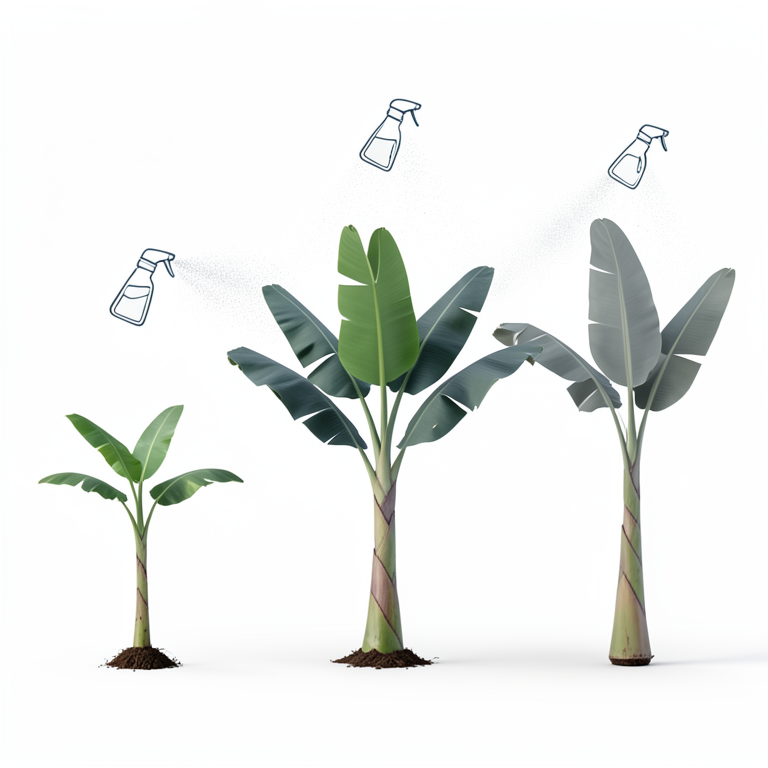
Foliar Application Timeline
AI-generated conceptual illustration (Banana plants (Musa spp. cv. Karpooravalli)). It explains the idea and does not show study data.
View source evidence ↗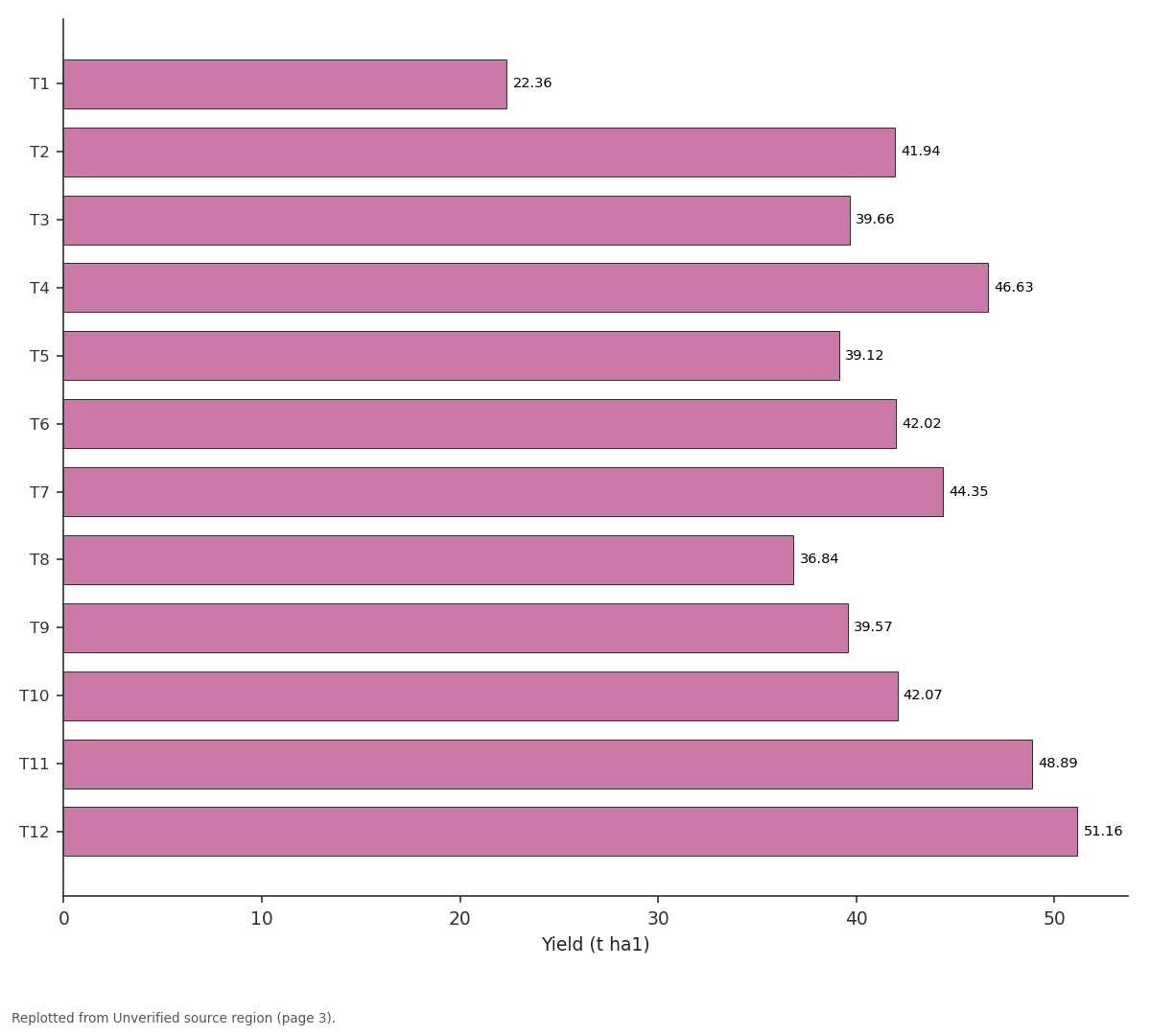
Yield (t ha1): T1 vs T2 vs T3 vs T4 vs T5
Replotted from a table (page 3) of the original paper. Every bar is the paper's own table value.
View source evidence ↗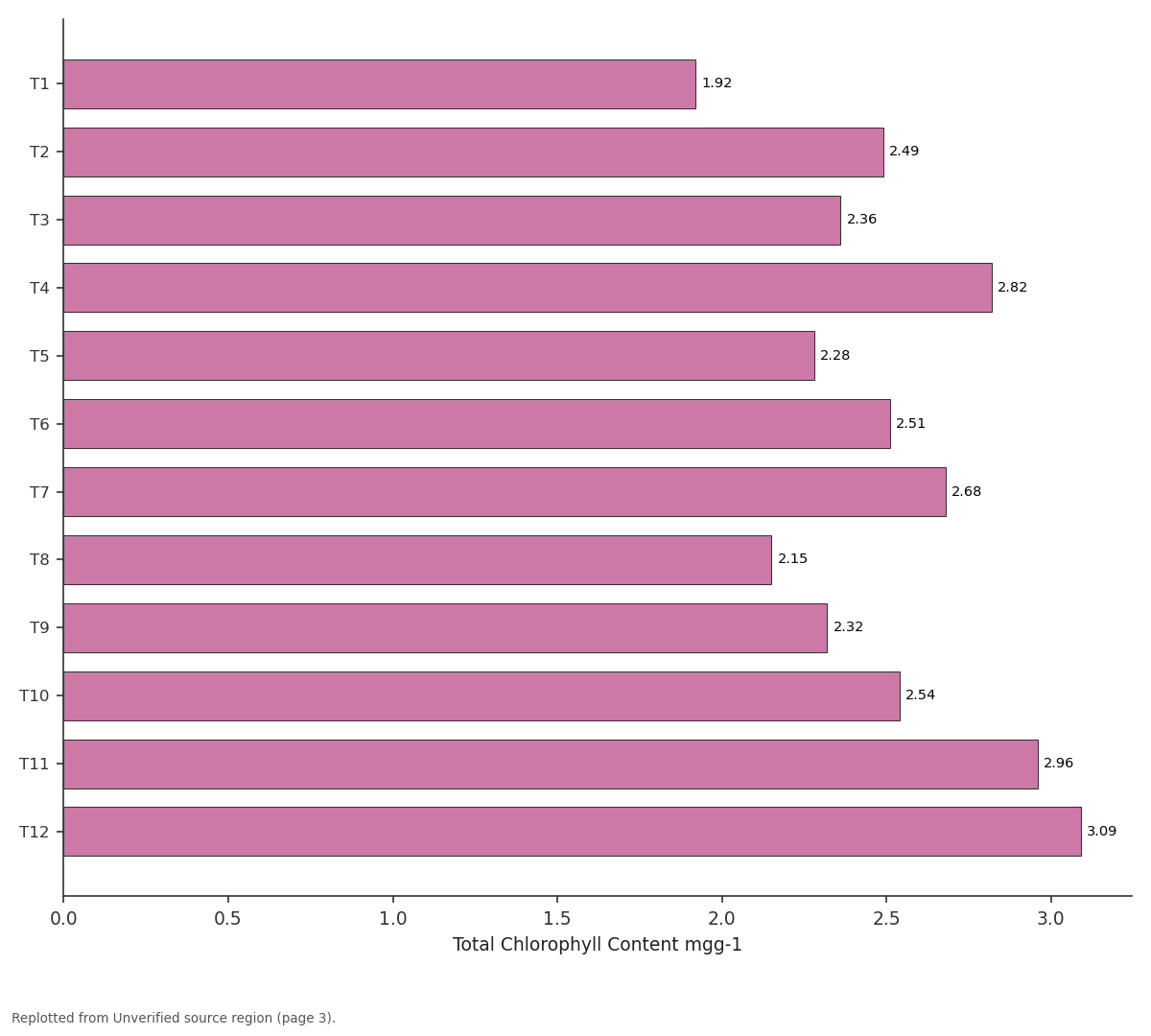
Total Chlorophyll Content mgg-1: T1 vs T2 vs T3 vs T4 vs T5
Replotted from a table (page 3) of the original paper. Every bar is the paper's own table value.
View source evidence ↗Introduction
Banana (Musa spp.) is one of the most important tropical and subtropical fruit crops grown in India, which belongs to the family Musaceae. The edible banana is believed to have originated in hot tropical regions of South-East Asia. In India banana is known for its antiquity and is interwoven with Indian heritage and culture. The plants considered as the symbol of prosperity and fertility. It is also called as 'Kalpataru', Apple of paradise, Plant of virtue, Adam's fig and Tree of wisdom. Banana is fourth most important fruit crop in the world after rice, wheat and maize and it is the second important fruit crop in India next to mango. Banana is a very popular fruit due to its low price and high nutritive value. It is consumed in fresh or cooked form both as ripe and raw fruit. It is a dessert fruit and is used in different regions as staple food owing to its rich and easily digestible carbohydrates with a calorific value of 67-137 kcal 100 g -1 edible fruit. It is a good source of vitamin A (190 IU per 100 g of edible portion) and vitamin C (100 mg 100 g -1 ) and fair source of vitamin B and B 2 . Karpooravalli, meaning 'scented flower', is a popular variety of banana largely grown in South India. They are prized for their taste, texture, and portion size. The ash-coated golden yellow skin of these bananas makes it stand out from other bananas in the market.
Karpooravalli banana is known for its delicious taste and pleasant aroma. It is mildly sweet and of large size, perfect for adding to desserts, ice cream or any sweet item, or simply eaten as it is. Karpooravalli bananas are rich in dietary fiber that helps regulate digestion and prevent constipation. The high fiber content in bananas helps regulate blood sugar levels, making it a good option for those with diabetes. Bananas are rich in vitamin C, which helps boost immunity and prevent infections. The potassium in bananas helps maintain healthy blood pressure levels, reducing the risk of heart disease. Karpooravalli banana is also rich in beta-carotene (143.12 µg per 100g) (Arora et al., 2008). Balanced nutrition is very important for high yield, quality and resistance to diseases. Banana is a high nutrient requiring crop. It requires a continuous supply of nutrients at proper growth stages for enhanced yield and productivity. The unscientific crop management practices being adopted by farmers led to poor utilization of nutrients and thereby resulted in low productivity. Continuous uptake of nutrients from the soil due to intensive cultivation and unscientific methods fertilizer application had resulted in reduced nutrient use efficiency and soil degradation. Micronutrients are often referred to as minor elements and their deficiency can reduce plant yield similar to macronutrient deficiency. So, an efficient and judicious use of fertilizers along with micronutrient application is essential for attaining higher yield per unit area (Bindu, 2019). Micronutrients exist in very small amounts in both soil and plants, but their role is essential for the crop growth and equally important as primary and secondary nutrients. They have an important role in the balance of plant nutrition for the stabilization of a crop yield and quality of a produce. Most of the cultivable lands are deficient in micronutrients viz., zinc, iron, magnesium and boron. The role of micronutrients for production of quality traits have been already reported by several scientists. Zinc aids in regulating plant growth hormone and enzyme system, necessary for carbohydrate and starch formation, iron (Fe) promotes formation of chlorophyll pigment, which acts as an oxygen carrier involving cell division and growth and Boron (B) is necessary for translocation of sugars and promotes fruit maturity (Premalatha and Suresh, 2019). Micronutrient deficiencies in soil and crops have become prevalent in recent years due to several factors like intensive cropping, loss of top soil, soil erosion and leaching (Singh et al., 2007). To meet the required micronutrients demand, foliar application of micronutrient is necessary to get more yield.
Materials and Methods
A field experiment on the "Effect of micronutrients on growth, yield and quality of Banana (Musa spp.) cv. Karpooravalli (ABB)" was carried out at Orchard, Department of Horticulture, Faculty of Agriculture, Annamalai University, Annamalai Nagar, Chidambaram, Tamil Nadu, India during 2023-2024. The details of the materials used and methods applied during this experimental study are described in this chapter. The experimental site is located at the latitude of 11 0 38' North and 79 0 72' East and at an altitude of +5.79 m above MSL. The climate is moderately warm with a hot summer. The mean maximum temperature is 35.50 0 C, while the mean minimum temperature is 23.50 0 C. Micronutrients viz., Zinc sulphate, Borox and Ferrous sulphate were applied at different concentrations on 60, 90 and 120 days after planting along with recommended dose of fertilizers (110:35:330 NPK g plant -1 ) as per the treatments are followed. T 1 control (Water spray) 25 t ha -1 FYM + RDF (110:35:330 NPK g plant -1 ) T 2 25 t ha -1 FYM + RDF + ZnSO4 @ 0.25 % on 60, 90 and 120 DAP,T 3 25 t ha -1 FYM + RDF + ZnSO4 @ 0.50 % on 60, 90 and 120 DAP,T 4 25 t ha -1 FYM + RDF + ZnSO4 @ 0.75 % on 60, 90 and 120 DAP,T 5 25 t ha -1 FYM + RDF + Borax @ 0.25 % on 60, 90 and 120 DAP,T 6 25 t ha -1 FYM + RDF + Borax @ 0.50 % on 60, 90 and 120 DAP,T 7 25 t ha-1 FYM + RDF + Borax @ 0.75 % on 60, 90 and 120 DAP,T 8 25 t ha -1 FYM + RDF + FeSO4 @ 0.25 % on 60, 90 and 120 DAP,T 9 25 t ha -1 FYM + RDF + FeSO4 @ 0.50 % on 60, 90 and 120 DAP,T 10 25 t ha -1 FYM + RDF + FeSO4 @ 0.75 % on 60, 90 and 120 DAP,T 11 25 t ha -1 FYM + RDF + ZnSO4 @ 0.25 % + Borax @ 0.25 % + FeSO4 @ 0.25 % on 60, 90 and 120 DAP,T 12 25 t ha -1 FYM + RDF + ZnSO4 @ 0.50 % + Borax @ 0.50 % + FeSO4 @ 0.50 % on 60, 90 and 120 DAP,T 13 25 t ha -1 FYM + RDF + ZnSO4 @ 0.75 % + Borax @ 0.75 % + FeSO4 @ 0.75 % on 60, 90 and 120 DAP The experimental field was thoroughly ploughed with tractor to get fine tilth. The field was levelled and divided into plots as per the layout of the experiment. Pits of 45 cm 3 size were dug at a spacing of 2.1m x 2.1m and allowed to expose sunlight for one week before planting of suckers. Then pits were filled with topsoil and 10 kg FYM per pit. Banana is commercially propagated through suckers. Healthy, disease free and uniform sized with 1.5-2.0 kg weight banana sword suckers of cv. Karpooravalli (ABB) were procured from the farmer's field and used for planting the recommended dose of fertilizers like nitrogen, phosphorous and potash were applied at 110:35:330 g plant - 1 in the form of urea, single super phosphate and muriate of potash. Nitrogen and potash were applied in three split doses at third, fifth and seventh month after planting. Certain gaps were observed one week after transplanting due to mortality, such gaps were filled with existing sword suckers the required quantity of micronutrients were weighed and dissolved in required quantity of water. Micronutrients were applied as foliar spray three levels at second, third and fourth month after planting the experimental field was kept weed free by regular hand weeding. Irrigation was given at regular interval on need basis. Desuckering was done whenever suckers arise besides the plant. Surplus leaves were pruned to reduce the disease from spreading through old leaves. Pseudostem was propped up with bamboo at the time of bunch emergence. Male buds were removed after completion of female phase in each tree.
Results and Discussion
The present experiment was conducted with objectives to find out "Effect of micronutrients on growth and yield of Banana (Musa spp.) cv. Karpooravalli (ABB)". The results of the investigation are presented in this chapter. The treatments T 13 T 13 25 t ha -1 FYM + RDF + ZnSO4 @ 0.75 % + Borax @ 0.75 % + FeSO4 @ 0.75 % on 60, 90 and 120 DAP was recorded maximum Pseudo stem height (272.35 cm), Pseudo stem girth (67.32 cm) followed by the treatment T 13 number of leaves plant -1 (33.60) followed by T 12 and T 11. The treatment T 12 25 t ha -1 FYM + RDF + ZnSO4 @ 0.50 % + Borax @ 0.50 % + FeSO 4 @ 0.50 % on 60, 90 and 120 DAP at harvest. However, minimum number of leaves plant -1 (21.54) was observed in treatment T 1 control (Water spray) 25 t ha -1 FYM + RDF (110:35:330 NPK g plant -1 ) as control. Foliar sprays of Zinc, Iron and Boron increased the nitrogen content of the leaves. Number of leaves increased may be due to promotive effects of macro and micronutrients on vegetative growth which ultimately led to more photosynthetic activities. Similar results have been reported by Shira et al., (2012) [8] , Anjali et al., (2013) [1] . The number of suckers (6.28) plant -1 of banana increased significantly with the increased crop growth period. And followed by the Treatments T 12 and T 11 (However, minimum number of suckers plant -1 was observed in treatment T 1 control (Water spray) 25 t ha -1 FYM + RDF (110:35:330 NPK g plant -1 ) as control. Probable reason for increased number of suckers due to the increased rates of photosynthesis and photosynthates supply for maximum suckers' growth or change in endogenous auxin in turn in apical dominance. These findings are in agreement with the findings of Paul et al., (2015) [7] , Hazarika, and Megha. 2018 [9] . Maximum number of fingers per hand (20.17), highest yield per hectare (53.42 tonnes) was recorded in the treatment of T 13 25 t ha -1 FYM + RDF + ZnSO 4 @ 0.75 % + Borax @ 0.75 % + FeSO 4 @ 0.75 % on 60, 90 and 120 DAP while lowest yield per hectare (22.36 tonnes) was recorded in control (T 1 ). The maximum yield in the treatment T 13 could be attributed to the production of maximum number of fruits in this treatment resulting in more yield. The production of a greater number of fingers per tree in this treatment could be due to zinc which act as catalyst in the oxidation and reduction process and is also of great importance in the sugar metabolism thus increased the yield per tree. These findings are in agreement with Kramer and Clamens.2005). Jyothi et al., 2020 [4] , Das and Mohan. 1993 [2] . Increase in yield of banana fingers due to foliar application of micronutrients alone or in combination has been reported by several workers from different parts of country Mor et al., (2024) [6] , which supports the results obtained in present investigation. Minimum yield in control treatment is obvious and it may be due to non-availability of nutrients required for formation and development of fruits resulting in production of minimum number of fruits and a smaller number of hands in turn leads to production of lowest yield in this treatment T 1 . The maximum fruit length (14.08 cm) and girth of fruit (10.22 cm) were recorded with foliar application of T 13 25 t ha -1 FYM + RDF + ZnSO 4 @ 0.75 % + Borax @ 0.75 % + FeSO 4 @ 0.75 % on 60, 90 and 120 DAP Effect of treatments on quality parameters of banana the maximum chlorophyll content (3.21mg g -1 ) was recorded in the treatment T 13 25 t ha -1 FYM + RDF + ZnSO 4 @ 0.75 % + Borax @ 0.75 % + FeSO 4 @ 0.75 % on 60, 90 and 120 DAP while the minimum chlorophyll content (1.92 mg g -1 ) was recorded in control treatment. The increase in chlorophyll content due to treatment of zinc is an established fact that zinc is credited with definite role in the hydrolysis of complex polysaccharides into simple sugars, synthesis of metabolites and rapid translocation of chlorophyll contribute photosynthetic products and minerals from other parts of the plant to developing fruits. (Kumari, and Deb. 2018) [5] reported that foliar application of ZnSO4 increased the chlorophyll) content by increasing photosynthetic activity of plants resulting into production of more sugars.
References
9 in the original paper- Anjali A, Lenka PC, Das SN, Das SS. Effect of micronutrients on growth and yield on banana cv. Grand Naine. Journal of Environment and Ecology. 2013;31(4):1919-1921.
- Das PK, Mohan NK. Effect of micronutrient on growth and development of banana cv. Chenichampa, Jahaji and Barjahaji. South Indian Horticulture. 1993;41(4):192-197.
- Sarkar T, Das K. Exploring new frontiers in banana (Musa spp.) farming: Challenges and opportunities. International Journal of Agriculture and Nutrition. 2024;6(2):38-43. DOI: https://doi.org/10.33545/26646064.2024.v6.i2a.181
- Jyothi R, Yaligar R, Kalibavi CM, Ravi MV, Radha J, Mahantesh MT, Ullikashi K, Mamathamadly NG. Effect of Arka banana special micronutrient mixture and bunch cover on yield and quality enhancement in banana. International Journal of Current Microbiology and Applied Science. 2020;Special Issue-11:2668-2673.
- Kumari U, Deb P. Effect of foliar application of zinc and boron on quality of pineapple cv. Mauritius. Journal of Pharmacognosy and Phytochemistry. 2018;7(6):1166-1168.
- Mor R, Rana GS, Kumar S, Kumari S, Jat ML. Influence of foliar application of boron, iron and magnesium on quality attributes and leaf nutrient status of guava cv. Hisar Surkha. Journal of Plant Nutrition. 2024;47(3):423-432.
- Paul AA, Nair CSJ. Effect of foliar application of nutrients on quality characters of banana (Musa AAB) Nendran. International Journal of Applied Pure Science and Agriculture. 2015:101-104.
- Shira VD, Bauri FK, Sarkar SK, Uchoi J. Bunch management technique for improving yield and quality of Martaman (AAB) banana. Plant Archives. 2012;12:875-878.
- Hazarika BN, Megha R. Effect of micronutrients on growth and yield of banana cv. Grand Naine (AAA) under foothills of Arunachal Pradesh. Crop Research. 2018;53(5&6):242-246