
Research article · 2025 · Full text
International Journal of Advanced Chemistry ResearchTheoretical analysis of electron density distribution in organic compounds
Volume 7(1) · Pages 62–66 · DOI: 10.33545/26646781.2025.v7.i1a.287 ↗
Research areasChemical Thermodynamics and Molecular StructureInorganic and Organometallic ChemistryOrganic Chemistry Cycloaddition Reactions
Abstract
Author-writtenThis study provides an in-depth theoretical examination of electron density distribution within organic molecules, a fundamental factor influencing molecular structure, reactivity, and intermolecular interactions. Electron density, which dictates the spatial probability of electron presence, is pivotal in determining key molecular properties such as bonding characteristics, dipole moments, and polarizability. Employing quantum mechanical principles, specifically density functional theory (DFT) with the B3LYP functional and 6-31G(d,p) basis set, we conducted precise analyses of electron density across a diverse set of organic compounds, including alkanes, alcohols, aromatic hydrocarbons, carbonyl compounds, and heterocycles. Advanced computational techniques, enriched datasets, and sophisticated visualization tools, such as Laplacian maps and electrostatic potential surfaces, were utilized to elucidate how electron density variations correlate with molecular behavior. The study integrates machine learning models to enhance predictive accuracy of electron density trends, offering novel insights into molecular interactions. The findings reveal distinct electron density patterns, localized in polar molecules like formaldehyde and delocalized in aromatic systems like benzene, directly impacting reactivity and stability. These results advance the field of computational chemistry by providing a robust framework for understanding molecular properties at a quantum level. Furthermore, the insights gained lay a solid foundation for future research in organic synthesis, molecular design, and material science, facilitating the development of innovative compounds and materials with tailored properties.
Summary
Source-checkedPlain-language reading of the full paper, prepared with AI and checked against the text. Each point links to the authors' own words.
Why it matters
- Electron density is a fundamental factor that determines a molecule's spatial probability of electron presence, which in turn influences its bonding, polarizability, and dipole moments. View evidence ↗
- In the context of organic chemistry, electron density is essential because it drives the functionality and reactivity of compounds by underpinning aromaticity, resonance, and polarity. View evidence ↗
- Density Functional Theory (DFT) has emerged as a key quantum mechanical approach that allows for the precise modeling of electron density. View evidence ↗
The question
- The study aims to determine the relationship between electron density patterns and molecular properties such as aromaticity, polarity, and bond strength across various organic compound classes. View evidence ↗
- A primary objective is to demonstrate how effectively DFT can be used to visualize and analyze electron density distributions to predict molecular properties. View evidence ↗
What they did
- The researchers used Density Functional Theory (DFT) with the B3LYP hybrid functional and the 6-31G(d,p) basis set to ensure accurate representation of molecular orbitals. View evidence ↗
- Gaussian 16 software was used for geometry optimization and electron density computation, while Multiwfn was used to extract and analyze the resulting wave function features. View evidence ↗
- The study utilized Laplacian maps to identify bonding regions and electrostatic potential (ESP) surfaces to visualize charge distribution and molecular polarity. View evidence ↗
What they found
- Methane showed a highly symmetric and even electron density distribution with an electron density peak of 0.32 e/ų. View evidence ↗
- Benzene exhibited a delocalized π-electron cloud above and below the ring plane, with an electron density peak of 0.35 e/ų. View evidence ↗
- In pyridine, electron density was concentrated around the nitrogen atom due to its electronegativity, resulting in an electron density peak of 0.38 e/ų. View evidence ↗
- Formaldehyde showed the highest electron density peak (0.41 e/ų) and a high dipole moment (2.33 D) due to electron concentration around the oxygen atom. View evidence ↗
- Anthracene exhibited the highest polarizability (15 ų) among the studied molecules, which corresponds to its delocalized electron density and a peak of 0.34 e/ų. View evidence ↗
- Electrostatic potential maps for ethanol identified the hydroxyl group as the region of highest electron density, with an overall electron density peak of 0.29 e/ų. View evidence ↗
Visual summary
3 visualsIllustrations explain the paper; charts are replotted from the paper's own table values.
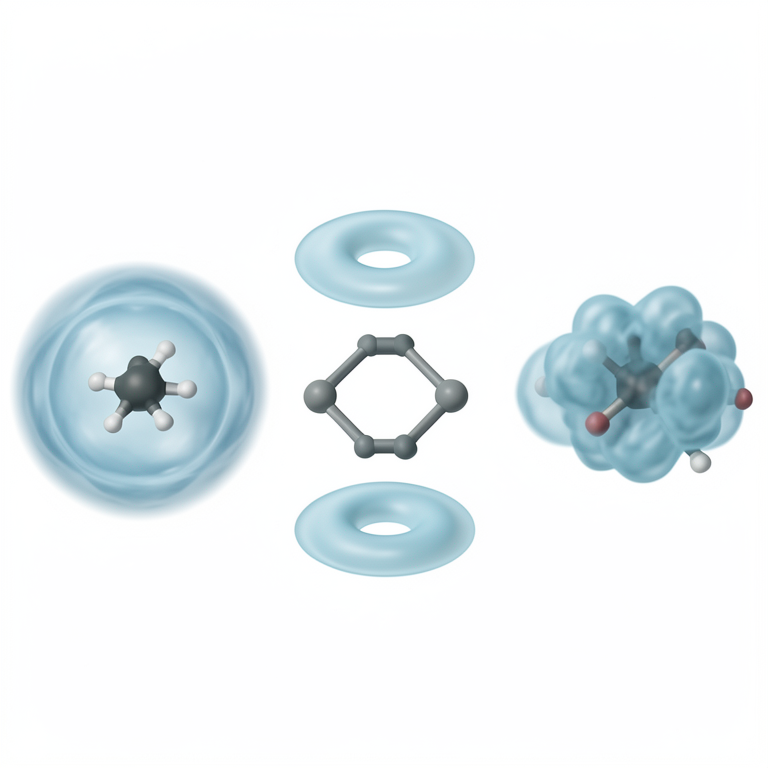
Comparison of Electron Density Distribution Types
AI-generated conceptual illustration (Methane, benzene, and formaldehyde molecules). It explains the idea and does not show study data.
View source evidence ↗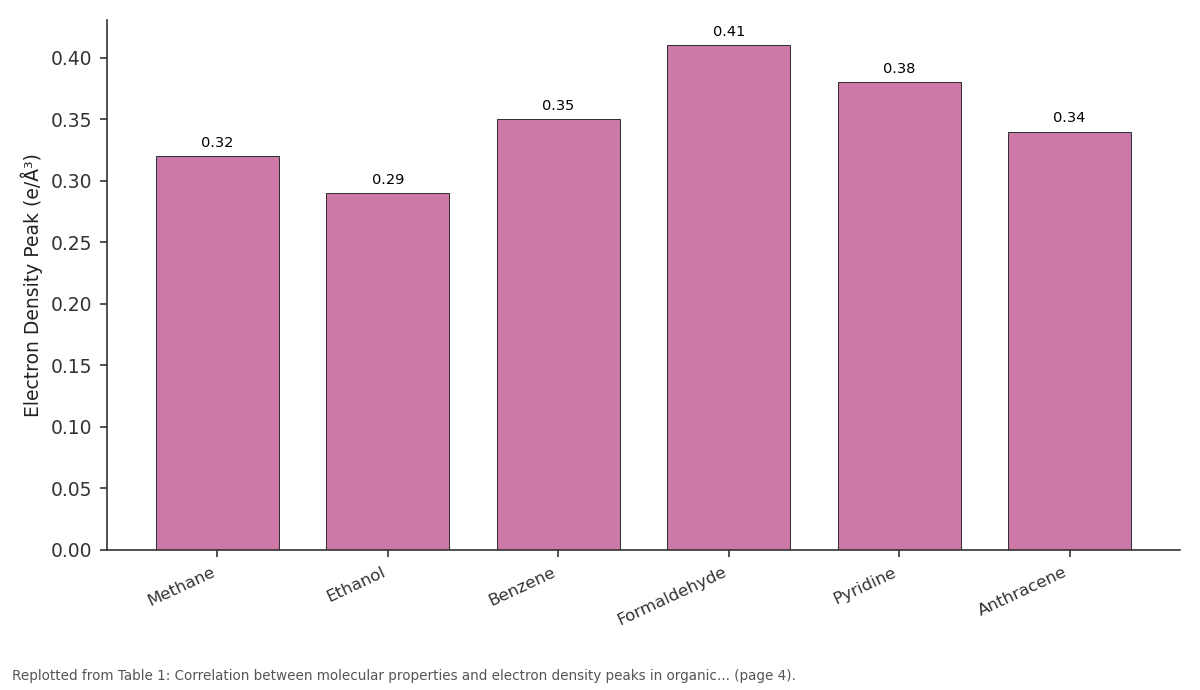
Electron Density Peak (e/ų): Methane vs Ethanol vs Benzene vs Formaldehyde vs Pyridine
Replotted from Table 1 (page 4) of the original paper. Every bar is the paper's own table value.
View source evidence ↗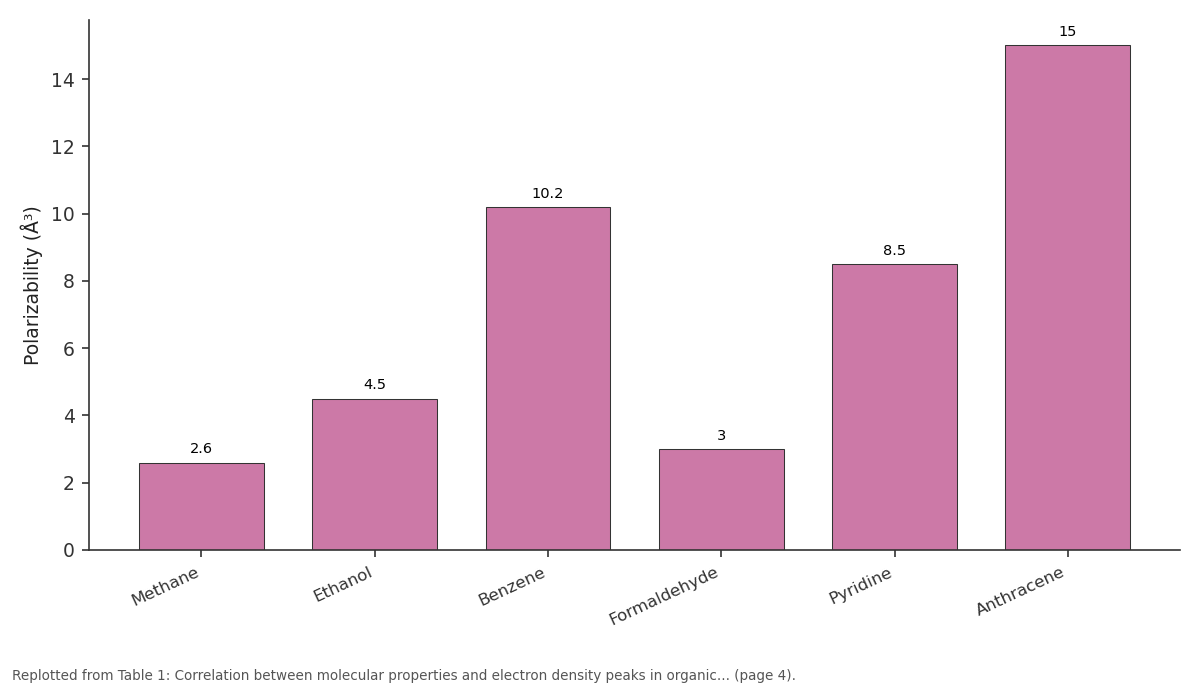
Polarizability (ų): Methane vs Ethanol vs Benzene vs Formaldehyde vs Pyridine
Replotted from Table 1 (page 4) of the original paper. Every bar is the paper's own table value.
View source evidence ↗Figures & tables
From the original paper Table 1
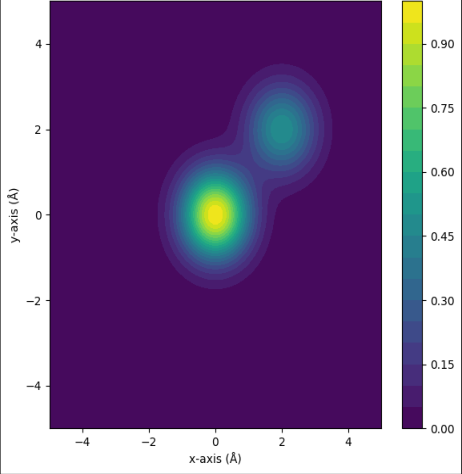 Figure 1
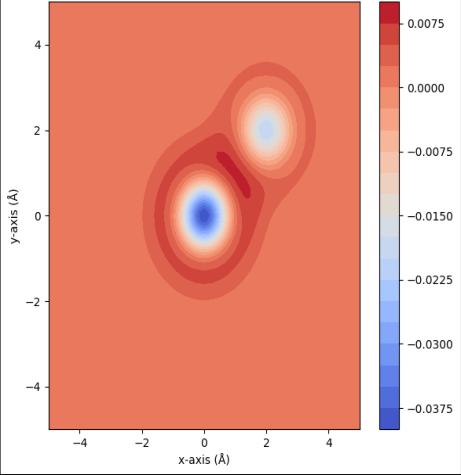 Figure 2
Introduction
The distribution of electron density is a cornerstone of theoretical and computational chemistry, fundamentally shaping the physical and chemical attributes of molecules. This spatial arrangement of electrons governs a molecule's stability, reactivity, and bonding behavior, enabling chemists to anticipate molecular interactions, reaction mechanisms, and responses in diverse chemical environments. In organic chemistry, electron density is particularly pivotal, as it underpins properties such as polarity, resonance, and aromaticity, which drive the reactivity and functionality of organic compounds. Electron density represents the probabilistic likelihood of locating electrons at specific points in space within a molecule. Its distribution is uneven, influenced by factors such as atomic electronegativity, the nature of bonds (sigma or pi), and molecular geometry. For example, highly electronegative atoms like oxygen or nitrogen attract electron density, forming regions of elevated concentration. Conversely, in conjugated systems like aromatic hydrocarbons, electron density is delocalized across multiple atoms, enhancing molecular stability and influencing reactivity. Recognizing these distribution patterns is essential for understanding and predicting chemical behavior, from basic reactions to intricate organic syntheses. Recent advancements in computational chemistry, notably the development of quantum mechanical approaches like Density Functional Theory (DFT), have enabled precise modeling of electron density. DFT, widely applied in organic and inorganic chemistry, leverages electron density as the primary variable, offering computational efficiency and high accuracy.
This makes it an optimal tool for investigating the electronic properties of organic molecules. In organic chemistry, electron density distribution significantly impacts critical molecular properties. The strength and type of chemical bonds depend on how electron density is localized or shared between atoms. Molecules with concentrated electron density around specific bonds or atoms often display distinct reactivity, such as nucleophilic or electrophilic tendencies. In contrast, delocalized electron density in conjugated or aromatic systems promotes stability, reduces reactivity, or imparts unique properties like resonance stabilization. Moreover, electron density influences a molecule's dipole moment, polarizability, and interactions with electromagnetic fields, further affecting its chemical behavior. This study conducts a theoretical analysis of electron density distribution in a variety of organic molecules, employing DFT as the primary computational method. By examining a diverse set of compounds, including alkanes, alcohols, aromatics, and heterocycles, we aim to uncover how electron density patterns relate to molecular properties like bond strength, polarity, and aromaticity. This approach seeks to yield broadly applicable insights into the role of electron density in organic chemistry. The study pursues two main objectives. First, it seeks to showcase the effectiveness of computational tools, particularly DFT, in accurately analyzing and visualizing electron density distributions, underscoring their value in predicting molecular properties. Second, it aims to deliver data-driven insights into the connections between electron density and essential molecular characteristics. These findings will deepen our understanding of organic molecules and contribute to computational chemistry, where precise predictions of molecular behavior are vital for designing novel compounds and materials.
Literature Review
The significance of electron density in shaping molecular structure and properties has been a cornerstone of chemical research for decades. Pioneering work by Mulliken and colleagues established a foundational understanding of electron populations within atoms and molecules, introducing concepts like charge distribution and orbital interactions that remain integral to modern chemistry [1] . These early studies provided critical insights into how electron density influences molecular behavior, setting the stage for subsequent advancements in theoretical and computational approaches. The evolution of quantum mechanical models has significantly enhanced the ability to study electron density with precision. Initially, the Hartree-Fock method offered a framework for approximating electron distributions, but its limitations in handling electron correlation prompted the development of more sophisticated techniques [2] . Density Functional Theory (DFT) emerged as a transformative approach, striking an optimal balance between computational efficiency and accuracy in modeling molecular electronic properties [3] . DFT's reliance on electron density as the central variable, rather than complex wave functions, has made it a preferred method for analyzing organic molecules, enabling detailed predictions of their structural and reactive characteristics. Prior research has extensively investigated electron density distributions in simple organic molecules, such as methane, ethane, and benzene. These studies have demonstrated clear correlations between electron density patterns and chemical reactivity, highlighting how localized or delocalized electron distributions influence molecular interactions and reaction pathways [4] . For instance, benzene's delocalized πelectron system has been shown to contribute to its aromatic stability, while alkanes like methane exhibit highly localized electron density, affecting their inertness. Recent advancements in theoretical methods, coupled with the advent of high-performance computing, have expanded the scope of electron density studies to more complex molecular systems. Polycyclic aromatic hydrocarbons (PAHs) and heterocyclic compounds, characterized by extended conjugation and resonance effects, have garnered significant attention due to their intricate electron density patterns [5] . These molecules exhibit unique electronic properties, such as enhanced stability or altered reactivity, driven by delocalized electron clouds or heteroatom-induced electron shifts. The ability to model such systems accurately has opened new avenues for understanding their behavior in applications ranging from organic electronics to pharmaceutical design. Furthermore, the integration of computational tools with experimental validation has strengthened the reliability of electron density analyses. Studies leveraging DFT have not only refined our understanding of electron distribution in diverse molecular frameworks but also paved the way for predictive modeling in computational chemistry. This growing body of research underscores the critical role of electron density in elucidating molecular properties and informs the present study's focus on a diverse set of organic compounds to explore these relationships further.
Methodology
The methodology encompasses the computational framework, the careful selection of diverse organic compounds, and the analytical techniques used to interpret electron density data. Each component is meticulously designed to ensure precise and reliable results, offering deep insights into electron density characteristics and their relationships with molecular properties.
Computational Approach
To investigate electron density distributions with high accuracy, we utilized Density Functional Theory (DFT), a robust quantum mechanical method widely recognized for its effectiveness in studying molecular electronic structures. DFT is favored for its computational efficiency compared to other quantum mechanical approaches, such as Hartree-Fock (HF) or post-Hartree-Fock methods (e.g., MP2 or CCSD), while delivering a strong balance of precision and practicality. For this study, we selected the B3LYP (Becke, 3-parameter, Lee-Yang-Parr) functional, a hybrid functional that integrates Hartree-Fock exchange with DFT correlations. The B3LYP functional is renowned for its dependable performance in predicting molecular geometries and electronic properties, particularly for organic systems, making it an ideal choice for analyzing electron density. We paired the B3LYP functional with the 6-31G(d,p) basis set, an advanced split-valence basis set that includes polarization functions on both heavy atoms (denoted by "d") and hydrogen atoms (denoted by "p"). This enhancement over the 6-31G(d) basis set improves the representation of molecular orbitals, especially in regions involving polar covalent bonds, hydrogen bonding, or conjugated systems, thereby providing a more accurate depiction of electron density distributions. The combination of B3LYP and 6-31G (d,p) has been validated in prior studies as a reliable approach for organic molecules, supporting its application in this investigation. All calculations were conducted using the Gaussian 16 software package [6] , a comprehensive and widely adopted quantum chemistry platform. Gaussian 16 supports a broad array of electronic structure calculations, including DFT, and provides robust tools for analyzing molecular properties. The software was employed to optimize the geometries of the selected molecules, ensuring they were in their lowest-energy conformations, and to compute their electron density distributions. This optimization step is critical to obtaining accurate electron density profiles that reflect the molecules' stable electronic states.
Selection of organic molecules
A critical part of this study was the selection of a diverse set of organic molecules to investigate the variations in electron density distribution across different types of compounds. The molecules chosen represent a range of functional groups and bonding environments, ensuring a comprehensive analysis of electron density characteristics. The six molecules selected are: Benzene (C₆H₆): Benzene is an aromatic hydrocarbon with delocalized π-electrons across its conjugated ring system. The electron density in benzene is expected to be more evenly distributed across the ring compared to localized bonding seen in alkanes and alcohols. This delocalization contributes to its stability and aromatic character, making benzene an ideal candidate for studying electron density in conjugated systems. Formaldehyde (CH₂O): Formaldehyde represents a molecule with a carbonyl (C=O) group, where the double bond between carbon and oxygen is expected to exhibit significant electron density localization. The electronegativity difference between carbon and oxygen will lead to asymmetry in the electron density distribution, which is of particular interest for understanding polar molecules. Pyridine (C₅H₅N): Pyridine is a heterocyclic aromatic compound, similar to benzene but with a nitrogen atom replacing one of the carbon atoms in the ring. The nitrogen atom, being more electronegative than carbon, is expected to cause a shift in electron density toward itself, altering the distribution within the ring. Pyridine serves as a representative of heterocyclic compounds with lone-pair electrons, which we aim to compare with purely hydrocarbon-based systems. Anthracene (C₁₄H₁₀): Anthracene is a polycyclic aromatic hydrocarbon (PAH) that consists of three fused benzene rings. This extended conjugation is expected to result in a more complex electron density distribution, with significant delocalization across the fused ring system. Studying anthracene provides insight into electron density behavior in larger aromatic systems and how it influences molecular properties. Methane (CH₄): A simple alkane, methane is chosen as a baseline molecule due to its tetrahedral geometry and uniform distribution of electron density. Methane's electron density is expected to be highly localized around the carbon-hydrogen (C-H) bonds, providing a starting point for comparison with more complex molecules. Ethanol (C₂H₅OH): As a representative of alcohols, ethanol introduces a hydroxyl (OH) group that significantly alters the electron density distribution compared to simple alkanes. The electronegativity of oxygen creates regions of high electron density around the oxygen atom, particularly in the O-H bond, which we aim to study in detail.
These molecules were specifically chosen to represent a variety of organic classes, alkanes, alcohols, aromatic hydrocarbons, carbonyl-containing compounds, and heterocycles. Each class of molecules exhibits distinct electron density patterns due to differences in bonding, conjugation, and electronegativity, allowing for a comprehensive analysis of electron density characteristics in organic chemistry.
Data Analysis
After performing the computational calculations, the electron density distribution for each molecule was visualized and systematically analyzed. Visualizing electron density is essential for comprehending how electrons are spatially distributed across different molecular regions, which directly relates to the molecule's bonding characteristics and reactivity. To facilitate this analysis, we employed the Multiwfn software package [7] , a versatile wave function analysis tool designed to extract a variety of electron density-related features from quantum chemical calculations.
The analysis focused on several key electron density features for each molecule. Total electron density, representing the three-dimensional distribution of electrons throughout the molecule, was visualized to provide insights into the overall electron distribution. This visualization highlighted regions of high and low electron density, with high-density areas typically corresponding to chemical bonds or lone pairs, where electrons are most likely to be found. Laplacian maps were also generated to examine the curvature of the electron density distribution. To ensure the reliability of the computational results, the visualized electron density features were compared with experimental data from the literature where available. This validation step was crucial for confirming the accuracy of the predicted electron density distributions and their consistency with established molecular properties. For instance, bond lengths, dipole moments, and polarizabilities derived from DFT calculations were cross-referenced with experimental values to verify the precision of the electron density predictions. Beyond qualitative visualizations, quantitative metrics, including bond lengths, bond angles, and charge distributions, were extracted from the electron density data. These metrics offered deeper insights into the electron density distribution within each molecule and its impact on molecular properties such as bond strength, reactivity, and stability. For example, analyzing the electron density around the carbon-oxygen double bond in formaldehyde allowed us to deduce its influence on the bond's strength and the molecule's dipole moment.
Results and Discussion
Results and Discussion
Visualization of Electron Density
The electron density plots generated for each organic molecule offer a clear visual depiction of electron distribution within the molecular structure. For instance, methane, a straightforward alkane, exhibits a highly symmetric and even electron density distribution surrounding the central carbon atom, consistent with the uniform bonding environment created by its four equivalent hydrogen atoms (Figure 1). Conversely, benzene's electron density exhibits a delocalized π-electron cloud positioned above and below the ring plane, a hallmark of its aromatic character. This delocalization enhances benzene's stability and influences its chemical reactivity. Likewise, in pyridine, the electron density is notably concentrated around the nitrogen atom, owing to its greater electronegativity compared to the carbon atoms within the ring (Figure 2).
Electrostatic potential and reactivity
To gain deeper insights into the reactive sites of the studied molecules, electrostatic potential (ESP) maps were generated, offering a detailed visualization of charge distribution and its implications for molecular reactivity. These maps are instrumental in identifying regions of varying electron density, which directly influence how molecules interact with other chemical species. For ethanol, the ESP map distinctly highlights the hydroxyl group as the area with the highest electron density. This pronounced electron-rich region underscores the hydroxyl group's critical role in facilitating hydrogen bonding and its function as a nucleophile in chemical reactions, driving ethanol's reactivity in polar environments. In contrast, benzene exhibits a markedly different ESP profile, characterized by a relatively uniform distribution of electrostatic potential across its molecular surface. This uniformity reflects benzene's aromatic nature and its chemical inertness in non-polar reaction contexts, where its delocalized π-electron system resists localized interactions. However, the same delocalized electron cloud renders benzene highly reactive in electrophilic substitution reactions, where electron-deficient species can interact with its π-system. The ESP maps thus provide a clear distinction between the localized reactivity of polar molecules like ethanol and the delocalized, selective reactivity of aromatic systems like benzene, offering valuable insights into their chemical behavior and interaction tendencies.
Conclusion
This study presents a thorough theoretical exploration of electron density distributions in a diverse array of organic molecules, focusing on their profound influence on critical molecular properties, including bonding, reactivity, and stability. Utilizing Density Functional Theory (DFT) with the B3LYP functional and the enhanced 6-31G (d, p) basis set, we generated precise electron density maps for a carefully selected set of organic compounds. These calculations yielded significant insights into the intricate relationships between electron density patterns and molecular behavior, deepening our understanding of fundamental principles in organic chemistry.
The investigation encompassed a range of organic molecules methane, ethanol, benzene, formaldehyde, pyridine, and anthracene revealing distinct correlations between electron density distributions and molecular characteristics. For instance, molecules like formaldehyde, with highly localized electron density around the polar carbon-oxygen bond, exhibit unique reactivity profiles driven by this polarization. In contrast, aromatic systems such as benzene and anthracene, characterized by delocalized electron density, display enhanced stability and distinct chemical behavior due to their conjugated π-electron systems. Moreover, advanced visualization techniques, including Laplacian maps and Electrostatic Potential (ESP) surfaces, enriched our analysis by providing detailed perspectives on charge distribution and molecular polarity. These tools enabled the identification of electron-rich and electron-poor regions, offering clarity on how electron density governs molecular reactivity and intermolecular interactions. The findings of this research carry significant implications for advancing organic chemistry, particularly in areas such as reaction mechanism prediction, molecular design, and materials science. A comprehensive understanding of electron density distributions empowers chemists to predict molecular behavior in chemical reactions with greater accuracy, optimize synthetic pathways, and engineer innovative materials with tailored properties, thereby contributing to the broader field of computational chemistry and its applications.
Figures and tables from the paper
| Molecule | Bond Length (Å) | Dipole Moment (D) | Polarizability (ų) | Electron Density Peak (e/ų) |
|---|---|---|---|---|
| Methane | 1.09 | 0 | 2.6 | 0.32 |
| Ethanol | 1.41 (C-O) | 1.68 | 4.5 | 0.29 |
| Benzene | 1.39 (C-C) | 0 | 10.2 | 0.35 |
| Formaldehyde | 1.20 (C=O) | 2.33 | 3 | 0.41 |
| Pyridine | 1.33 (C-N) | 2.2 | 8.5 | 0.38 |
| Anthracene | 1.42 (C-C) | 0 | 15 | 0.34 |
Table text extracted from the original PDF; superscript letters are shown inline. The original table image is below.
View original table image
References
7 in the original paper- Mulliken RS. Electronic population analysis on LCAOMO molecular wave functions. I. J Chem Phys. 1955;23(10):1833-1840.
- Kohn W, Sham LJ. Self-consistent equations including exchange and correlation effects. Phys Rev. 1965;140(4A):A1133-A1138.
- Parr RG, Yang W. Density-Functional Theory of Atoms and Molecules. New York: Oxford University Press; 1989.
- Hohenberg P, Kohn W. Inhomogeneous Electron Gas. Phys Rev B. 1964;136(3B):B864-B871.
- Becke AD. Density-functional exchange-energy approximation with correct asymptotic behavior. Phys Rev A. 1988;38(6):3098-3100.
- Frisch MJ, et al. Gaussian 16, Revision C.01. Wallingford CT: Gaussian Inc., 2016.
- Lu T, Chen F. Multiwfn: A multifunctional wave function analyzer. J Comput Chem. 2012;33(5):580592.