
Research article · 2025 · Full text
International Journal of Biology SciencesBiomedical assay of Tridax procumbens Linn and Hibiscus schizopetalus Linn for treatment of kidney stones
Volume 7(6) · Pages 91–94 · DOI: 10.33545/26649926.2025.v7.i6b.359 ↗
Research areasHibiscus Plant Research Studies
Abstract
Author-writtenKidney stone is a common disorder in males than females. Kidney stones forms when urine contains more crystal forming substances such as calcium, oxalate and uric acid. Symptoms of kidney stones are nausea, fever, blood in urine, severe pain in back, frequent urination, sweating, cloudy or foul smell in urine. Medicinal plants helps to dissolve and pass the kidney stones. Main objective of this study is used to compare the effects of Tridax procumbens and Hibiscus schizopetalus against stone formation by nucleation assay method. Parts used were leaves of Tridax procumbens and petals of Hibiscus schizopetalus. Tridax procumbens exhibited better results than Hibiscus schizopetalus. This study will help to decrease the side effects caused by other treatments. This study helped to search new herbal plants for the treatment of kidney stone such as Hibiscus schizopetalus
Summary
Source-checkedPlain-language reading of the full paper, prepared with AI and checked against the text. Each point links to the authors' own words.
Why it matters
- Kidney stones are a common disorder, occurring more frequently in males, and form when urine has high levels of crystal-forming substances like uric acid, oxalate, and calcium. View evidence ↗
- Current medical treatments for kidney stones, including shock wave lithotripsy and laparoscopic procedures, are often considered inconvenient due to their high cost and the pain they cause patients. View evidence ↗
- Herbal medicines are viewed as a viable alternative because they are generally affordable, readily available, and have minimal to no side effects. View evidence ↗
The question
- The primary goal of the study was to use a nucleation assay to compare how effectively Tridax procumbens and Hibiscus schizopetalus inhibit the formation of kidney stones. View evidence ↗
What they did
- The researchers used leaves from Tridax procumbens and petals from Hibiscus schizopetalus collected from the R.B.N. Borawake College botanical garden. View evidence ↗
- Aqueous extracts were prepared by boiling 1g of dried plant powder in 100ml of distilled water for 6 hours, followed by filtration and centrifugation at 2500 rpm for 1 minute, eventually concentrating 1g of material into 25ml of water. View evidence ↗
- The nucleation assay utilized a buffer at pH 6.5 containing 0.5mmol/L Tris and 0.15 mmol/L NaCl, with calcium chloride and sodium oxalate concentrations of 3 mmol/L and 0.5mmol/L, respectively. View evidence ↗
- Crystallization was triggered by adding 950 µl of sodium oxalate to a mixture of 950µl calcium chloride and 50 µl of plant extract, with optical density monitored at 620nm. View evidence ↗
What they found
- Increasing the concentration of Tridax procumbens leaf extract led to a decrease in calcium oxalate monohydrate (COM) particles and a gradual increase in calcium oxalate dehydrate (COD) particles. View evidence ↗
- Increasing the concentration of Hibiscus schizopetalus petal extract resulted in a slight decrease in COM particles and a slight increase in COD particles. View evidence ↗
- Tridax procumbens leaf extract was found to be more effective than Hibiscus schizopetalus in inhibiting COM formation and promoting COD formation at higher concentrations. View evidence ↗
- The observation table categorized the therapeutic effect of Tridax procumbens as 'Better' and Hibiscus schizopetalus as 'Good' for kidney stones. View evidence ↗
What it means
- The authors concluded that both plant extracts are beneficial for treating kidney stones, though Tridax procumbens leaves were more effective at inhibiting crystal nucleation growth. View evidence ↗
Visual summary
1 visualsIllustrations explain the paper; they do not show study data.
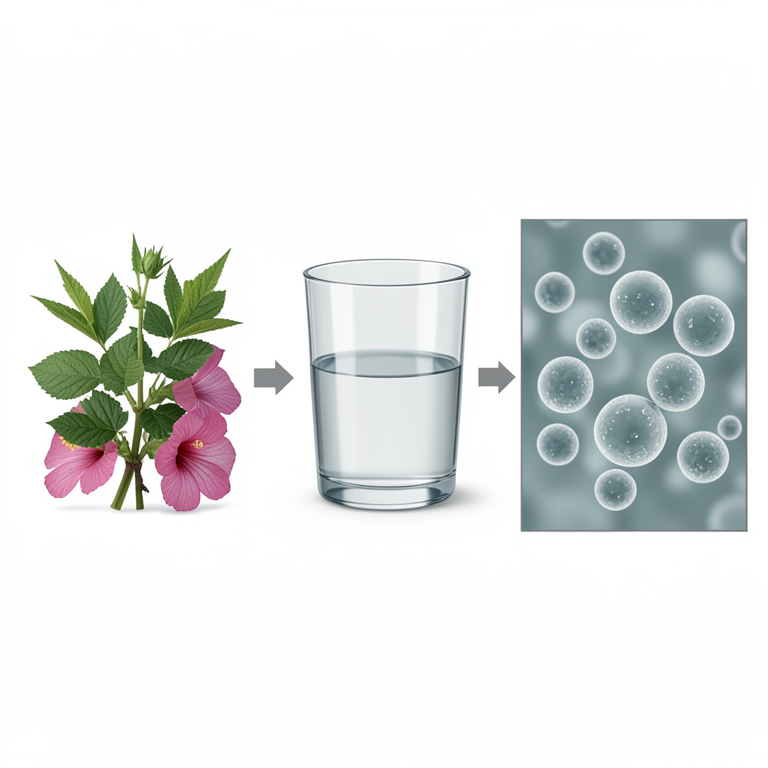
Nucleation Assay Concept
AI-generated conceptual illustration (Tridax procumbens leaves, Hibiscus schizopetalus petals, and calcium oxalate crystals). It explains the idea and does not show study data.
View source evidence ↗Figures & tables
From the original paper Table 1
Introduction
A large number of people are suffering from urinary stone problem all over the globe. Not only the humans but animals and birds also suffer from the urinary stone problem. The occurrence in some areas is so alarming that they are known as stone belts. Stone are more common in males than in females. Most urinary calculi occur in patients aged 20-49 years. Hibiscus rosa-sinensis Linn (Malvaceae) is a glabrous shrub widely cultivated in the tropics as an ornamental plant and has several varieties with varying colours. In medicine, however, the red flower variety is preferred. The herb Hibiscus rosa-sinensis Linn may emerge as a major player in the growing field of herbal health supplements and medicines both in daily self care and in professionally managed health care system (Nirmaladevi et al;2012) [8] . Strategies of dietary supplementation for preventing calcium oxalate stones formation-Intake of oxalate-rich foods should be limited. Some items are oxalate rich in food such as spinach, rhubarb, beets, nuts, chocolate, tea, wheat bran, and strawberries which have been shown influence for raising oxalate levels and significant increase in urinary oxalate excretion. It is well-known that vitamin C can convert to oxalate therefore; supplementation of higher dose vitamin C may induce to increase oxaluria and increased risk of stone formation. Excess of fluid intake, restricted sodium and protein intake are advisable. Calcium intake during meal time is advised in order to avoid calcium oxalate (Phatak and Hendre 2015) [11] . Several plants have been subject to scientific studies in Morocco & around the world to evaluate the litholytic activity in an in-vitro system like: Herniaria hirsute, Zea mays, Ammi visnag, Zizyphus lotus L (Yachi 2018) [7] . Traditional treatments are very beneficial to cure diseases like renal tract infections. Urinary stones are crystals in the form that can be found anywhere,in the urinary tract, this condition is called urolithiasis. Kidney stones are a lump of crystals that are present in one or both kidneys with different sizes & shapes. Phosphate, uric acid, magnesium ammonium phosphate and struvite all contribute to the crystallization of urinary stones. Urinary stones have a calcium content of 75%, calcium oxalate of 5%, and calcium phosphate of 5%. (Amjad et al; 2023) [4] .
Ethno medicines are herbal substances that are used to treatment of different diseases. Approximately 25% of the drugs prescribed globally are originated from ethno medicinal plants. They are found in various essential medicines in the World Health Organization (WHO), Out of 252 drugs, 11% medicines are originated from exclusively plant. There are various treatment of approaches for kidney stones such as percutaneous nephrostolithotomy, ureteroscopy, laproscopic and shock wave lithotripsy. Hence these treatment methods are non-convenient for patients because they are costly and painful. The herbal remedies and herbal medicine which are quite safe, cost effective, readily available, and minimal or no side effects, and easily affordable (Bishoyi and Tripathy 2023) [13] .
Materials and Methods
Collection and of plant sample-The leaves of Tridax procumbens and fresh flowers Hibiscus schizopetalus were collected from botanical garden of R.B.N. Borawake College. Leaves and petals of flowers were dried at room temperature, pulverized in a mixer grinder, powdered, sieved and stored in refrigerator. For aqueous extract preparation, 1g of dried powder of Tridax procumbens were placed in 100ml of distilled water and boiled for 6 hours and it was filtered through Whatman No. 1 filter paper and centrifuged at 2500 rpm for 1 minute. The supernant was concentrated and finally 1g material was extracted in 25 ml of distilled water. Same extraction process was carried out for Hibiscus schizopetalus.
Nucleation assay -Nucleation assay was done according to Nirmaladevi et al (2012) [8] with some modification. Nucleation assay is important in stone formation. Solutions of calcium chloride and sodium oxalate were prepared at a final concentration of 3 mmol/L and 0.5mmol/L respectively, in a buffer containing Tris 0.5mmol/L and NaCl 0.15 mmol/L at pH 6.5. Calcium chloride (950µl) solution was mixed with 50 µl of the extracts separately with different concentrations. Crystallization was initiated by the addition of 950 µl of sodium oxalate solution. The optical density of the solution was monitored at 620nm. The rate of nucleation was estimated by comparing the induction time in the presence of the extracts and in the absence of the extracts. The Ca Ox (Calcium oxalate) stones were observed using light microscopy for comparison.
Results and Discussion
The results of nucleation assay are shown in figure 1. Ca Ox nucleation was monitored in the presence and absence of plant extracts using light microscope. When Tridax procumbens leaves extract concentration is increased,the amount of COM(calcium oxalate monohydrate) particles decreased and those of COD (calcium oxalate dehydrate) gradually increased.This indicates the inhibition of crystal nucleation. When Hibiscus schizopetalus petals extract concentration is increased, the amount of COM particles little decreased and those of COD little increased, indicating the inhibition of crystal nucleation. This study shows that higher concentration of Tridax procumbens leaves extract inhibits the formation of COM and promotes the formation of COD and is more effective than Hibiscus schizopetalus.
Conclusion
The study revealed that Tridax procumbens leaves exhibited better effect against crystal nucleation growth. Hibiscus schizopetalus also exhibited good effect. Therefore, the components present in both the extracts are beneficial for medicinal use in treatment of kidney stones.
Figures and tables from the paper
| Sr. No. | Scientific Name | Family | Parts Used | Therapeutic Effect | Effect of extract |
|---|---|---|---|---|---|
| 1. | Tridax procumbens | Asteraceae | Leaves | Kidney stone | Better |
| 2. | Hibiscus schizopetalus | Malvaceae | Petals | Kidney Stone | Good |
Table text extracted from the original PDF; superscript letters are shown inline. The original table image is below.
View original table image
References
15 in the original paper- Jaiswal AK, Goswami AND, Singh S. Microstructural analysis of kidney stone expelled during the homeopathic treatment. Int J Sci Res. 2017;7(8):1430914314.
- Choubey A, Parasar A, Choubey A, Iyer D, Pawar RS, Patil UK. Potential of medicinal plants in kidney, gall and urinary stones. Int J Drug Dev Res. 2010 AprJun;2(2).
- Khan F, Haider MF, Singh MK, Sharma P, Kumar T, Nezhad EN. A comprehensive review on kidney stones, its diagnosis and treatment with allopathic and ayurvedic medicines. Int J Pharm Sci Res. 2019;7(4):69-74.
- Amjad F, Ishfaq S, Afzal Q, Nadeem A, et al. Herbal treatment of kidney stones: A review. Int J Biol Pharm Allied Sci. 2023;2582-9343.
- Gupta S, Kanwar SS. Phyto-molecules for kidney stones treatment and management. Int J Biotechnol Biochem. 2018;7(4):2161-1009.
- Han H, Segal AM, Seifter JL, Dwyer JT. Nutritional management of kidney stone (nephrolithiasis). Clin Nutr Res. 2015;4:137-152.
- Yachi L, Bennis S, Aliat Z, et al. In vitro litholytic activity of some medicinal plants on urinary stones. J Pharm Res. 2018 Sep;24(3).
- Nirmaladevi R, Kalpana S, Kavitha D, Padma PR. Evaluation of antilithiatic potential of Hibiscus rosasinensis Linn, in vitro. Int J Pharm Pharm Sci. 2012;5(8):4353-1456.
- Cunningham P, Noble H, Al-Modhefer AK, Walsh I. Kidney stones: pathophysiology, diagnosis and management. Br J Nurs. 2016;25(20):1112-1126.
- Mitra P, Pal DK, Das M. Does quality of drinking water matter in kidney stone disease: A study in West Bengal, India. J Clin Nephrol Res. 2018;2466-0493.
- Phatak RS, Hendre AS. In-vitro antiurolithiatic activity of Kalanchoe pinnata extract. Int J Pharmacogn Phytochem Res. 2015 Mar;7(2):275-259.
- Abbagani S, Gundimeda SD, Varre S, Ponnala D, Munduluru HP. Kidney stone disease: Etiology and evaluation. J Med Allied Sci. 2010;0976-4550.
- Bishoyi SK, Tripathy UP. Ethnomedicinal plants used in kidney stones and infection of urinary tract by tribal community of Raygada District, Odisha. Int J Sci Res Arch. 2023; eISSN:2582-8185.
- Bawari S, Sah AN, Tewari D. Urolithiasis: An update on diagnostic modalities and treatment protocols. Indian J Pharm Sci. 2017;79(2):164-74.
- Atodariya U, Barad R, Upadhyay S, Upadhyay U. Antiurolithiatic activity of Dolichos biflorus seeds. Int J Pharmacogn Phytochem Res. 2013;2(2):2278-4136.