
Research article · 2025 · Full text
International Journal of Biology SciencesImpact of Woolly Aphid (Ceratovacuna lanigera) Infestation on Photosynthetic and Biochemical Parameters of Sugarcane
Volume 7(6) · Pages 359–361 · DOI: 10.33545/26649926.2025.v7.i6f.398 ↗
Research areasInsect-Plant Interactions and ControlInsect Pest Control StrategiesAgricultural pest management studies
Abstract
Author-writtenThis study examines the impact of woolly aphids (Ceratovacuna lanigera) on the biochemical parameters of sugarcane (Saccharum officinarum). Through a combination of field experiments and laboratory analyses, the research explores the physiological and biochemical responses of sugarcane to aphid infestation. Sugarcane, a key source of sugar and ethanol, is frequently affected by various pests, among which the woolly aphid poses a significant threat, potentially leading to severe damage if left uncontrolled. The study's findings reveal that woolly aphid infestation significantly reduces photosynthetic efficiency, resulting in decreased biomass accumulation and lower sugar content in affected plants. Field assessments demonstrated a notable reduction of approximately 37% in total chlorophyll content, indicating impaired photosynthesis. Additionally, sugarcane juice analysis showed a decline in juice quality at high infestation levels compared to healthy plants. An increase in phenolic compounds and a shift towards acidic pH in infested plants suggest stress-induced biochemical changes due to aphid feeding. These results provide valuable insights into the ecological interactions between woolly aphids and sugarcane, emphasizing the need for integrated pest management strategies to minimize their negative impact on sugarcane productivity.
Summary
Source-checkedPlain-language reading of the full paper, prepared with AI and checked against the text. Each point links to the authors' own words.
Why it matters
- Sugarcane is a globally significant commercial crop used to produce sugar, bioethanol, and by-products like molasses and bagasse. View evidence ↗
- The woolly aphid (Ceratovacuna lanigera) is a major pest threatening sugarcane cultivation in Indian states including Uttar Pradesh, Karnataka, and Maharashtra. View evidence ↗
- Woolly aphids damage sugarcane by sucking phloem sap, which causes leaf curling, drying, and chlorosis, thereby impairing photosynthesis. View evidence ↗
The question
- The study aims to evaluate how Ceratovacuna lanigera infestation affects specific biochemical parameters of sugarcane in field conditions. View evidence ↗
What they did
- Researchers collected healthy and infested samples of the Co 8014 sugarcane variety from fields in the Nashik district of Maharashtra, India, in January 2023. View evidence ↗
- Chlorophyll content was measured by extracting leaf tissue using 80% acetone according to the Sadasivam and Manickam method. View evidence ↗
- Total phenolic content was estimated using the Folin-Ciocalteu reagent method. View evidence ↗
- The pH of fresh sugarcane juice from both groups was measured in triplicate using a calibrated digital pH meter. View evidence ↗
What they found
- Infested plants exhibited elevated levels of phenolic compounds, which the authors interpret as an active defense response to the aphid attack. View evidence ↗
What it means
- The authors conclude that timely monitoring and effective pest management are essential to protect sugarcane yield and quality from aphid infestation. View evidence ↗
- The authors note that results may vary based on the sugarcane variety, planting season, crop age at attack, and the severity of colonization. View evidence ↗
Visual summary
2 visualsIllustrations explain the paper; charts are replotted from the paper's own table values.
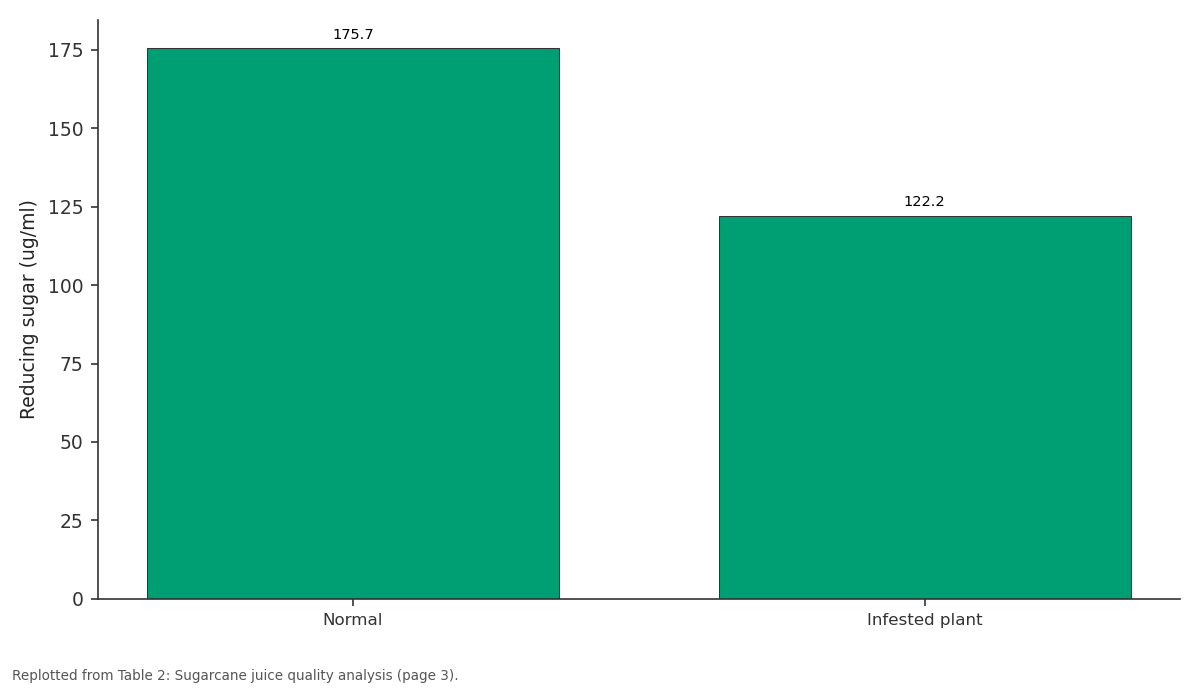
Reducing sugar (ug/ml): Normal vs Infested plant
Replotted from Table 2 (page 3) of the original paper. Every bar is the paper's own table value.
View source evidence ↗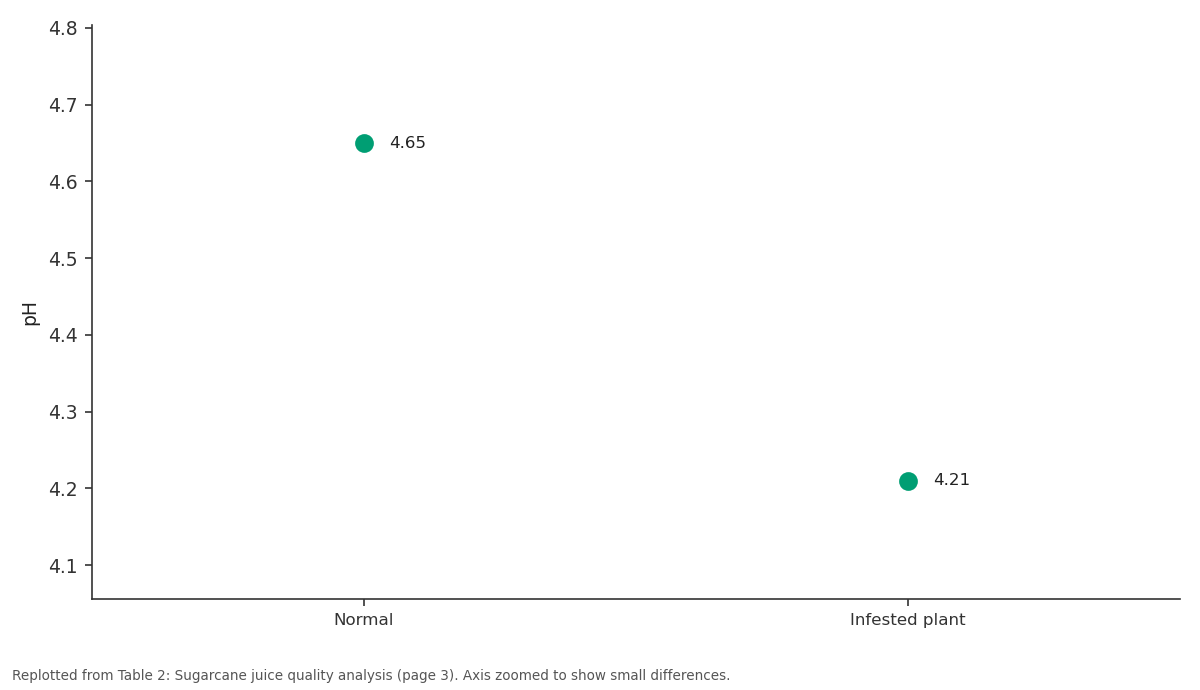
pH: Normal vs Infested plant
Replotted from Table 2 (page 3) of the original paper. Every bar is the paper's own table value.
View source evidence ↗Figures & tables
From the original paper Table 1
 Table 2
Introduction
Sugarcane (Saccharum officinarum L.) is one of the most important commercial crops globally, serving as a primary source of sugar, bioethanol, and various by-products such as bagasse and molasses. In India, sugarcane holds a pivotal role in rural economies, sustaining millions of farmers and contributing substantially to agro-based industries. However, sugarcane productivity is frequently hindered by a range of biotic stresses, of which pest infestations are particularly detrimental. Among the major insect pests, the woolly aphid (Ceratovacuna lanigera Zehntner) has emerged as a serious threat to sugarcane cultivation in several Indian states, notably Maharashtra, Karnataka, and Uttar Pradesh (Patil et al., 2015) [7] . The woolly aphid, first reported in India during the late 1990s, is a sucking pest that infests the undersides of sugarcane leaves, forming dense colonies covered with white, waxy filaments. These aphids suck phloem sap, leading to chlorosis, curling, and drying of leaves, and severely affect photosynthetic activity (Naik et al., 2013) [6] . Additionally, the secretion of honeydew promotes the growth of sooty mold fungi, further impeding physiological processes like respiration and transpiration. The cumulative damage caused by C. lanigera not only reduces cane quality and sugar recovery but also affects the biochemical equilibrium of the plant. Biochemical parameters such as chlorophyll content, total phenols, soluble sugars, and proline levels serve as vital indicators of plant health and stress response. Aphid infestation typically disrupts these parameters, causing oxidative stress and triggering metabolic adjustments in the host plant (Chakraborty & Mondal, 2017) [2] . For instance, a reduction in chlorophyll can directly lower the photosynthetic efficiency of sugarcane, while a rise in phenolic content may reflect a defense mechanism against herbivory (Kumar et al., 2019) [4] . Soluble sugars and proline, on the other hand, are often involved in osmotic regulation and protective responses under stress conditions. Studying these parameters under pest pressure provides insights into the plant's physiological and biochemical adaptations. Despite numerous studies on the population dynamics and management of C. lanigera, limited research has focused on its biochemical impact on sugarcane plants, particularly in relation to key physiological markers. Understanding the biochemical consequences of aphid attack is critical for evaluating crop damage beyond visual symptoms and yield loss [3] . It can also aid in screening resistant cultivars and developing integrated pest management strategies with a biochemical basis. This study aims to evaluate the impact of Ceratovacuna lanigera infestation on selected biochemical parameters of sugarcane under field conditions. By comparing healthy and infested plants across different growth stages, the research intends to establish a biochemical profile associated with aphid stress. The findings are expected to contribute to the understanding of host-pest interactions and provide a foundation for future work on pest resistance and crop protection. The present investigation was undertaken with an objective to determine the impact of woolly aphid infestation the sugar content in different sugarcane varieties.
To assess the effect of woolly aphid infestation on the chlorophyll content of sugarcane leaves. To analyse the changes in phenolic compound levels in sugarcane plants in response to woolly aphids' infestation. Study will also focus on plants defence response by measuring the concentration of key phenolic compounds. To carry out damage assessment of sugar by woolly aphid using there biochemical properties.
Materials and Methods
Materials and Methods
Collection of Plant Material and Aphid Specimens
This study was conducted using the Co 8014 variety of sugarcane. Healthy and aphid-infested plant samples were collected in January 2023 from different fields in the Nashik district, Maharashtra, India. The aphid specimens (Ceratovacuna lanigera Zehntner) were carefully collected from visibly infested sugarcane fields to confirm the identity of the pest responsible for the observed damage. Sugarcane plants were categorized into two groups:
• Healthy samples: Plants showing no visible signs of pest infestation. • Infested samples: Plants heavily colonized by C. lanigera on the undersides of leaves and exhibiting characteristic symptoms such as yellowing and curling of leaves, along with the presence of sooty mold.
From each category, stems and leaves were collected separately. The stems were transported to a local sugarcane juice processing unit for crushing and juice analysis, while the leaves were brought to the laboratory under cooled and protected conditions for biochemical analysis.
Juice Sample Collection and Analysis
Juice Extraction Procedure: Before juice extraction, the crusher was thoroughly cleaned and sterilized to avoid cross-contamination between healthy and infested samples. Stems from both groups were crushed separately, and the juice was collected in labeled, sterilized conical flasks.
Analysis of Juice Parameters Determination of pH
The pH of fresh juice samples from healthy and infested plants was measured using a calibrated digital pH meter. Readings were recorded in triplicates for accuracy.
Biochemical Analysis of Leaf Samples Quantitative Estimation of Chlorophyll Content
Chlorophyll was extracted from the leaves using 80% acetone following the method of Sadasivam and Manickam (2004) [8] :
• Approximately 1 gram of fresh leaf tissue was finely chopped and ground in a clean mortar and pestle with 20 mL of chilled 80% acetone. • The extract was centrifuged at 5000 rpm for 5 minutes.
• The supernatant was collected in a 100 mL volumetric flask. • The residue was re-extracted with another 20 mL of 80% acetone and centrifuged again. The process was repeated until the residue was colorless. • All supernatants and acetone washings were pooled in the same volumetric flask and made up to 100 mL with 80% acetone. • The absorbance of the final solution was recorded at 645 nm, 663 nm, and 652 nm using 80% acetone as a blank.
Chlorophyll a, chlorophyll b, and total chlorophyll were calculated using Arnon's equations.
Estimation of Total Phenolic Content
Phenol content was estimated using the Folin-Ciocalteu reagent method (Sadasivam & Manickam, 2004) [8] :
• 0.5 to 1.0 g of fresh leaf tissue was ground in a mortar with 10 volumes of 80% ethanol. • The homogenate was centrifuged at 10,000 rpm for 10 minutes. The supernatant was retained. • The residue was re-extracted with 5 volumes of 80% ethanol, and the resulting supernatant was combined with the first extract. • The pooled extract was evaporated to dryness in a water bath. • The dried residue was redissolved in 5 mL of distilled water. • Aliquots ranging from 0.2 to 2.0 mL were taken and made up to 3 mL with distilled water in separate test tubes. • 0.5 mL of Folin-Ciocalteu reagent was added to each tube and allowed to react for 3 minutes. • 2.0 mL of 20% sodium carbonate (Na₂CO₃) solution was added to each tube. • The tubes were placed in a boiling water bath for 1 minute and then cooled to room temperature. • Absorbance was measured at 650 nm using a reagent blank as the control. • Total phenolic content was calculated using a standard calibration curve prepared with gallic acid.
Results and Discussion
The results of the study clearly demonstrate that the presence of sugarcane woolly aphid (SWA) infestation significantly impairs the photosynthetic capacity of sugarcane plants. Specifically, samples from the highly infested group exhibited a marked reduction of approximately 37% in total chlorophyll content compared to healthy plants (Table 1). This decline in chlorophyll levels was directly correlated with the intensity of infestation, with more severe infestations leading to greater losses. Given that chlorophyll pigments are essential for photosynthesis and
| Chlorophyll Content | Healthy Plant | Highly infested plants |
|---|---|---|
| Chlorophyll -a (mg/ml) | 0.42 (0%) | 0.05 (40%) |
| Chlorophyll -b (mg/ml) | 0.76 (0%) | 0.04 (60%) |
| Total Chlorophyll (mg/ml) | 1.18 (0%) | 0.09 (37%) |
Table text extracted from the original PDF; superscript letters are shown inline. The original table image is below.
View original table image
International Journal of Biology Sciences https://www.biologyjournal.net play a central role in sugar biosynthesis, their reduction directly hampers the plant's productivity. As sugarcane is primarily cultivated for sugar production, any compromise in chlorophyll content is likely to result in decreased crop yield and economic loss.
In addition to photosynthetic pigments, sugarcane juice quality was also negatively impacted by woolly aphid infestation. Juice extracted from highly infested stems showed a noticeable decline in purity levels when compared with juice from healthy plants (Table 2). This suggests that the pest not only affects the physiological processes within the plant but also degrades the quality of the final agricultural product. Plants possess complex defense mechanisms, which may be either constitutive (always present) or induced (activated in response to stress), to defend themselves against insect pests and pathogens (Mauricio et al., 1997; Buell, 1998) [5,1] . Among these defenses, phenolic compounds play a crucial role in plant resistance and stress response (Hartley & Jones, 1991) [3] . In the present study, an elevated level of phenolic content was observed in the infested plants, indicating an active defense response against woolly aphid attack. The significant increase in phenolics further supports the conclusion that the plants were under severe biotic stress, which triggered metabolic alterations aimed at mitigating pest damage. Values in parenthesis indicate% loss in chlorophyll content. The results of the present study reveal that infestation by the sugarcane woolly aphid (Ceratovacuna lanigera) significantly impairs the photosynthetic capacity of sugarcane plants, ultimately affecting their overall yield and quality. This study, which aimed to assess the impact of woolly aphid infestation on the growth, yield, and biochemical parameters of sugarcane, produced insightful yet variable results. These variations can be attributed to several factors, including the season of planting, the sugarcane variety used, the age of the crop at the time of initial aphid attack, and the severity of aphid colonization. Total phenolic content is also found increased in infested plants over non infected it suggest the defense mechanism in sugarcane plant. The findings suggest that woolly aphids have the potential to cause considerable damage to individual canes. However, the actual extent of losses observed in field conditions would depend on a range of variables, such as the overall proportion of the plant and leaf population affected, the intensity of aphid colonization on each leaf, the duration of infestation, and the fluctuations in aphid population during the colonization period. Therefore, these factors must be carefully considered when estimating field-level yield losses due to aphid infestation.
| Parameters | Normal | Infested plant |
|---|---|---|
| Reducing sugar (ug/ml) | 175.7 | 122.2 |
| pH | 4.65 | 4.21 |
Table text extracted from the original PDF; superscript letters are shown inline. The original table image is below.
View original table image
The study underscores the importance of timely monitoring and effective pest management strategies to mitigate the negative impact of aphid infestation on both the yield and quality of sugarcane crops.
References
9 in the original paper- Buell CR. Relationships among plant defense responses and disease resistance. Annu Rev Phytopathol. 1998;36(1):375-402. https://doi.org/10.1146/annurev.phyto.36.1.375
- Chakraborty S, Mondal B. Biochemical changes in rice plants infested with brown planthopper (Nilaparvata lugens). J Entomol Zool Stud. 2017;5(4):237-241.
- Biyon Ngotta JB, Nkoue Nkouemou GH, Nyaka AN, Dzoyem C, Iyodi AB, Taffouo VD. Impact of Loranthaceae infestation in some yield parameters of cultivated grapefruit in Njombe locality (LittoralCameroon). Int J Res Agron. 2023;6(2):05-09.
- Kumar A, Singh RK, Meena R. Role of biochemical markers in insect resistance in plants. Int J Curr Microbiol Appl Sci. 2019;8(2):1142-1153.
- Mauricio R, Rausher MD, Burdick DS. Variation in the defense strategies of plants: Constitutive versus inducible defenses. Ecology. 1997;78(4):1123-135. https://doi.org/10.1890/00129658(1997)078[1123:VITDSO]2.0.CO;2
- Naik AA, More DG, Adsule PG. Biology and seasonal incidence of woolly aphid on sugarcane. Indian J Sugarcane Technol. 2013;28(2):45-48.
- Patil AS, Jadhav AS, Kale PB. Sugarcane woolly aphid and its management. Int J Plant Prot. 2015;8(2):310313.
- Sadasivam S, Manickam A. Biochemical Methods. 2 nd ed. New Delhi: New Age International Publishers; 2004.
- Hartley SE, Jones CG. Effects of herbivory and plant defense on arthropod community structure in deciduous woodland. Ecology. 1991;72(5):1586-1596. https://doi.org/10.2307/1940962