
Research article · 2025 · Full text
International Journal of Biology SciencesStudies on zooplankton egg bank diversity of ephemeral water body in the Loni area of the Ahilyanagar District by using the soil sediment rehydration method
Volume 7(6) · Pages 227–229 · DOI: 10.33545/26649926.2025.v7.i6d.380 ↗
Research areasFish Biology and Ecology Studies
Abstract
Author-writtenEphemeral pools, which are transient bodies of water, are essential habitats for invertebrates and vertebrate species, such as zooplankton. These short-lived rainy-season ponds are fast disappearing as a result of human activity and environmental elements including pH, salinity, and temperature. In addition to greatly enhancing regional variety and serving as a unique source of flora and wildlife, they also serve to manage flooding and replenish groundwater. However, owing to water management practices and climate change, they are at risk of habitat loss, changes in soil qualities, and altered hydrological seasons. In order to contribute to food chains and webs, comprehend variety patterns and species distributions, and create conservation plans, it is imperative that these water bodies be monitored.
Summary
Source-checkedPlain-language reading of the full paper, prepared with AI and checked against the text. Each point links to the authors' own words.
Why it matters
- Ephemeral pools are temporary water bodies that provide critical habitats for various vertebrate and invertebrate species, including zooplankton. View evidence ↗
- These rainy-season ponds are rapidly declining due to environmental factors like temperature, salinity, and pH, as well as human activities. View evidence ↗
- Zooplankton are vital to aquatic ecosystems because they connect phytoplankton to higher trophic levels. View evidence ↗
The question
- The study aimed to investigate the diversity of the soil egg bank and the emergence patterns of zooplankton using artificial rehydration of dry sediment. View evidence ↗
What they did
- The research was conducted at a temporary pool located on the Nandur Shingote-Loni state Highway in Maharashtra, India. View evidence ↗
- Dry sediment samples were collected from a small pond with a muddy bottom on March 25, 2022. View evidence ↗
- Soil samples were taken from a depth of 1-1.5 cm from the dried surface of the pond sites. View evidence ↗
- Dry sediment was crushed into a fine powder and rehydrated in dechlorinated aged tap water using a modified SAR'S method, with hatching monitored every 24 hours. View evidence ↗
- The rehydration experiment was concluded once no further hatching was observed for three consecutive days. View evidence ↗
What they found
- The rehydration of sediment from the freshwater pond revealed eight distinct species, including Ostracoda, Copepods, Rotifers, and prawns. View evidence ↗
- Two types of copepods, Cyclopoid and Calanoid, emerged from the sediment rehydration. View evidence ↗
- Two Ostracod species, Cypretta and Heterocypris, were identified among the emerged fauna. View evidence ↗
- Three types of nauplii emerged: Fairy shrimp, Triops, and Brine shrimp. View evidence ↗
- Rotifers were also found to be present in the sediment egg bank. View evidence ↗
What it means
- The authors conclude that the egg bank serves as an archive of the local ecosystem, reflecting changes in genotype and species composition caused by natural or human activities. View evidence ↗
- The study provides a foundation for understanding hatching dynamics, which the authors suggest will be useful for future research on dry sediment rehydration in temperate climates. View evidence ↗
Visual summary
1 visualsIllustrations explain the paper; they do not show study data.
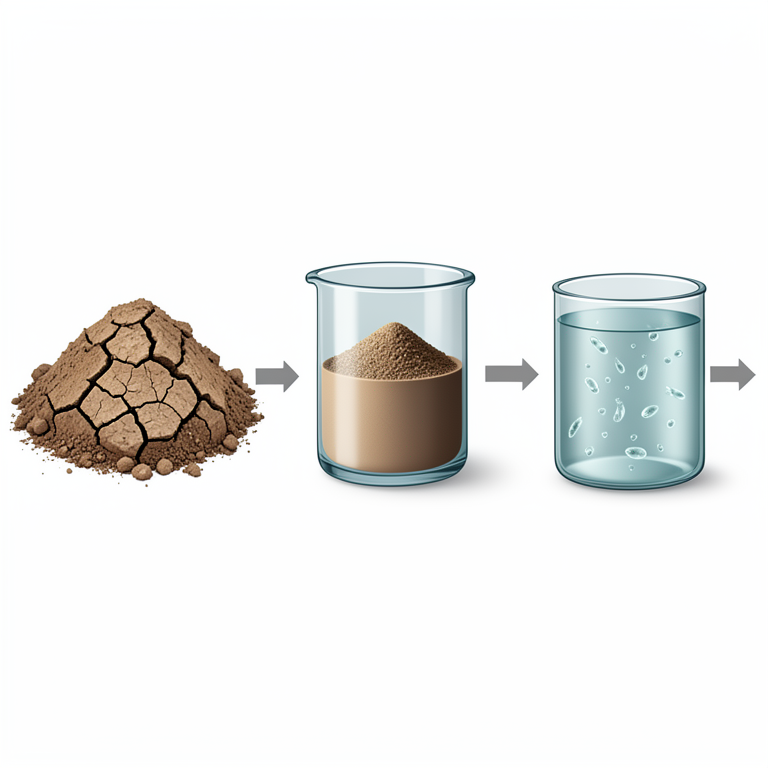
Sediment Rehydration Process
AI-generated conceptual illustration (zooplankton eggs in dry soil sediment). It explains the idea and does not show study data.
View source evidence ↗Introduction
Ephemeral water bodies, derived from the Greek word ephemeras (William, 2006) [9] , are studied using artificial rehydration of dry sediments containing dormant eggs. This method can add data for species missed during field sampling, particularly in variable systems like shallow lakes and ephemeral pools (Waterkeyn et al. 2009) [8] . Banks of resting stages occur in most aquatic environments, particularly in variable systems like shallow lakes and ephemeral pools (de Stasio, 1989) [5] . Combined data from field sampling and rehydration provides better information to check biodiversity of aquatic organisms, including zooplankton. Zooplankton play a crucial role in aquatic systems due to their link between phytoplankton and higher tropic levels. Their composition of proteins, minerals, fatty acids, and lipids provides essential feed for fish. Many zooplankton that might be missed during field sampling can emerge through their resting eggs, which are deposited in sediments. The egg bank can be considered as an archive of local habitat due to changes in species assemblage and genotype from past to present due to natural or anthropogenic activities. A portion of resting eggs sinks to the bottom of the lake, contributing to the buildup of the resting egg bank. In present study, we focused on the soil egg bank diversity and emergence pattern of zooplankton by artificial rehydration of dry sediment.
Methodology
The study site was a temporary pool on Nandur Shingote-Loni state Highway in Maharashtra, India (Lat.19.61 6311^°, Long. 74,422335). Dried sediment was collected on March 25, 2022, from a small pond with a muddy bottom. The habitat lasts 4-5 months from the monsoon and is typically inundated again in the next season.
a) Dry sediment sampling
The study collected dry sediments from various pond sites and soil samples from 1-1.5 cm from the dried surface, as the most viable eggs in sediment cores occur in the upper [2] .
b) Rehydration setup:
The study involved crushing dry sediment into fine powder and rehydrating it using modified SAR'S method. The sediment was rehydrated in dechlorinated aged tap water and observed every 24 hours to check hatching. Water samples were taken from all three beakers, and physicochemical parameters were checked daily. The experiment was terminated after three consecutive days of no further hatching (Bhusnale et al., 2016) [1] . -The body of copepods is year drop shape, contain a thin, almost transparent exoskeleton, and two pair of antennae.
-Copepods lack a circulatory system and gills. Instead, oxygen is absorbed directly via the skin.
Calanoid Copepod
-Calanoids can be distinguished from other copepods by having first antennae at least half length of the body and biramous second antennae. -Gymnoplean tagmosis (boundary between fifth pedigerous somite and genital somite). -However, their most distinctive anatomical trait is the presence of a joint between the fifth and sixth body segments.
-The largest specimens reach 1-8 millimeters (0.71) long, but most do not exceed 0.5-2.0mm (0.02-0.08 in) long.
3.Cypretta (Ostracod Species)
-They are small crustaceans, typically around 1 mm (0.039 in) size, but varying from 0.2to 30mm (0.008to1.18 in) in the case of gigantocypris. -Their bodies are flattened from side to side and protected by a bivalve-like, chitinous or calcareous valve or "shell".
-Ostracods are group together based on gross morphology. -These biological attributes predict them to from successful radiation in these habitats.
4.Heterocypris (Ostracod species)
-They are small crustaceans, typically around 1 mm (0.039 in) size, but varying from 0.2to 30mm (0.008 to1.18 in) in the case of gigantocypris. -Their bodies are flattened from side to side and protected by a bivalve-like, chitinous or calcareous valve or "shell".
-They occur in temporary water bodies and produces drought-resistant egg, mixed/ parthenogenetic reproduction, and the ability to swim. -These biological attributes predict them to from successful rediation in these habitats.
5.Fairy shrimp (nauplii)
-Fairy shrimps are medium sized Branchiopods, usually 0.39 -1.18 in (1.3 cm) long; but a few raptorial species, such as Branchinecta gigas may grow as long as 3.9 in (10cm -The sexes are separate, except in some strains of artemia, which may be parthenogenetic, they swim upside down -Males have modified second antenna that serve to grasp females the antennae may also demonstrate structural complexity.
Triops (nauplii)
-Triops longicaudatus commonly known as a tadpole shrimp because the body superficially resembles a trop larva.
-Triops longicaudatus is a fairly large tadpole shrimp, with a length of 10 to 40 mm long, awidth of 3 to 8 mm and a mass of 2 to 2.59. -The body of T. longicaudatustends to be a brown or grayish yellow colour and is segmented in to a head, thoras and abdomen. -A female keeps her eggs in the egg sac for several hours after fertilization.
7.Brine shrimp (nauplii)
-Brine shrimp in habiting brine pools and other highly saline inland waters throughout the world, they are filter feeder & feed primarily on green algae -Measuring up to 15 mm (0.6 mm) in length, the body of brine shrimp has a discrete head with nauplius (larval) eye and stalked compound eyes, a thorax bearing a series of leaf like limbs, and a slender abdomen without appendages.
-Brine shrimp normally swim in an upside-down position by rhythmically beating their legs. -Young brine shrimp hatched there from dried eggs are used widely as food for fish and other small animals, birds etc.
Rotifer
-Most rotifers are around 0.1-0.5 mm long (although their size can range from 50 um to over 2mm) -They are common in fresh water environments throughout the world with a few salt water species.
-Some rotifers are free swimming and truly planktonic others move by in chworming along a substrate.
-Rotifer are an important part of the freshwater zooplankton being a major food source and with many species also contributing to the decomposition of soil organic matter.
Discussion and Conclusion
In high-altitude lakes, the accumulation of various species, generations, and genotypes in sediments represents a potential biodiversity reserve, and diapausing eggs is an essential survival strategy. From a freshwater pond, eight distinct species were found, including Rotifers, Copepods, Ostracoda, and prawns. The zooplanktons found in freshwater bodies in India offer valuable information about the local ecosystem. Because of changes in species composition and genotype brought about by anthropogenic or natural activity, the eggs bank may be seen of as an archive of the local ecosystem. The huge branchiopods from the temperate zone with a short hydroperiod of 4-5 months are studied in this study to depict their emerging pattern and population dynamics. The research also looks at the hatching dynamics of the nearby temporary body of water, which is in danger from trash. Our initial research in this area on the huge branchiopod emergence pattern serves as a foundation for understanding the hatching dynamics, which will be useful in further research on the rehydration of dry sediments from temperate climates.
References
9 in the original paper- Bhusnale R, Marathe A, Kulkarni A, Padhye S, Pai K. Observations on the hatching dynamics and phenology of co-occurring large branchiopods from a small temporary pool in western India using ex situ sediment rehydration. Ann Limnol Int J Lim. 2016;52:327-33.
- Brendonck L, De Meester L. Egg banks in freshwater zooplankton: evolutionary and ecological archives in the sediment. Hydrobiologia. 2003;491:65-84.
- Brendonck L, Rogers CD, Olesen J, Weeks S, Hoeh WR. Global diversity of large branchiopods (Crustacea: Branchiopoda) in freshwater. Hydrobiologia. 2008;595:167-76.
- De Meester L. Local genetic differentiation and adaptation in freshwater zooplankton populations: patterns and processes. Ecoscience. 1996;3(4):385-99.
- De Stasio BT. The seed bank of a freshwater crustacean: Copepodology for the plant ecologist. Ecology. 1989;70(5):1377-89.
- Gaikwad SR, Ingale KN, Thorat SR. Study of zooplankton emergence pattern and resting egg diversity of recently dried waterbodies in North Maharashtra Region. J Environ Biol. 2008;29(3):353-6.
- Hairston NG Jr, Kearns CM. Temporal dispersal: ecological and evolutionary aspects of zooplankton egg banks and the role of sediment mixing. Integr Comp Biol. 2002;42(3):481-91.
- Waterkeyn A, Grillas P, De Roeck ERM, Boven L, Brendonck L. Assemblage structure and dynamics of large branchiopods in Mediterranean temporary wetlands: patterns and processes. Freshw Biol. 2009;54(7):1256-72.
- Williams DD. The biology of temporary waters. Oxford, UK: Oxford University Press; 2006.