
Research article · 2025 · Full text
International Journal of Biology SciencesStudy of tree flora of Yeola City
Volume 7(6) · Pages 362–364 · DOI: 10.33545/26649926.2025.v7.i6f.399 ↗
Research areasEcology and Conservation Studies
Abstract
Author-writtenThe tree flora of Yeola City plays a vital role in maintaining ecological balance, supporting biodiversity, and enhancing the overall environmental quality of the region. This study focuses on identifying and analyzing the diversity of tree species found in and around Yeola City, considering their distribution, habitat preferences, and ecological significance. Various environmental factors such as climate, soil composition, and water availability significantly influence tree growth and species composition in the area. Additionally, human activities like urbanization, deforestation, and agricultural practices have impacted the natural vegetation, leading to changes in tree diversity. This research highlights the importance of preserving the city’s green cover to ensure sustainable urban development and environmental well-being. Trees contribute to air purification, carbon sequestration, temperature regulation, and provide habitat for various species, making their conservation crucial. The study also emphasizes the need for awareness programs and afforestation initiatives to protect and restore tree flora in Yeola City. By understanding the tree species present and their ecological functions, this research aims to contribute valuable insights toward biodiversity conservation and sustainable environmental planning for the city’s future.
Summary
Source-checkedPlain-language reading of the full paper, prepared with AI and checked against the text. Each point links to the authors' own words.
Why it matters
- The tree flora in Yeola City is essential for maintaining the region's environmental quality, biodiversity, and ecological balance. View evidence ↗
- Conservation of these trees is critical because they provide habitats for species and assist with temperature regulation, carbon sequestration, and air purification. View evidence ↗
- Natural vegetation and tree diversity in the area have been altered by human activities, specifically agricultural practices, deforestation, and urbanization. View evidence ↗
The question
- The study aims to identify and analyze the diversity, ecological significance, habitat preferences, and distribution of tree species in and around Yeola City. View evidence ↗
What they did
- The research methodology involved conducting a survey of the area to list and describe the tree species present. View evidence ↗
- Species identification was performed using library floras and assistance from teachers. View evidence ↗
- The study incorporated ethnobotanical information gathered through interviews with local tribal populations. View evidence ↗
- Soil samples were collected from various regions to analyze parameters such as pH. View evidence ↗
- The findings are based on an intensive six-month exploration of the Yeola area. View evidence ↗
What they found
- The tree flora of Yeola consists of approximately 40 indigenous species distributed across 22 families. View evidence ↗
- The area is dominated by Angiosperm species, while Gymnosperms and Monocots are poorly represented. View evidence ↗
- Many of the trees currently in the area were recently introduced via home gardens, nursery owners, and social forestry. View evidence ↗
- The diversity and number of indigenous trees have decreased due to road expansion and construction clearing. View evidence ↗
- Exotic trees have generally acclimatized well, with some becoming naturalized, which has increased the city's greenery and aesthetic appeal. View evidence ↗
What it means
- The authors suggest that the depletion of indigenous trees is the primary reason for the preference for exotic species. View evidence ↗
- The authors state that the effects of introduced exotic species on the native vegetation are not yet known. View evidence ↗
Visual summary
1 visualsIllustrations explain the paper; they do not show study data.
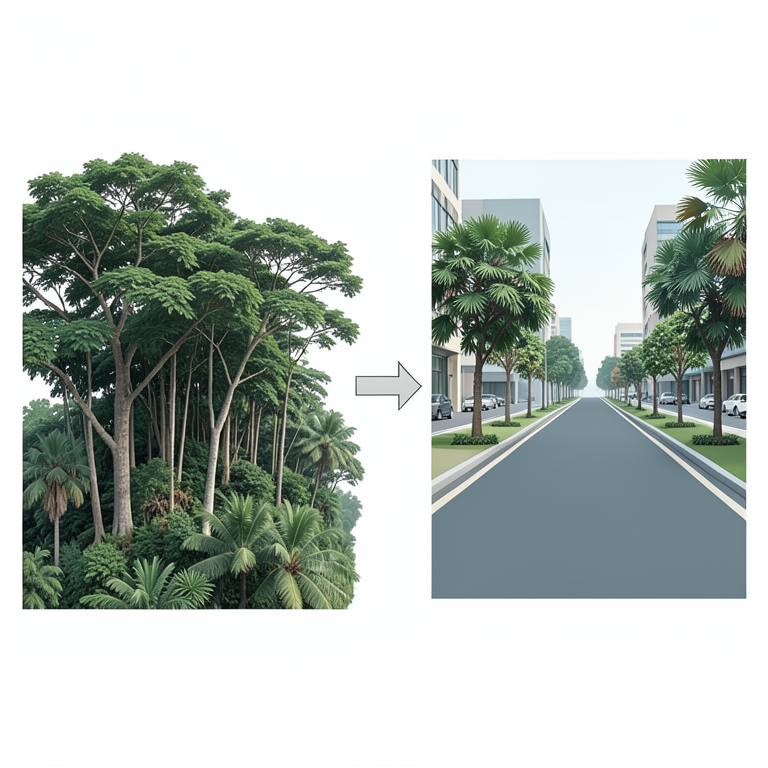
Shift in Urban Flora
AI-generated conceptual illustration (Urban tree flora of Yeola City). It explains the idea and does not show study data.
View source evidence ↗Introduction
Research on the tree flora of specific regions is critical for multiple reasons, particularly in the Indian context. It aids in understanding the biodiversity of the region, supports conservation efforts, and promotes sustainable development that respects both nature and local communities. This is especially true for areas like Yeola in Maharashtra, a town with significant ecological importance due to its unique geography and the role it plays in local biodiversity [1] .
Importance of Yeola for Floristic Study
Yeola, located in the Nashik district of Maharashtra, is an ideal site for floristic studies. Its strategic location near the Western Ghats, one of the world's biodiversity hotspots, makes it significant for understanding the local flora. Moreover, Yeola is surrounded by agricultural fields and scrublands, which are important ecosystems for studying how tree species interact with agriculture and semi-arid environments. Studying Yeola's flora can provide valuable insights into the adaptation of plant species to different altitudinal zones and soil types, as well as the effects of human activities on local ecosystems. This knowledge is crucial for biodiversity conservation and sustainable land management in this part of Maharashtra [2] .
Need for Floristic Study
A floristic study of Yeola is needed for multiple reasons, including conservation of the area's biodiversity and the promotion of sustainable practices that integrate nature with human needs. Given the proximity to the Western Ghats, Yeola's ecosystems may host a variety of tree species that are crucial for soil fertility, water retention, and maintaining the balance of the local climate. Additionally, such a study can help document endemic or rare species that may be vulnerable to climate change or human activities like deforestation 4 and urbanization. Understanding the distribution and composition of these species is vital for ensuring that they are protected and their ecological roles are maintained [3] .
Past Work Done and Gaps in Research
Although floristic studies have been conducted in certain parts of Maharashtra, such as the Western Ghats and Deccan Plateau, less attention has been given to regions like Yeola. Previous studies, such as those by and, have highlighted the importance of understanding species distribution across different altitudinal zones and climatic conditions. However, much of this research has been focused on more prominent regions like the Western Ghats, leaving areas like Yeola under-explored. Future research should focus on documenting the specific tree species of Yeola, analyzing their ecological roles, and assessing how human activities like agriculture and urbanization are impacting local flora [4] .
Common Plants Found in Yeola
Based on existing knowledge of the region, common plant species found in and around Yeola include Azadirachta indica (Neem), Tamarindus indica (Tamarind), Ficus religiosa (Peepal), and Butea monosperma (Flame of the Forest). These species play important roles in maintaining the ecological balance of the region by providing shade, supporting soil fertility, and contributing to water retention in the soil. However, further floristic studies are needed to document the full range of species present in Yeola [5] .
Location of Yeola and Its Surroundings
Yeola is located approximately 83 kilometers from Nashik City, making it easily accessible for research purposes. Geographically, it is well-positioned for floristic studies due to its proximity to different ecosystems [6] . To the east of Yeola lies the town of Kopargaon, situated in a semi-arid region. To the west, the city of Shirdi is located, known for its agricultural lands. To the north, Malegaon, another important agricultural town, is located, while to the south lies Ahmednagar, which has a more urbanized landscape [7] . This diverse geographical setting makes Yeola an ideal region for studying the interactions between different ecosystems and human activities. Understanding the distribution of tree species across these varied landscapes can provide valuable insights into how flora adapts to different environmental condition [8] .
Materials and Methods
A survey of the area will be made. At the same time tree species plants will be made. All the tree species will be listed and will be described. The identification of the species will be done with the help of floras available in the library. Help of teachers also will be sought for identification. Some rare and endangered species will be photographers. During visits to these stations interviewing local tribal peoples will collect some ethnobotanical information. Ethanobotonical aspects will also be represented in the present project. Soils samples from different regions will also be collected during visits. Some parameters of soil like pH will also be passed Methodology Location: Yeola Yeola is a city located in the Nashik district of Maharashtra, India. Geographically, it lies at a latitude of approximately 20.0426° N and a longitude of 74.4892° E, with an average elevation of 583 meters (1,913 feet) above sea level. The city is situated in the northern part of Maharashtra and is well-connected to major cities like Nashik and Aurangabad by road and rail. Yeola has a predominantly semi-arid climate, with hot summers, moderate winters, and a monsoon season that provides the bulk of its annual rainfall. The region around Yeola is characterized by its dry, flat plains and some rocky terrain, interspersed with grasslands and agricultural fields. Agriculture is the mainstay of the local economy, with crops such as cotton, millet, and onions being widely grown. The city is also famous for its traditional Paithani silk saree weaving industry, which has historical and cultural significance. Water resources in the area are largely dependent on seasonal rainfall, and irrigation plays a vital role in supporting local agriculture
Conclusion
The work embodied in this dissertation is the result of sixmonth intensive exploration of the areas indicated in the map of yeola. The tree cover is fairly good representing various tree species. The tree flora comprises various Angiosperms species whereas the Monocots and gymnosperm species are poor in their numbers. The plants were identified using standard floras Each taxon was described briefly with special reference to morphological characters. A brief informative note on economic importance, local name of the taxon Most of them are recently introduced in the area by the social forestry; different nursery owners and personal introduction by the people in their home garden. On the other hand, many indigenous trees have been cut off for expansion of roads clearing for constructional work etc. This has resulted in depletion of the number of the indigenous trees and their diversity. In our opinion, this is the main reason to prefer exotic trees over the indigenous ones. Most of the exotic trees have been acclimatized well and few have been naturalized in the area. They have increased the greenery and beauty of the city. The effects of the new introduction over a native beauty of the city. We do not know the effects of the new introduction over native vegetation yet. However, it is felt that this hetero culture should provide a better association with the native vegetation. The data presented in this work are original and firsthand It is hoped that it will be helpful in the preparation of the tree flora of yeola. The tree flora comprises at about 40 species these are all indigenous and spread over 22 families
References
43 in the original paper- Singh JS, Singh SP. Tree flora of the Himalayan region. Himalayan Ecol Conserv J. 1992.
- Parthasarathy N. Tree species diversity in the Eastern Ghats. Indian For Ecol J. 1999.
- Ghate U, Ranganathan P. Tree flora of Maharashtra. J Indian Biodivers Stud. 1998.
- Kulkarni V, Narayan R. Floristic studies in the Western Ghats. Bot J India. 2013.
- Joshi V, Janarthanam M. Altitude and tree species distribution in Maharashtra. Indian Ecol Res. 2004.
- Deshmukh M, Rathod G. Ecological functions of native trees. Agric Sci J. 2008.
- Pawar S, Patil P, Thorat V. Impacts of urbanization on tree flora in Maharashtra. Ecol Res Bull. 2015.
- Wikipedia contributors. Yeola. Wikipedia, The Free Encyclopedia. 2023. Available from: https://en.wikipedia.org/wiki/Yeola
- Sharma GN, Dubey SK, Sharma P, Sati N. Medicinal values of Aegle marmelos (L.) Corr. 2011.
- Dasaroju S, Gottumukkala KM. Current trends in the research of Emblica officinalis (Amla). 2014.
- Jaiarj P, Khoohaswan P, Wongkrajang Y, Peungvicha P, Suriyawong P, Saraya MLS, Ruangsomboon O. Anticough and antimicrobial activities of Psidium guajava Linn. leaf extract. 1999.
- Kalantri M, Aher AN. Traditional medicinal plant: Plumeria rubra. 2016.
- Pathak K, Zaman K. Medicinally important plant - Annona reticulata Linn. 2016.
- Ahmed F, Urooj A. Traditional uses, medicinal properties, and phytopharmacology of Ficus racemosa. 2010.
- Vij T, Prashar Y. Medicinal properties of Carica papaya Linn. 2015.
- Mohale DS, Dewani AP, Chandewar AV, Khadse CD, Tripathi AS, Agrawal SS. Medicinal potential of Terminalia catappa. 2008.
- Salem MZM, Abdel-Megeed A, Ali HM. Stem wood and bark extracts of Delonix regia (Boj. ex Hook): Chemical analysis and antibacterial, antifungal, and antioxidant properties. 2005.
- Imrana M, Asif M. Morphological, ethnobotanical, pharmacognostical and pharmacological studies on the medicinal plant Plumeria alba Linn. (Apocynaceae). 2020.
- Shelton HM, Brewbaker JL. Leucaena leucocephala - the most widely used forage tree legume. 1999.
- Patia PK, Cannoo DS. Evaluation of volatile compounds, phenolic acids, antioxidant potential and DFT study of essential oils from different parts of Araucaria columnaris (G. Forst.) Hook. from India. 2020.
- Dhanavade MJ, Jalkute CB, Ghosh JS, Sonawane KD. Study of antimicrobial activity of lemon (Citrus lemon L.). 2011.
- Prashanth D, Asha MK, Amit A. Antibacterial activity of Punica granatum. Fitoterapia. 2001.
- Singh D, Singh B, Goel RK. Traditional uses, phytochemistry and pharmacology of Ficus religiosa. J Ethnopharmacol. 2011.
- Handral HK, Pandith A, et al. Murraya koenigii multipotential medicinal plant. Asian J. 2012.
- Yong JWH, Ge L, Ng YF, Tan SN. The chemical composition and biological properties of coconut (Cocos nucifera L.). Molecules. 2009.
- Pandey N, Barve D. Phytochemical and pharmacological review on Annona squamosa Linn. 2011.
- Singh S, Krishna THA, Kamalraj S, Kuriakose GC, Valayil JM, Jayabaskaran C. Phytomedicinal importance of Saraca asoca (Ashoka). 2015.
- Stearn WT. Union of Chionanthus and Linociera (Oleaceae). 1976.
- Biswas K, Chattopadhyay I, Banerjee RK, et al. Biological activities and medicinal properties of neem (Azadirachta indica). Curr Sci. 2002.
- Akumavat R, Sharma S, Kumar S. Various aspects of plants. 2012.
- Gopalakrishnan L, Doriya K, Kumar DS. Moringa oleifera: A review on nutritive importance and its medicinal application. 2016.
- Mahajan RT, Chopda MZ. Phyto-pharmacology of Ziziphus jujuba Mill -A plant review. 2009.
- Gopukumar ST, Praseetha PK. Ficus benghalensis Linn -The sacred Indian medicinal tree with potent pharmacological remedies. 2015.
- Ramya S, Neethirajan K, Jayakumararaj R. Bioactive compounds in Syzygium cumini -A review. 2012.
- Chandel M, Sharma U, Kumar N, Singh B, Kaur S. Antioxidant activity and identification of bioactive compounds from leaves of Anthocephalus cadamba by UPLC/ESI-QTOF-MS. 2012.
- Gupta M. Pharmacological properties, pharmacognosy and therapeutic actions of Putranjiva roxburghii Wall. (Putranjiva). 2016.
- Shaheen M, Mostafa S, El-Esnawy N. Anti-rotaviral effects of Calliandra haematocephala leaf extracts invitro and in-vivo. 2015.
- Wahab R, Mustapa MT, Sulaiman O, Mohamed A, Hasankhalid A. Anatomical and physical properties of cultivated two-and four-year-old Bambusa vulgaris. 2010.
- Kamagaté M, Koffi C, Kouamé NM, Akoubet A, Yao NAR, Die-Kakou HM. Ethnobotany, phytochemistry, pharmacology and toxicology profiles of Cassia siamea Lam. 2014.
- Gribel R, Gibbs PE, Queiróz AL. Flowering phenology and pollination biology of Ceiba pentandra (Bombacaceae) in Central Amazonia. 1999.
- Nainwal P, Nanda D, Batsa R. Alstonia scholaris: Its phytochemistry and pharmacology; Caesalpinia pulcherrima. 2011.
- Rumzhum NN, Rahman MM, Kazal MK. Antioxidant and cytotoxic potential of methanol extract of Tabernaemontana divaricata leaves. 2012.
- Pino JA, Mesa J, Muñoz Y, Martí MP, Marbot R. Volatile components from mango (Mangifera indica L.) cultivars. 2005.