
Research article · 2025 · Full text
International Journal of Biology SciencesPollen morphology analysis Khandesh region, India: A scientific investigation
Volume 7(6) · Pages 183–187 · DOI: 10.33545/26649926.2025.v7.i6c.375 ↗
Research areasGenetic diversity and population structurePlant Ecology and Soil ScienceAnimal Ecology and Behavior Studies
Abstract
Author-writtenThe evolutionary relationships, taxonomy, and reproductive techniques of flowering plants can be gleaned from pollen morphology. This study aims to clarify the structural diversity and possible evolutionary implications of the pollen morphology of some polypetalous taxa. We examined pollen grains from representative species in several families. Using simple mounting, acetolysis and permanent slides preparation, cutting-edge microscopic techniques, noting differences in size, shape, aperture type, and exine ornamentation. The results further our knowledge of the taxonomic and evolutionary importance of pollen features in plants that are polypetalous.
Summary
Source-checkedPlain-language reading of the full paper, prepared with AI and checked against the text. Each point links to the authors' own words.
Why it matters
- Pollen morphology is a valuable tool for understanding the taxonomy, reproductive methods, and evolutionary relationships of flowering plants. View evidence ↗
- Pollen grains are useful for research because they are resistant to deterioration, preserving information about the parent plant. View evidence ↗
- Detailed morphological data on pollen can support conservation efforts by enabling the accurate identification of rare or endangered species. View evidence ↗
The question
- The study aims to investigate the structural diversity of pollen in polypetalous taxa and explore the resulting evolutionary implications. View evidence ↗
What they did
- The researchers sampled polypetalous species from the Rosaceae, Fabaceae, and Malvaceae families. View evidence ↗
- Light microscopy (LM) was used to observe basic structural traits such as overall shape, size, and appearance. View evidence ↗
- Scanning electron microscopy (SEM) was used to provide high-resolution images of surface features like spines, ridges, and pores. View evidence ↗
- Transmission electron microscopy (TEM) was used to examine internal cellular architecture, including organelles and pollen wall layering. View evidence ↗
- The researchers used Erdtman's acetolysis method to remove organic material and improve the visibility of the pollen's structural features. View evidence ↗
What they found
- The studied polypetalous taxa exhibited a wide range of pollen sizes and shapes, including spherical, prolate, and oblate forms. View evidence ↗
- The researchers identified various aperture types among the taxa, specifically colpate, porate, and colporate grains. View evidence ↗
- Pollen from the Rosaceae family was typically medium-sized and tricolporate with coarsely reticulate exine ornamentation. View evidence ↗
- Fabaceae pollen was characterized as large, prolate to spherical, and predominantly colporate with intricate reticulate patterns. View evidence ↗
- Malvaceae pollen was often small to medium-sized and porate, featuring distinct echinate ornamentation. View evidence ↗
- Significant variation in surface patterns (reticulate, echinate, and striate) was observed even within a single plant family. View evidence ↗
What it means
- The authors conclude that the diversity in pollen morphology among polypetalous taxa reflects adaptations to different pollination methods and ecological niches. View evidence ↗
- The authors state that combining morphological pollen data with molecular DNA analysis creates more robust phylogenetic reconstructions. View evidence ↗
- The authors suggest that future research should focus on further integrating morphological data with genomic data to better understand the evolutionary history of flowering plants. View evidence ↗
Visual summary
1 visualsIllustrations explain the paper; they do not show study data.
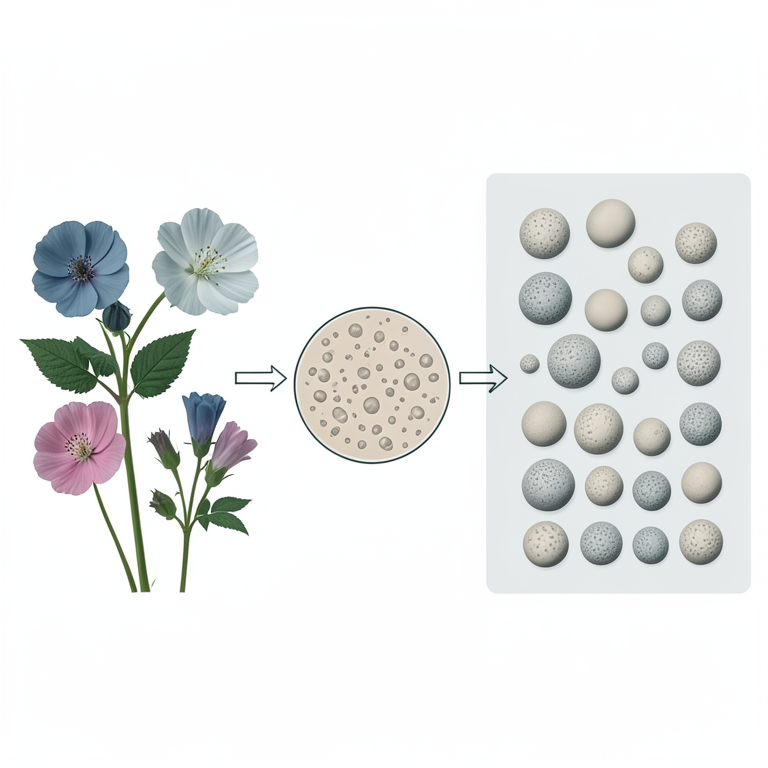
Study overview
AI-generated conceptual illustration (Pollen grains from Rosaceae, Fabaceae, and Malvaceae flowers). It explains the idea and does not show study data.
View source evidence ↗Introduction
The floral morphology of polypetalous taxa, which are identified by their distinct and independent petals, is remarkably diverse. Researchers in plant systematics and evolution find pollen morphology particularly fascinating. Because pollen grains are resistant to deterioration, they provide a wealth of information about the plants that produce them. Examining traits like exine ornamentation, aperture type, size, and shape might help us distinguish between species and comprehend their evolutionary links. The goal of this study is to thoroughly examine pollen properties in a variety of polypetalous species. By studying the ornamentation and the dimensions, forms, and aperture kinds of pollen grains, we aim to obtain important information that will improve categorization schemes and clarify evolutionary patterns. The process entails gathering pollen samples from a variety of polypetalous taxa and closely examining their morphology using light and electron microscopy. Advanced imaging software will be used to measure and analyze these traits. This study holds importance as it may contribute to the development of more precise classification criteria for polypetalous taxa exhibiting complex pollen morphology. Additionally, identifying physical traits tied to specific historical lineages can greatly enhance our understanding of evolutionary history and species interactions. This research underpins conservation initiatives by supplying comprehensive morphological data essential for the accurate identification and effective preservation of rare or endangered taxa. The expected outcomes include the creation of more precise taxonomic keys based on pollen morphology, improved understanding of the evolutionary history and relationships among polypetalous taxa. By addressing existing knowledge gaps in the pollen morphology of polypetalous plants, this study seeks to advance the broader disciplines of plant systematics and evolutionary biology. Furthermore, it establishes a robust foundation of pollen morphological characteristics for future research and taxonomic reference.
species. This two-pronged strategy guaranteed the inclusion of naturally occurring varieties from their native locations in addition to giving access to a controlled array of specimens from botanical gardens. This study included species representing several prominent families exhibiting polypetalous characteristics, notably Rosaceae, Fabaceae, and Malvaceae. Within Rosaceae, specimens were sampled from diverse taxa such as Rosa and Fragaria, both recognized for their distinctive petal morphologies and considerable horticultural importance. Lupinus and Trifolium, two economically and ecologically significant legume species, were chosen to highlight the variety of floral forms found in the Fabaceae family. The selection of the Malvaceae family, which includes species like as Hibiscus and Malva, was based on its huge and frequently ostentatious flowers, which offer an abundant supply of pollen for morphological research. The aim of this diverse selection process was to capture a broad spectrum of pollen morphological characteristics across different ecological and evolutionary contexts. The species were carefully chosen and gathered from a variety of settings in order to provide a solid dataset for assessing pollen features and to ensure that the study covers a wide range of morphological differences. This comprehensive approach ensures that the results are broadly applicable across numerous polypetalous taxa and enhances the reliability of the findings. Detailed analyses of pollen morphology in various polypetalous species were conducted using multiple microscopy techniques. Each method gave distinct insights into various facets of pollen structure, enabling a thorough comprehension of their properties.
Light Microscopy (LM)
Light microscopy served as the primary technique for observing the fundamental structural characteristics of pollen grains. This method enabled the examination of overall morphology, including shape, size, and general appearance, at lower magnifications. Pollen samples from various species within families such as Rosaceae, Fabaceae, and Malvaceae were analyzed using conventional light microscopes. LM facilitated an initial understanding of pollen morphology and allowed for the preliminary classification of pollen grains based on their external features.
Scanning Electron Microscopy (SEM)
Scanning electron microscopy (SEM) was employed to investigate the surface ultrastructure and exine ornamentation of pollen grains with high resolution. By directing a focused electron beam across the surface of specimens, SEM generated detailed images that revealed fine-scale features such as ridges, spines, and pores. This technique was instrumental in characterizing speciesspecific surface patterns that are critical for differentiating closely related taxa. SEM provided comprehensive visualizations of the external morphology of pollen grains from all studied families, enabling more precise taxonomic comparisons.
Transmission Electron Microscopy (TEM)
Transmission electron microscopy (TEM) was employed to explore the ultrastructural features of pollen grains with high resolution. Utilizing thin sections of the specimens and a focused electron beam, TEM generated highly detailed images of internal cellular architecture. This technique enabled visualization of intracellular components, including organelles such as mitochondria and plastids, as well as detailed layering of the pollen wall and cytoplasmic structures. TEM proved particularly valuable in revealing ultrastructural features that are not discernible with light microscopy or SEM. The internal morphological insights obtained through TEM complemented the surface data provided by SEM, collectively offering a comprehensive understanding of pollen grain morphology across the studied families. This study achieved a comprehensive evaluation of pollen morphology across multiple polypetalous taxa by integrating three complementary imaging techniques: light microscopy (LM) for assessing fundamental morphological traits, scanning electron microscopy (SEM) for detailed surface architecture, and transmission electron microscopy (TEM) for ultrastructural analysis. The combination of these methods enabled a multidimensional understanding of pollen characteristics, thereby enhancing insights into evolutionary relationships among plant taxa and refining existing classification frameworks. Pollen preparation was carried out using Erdtman's acetolysis method, a well-established protocol that effectively removes organic material from pollen grains, thereby enhancing the visibility of structural features. Fresh pollen samples were meticulously collected from a diverse array of polypetalous species to ensure adequate representation of families such as Rosaceae, Fabaceae, and Malvaceae at the initial stage of analysis. The collected pollen grains underwent the acetolysis process using a solution of sulfuric acid. This chemical treatment selectively preserves the resistant exine while removing organic components of the pollen wall, including sporopollenin. The removal of these materials enhances the visibility of structural features, facilitating more accurate morphological analysis. Following acetolysis, the pollen grains were thoroughly washed and purified to eliminate residual debris and contaminants. The cleaned specimens were then mounted onto stubs or specimen holders using appropriate adhesives. Prior to electron microscopy, the mounted samples were gold-coated using techniques such as sputter coating. This conductive coating enhances the imaging quality and resolution in scanning electron microscopy by improving the electron conductivity of the pollen grain surfaces. The gold-coated pollen samples were placed in the chamber of the scanning electron microscope (SEM) and exposed to a focused electron beam for surface imaging. SEM, operating at high magnifications, enabled detailed examination of the external morphology of pollen grains, including exine ornamentation, sculpturing patterns, and aperture types. This technique provided critical data for identifying and comparing species-specific features across different polypetalous families. Simultaneously, the internal ultrastructure of pollen grains was investigated using transmission electron microscopy (TEM). Acetolyzed pollen samples were sectioned into ultrathin slices and examined with TEM, which utilizes transmitted electrons to generate high-resolution images of internal structures. This analysis revealed detailed information on organelle organization, cytoplasmic contents, and the multilayered architecture of the pollen wall, offering deeper insight into pollen morphology beyond external characteristics. Through the integration of Erdtman's acetolysis method with both scanning and transmission electron microscopy (SEM and TEM), this study ensured meticulous preparation and in-depth analysis of pollen grains from diverse polypetalous taxa. The detailed structural data generated through these techniques played a pivotal role in clarifying evolutionary relationships among the investigated plant families and in enhancing existing taxonomic classification systems.
Results
Results
Figures: Light microscopy
Figures: Light microscopy
Morphological Features
The polypetalous taxa under investigation showed significant variation in pollen shape, according to the study. Important conclusions consist of: 1. Pollen grains ranged in size from tiny to large, and their morphologies included spherical, prolate, and oblate.
Aperture Types:
The taxa showed a variety of aperture types, such as pollen grains that are colpate, porate, and colporate.
Exine Ornamentation:
Variations were notable even within a single family, with surface patterns ranging from reticulate to echinate and striate.
• Rosaceae:
Typically produced medium-sized, tricolporate pollen grains with coarsely reticulate exine ornamentation.
• Fabaceae: Characterized by large, prolate to spherical pollen grains, predominantly colporate, with intricate reticulate surface patterns. • Malvaceae: Often bore small to medium-sized, porate pollen grains with distinct echinate ornamentation.
Discussion
Pollen grains from polypetalous taxa exhibit morphological variation, which is indicative of their adaptive evolution and ecological interactions. Variations in pollen morphology within families like Rosaceae, Fabaceae, and Malvaceae are indicative of adaptations to various environmental factors and pollination techniques. Aperture variation is a critical component of pollen morphology and is closely related to pollen dispersal mechanisms. The way that pollen grains release their male gametes during pollination is influenced by the sorts of apertures, such as furrows, pores, and colpi.
In contrast to species with porate pollen, which may specialize in self-pollination or certain insect interactions, species with colpate pollen may depend on wind or insect pollinators. The tactics that polypetalous taxa have evolved to optimize reproductive success in a variety of environments are exemplified by these adaptations. Furthermore, a major factor in pollen-pistil interactions is the exine patterns on pollen grains. The exine, which is made up of sporopollenin, shields the pollen grain and has sculpturing unique to its species, which can affect the success of fertilization and pollination efficiency. Reticulate, striate, and verrucate structures are examples of ornamentation patterns that are frequently modified to draw particular pollinators or promote pollen adherence to stigmas. This adaptation highlights the complex coevolutionary connections that exist between pollinators and plants, whereby little changes in pollen morphology can improve compatibility and transmission of pollen, hence increasing reproductive fitness.
In addition to demonstrating the intricacy of evolutionary paths, the observed variations in pollen shape between families further bolster the usefulness of pollen features in taxonomic classification. Evolutionary links and phylogenetic trends within and between plant groups can be identified by researchers by analyzing pollen features like as size, shape, aperture type, and exine ornamentation. These characteristics are useful diagnostic tools that support conventional morphological and molecular methods in the precise identification and classification of plant species. In summary, polypetalous taxa's varied pollen shape is a reflection of their adaptive adaptations to various ecological niches and pollination techniques. Understanding pollen dispersal mechanisms and reproductive interactions with pollinators requires an understanding of aperture changes and exine patterns. In addition to enhancing our knowledge of plant history, research on pollen attributes highlights the importance of these features in determining biodiversity and ecological interactions within natural ecosystems.
Phylogenetic Implications
The varied pollen traits found in several polypetalous taxonomic families imply that a complex interaction between ecological and reproductive factors generated evolutionary divergence. Pollen morphology is an important indicator of evolutionary history because it shows how different plant lineages have adapted to different conditions and used different pollination techniques. Differences in pollen size, shape, aperture type, and exine ornamentation are found in families such as Rosaceae, Fabaceae, and Malvaceae. These differences highlight the adaptations of these organisms to certain pollination vectors and environmental conditions. Families including windpollinated species, for example, frequently have small, smooth pollen grains with straightforward aperture types, which maximize long-distance dissemination. Families that depend on animal pollinators, on the other hand, might have larger, more intricate pollen grains with intricate sculpturing patterns that improve adherence to insect bodies or make it easier for particular pollinator species to recognize them. Molecular data combined with pollen morphology in phylogenetic analysis provide a strong foundation for understanding the evolution of angiosperms. Researchers can resolve taxonomic difficulties, reconstruct evolutionary relationships, and clarify phylogenetic affinities by integrating genetic markers with physical properties, such as pollen characteristics. In addition to improving phylogenetic reconstruction accuracy, this multidisciplinary method sheds light on the evolutionary mechanisms that have shaped plant variety over geological timeframes.
Pollen morphology can also be used to uncover patterns of convergent evolution, in which closely related taxa may independently evolve similar pollen features in response to comparable ecological stressors. On the other hand, phylogenetic analysis can also reveal examples of evolutionary conservatism, in which environmental heterogeneity does not affect the conservation of specific pollen features across closely related species. The many pollen traits found in various polypetalous taxa's families are indicative of their evolutionary divergence, which has been shaped by ecological interactions and reproductive tactics. A potent method for resolving the complexity of angiosperm evolution is to combine molecular phylogenetic analysis with pollen morphology. This approach allows for a greater understanding of how plants have varied and adapted in response to their habitats and interactions with pollinators. In addition to expanding our understanding of plant evolutionary biology, this allencompassing method helps guide conservation initiatives and sustainable management strategies in an ever-evolving global environment.
Conclusion
This work emphasizes how important pollen morphology is to improving our knowledge of taxonomy and the dynamics of evolution in polypetalous taxa. In addition to being used to identify species, pollen grains can reveal details about the relationships and wider evolutionary patterns among different plant lineages. A multitude of structural diversity is available in pollen morphology, which can be methodically examined to clarify evolutionary relationships. distinct families, including Rosaceae, Fabaceae, and Malvaceae, have distinct adaptations to diverse pollination tactics and environmental conditions, which are reflected in variations in size, shape, aperture type, and exine decoration. For example, certain pollen characteristics like as reticulate sculpturing or colpi can reveal evolutionary difference within and between different families, or suggest phylogenetic connections.
Comprehensive information on the morphology of pollen grains at various scales can be obtained by carefully examining them using methods like light microscopy, transmission electron microscopy (TEM), and scanning electron microscopy (SEM). While scanning electron microscopy (SEM) provides high-resolution imaging of surface features such as exine ornamentation, light microscopy enables preliminary observations of overall pollen structure and morphology. In contrast, transmission electron microscopy (TEM) offers valuable insights into the internal cellular structures and organelles of pollen grains, which are crucial to their functional biology. When pollen morphology is combined with molecular data, like DNA sequence analyses, phylogenetic reconstructions become more robust. Researchers can obtain more precise and thorough phylogenies, resolving taxonomic problems and painting a clearer picture of the evolutionary relationships among polypetalous taxa, by integrating morphological features with genetic markers. This multidisciplinary method exposes evolutionary trends including convergent evolution and evolutionary conservatism in addition to confirming the phylogenetic significance of pollen characteristics.
To gain a better knowledge of the complex evolutionary history of flowering plants, future research endeavors ought to concentrate on the additional integration of morphological and genomic data. Technological developments in genomics and bioinformatics provide hitherto unseen possibilities for investigating the genetic foundation of pollen morphology and its evolutionary consequences. We can learn a great deal about speciation events, adaptive strategies, and the ecological interactions that have influenced plant variety by explaining how pollen features have changed and diversified over time.
Finally, research on pollen morphology is essential to understanding both taxonomy and the evolutionary history of polypetalous taxa. In addition to improving our capacity to categorize and identify species, a thorough analysis of it deepens our understanding of their evolutionary paths and ecological adaptations. Researchers can better understand the intricate evolutionary history of flowering plants and
International Journal of Biology Sciences https://www.biologyjournal.net make significant contributions to the fields of conservation biology and biodiversity science by integrating morphological and genomic approaches going forward.
References
12 in the original paper- Erdtman G. Pollen morphology and plant taxonomy: Angiosperms. Stockholm: Almqvist & Wiksell; 1952.
- Hesse M, Halbritter H, Zetter R, Weber M, Buchner R, Frosch-Radivo A, et al. Pollen terminology: An illustrated handbook. Vienna: Springer; 2009.
- Faegri K, Iversen J. Textbook of pollen analysis. 4th ed. Chichester: John Wiley & Sons; 1989.
- Patil DA. Flora of Dhule & Nandurbar districts: Maharashtra. Dehradun: Bishen Singh Mahendra Pal Singh; 2003.
- Kshirsagar SR, Patil DA. Flora of Jalgaon District Maharashtra. 1 st ed. Dehradun: Bishen Singh Mahendra Pal Singh; 2008.
- Buchner R. Pollen morphology and plant phylogeny: I. Early and primitive monocotyledons. Plant Syst Evol. 1990;171(1-4):67-91.
- Gottsberger G, Silberbauer-Gottsberger I. Evolution of pollination systems in Old World Salvia (Lamiaceae): Ecological correlates of pollination ecology. Mem N Y Bot Gard. 2006;97:116-26.
- Williams JH, Friedman WE. The four-celled pollen of wind-pollinated anthophytes: A basal anatomical trait with convergent evolutionary development. Evolution. 2004;58(6):1159-69.
- Kshirsagar SR. Role of pollen morphology in taxonomy and detection of adulteration in crude drugs. J Plant Sci Phytopathol. 2020;4:24-7.
- Jabbour F, Gaudeul M, Lambourdière J, Nadot S. Internal transcribed spacer (ITS) variation in the Andropogon gerardii complex (Poaceae): Patterns and implications. In: Barker MS, Kane MA, editors. Pollen structure and function: Contributions from plant systematics. Cham: Springer International Publishing; 2014. p. 55-72.
- Ren ZX, Manchester SR. Fruits and seeds of the Middle Eocene Nut Beds flora, Clarno Formation, Oregon. Palaeontogr Am. 2010;64:353-415.
- Stevens PF. Angiosperm Phylogeny Website. Version 14, July 2017 [and more or less continuously updated since]. http://www.mobot.org/MOBOT/research/APweb/