
Research article · 2025 · Full text
International Journal of Biology SciencesPhytochemical screening of Enicostemma littorale plant from Washim district of Maharashtra state
Volume 7(6) · Pages 230–232 · DOI: 10.33545/26649926.2025.v7.i6d.381 ↗
Research areasPhytochemistry and Bioactive CompoundsPhytochemistry and Biological ActivitiesEssential Oils and Antimicrobial Activity
Abstract
Author-writtenThe phytochemical screening of plants plays a commercial role and has great interest in pharmaceutical companies for the manufacture of the new drugs to treat various diseases. The present research work is conducted to search the qualitative analysis of the plant material of Enicostemma littorale. Qualitative phytochemical evaluation was carried out to test the presence of alkaloids, Terpenoids, flavonoids, carbohydrates, tannin, saponin, amino acid, glycoside and phenol in the methanol, petroleum ether and acetone extracts of plant material using Soxhlet extraction methods. The present effort is targeted at the evaluation of the phytochemicals present in the plant species.
Summary
Source-checkedPlain-language reading of the full paper, prepared with AI and checked against the text. Each point links to the authors' own words.
Why it matters
- Phytochemical screening is commercially important for pharmaceutical companies seeking to develop new drugs for various diseases. View evidence ↗
- Naturally occurring phytochemicals are used to treat conditions like cancer, arthritis, and asthma, and are noted for lacking the side effects associated with synthetic pharmaceutical chemicals. View evidence ↗
- Enicostemma littorale is traditionally used in Ayurveda as a laxative, stomachic, and treatment for fever, diabetes, and parasitic worms. View evidence ↗
The question
- The study aimed to perform a qualitative phytochemical analysis of the plant material from Enicostemma littorale. View evidence ↗
What they did
- Plant samples were collected from the Panghrikute and Hiwara rural areas of the Washim district in Maharashtra, India. View evidence ↗
- The plant material was washed 2-3 times, shade-dried for 18 days, and then ground into a fine powder. View evidence ↗
- Five grams of the powdered plant material were extracted using a Soxhlet extractor with different solvents. View evidence ↗
- The researchers tested methanol, petroleum ether, and acetone extracts for the presence of nine secondary metabolites, including alkaloids, saponins, and phenols. View evidence ↗
What they found
- In the leaf, the methanol extract tested positive only for saponins and phenol. View evidence ↗
- The petroleum ether extract of the leaf tested positive for alkaloids and saponins, but negative for all other tested metabolites. View evidence ↗
- The acetone extract of the leaf tested positive for saponins and phenol. View evidence ↗
- The methanol extract of the stem tested positive for alkaloids, tannin, and saponins. View evidence ↗
- The petroleum ether extract of the stem tested positive for alkaloids and saponins. View evidence ↗
- The acetone extract of the stem tested positive for alkaloids, tannin, and saponins. View evidence ↗
What it means
- The authors conclude that Enicostemma littorale is a promising source for the development of useful drugs due to its medicinally important constituents. View evidence ↗
- The authors state that future research is needed to isolate, purify, and characterize the specific active constituents of the plant. View evidence ↗
Visual summary
1 visualsIllustrations explain the paper; they do not show study data.
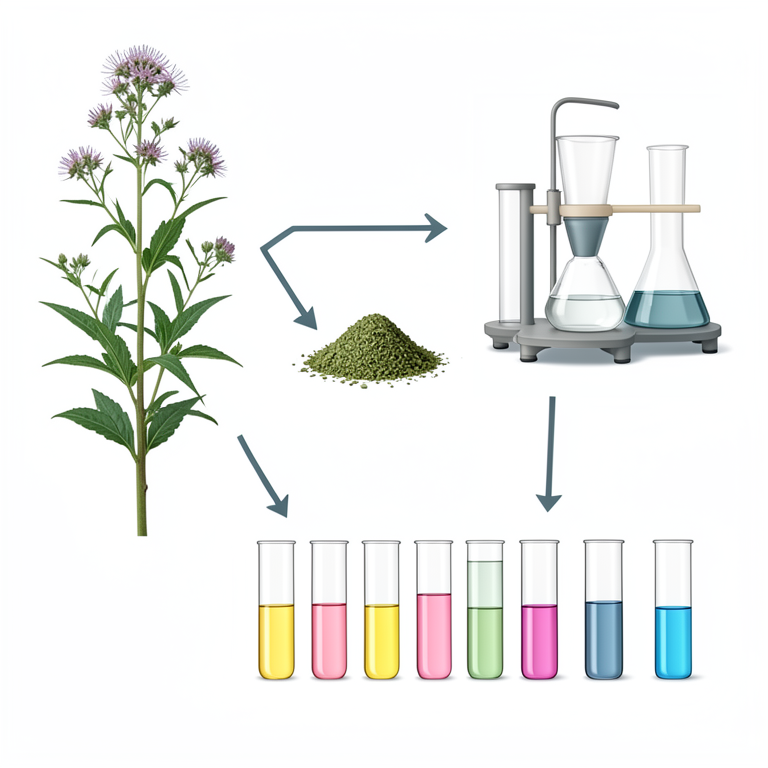
Phytochemical Analysis Workflow
AI-generated conceptual illustration (Enicostemma littorale plant). It explains the idea and does not show study data.
View source evidence ↗Introduction
Phytochemicals are the chemicals that are present naturally in plants. Nowadays these phytochemicals become more popular due to their countless uses, Phytochemicals play a vital role against several diseases such as asthma, arthritis, cancer etc. Unlike pharmaceutical chemicals, these phytochemicals do not have any side effects. Since the phytochemicals cure diseases without causing any harm to human beings these can also be considered as medicine (K. Sahirabanu and L. Catherine, 2015) [6] . Plant products have been part of phytomedicines since time immemorial. This can be derived from barks, leaves, flowers, roots, fruit and seeds. Medicinal plants which from the backbone of traditional medicine have in the last few decades been the subject of very intense pharmacological studies (Hasler and Blumberg, 1999.) [7] In the present work, of phytochemical analysis was carried out in plants Enicostemma littorale Blume. Enicostemma littorale Blume is herbaceous and perennial herb 10-15 cm high. It is branched from the base with erect stems. Leaves are sessile and can be linear or linear-oblong (Abirami, 2004). Flowers are white in whorled axillary clusters and are sessile. The fruits are capsule, one-celled with many small, pale, ridged ovate seeds. Ayurveda describes the plant as stomachic and laxative. The plant is very bitter. It can be used as an anthelmintic and it cures fever (Sarvanan et al., 2012) [8] . It is traditionally used as antidiabetic due to the presence of C-glycosyl flavonoids. It is also used as a urinary astringent, antiperiodic, anthelmintic, anti-inflammatory, antioxidant, antimicrobial, antiedematologinic, antitumor activities, laxative and carminative. Animal experiments of E. littorale Blume reported its hypoglycaemic activity (Jaishree and Badami, 2010) [9] .
Materials and Methods
Materials and Methods
Collection of plant material
Fresh plant material of Enicostemma littorale Blume is collected from rural areas of Washim districts like Panghrikute and Hiwara Maharashtra, India respectively. The plant species Enicostemma littorale Blume commonly occurs in non-cultivated land, along with the roadside. Shady moist place plant material washed under tap water 2-3 times to remove soil particles and dust the plant material was shaded for 18 days. After drying plant material is ground into a fine powder and then transferred into an airtight container with proper labelling for further use (Devi et al., 2023) [5] .
Preparation of Solvent Extract
The leaves and stem of the plant of Enicostemma littorale Blume sample were dried and then powdered using mixer and grinder 5 gm of plant powdered was extracted in different solvent by using Soxhlet extractor and then tests were carried out with different reagents. Qualitative phytochemical analysis of leaves and stem of Enicostemma littorale Blume were carried out and result were recorded as present (+) or absent (-) depending on the outcome of the test.
Test for Alkaloids
Wagner's' test: Add 2 ml of Wagner's reagents was added into plant extract and the resulting reddish-brown precipitate indicates positive test for alkaloids (Wagner, 1993) [1] .
Test for Tannins: A few drops of 0.1% ferric chloride was added and observed blackish blue or brownish green coloration indicates the presence of tannin.
Test for Saponins: Extract was added with 5ml of distilled water in a test tube and then it was shaken and the formation of stable foam indicates presence of saponin (Chen et al., 2006) [2] .
Test for flavonoids: A few drops of lead acetate were treated with extract and yellow coloration indicates presence of flavonoid.
Test for Phenol:
The extract was treated with 3-4 drop of ferric chloride solution bluish black or blue green colour indicates positive test for phenol (Mace. M. D, (1963) [3] .
Test for Terpenoids: Extract was mixed in 2 ml of chloroform and concentrated H2SO4 (3ml) was carefully added to form reddish brown coloration in inner face indicates positive test for terpenoid.
Test for Amino acid: When extract in which two drop of Ninhydrin reagent added then purple colour form it indicates positive test for amino acid (Yasuma. A and Ichikawa (1953) [4] .
Test for Carbohydrates
Benedict's test: Reagent was added with extract and heated on boiling water bath for 2 min reddish brown precipitate indicates the presence of carbohydrates.
Test for Glycosides:
Test for Glycosides:
Conclusion
The result revealed the presence of medicinally important constituents in the wild plants studied. Many evidences gathered in earlier studies which confirmed the identified phytochemicals to be bioactive. Several studies confirmed the presence of these phytochemicals contribute medicinal as well as physiological properties to the plant studied in the treatment of different ailments. Therefore, extracts from Enicostemma littorale Blume plant could be seen as a good source for useful drugs. The traditional medicine practice is recommended strongly for these plant as well as it is suggested that further work should be carried out to isolate, purify, and characterize the active constituents responsible for the activity of these plant. Also, additional work is encouraged to elucidate the possible mechanism of action of the extracts the Enicostemma littorale Blume this plant are source of secondary metabolites and the solvent choice is very important for extraction of phytochemical from plant. Wild plant is helpful for discovering and manufacturing of new drugs.
References
9 in the original paper- Wagner H. Pharmazeutische Biologie. 5 th ed. AUFI; 1993. ISBN: 3-437-20498-X.
- Chen FW, Shieh P, Kuo D, Hsieh C. Evaluation of the antioxidant activity of Ruellia tuberosa. Food Chem. 2006;94:14-8.
- Mace MD. Histochemical localization of phenols in healthy and diseased tomato roots. Phytopathology. 1963;16:915-25.
- Yasuma A, Ichikawa T. Ninhydrin-Schiff and alloxanSchiff staining: A new histochemical staining method for proteins. J Lab Clin Med. 1953;41:296-9.
- Devi RS, Bihari SK, Kumar S. Validation of tribal claims for formulation of future drugs through evaluation of ethnopharmacological values of Ludwigia adscendens. Med Plants. 2023;15(4):691-7.
- Sahirabanu K, Catherine L. General techniques involved in phytochemical analysis. Int J Adv Res Chem Sci. 2015;2(4):25-32.
- Hasler CM, Blumberg JB. Symposium on phytochemicals: Biochemistry and physiology. J Nutr. 1999;129(4):756S-757S.
- Saravanan S, Babu NP, Pandikumar P, Raj MK, Paulraj MG, Ignacimuthu S. Immunomodulatory potential of Enicostema axillare (Lam.) Raynal, a traditional medicinal plant. J Ethnopharmacol. 2012;140(2):23946.
- Jaishree V, Badami S. Antioxidant and hepatoprotective effect of swertiamarin from Enicostema axillare against D-galactosamine-induced acute liver damage in rats. J Ethnopharmacol. 2010;130(1):103-6.