
Research article · 2025 · Full text
International Journal of Biology SciencesReview on different collection methods and Biodiversity of insect
Volume 7(6) · Pages 215–217 · DOI: 10.33545/26649926.2025.v7.i6d.377 ↗
Research areasLepidoptera: Biology and Taxonomy
Abstract
Author-writtenInsect collection is an important step in insect biodiversity study, ecology. Now a days very different methods are used in insect collection each methods have its own advantages and disadvantages. This review provides overview on traditional and modern insect collection methods including trapping, netting, pitfall trap and insect biodiversity. Collection methods of insect varies species to species and habitat to habitat. The successes of your work it totally depend upon which methods are used for your studies.
Summary
Source-checkedPlain-language reading of the full paper, prepared with AI and checked against the text. Each point links to the authors' own words.
Why it matters
- Insects are vital ecosystem components that significantly impact natural resources, human health, and agriculture. View evidence ↗
- Insects serve critical ecological roles as pollinators, recyclers of organic matter, and key parts of food webs. View evidence ↗
- Insects represent approximately 55% of all known species. View evidence ↗
The question
- The review aims to provide an overview of both modern and traditional insect collection methods, such as netting and trapping, and their relation to biodiversity. View evidence ↗
What they did
- Various collection methods are employed depending on the habitat, including light traps, pitfall traps, aspirators, insect nets, aquatic dip nets, and hand picking. View evidence ↗
- Modern remote-sensing technology, specifically vertical-beam entomological radar, is used for observing insect biodiversity. View evidence ↗
What they found
- In a study in West Bengal, 120 insect species (98 genera, 37 families) were found, with Hemiptera, Orthoptera, and Lepidoptera being more abundant in non-industrial zones than industrial ones. View evidence ↗
- A study at Rajmohini Devi College identified 50 species across 50 families and 11 orders, with Hymenoptera being the most numerous. View evidence ↗
- Research at Abheda Mahal in Rajasthan identified 8 Odonate species from 2 families: 5 dragonflies (Libellulidae) and 3 damselflies (Coenagrionidae). View evidence ↗
- A study at an Agri-biodiversity Park in Hyderabad collected 6,739 dipterans from 27 families, with yellow pan traps being the most effective method (2,789 individuals). View evidence ↗
- In North East India, 2,635 Coleoptera specimens were collected, comprising 2 families of suborder Adephaga and 24 families of suborder Polyphaga. View evidence ↗
- Between January and December 2021 in Jhunjhunu District, Rajasthan, 956 carabid beetles were found, representing 28 species and 19 genera. View evidence ↗
- In the Tisgaon region, 20 species were observed, with Coleoptera being the dominant order among the 10 species identified in Coleoptera, Orthoptera, Hemiptera, and Hymenoptera. View evidence ↗
- A study at a college campus in Jhalawar recorded 38 insect species across 7 orders and 16 families, with Lepidoptera being the most abundant. View evidence ↗
What it means
- The authors conclude that no single collection method works for all insects; instead, methods must be chosen based on the insect's behavior and morphology. View evidence ↗
- The authors recommend using aerial nets for flying insects like butterflies and dragonflies, and pitfall traps for soil-dwelling insects. View evidence ↗
Visual summary
1 visualsIllustrations explain the paper; they do not show study data.
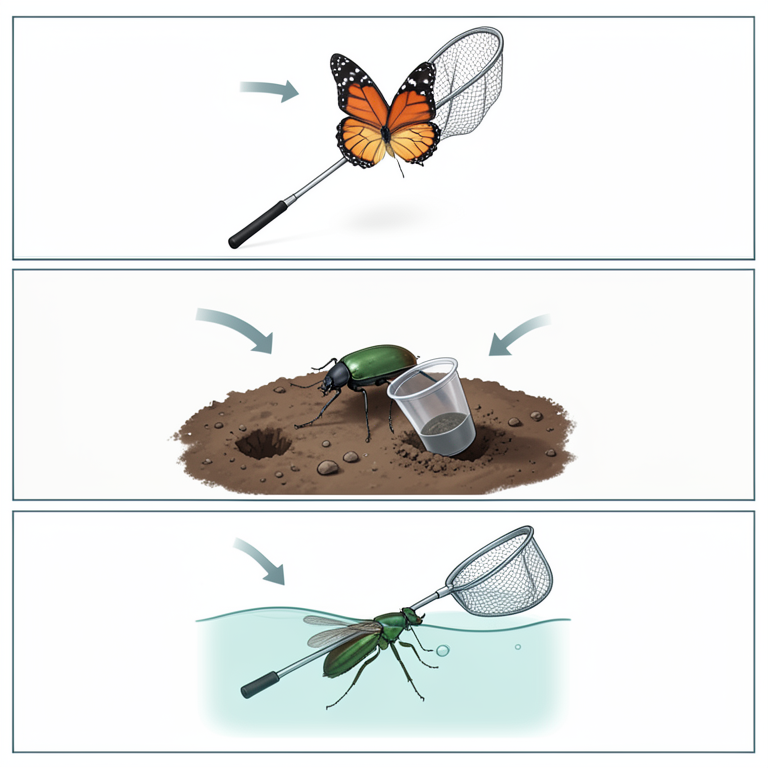
Matching Collection Methods to Insect Habitats
AI-generated conceptual illustration (various insects and collection tools). It explains the idea and does not show study data.
View source evidence ↗Introduction
Arthropoda is most diversified phylum in animal kingdom it includes class insect a belongs to subphylum hexapoda. Insect is one of the most successful organisms on the earth [7] . Insect are found in almost every habitat. It present at all type of ecosystem such as Arial, water and terrestrial due to their diverse characteristics body size, habit, fecundity, different modes of respiration, food diversity etc. Insects are an important component of the ecosystem. They have significant influence on agriculture, human health and natural resources [11] . They are pollinators of blooming plants, consumers and recyclers of decaying organic materials, and vital components of vertebrate and invertebrate food webs. Insects are collected for various purposes such as educational and pharmaceutical [18] The insects present around 55% of all the species known till date [10] . India having divers fauna of plant and animal species. There are an estimated 68,370 species of animals in which 60,000 species are insects [11] . The globally 1.4 -1.5 million animal species in which 75,000 to 100,000 species are insects, 41,000 vertebrates. Insect are found in a different habitat these are collected with different methods such as hand picking, insect net, aspirator, aquatic dip net, pit fall trap, light trap, This review focuses on insect biodiversity and different insect collection methods [18] Around 32 species of grasshopper in four different sites open ground type, field type, scrub type and woodland type of Sagar district is situated on northern boundary of Madhya Pradesh state of India. Insect collection were done by sweep net method, hand picking, beating as well as collecting with aerial nets and trapping in the morning and evening time. Longe horn grasshoppers were collected with light trap at night. Mecopoda were collected and counted by their sound [17] . Hemiptera were collected by aerial nets, sweeping nets, and beating. Orthoptera were collected with the help of aerial net and butterfly collect with help of large forceps. During this study, a total of 120 species of insect is found under 98 genera in 37 families. In that Hemiptera, Orthoptera and Lepidoptera is higher in non-industrial zone in comparison to that of industrial zone of West Bengal Gautam Jana et.al [5] . Insect diversity in Rajmohini Devi College of Agriculture and Research Station, Ambikapur Chhattisgarh sub centre of Indira Gandhi Krishi Vishwavidyalaya, Raipur during 2016-17. Study area consist different plat such as mango, litchi, ber, sal, bamboo, palas, neem and gulmohar so they hav large insect biodiversity (Maity, 2023) [3] . They found a 11 orders of insect belonging to 50 families and 50 species in which maximum number of hymenoptera were identified. Live insect were collected with hand net or light trap. Then insect were killed in killing bottle [11] . The insect coleoptera samples were randomly collected by using. aspirators, sweep net and light traps of different light sources. From agricultural and horticultural fields, medicinal plants and forest areas of 321 localities of 67 districts of 8 states viz. Assam, Arunachal Pradesh, Manipur, Meghalaya, Mizoram, Nagaland, Sikkim and Tripura of North East India. A total collection of 2635 specimens of Coleoptera belonging to different families of Suborder Adephaga (2 families) and superfamilies (12 Nos.) of suborder Polyphaga (24 families) [14] . Coleoptera were collected from agriculture land, flat land, rocky area and blanks of water bodies using pitfall trap, hand picking and light trap. A total of 956 individuals of carabid beetles, representing 28 species and 19 genera belonging to 11 subfamilies n Jhunjhunu District of Rajasthan, India in January 2021 to December 2021 [15] . 100 species of 53 families belonging to 15 orders namely Diptera, Hymenoptera, Lepidoptera, Orthoptera, Odonata, Dictyoptera, Mantodea, Isoptera, Thysanura, Siphunculata, Hemiptera, Neuroptera, Phasmida, Pilibanga tehsil of Hanumangarh district, Rajasthan monthly from April to December 2021 [12] . During study a wide variety of beetle collecting with trapping methods, forceps from dung and soil, light trap through the night. The present study, includes 59 beetle species belonging to 48 genera and 17 families recorded from Sindhudurg district [2] . Total 603 species of insect from 38 families, from 10 orders of insects were obtained from January2019 to February 2020. Sampling will done by hand picking, shaking or beating, Hair brush, Forceps, Stick, Hand net from agricultural fields, fruit and vegetable market, Kalinga university campus and other nearest locality of Santoshi Nagar collected in Raipur Chhattisgarh [13] . Study insect diversity in Tisgaon is a village in Deola Taluka in Nashik district of Maharashtra State. They collect the insects from agricultural field, houses and garbage grounds with help of handpicked and using pitfall traps. during September 2021 to January 2022. 20 species is observed in which 10 species belong to order. Coleoptera, Orthoptera, Hemiptera and Hymenoptera, in that Coleoptera is dominant [1] . The study was conducted in the Post Graduate Government College campus, Jhalawar, Rajasthan. Insect collection is done by sweep netting, hand picking and beating tray in month of Feb.-March and Sept-Oct in the year 2012. Species diversity and abundance of insects were recorded 38 species insects belonging to 7 orders 16 families and 38 species. The largest number of insect identified was of Lepidoptera followed by Hymenoptera, Odonata, Hemiptera, Orthoptera, Coleoptera and Neuroptera. Anthropogenic activities influenced the abundance of insect orders [8,9] . In this study they used vertical-beam entomological radar for observation of insect biodiversity. Now a day Widley decline insect population and biodiversity because longterm monitoring of insect biodiversity is essential. Radar is a remote-sensing technology that employs electromagnetic radiation at radio frequencies (broadly, 100 kHz to 100 GHz) to obtain information about distant objects. A radar transmits a radio signal, to the object and receives 'signal from objects. Analysis of the received signals allows information about the distance of the target. Thes method also use full for study of insect migration. Insect Monitoring Radar' (IMR) was designed to observe insects in flight at heights above approximately 150 m (3). Study on moths biodiversity forest habitats in the Silent Valley National Park, India. Preliminary data suggested that species richness of silent valley national park is maximum. Insect collection done by using a modi-tied Pennsylvanian-type light trap operated by a 6 V battery, with an automatic switching device to facilitate self-operation of the trap in the deep forests at specified timings. An8 watt UV tube was used in the trap for illumi-nation. The trap was set up on a stand, about1.2 m i n height, on the ground in small forest clearing and the trap was operated overnight on all days (from 6 PM to 6 AM on the next day). Maximum number of moths collected belonged to the families Pyralidae, Noctuidae, Geometridae and Arctiidae. Somefamilies like Lasiocampidae Bombycidae and Gelechidae were only poorly represented [4] . Work on Abheda Mahal of Kota, Rajasthan, India in 2018 -2019 It is situated just adjacent to a pond and beautiful gardens. This study odonet biodiversity was carried out in three seasons during November 2018 to October 2019. Adult Odonate collection was done by belt transect method between 9:00 am to 11:00 am. The study revealed a total number of 8 species of Odonates belonging to 2 families, out of which 5 species were dragonflies of family Libellulidae and 3 species were damselflies of family Coenagrionidae [6] . Study on Agri-biodiversity Park, Professor Jayashankar Telangana State Agricultural University, Hyderabad was studied from September 2019 to January 2020. The sampling of dipteran flies was carried by pitfall trap, yellow pan trap, yellow sticky trap, manual collection and light trap. In pitfall traps and yellow pan traps fill with soap water was used to kill the trapped insects. In these study total 6739 dipterans under 27 families were collected. Family Dolichopodidae 10.76%, Sarcophagidae 10.19% and Ceratopogonidae 8.92%. Yellow pan trap collected maximum number of individuals (2789) [16]
Conclusion
Insect are found everywhere soil, air, water, tree, and also found under the soil. The habitat of insect is always depending upon their feeding habitat. Because of not only one insect collection method are used for all kinds of insect. Insect collection method is originated on the basics of their morphology and behaviour. Arial insect like butter fly, dragon fly this are collected with arial net, soil dwelling insect collected with pitfall trap.
References
19 in the original paper- Bhadane RS, Deore JN. Diversity of certain insects found in Tisgaon region, Taluka Deola, District Nashik, Maharashtra. Int J Adv Res Biol Sci. 2023;10(8):18-23.
- Bharamal DL, Koli YJ, Bhawane GP. An inventory of the Coleopteran fauna of Sindhudurg district, Maharashtra, India. Int J Curr Microbiol Appl Sci. 2014;3(12):189-93.
- Maity S, Mondal S. Diversity of mite fauna associated with some fruit trees in Paschim Medinipur district of West Bengal, India with their economic importance. Acta Entomol Zool. 2023;4(1):44-47. DOI: 10.33545/27080013.2023.v4.i1a.95
- George M, Rahamathulla VK. Biodiversity in the Western Ghats -A study with reference to moths (Lepidoptera: Heterocera) in the Silent Valley National Park, India. Entomon. 1995;20(2):25-33.
- Jana G, Misra KK, Bhattacharya T. Diversity of some insect fauna in industrial and non-industrial areas of West Bengal, India. J Insect Conserv. 2006;10:249-60.
- Johari PR, Jain N. Seasonal variation of odonate diversity in Abheda Mahal, Kota, Rajasthan, India. Biosci Biotechnol Res Commun. 2020;13(3):1429-32.
- Khan MR. Diversity of ants (Hymenoptera: Formicidae) in a college campus of Karjat city, District Ahmednagar, Maharashtra, India. Int J Res Biosci Agric Technol. 2018;6(Special Issue 2):182-6.
- Kulshrestha R, Jain N. A note on the biodiversity of insects collected from a college campus of Jhalawar District, Rajasthan. Biosci Biotechnol Res Commun. 2016;9(2):327-30.
- Kumari B, Priya A. Seasonal variation in insect biodiversity in a transitioning sub-urban area. Zool Entomol Lett. 2022;2(1):42-49. doi: 10.22271/letters.2022.v2.i1a.31.
- Kumar R, Saksena S. Insect collection and preservation techniques. In: Ghoneim K, editor. Advances in Agricultural Entomology. New Delhi: Akinik Publications; 2021.
- Painkra P, Painkra KL. Biodiversity of insects in Ambikapur of Chhattisgarh. J Entomol Zool Stud. 2018;6(6):1020-2.
- Parihar HR, Rajani. A study on biodiversity of insects collected from Pilibanga Block of Hanumangarh District, Rajasthan. Int J Creat Res Thoughts. 2022;10.
- Prakhar P, Singh M, Agrawal RK. A study of insect diversity in different habitats found in nearby locality of Raipur, Chhattisgarh. Int J Sci Res Sci Technol. 2021;8(5):467-8.
- Rahman Z, Sarma S, et al. Biodiversity of Coleopterans associated with ecosystems in North East India - study. Indian J Entomol. 2011;73(2):171-85.
- Rajmohan M, Vinod K. Diversity, abundance and composition of ground beetles (Coleoptera: Carabidae) in Jhunjhunu District of Rajasthan, India. Agric Sci Dig. 2023;43(1):68-74.
- Sahoo KC, Sunitha V, Rao VV, Chary DS. Diversity of Diptera at Agri-Biodiversity Park, Hyderabad. Indian J Entomol. 2022;84(4):967-70.
- Tiwari U, Gupta US. Diversity of Orthoptera fauna of Sagar District, Madhya Pradesh, India. Int J Adv Res Rev. 2020;5(12):15-21.
- Kumar M, Ranjan R, Sinha MP, Dhan A, et al. A review on insect collection and preservation techniques. Eur J Pharm Med Res. 2022;9(7).
- Drake VA, Hao Z, Wang H. Monitoring insect numbers and biodiversity with a vertical-beam entomological radar. Phil Trans R Soc B. 2024;379:20230117. https://doi.org/10.1098/rstb.2023.0117