
Research article · 2025 · Full text
International Journal of Horticulture and Food ScienceComparative Study of Irrigation and Fertigation Strategies on Performance of Papaya (Carica papaya L.) Under Shade Net House
Volume 7(6) · Pages 18–23 · DOI: 10.33545/26631067.2025.v7.i6a.314 ↗
Research areasPlant Growth and Agriculture TechniquesAgricultural Science and Fertilization
Abstract
Author-writtenExperimental conducted aimed to entitle “Comparative Study of Irrigation and Fertigation Strategies on Performance of Papaya (Carica papaya L.) Under Shade Net House” was carried out at the Agriculture Farm (Horticulture), Career Point University, Alaniya, Kota during 2024-2025. The experiment was laid out in Factorial Randomized Block Design three replication with 09 treatment combinations, comprising like Factor- A treatments isI1- Drip Irrigation IE/CPE- 0.4 ECP, I2Drip Irrigation IE/CPE- 0.6 ECP, I3- Drip Irrigation IE/CPE- 0.8 ECP. Factor -BRDF is F1-60% RDF through fertigation and F2-80% RDF through fertigation and F3- 100% RDF through fertigation. The application of irrigation on productivity was found most effective improve success all parameters of papaya. Plant height was found to be maximum (113.71, 154.90, 199.58 cm), maximum number of leaves (33.10, 54.28 and 68.78), The maximum number of fruit (20.24 fruit per plant), The maximum d fruit weight (0.910 g) Fruit yield was found to be maximum (18.42 kg /plant) Highest TSS (11.20 0brix) and the ascorbic acid was found to be maximum (44.95 mg/100) under treatment I3 (Drip Irrigation IE/CPE- 0.8 ECP). Fertilization RDF significantly height plant height was found to be maximum (114.95, 151.04 and 203.90 cm) number of leaves be maximum (30.64, 52.70 and 66.85), Number of fruit was found to be maximum (19.46 fruit per plant), fruit weight maximum (0.877 g), Fruit yield be maximum (17.07 kg/plant) Fertilization RDF significantly height plant height was found to be maximum (114.95, 151.04 and 203.90 cm) number of leaves be maximum (30.64, 52.70 and 66.85), Number of fruit was found to be maximum (19.46 fruit per plant), fruit weight maximum (0.877 g), Fruit yield be maximum (17.07 kg/plant) TSS was found to be maximum (10.60 0brix), ascorbic acid was found to be maximum (41.27 mg/100)under treatmentF3 (100% RDF through fertigation). Interaction effect of fertigation and RDF were recorded maximum plant height (125.33, 157.83 and 217.72 cm), highest number of leaves (34.85 and 57.54), maximum number of fruit (21.76), maximum fruit weight (1.07 kg), maximum fruit yield (23.28 kg), maximum TSS (11.66 0brix) was recorded in (Drip Irrigation IE/CPE- 0.8 ECP+100% RDF through fertigation.
Summary
Source-checkedPlain-language reading of the full paper, prepared with AI and checked against the text. Each point links to the authors' own words.
Why it matters
- Papaya is a significant fruit crop cultivated in tropical and sub-tropical regions globally. View evidence ↗
- Because climate is unpredictable and heavily influences agricultural output, using protected environments can help manage the growing atmosphere. View evidence ↗
- Fertigation, the process of applying fertilizer via micro-irrigation, allows nutrients to be delivered directly to the plant's active root zone. View evidence ↗
The question
- The study aimed to compare different irrigation and fertigation strategies to determine their effect on the performance of papaya grown in a shade net house. View evidence ↗
What they did
- The experiment used the 'Red Lady' papaya variety and was conducted over a 5-month period at Career Point University in Kota, India. View evidence ↗
- The study used a Factorial Randomized Block Design with three replications and nine treatment combinations, testing three drip irrigation levels (0.4, 0.6, and 0.8 ECP) and three recommended dose of fertilizer (RDF) levels (60%, 80%, and 100%). View evidence ↗
What they found
- The highest plant height at 150, 200, and 250 days after transplanting (DAT) was achieved with the 0.8 ECP irrigation level (113.71, 154.90, and 199.58 cm), while the 0.4 ECP level resulted in the lowest height. View evidence ↗
- The 0.8 ECP irrigation level produced the most leaves at 150, 200, and 250 DAT (33.10, 54.28, and 68.78), compared to the 0.4 ECP level which produced the fewest. View evidence ↗
- Applying 100% of the recommended fertilizer dose (RDF) through fertigation resulted in the highest number of fruits per plant (19.46), while 60% RDF resulted in the lowest (18.69). View evidence ↗
- The 0.8 ECP irrigation level led to the maximum fruit weight of 0.910 g, whereas the 0.4 ECP level led to the minimum weight of 0.772 g. View evidence ↗
- Fruit quality, measured by Total Soluble Solids (TSS), was highest at the 0.8 ECP irrigation level (11.20 °Brix) and lowest at the 0.4 ECP level (9.42 °Brix). View evidence ↗
- The combination of 0.8 ECP irrigation and 100% RDF fertigation produced the maximum fruit yield of 23.28 kg, significantly higher than the 0.4 ECP and 60% RDF combination (9.67 kg). View evidence ↗
- The interaction of 0.8 ECP irrigation and 100% RDF fertigation resulted in the highest TSS (11.66 °Brix), compared to the lowest TSS (8.87 °Brix) in the 0.4 ECP and 60% RDF group. View evidence ↗
What it means
- The authors conclude that the combination of 0.8 ECP drip irrigation and 100% RDF fertigation is the preferred strategy for maximizing the growth, yield, and quality of papaya in protected cultivation. View evidence ↗
- The authors note that their observations are based on data from only one season and suggest further experimentation to obtain more precise information. View evidence ↗
Visual summary
3 visualsIllustrations explain the paper; charts are replotted from the paper's own table values.
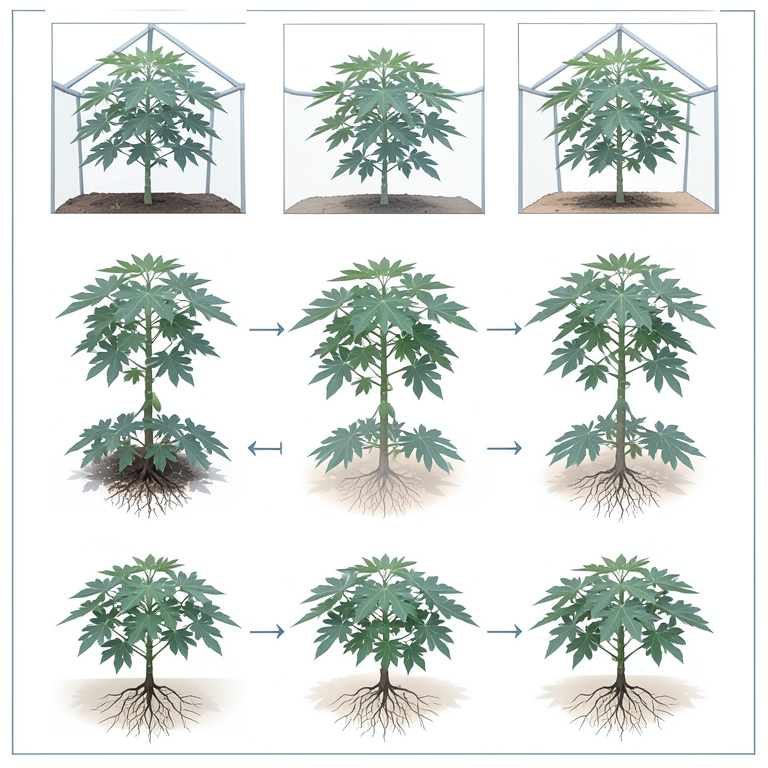
Experimental Treatment Matrix
AI-generated conceptual illustration (papaya plants in a shade net house). It explains the idea and does not show study data.
View source evidence ↗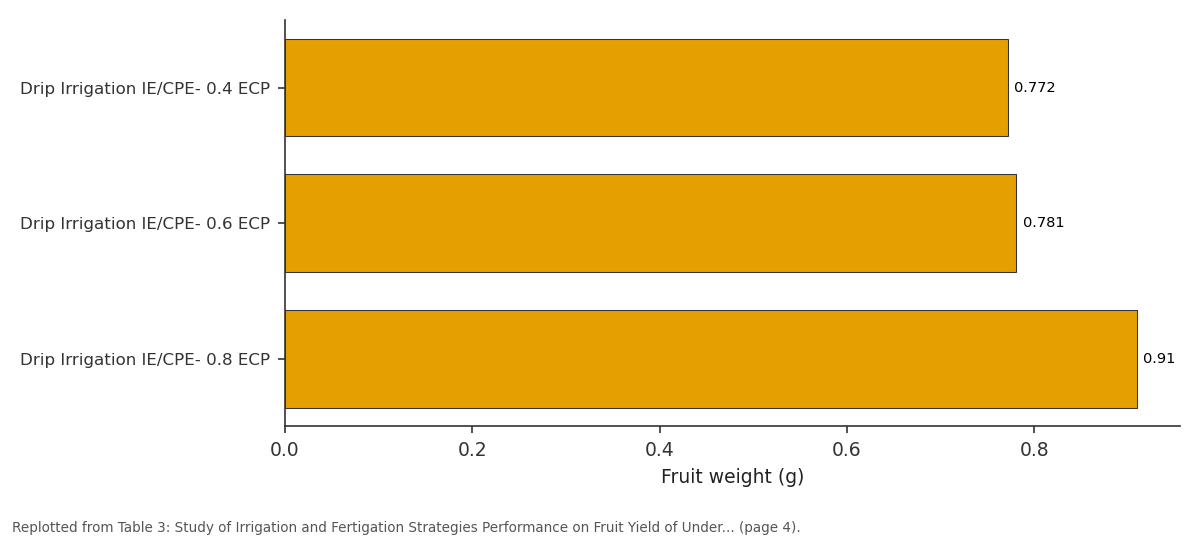
Fruit weight (g): Drip Irrigation IE/CPE-... vs Drip Irrigation IE/CPE-... vs Drip Irrigation IE/CPE-...
Replotted from Table 3 (page 4) of the original paper. Every bar is the paper's own table value.
View source evidence ↗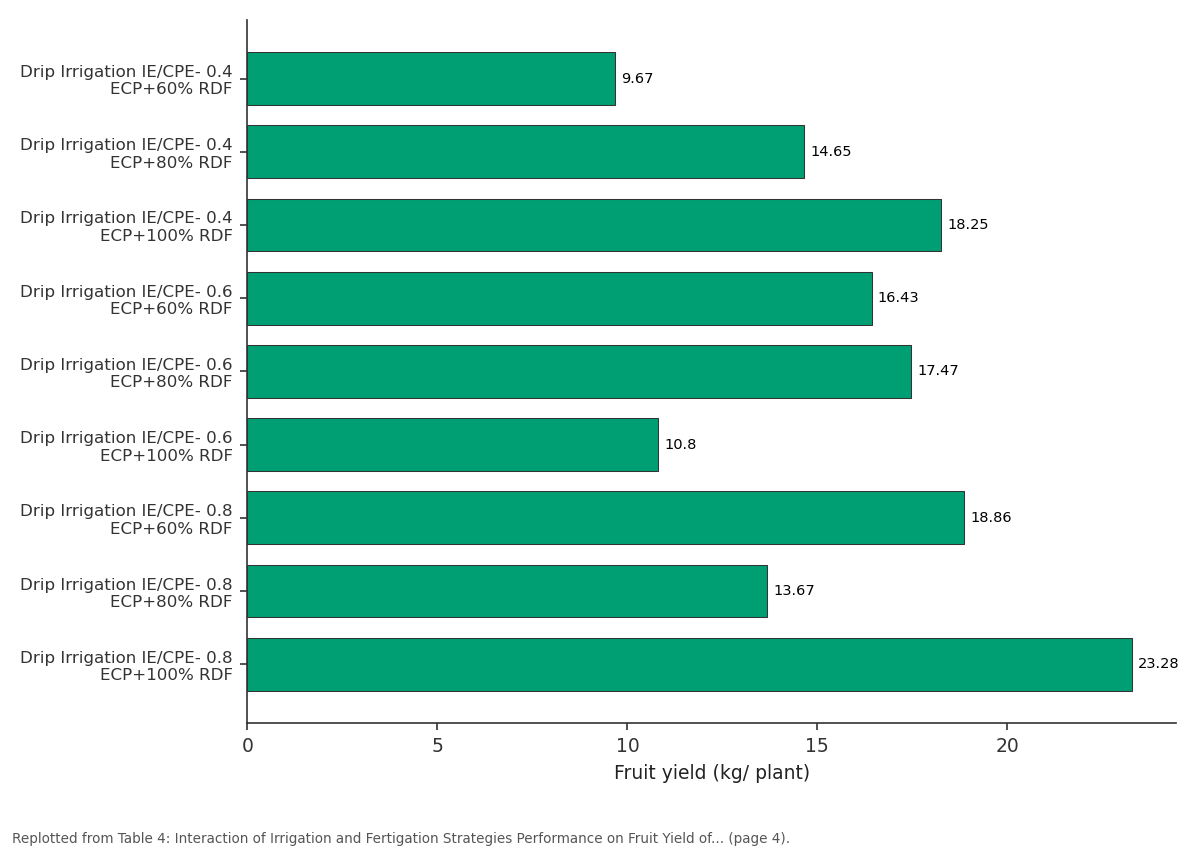
Fruit yield (kg/ plant): Drip Irrigation IE/CPE-... vs Drip Irrigation IE/CPE-... vs Drip Irrigation IE/CPE-... vs Drip Irrigation IE/CPE-... vs Drip Irrigation IE/CPE-...
Replotted from Table 4 (page 4) of the original paper. Every bar is the paper's own table value.
View source evidence ↗Figures & tables
From the original paper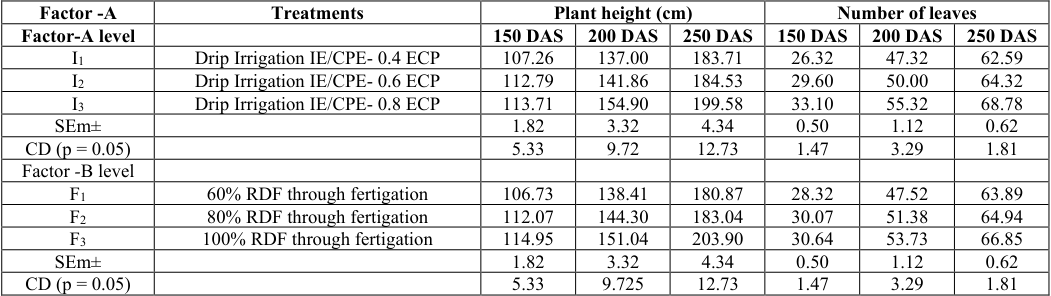 Table 1
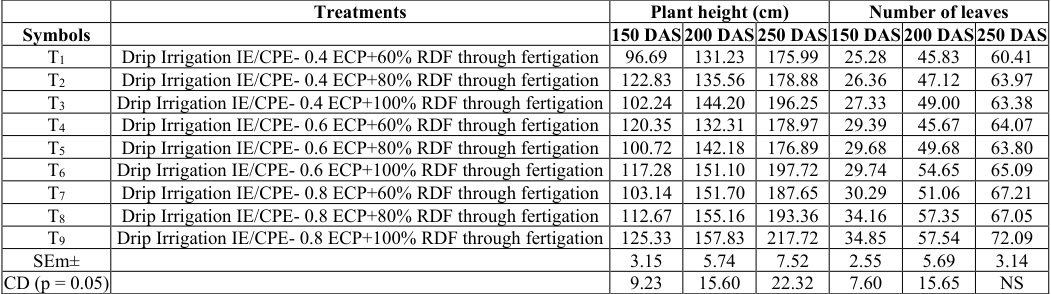 Table 2
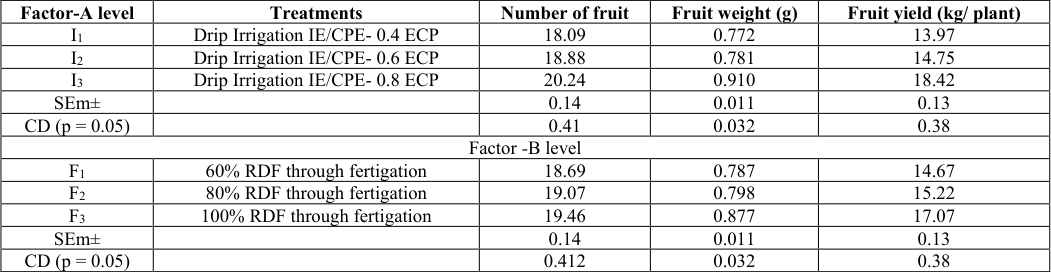 Table 3
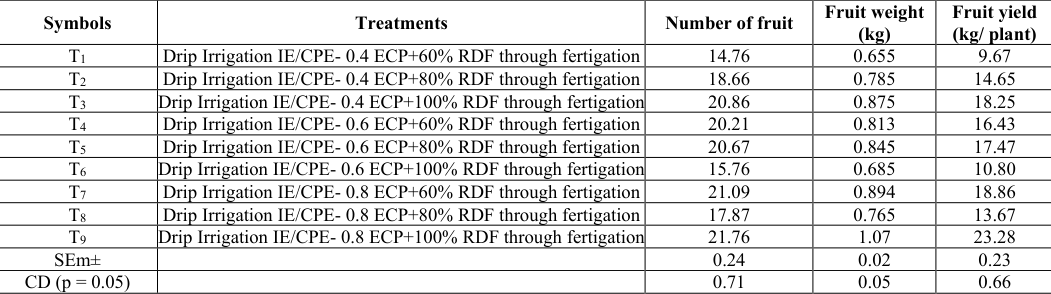 Table 4
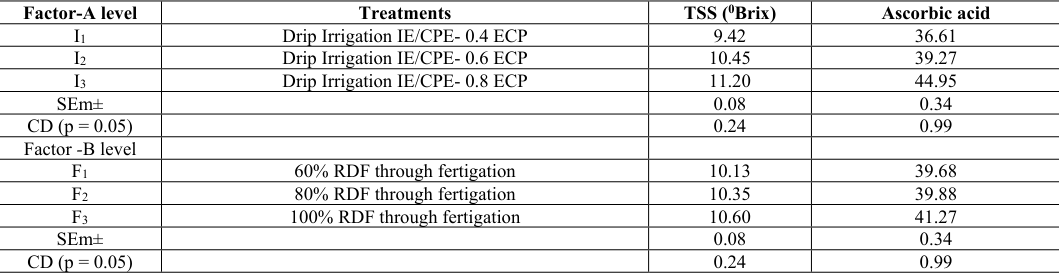 Table 5
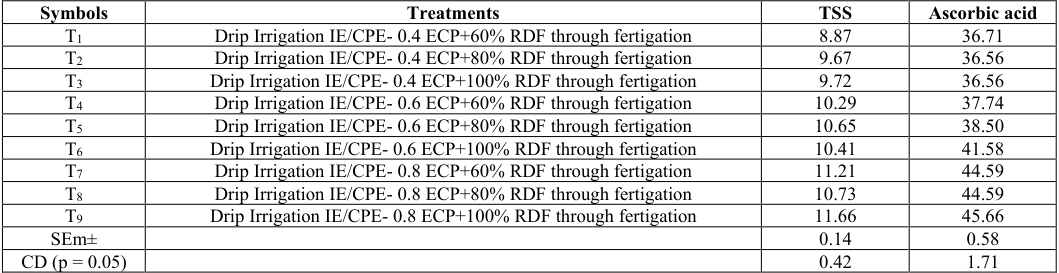 Table 6
Introduction
Papaya (Carica papaya L.) is one of the important delicious fruit crops grown in tropical and sub-tropical parts of the world, covering 32 0 N and S latitudes on the globe. It can be grown up to 1000 m above mean sea level. Papaya fruit receded one of the highest production of fruits per hectare and an income next to banana. Due to its great degree of unpredictability, the climate is the most significant component in agricultural output; thus, a protected environment can alter the atmosphere in which the crops are grown. (Iizumi et al., 2015) [6] . It is important to assess the conditions under which plants are grown and to keep in mind that environmental elements affect the fruit's quality. (Martínez et al., 2017) [8] . Some of the environmental that have an important effect on temperature and relative humidity. Fertigation is the application of fertilizer through micro irrigation systems. Irrigation with use of fertilizer is permits application of various fertilizer formulations directly at the site of active root zone area of plant. Elfving, (1982) [4] found that drip irrigation with fertilizer is much more precise than other methods at delivering nutrients to the root where it can be effectively utilized and therefore, resulting in greater uptake and use efficiency.
In Irrigation with use of fertilizer nutrient use efficiency have as a high as 90-95 per cent as compared to conventional methods (Solaimalai et al., 2005). In addition it saves the fertilizers, time and labour. Generally crop response to fertilizer application through drip irrigation has been excellent. So far as papaya is concerned, its demand for nitrogen, phosphorus and potassium under conventional method of fertilization is high, which can be considerably slashed when applied through drip in small quantities at frequent intervals in accordance to crop need. Chaudhri et al. (2001) [2] found 50 per cent saving of fertilizer and 53 per cent water saving with substantial increase in yield of papaya. Because papaya is an indeterminate crop, its vegetative and reproductive stages overlap, and it need nutrients all the way up to the fruit ripening stage for optimal growth and fruit size, fertigation works wonders for papaya. Flexible and precise fertilizer application is another potential advantage of the drip system. Fertigationthe application of fertilizer through micro irrigation systems. Fertigation permits application of various fertilizer formulations directly at the site of active root zone area of plant. Elfving (1982) [4] found that Fertilizer applied by drip irrigation is far more accurate than other techniques in getting nutrients to the root where they may be used efficiently, increasing absorption and usage efficiency.
Materials and Methods
The research was conducted at Research Farm Department of Horticulture, School of Agriculture Science, Career Point University Kota, India. Variety used in research Red Lady period of experiment work 5 Month. The site is situated in Humid South Eastern Plain Zone V which falls in south eastern part of Rajasthan and covers geographical area of 26.43 lakh ha and represents 7.71 per cent of the total geographical area of the state. The zone is located between 23 0 45´ and 26 0 33´ North latitudes and 75 0 27´ and 77 0 26´ East longitudes. The experiment was laid out in Factorial Randomized Block Design. Replicated thrice with nine treatment combination of drip Irrigation with RDF and through fertigation.
Results and Discussion
Results and Discussion
• Growth parameters
The height of papaya plant growth was recorded significant increased. Plant height was found to be maximum (113.71, 154.90, 199.58 Drip irrigation levels of IE/CPE-0.8 ECPin case of papaya may be due to retention of soil moisture always at field capacity. This help in more absorption of moisture and nutrients from soil which may reflect an increase in cell turgidity and cell elongation. This was again aided with higher photosynthetic rate at different stages of growth. Better availability of plant nutrients that promote their accumulation in the soil may have resulted from the simple availability of water-soluble nutrients to the crop's root zone by fertigation in a balanced form using 100% RDF. In order to address the nutritional needs of the crop during crop development, 100% RDF is applied via fertigation of watersoluble fertilisers dispersed across the growth period and separated into splits according to growth stages for papaya beginning from 30 DAT. This might be explained by enhanced food intake during the development phase, which raised protoplasm and protein synthesis for a faster rate of mitosis and, eventually, growth parameters. This result is in agreement with those reported by earlier workers (Sharma et al., 2005) [14] and (Sadarunnisa et al., 2010) [11] . The increase in papaya plant height and trunk girth could be related to improved soil physical characteristics, improved nutrient uptake, and increased microbial activity resulted in better carbohydrates production (Hazarika et al., 2016 and Yadav et al. 2011) [5,7] . Mirza et al., (2018) [9] observed increase leaf number might be due to the reason that ferigation (F3) helps in enhancing of physiological process and stimulatory effect of chemicals to form new leaves at a faster rate.
• Yield parameters A significantly variation in number of fruit of papaya plant in RDF through fertigation. Number of fruit was found to be maximum (19.46 fruit per plant), under treatment F3 (100% RDF through fertigation). The minimum number of fruit (18.69 fruit per plant) respectively, was recorded in F1 (60% RDF through fertigation). A data examines reveals that brought the significantly variation in different irrigation level on fruit weight. The maximum d fruit weight (0.910 g) respectively, was recorded in treatment I3 (Drip Irrigation IE/CPE-0.8 ECP). The minimum fruit weight (0.772 g) was recorded in I1 (Drip Irrigation IE/CPE-0.4 ECP). The significantly fruit weight of papaya plant in RDF through fertigation fruit weight was found to be maximum (0.877 g) respectively, under treatment F3 (100% RDF through fertigation). The minimum fruit weight (0.787 g) was recorded in F1 (60% RDF through fertigation). The fruit yield was recorded significantly increased. Fruit yield was found to be maximum (18.42 kg /plant), under treatment I3 (Drip Irrigation IE/CPE-0.8 ECP), which was at par with I2. The minimum fruit yield (13.97 kg/plant) was recorded in I1 (Drip Irrigation IE/CPE-0.4 ECP. The significantly in RDF through fertigation level fruit yield was found to be maximum (17.07 kg/plant), under treatment F3 (100% RDF through fertigation). The minimum fruit yield (14.67 kg/plant) was recorded in F1 (60% RDF through fertigation). Application of fertilizer (nutrient) directly to the root zone through drip irrigation could improve plant growth and development by maintaining optimum soil moisture and eliminating water stress to the plant (Deshmukh et al., 2014) [3] . The increase in production caused by drip irrigation levels of IE/CPE-0.8 ECP could be attributable to an increase in balanced vegetative development with maximum solar light harvest. Further, fertigation level (100% of RDF) resulted in highest yield closely. Fertigation may have increased output by providing nutrients for a longer length of time throughout the growth, blooming, and fruiting phases. Further, more healthy and optimum vegetative growth with the application of treatment drip irrigation levels of IE/CPE-0.8 ECP+ 100% RDF might have augmented photosynthesis, The outcomes are consistent with the findings of (Kumawat et al., 2019 and Hazarika 2016) [7,5] . The improve in fruiting set is due to the application of RDF which resulted in the production of reproductive part of plant a, leading to development of flower buds exhibiting all functional reproductive parts, which increased fruit set tremendously compared with the others (Mirza et al., 2018) [9] . The negative impact of moisture stress on a plant's regular growth and development may be the cause of the yield loss under stress. (Awada et al., 1979, Deshmukh et al., 2014, Santana et al., 2008) [1,3,12] . Application of fertilizers through drip at 100% RDF proved its superiority by recording significantly higher papaya fruit yield than rest of the fertigation levels tried during the year. This could be because consistent application of the necessary amount of nutrients close to the root zone during the crop's growth period improved the nutrient use efficiency, which in turn improved all of the crop's growth and yield characteristics. It could also be because physiological processes increased and photosynthates were efficiently translocated to the reproductive organs, which resulted in a higher yield of papaya fruit. Sathya et al. (2008) [13] reported that the fertigation of nutrients significantly increased saving of fertilizer up to 40 per cent without affecting the yield of crops compared to the conventional method of fertilizer application.
• Quality parameters A TSS significantly through different irrigation level. Highest TSS (11.20 0 brix) was recorded in I3 (Drip Irrigation IE/CPE-0.8 ECP), While lowest TSS (9.42 0 brix) was noted in treatment I1 (Drip Irrigation IE/CPE-0.4 ECP). TSS was recorded significantly increased. TSS was found to be maximum (10.60 0 brix), under treatment F3 (100% RDF through fertigation), which was at par with F2. The minimum TSS (10.13 0 brix) was recorded in F1 (60% RDF through fertigation). Aascorbic acid was recorded significantly increased. The ascorbic acid was found to be maximum (44.95 mg/100), under treatment I3 (Drip Irrigation IE/CPE-0.8 ECP), which was at par with I2. The minimum ascorbic acid (36.62 mg/100) was recorded in I1 (Drip Irrigation IE/CPE-0.4 ECP. A data presented to reveals that the significantly in RDF through fertigation level ascorbic acid was found to be maximum (41.27 mg/100), under treatment F3 (100% RDF through fertigation). The minimum ascorbic acid (39.68 mg/100 g), was recorded in F1 (60% RDF through fertigation). Because potassium is involved in the synthesis of carbohydrates, the breakdown and translocation of starch, the synthesis of proteins, and the neutralisation of physiologically significant organic acids, the quality of TSS and ascorbic acid has improved. Otassium is often unnecessary for increasing output and quality. Additionally, it stimulates enzyme activity, stomata management, and photosynthesis. These elements working together may have raised the papaya fruits' general quality.The superiority of fertigation treatments in increasing the quality of papaya has also been reported by, Sadarunnisa et al. (2010) [11] , Tank et al. (2011) [16] , Singh and Singh (2012) [15] and Panigrahi et al. (2015) [10] .
Figures and tables from the paper
| Factor -A | Treatments | Plant height (cm) | — | — | Number of leaves | — | — |
|---|---|---|---|---|---|---|---|
| Factor-A level | 150 DAS | 200 DAS | 250 DAS | 150 DAS | 200 DAS | 250 DAS | |
| I1 | Drip Irrigation IE/CPE- 0.4 ECP | 107.26 | 137.00 | 183.71 | 26.32 | 47.32 | 62.59 |
| I2 | Drip Irrigation IE/CPE- 0.6 ECP | 112.79 | 141.86 | 184.53 | 29.60 | 50.00 | 64.32 |
| I3 | Drip Irrigation IE/CPE- 0.8 ECP | 113.71 | 154.90 | 199.58 | 33.10 | 55.32 | 68.78 |
| SEm± | 1.82 | 3.32 | 4.34 | 0.50 | 1.12 | 0.62 | |
| CD (p = 0.05) | 5.33 | 9.72 | 12.73 | 1.47 | 3.29 | 1.81 | |
| Factor -B level | |||||||
| F1 | 60% RDF through fertigation | 106.73 | 138.41 | 180.87 | 28.32 | 47.52 | 63.89 |
| F2 | 80% RDF through fertigation | 112.07 | 144.30 | 183.04 | 30.07 | 51.38 | 64.94 |
| F3 | 100% RDF through fertigation | 114.95 | 151.04 | 203.90 | 30.64 | 53.73 | 66.85 |
| SEm± | 1.82 | 3.32 | 4.34 | 0.50 | 1.12 | 0.62 | |
| CD (p = 0.05) | 5.33 | 9.725 | 12.73 | 1.47 | 3.29 | 1.81 |
Table text extracted from the original PDF; superscript letters are shown inline. The original table image is below.
View original table image
| — | Treatments | Plant height (cm) | — | — | Number of leaves | — | — |
|---|---|---|---|---|---|---|---|
| Symbols | 150 DAS | 200 DAS | 250 DAS | 150 DAS | 200 DAS | 250 DAS | |
| T1 | Drip Irrigation IE/CPE- 0.4 ECP+60% RDF through fertigation | 96.69 | 131.23 | 175.99 | 25.28 | 45.83 | 60.41 |
| T2 | Drip Irrigation IE/CPE- 0.4 ECP+80% RDF through fertigation | 122.83 | 135.56 | 178.88 | 26.36 | 47.12 | 63.97 |
| T3 | Drip Irrigation IE/CPE- 0.4 ECP+100% RDF through fertigation | 102.24 | 144.20 | 196.25 | 27.33 | 49.00 | 63.38 |
| T4 | Drip Irrigation IE/CPE- 0.6 ECP+60% RDF through fertigation | 120.35 | 132.31 | 178.97 | 29.39 | 45.67 | 64.07 |
| T5 | Drip Irrigation IE/CPE- 0.6 ECP+80% RDF through fertigation | 100.72 | 142.18 | 176.89 | 29.68 | 49.68 | 63.80 |
| T6 | Drip Irrigation IE/CPE- 0.6 ECP+100% RDF through fertigation | 117.28 | 151.10 | 197.72 | 29.74 | 54.65 | 65.09 |
| T7 | Drip Irrigation IE/CPE- 0.8 ECP+60% RDF through fertigation | 103.14 | 151.70 | 187.65 | 30.29 | 51.06 | 67.21 |
| T8 | Drip Irrigation IE/CPE- 0.8 ECP+80% RDF through fertigation | 112.67 | 155.16 | 193.36 | 34.16 | 57.35 | 67.05 |
| T9 | Drip Irrigation IE/CPE- 0.8 ECP+100% RDF through fertigation | 125.33 | 157.83 | 217.72 | 34.85 | 57.54 | 72.09 |
| SEm± | 3.15 | 5.74 | 7.52 | 2.55 | 5.69 | 3.14 | |
| CD (p = 0.05) | 9.23 | 15.60 | 22.32 | 7.60 | 15.65 | NS |
Table text extracted from the original PDF; superscript letters are shown inline. The original table image is below.
View original table image
| Factor-A level | Treatments | Number of fruit | Fruit weight (g) | Fruit yield (kg/ plant) |
|---|---|---|---|---|
| I1 | Drip Irrigation IE/CPE- 0.4 ECP | 18.09 | 0.772 | 13.97 |
| I2 | Drip Irrigation IE/CPE- 0.6 ECP | 18.88 | 0.781 | 14.75 |
| I3 | Drip Irrigation IE/CPE- 0.8 ECP | 20.24 | 0.910 | 18.42 |
| SEm± | 0.14 | 0.011 | 0.13 | |
| CD (p = 0.05) | 0.41 | 0.032 | 0.38 | |
| Factor -B level | ||||
| F1 | 60% RDF through fertigation | 18.69 | 0.787 | 14.67 |
| F2 | 80% RDF through fertigation | 19.07 | 0.798 | 15.22 |
| F3 | 100% RDF through fertigation | 19.46 | 0.877 | 17.07 |
| SEm± | 0.14 | 0.011 | 0.13 | |
| CD (p = 0.05) | 0.412 | 0.032 | 0.38 |
Table text extracted from the original PDF; superscript letters are shown inline. The original table image is below.
View original table image
| Symbols | Treatments | Number of fruit | Fruit weight (kg) | Fruit yield (kg/ plant) |
|---|---|---|---|---|
| T1 | Drip Irrigation IE/CPE- 0.4 ECP+60% RDF through fertigation | 14.76 | 0.655 | 9.67 |
| T2 | Drip Irrigation IE/CPE- 0.4 ECP+80% RDF through fertigation | 18.66 | 0.785 | 14.65 |
| T3 | Drip Irrigation IE/CPE- 0.4 ECP+100% RDF through fertigation | 20.86 | 0.875 | 18.25 |
| T4 | Drip Irrigation IE/CPE- 0.6 ECP+60% RDF through fertigation | 20.21 | 0.813 | 16.43 |
| T5 | Drip Irrigation IE/CPE- 0.6 ECP+80% RDF through fertigation | 20.67 | 0.845 | 17.47 |
| T6 | Drip Irrigation IE/CPE- 0.6 ECP+100% RDF through fertigation | 15.76 | 0.685 | 10.80 |
| T7 | Drip Irrigation IE/CPE- 0.8 ECP+60% RDF through fertigation | 21.09 | 0.894 | 18.86 |
| T8 | Drip Irrigation IE/CPE- 0.8 ECP+80% RDF through fertigation | 17.87 | 0.765 | 13.67 |
| T9 | Drip Irrigation IE/CPE- 0.8 ECP+100% RDF through fertigation | 21.76 | 1.07 | 23.28 |
| SEm± | 0.24 | 0.02 | 0.23 | |
| CD (p = 0.05) | 0.71 | 0.05 | 0.66 |
Table text extracted from the original PDF; superscript letters are shown inline. The original table image is below.
View original table image
| Factor-A level | Treatments | TSS (0Brix) | Ascorbic acid |
|---|---|---|---|
| I1 | Drip Irrigation IE/CPE- 0.4 ECP | 9.42 | 36.61 |
| I2 | Drip Irrigation IE/CPE- 0.6 ECP | 10.45 | 39.27 |
| I3 | Drip Irrigation IE/CPE- 0.8 ECP | 11.20 | 44.95 |
| SEm± | 0.08 | 0.34 | |
| CD (p = 0.05) | 0.24 | 0.99 | |
| Factor -B level | |||
| F1 | 60% RDF through fertigation | 10.13 | 39.68 |
| F2 | 80% RDF through fertigation | 10.35 | 39.88 |
| F3 | 100% RDF through fertigation | 10.60 | 41.27 |
| SEm± | 0.08 | 0.34 | |
| CD (p = 0.05) | 0.24 | 0.99 |
Table text extracted from the original PDF; superscript letters are shown inline. The original table image is below.
View original table image
| Symbols | Treatments | TSS | Ascorbic acid |
|---|---|---|---|
| T1 | Drip Irrigation IE/CPE- 0.4 ECP+60% RDF through fertigation | 8.87 | 36.71 |
| T2 | Drip Irrigation IE/CPE- 0.4 ECP+80% RDF through fertigation | 9.67 | 36.56 |
| T3 | Drip Irrigation IE/CPE- 0.4 ECP+100% RDF through fertigation | 9.72 | 36.56 |
| T4 | Drip Irrigation IE/CPE- 0.6 ECP+60% RDF through fertigation | 10.29 | 37.74 |
| T5 | Drip Irrigation IE/CPE- 0.6 ECP+80% RDF through fertigation | 10.65 | 38.50 |
| T6 | Drip Irrigation IE/CPE- 0.6 ECP+100% RDF through fertigation | 10.41 | 41.58 |
| T7 | Drip Irrigation IE/CPE- 0.8 ECP+60% RDF through fertigation | 11.21 | 44.59 |
| T8 | Drip Irrigation IE/CPE- 0.8 ECP+80% RDF through fertigation | 10.73 | 44.59 |
| T9 | Drip Irrigation IE/CPE- 0.8 ECP+100% RDF through fertigation | 11.66 | 45.66 |
| SEm± | 0.14 | 0.58 | |
| CD (p = 0.05) | 0.42 | 1.71 |
Table text extracted from the original PDF; superscript letters are shown inline. The original table image is below.
View original table image
References
17 in the original paper- Awada IP, Suehisa RH, Padgett MM. Effects of drip irrigation and fertilization on vegetative growth, fruit yield and mineral composition of the petioles and fruits of papaya. Honolulu: Agricultural Experiment Station, University of Hawaii; 1979. 20 p.
- Chaudhri SM, Shinde SH, Dahiwalkar SD, Danawale NJ, Shirsath HK, Berad SM. Effect of fertigation through drip on productivity of papaya. Journal of Maharashtra Agricultural Universities. 2001;26 (1):1820.
- Deshmukh G, Hardaha MK, Mishra KP. Parameters design of drip fertigation system for papaya (Carica papaya Linn.) crop. International Journal of Science Research and Technology. 2014;2 (5):1-4.
- Elfving DC. Crop response to trickle irrigation. Horticultural Reviews. 1982;4:1-48.
- Hazarika TK, Sangma BD, Mandal D, Nautiyal BP, Shukla AC. Effect of plant growth regulators on growth, yield and quality of tissue cultured papaya (Carica papaya) cv. Red Lady. Indian Journal of Agricultural Sciences. 2016;86 (3):404-408.
- Iizumi T, Ramankutty N. How do weather and climate influence cropping area and intensity? Global Food Science. 2015;4:46-50.
- Kumawat KL, Sarolia DK, Kaushik RA, Ramniwas, Devra NS. Effect of irrigation and fertigation scheduling on input use efficiency, yield and quality of guava cv. Lalit under intensive orcharding system. Journal of Soil and Water Conservation. 2019;18 (2):136-143.
- Martínez F, Oliveira JA, Calvete EO, Palencia P. Influence of growth medium on yield, quality indexes and SPAD values in strawberry plants. Science Horticulture. 2017;217:17-27.
- Mirza A, Jakhar R, Singh J. Response of organic practices, mulching and plant growth regulators on growth, yield and quality of papaya (Carica papaya L) cv. Taiwan Red Lady. Indian Journal of Agriculture Research. 2019;53 (1):96-99.
- Panigrahi HK, Verma A, Pandey N. Effect of different level of fertigation through water soluble fertilizers on growth, yield and quality parameters of papaya (Carica papaya L.). International Journal of Tropical Agriculture. 2015;33 (4):3587-3589.
- Sadarunnisa S, Madhumathi C, HariBabu K, Sreenivasulu B, Rama Krishna M. Effect of fertigation on growth and yield of papaya cv. Red Lady. Acta Horticulture. 2010;851:395-400.
- Santana JL, Sousa MJ, Rodriguez MC, Suarez CL. Response of the papaya (Carica papaya L.) plant to deficit irrigation in the Canary Islands. Acta Horticulture. 2008;792:559-566.
- Sathya S, James PG, Indirani R, Kannathasan M. Effect of fertigation on availability of nutrients (N, P and K) in soil -A review. Agriculture Revised. 2008;29 (3):214217.
- Sharma HG, Dubey P, Agrawal N, Satpute P. Effect of fertigation through water soluble fertilizers on growth, yield and quality of papaya. In: International Conference on Plasticulture and Precision Farming; 2005 Nov 17-21; New Delhi. p. 250-254.
- Singh SK, Singh RK. Combined effect of drip irrigation and fertilizer application on growth, yield and waterfertilizer expense. New Agriculturist. 2012;23 (1):107112.
- Tank RV, Patel NL, Naik JR. Effect of fertigation on growth, yield and quality of papaya (Carica papaya L.) cv. MadhuBindu under South Gujarat conditions. The Asian Journal of Horticulture. 2011;6 (2):339-343.
- Yadav PK, Yadav AL, Yadav AS, Yadav HC. Effect of integrated nutrient nourishment on vegetative growth and physico-chemical attributes of papaya (Carica papaya L.) fruit cv. Pusa Dwarf. Plant Archives. 2011;11 (1):327-329.