
Research article · 2025 · Full text
International Journal of Horticulture and Food ScienceInheritance patterns of bottle gourd (lagenaria Siceraria (Molina) Standl.) in f4 progenies
Volume 7(6) · Pages 05–08 · DOI: 10.33545/26631067.2025.v7.i6a.309 ↗
Research areasAdvances in Cucurbitaceae ResearchChromosomal and Genetic Variations
Abstract
Author-writtenThis studyinvestigated GCV, PCV, ECV, Heritability, GA, and correlation analysis for 13characters in calabash derived of the cross Pusa Samrudhi × DHARWAD BOTTLEGOURD - 5 in the F4 generation. The traits including number of primary branchesper vine, number of fruits per vine, yield per vine, and average fruit weightdemonstrated considerable variability at both genotypic and phenotypic levels,accompanied by high heritability and notable genetic advance as a percentage ofthe mean. This indicates a predominant role of additive gene action, makingthese traits amenable to improvement through straightforward selectionstrategies. Yield per vine showed a strong and statistically significantpositive correlation with several other characters—such as sex ratio, node atwhich the first female flower emerged, average fruit length, and fruitdiameters at the pedicel, central, and stylar regions—at both genotypic andphenotypic levels. These associations highlight the importance of selecting fortraits like node position of the first female flower, fruit length, diametersat various fruit positions, and fruit count per vine when aiming to enhanceoverall yield performance.
Summary
Source-checkedPlain-language reading of the full paper, prepared with AI and checked against the text. Each point links to the authors' own words.
Why it matters
- Bottle gourd (Calabash) is a widely grown vegetable in the Cucurbitaceae family with a chromosome number of 2n=22. View evidence ↗
- There is an increasing need for bottle gourd varieties that offer higher yields, early fruiting, specific fruit shapes, and resistance to various pests and diseases. View evidence ↗
The question
- The study aimed to evaluate F4 progenies for genetic variability, heritability, genetic advance, and trait correlations to help incorporate desirable traits into breeding programs. View evidence ↗
What they did
- The research used a Randomized Block Design with three replications, studying five F4 progenies from the Pusa Samrudhi × DHARWAD BOTTLE GOURD - 5 cross, with 20 plants per progeny plus parental lines. View evidence ↗
- The study employed established statistical methods to calculate genotypic (GCV), phenotypic (PCV), and environmental coefficients of variation, broad-sense heritability, genetic advance (GA), and correlation coefficients. View evidence ↗
What they found
- Significant variation was found among F4 progenies for vine length (7.45-10.48 m), primary branches (7.33-9.00), days to first female flower (52.33-57.33), and sex ratio (14.23-15.46). View evidence ↗
- Productivity traits showed marked variability, with fruit count ranging from 16-25 per vine, fruit weight from 634.66-809.66 g, and yield per vine from 12.38-18.12 kg. View evidence ↗
- Phenotypic coefficients of variation (PCV) were slightly higher than genotypic coefficients (GCV), suggesting that the environment had minimal influence on the traits. View evidence ↗
- Broad-sense heritability ranged from 40% to 87%, indicating that selection is a viable method for genetic improvement. View evidence ↗
- Fruit length and fruit number per vine exhibited both high heritability and high genetic advance, which suggests that additive gene action is the primary driver for these traits. View evidence ↗
- Yield per vine, fruit weight, and fruit diameters showed high heritability but only moderate genetic advance, indicating a combination of additive and non-additive genetic effects. View evidence ↗
- Yield per vine was significantly and positively correlated with fruit length, fruit number, sex ratio, and fruit diameters, but was negatively influenced by vine length and average fruit weight. View evidence ↗
What it means
- The authors conclude that because additive gene action is predominant for several traits, they can be improved using simple selection strategies. View evidence ↗
- The authors recommend selecting for fruit count, fruit length, fruit diameters, and the node position of the first female flower to increase overall yield. View evidence ↗
Visual summary
3 visualsIllustrations explain the paper; charts are replotted from the paper's own table values.
Yield Correlation Map
AI-generated conceptual illustration (bottle gourd plants (Lagenaria siceraria)). It explains the idea and does not show study data.
View source evidence ↗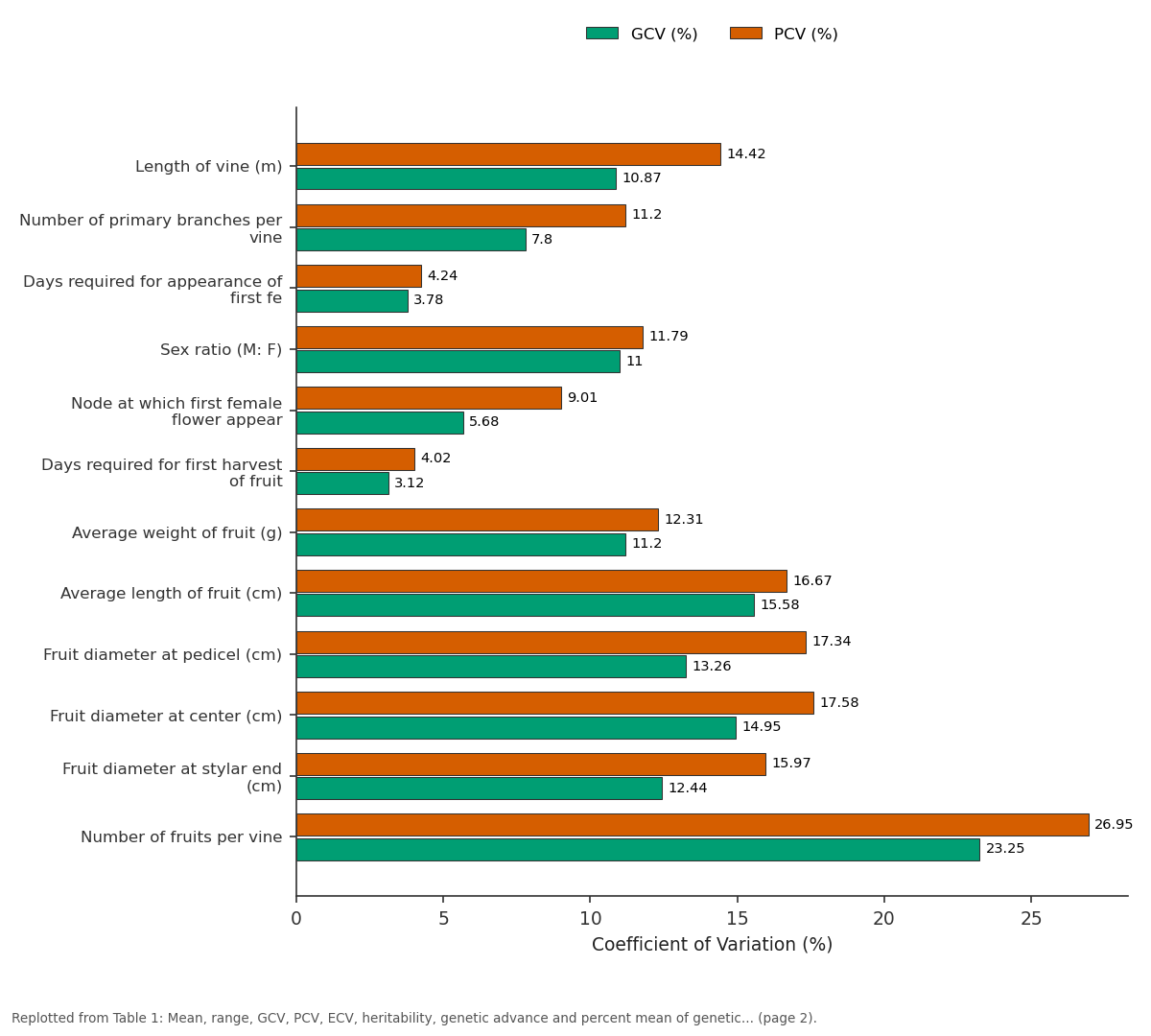
GCV (%) and PCV (%): Length of vine (m) vs Number of primary... vs Days required for... vs Sex ratio (M: F) vs Node at which first...
Replotted from Table 1 (page 2) of the original paper. Every bar is the paper's own table value.
View source evidence ↗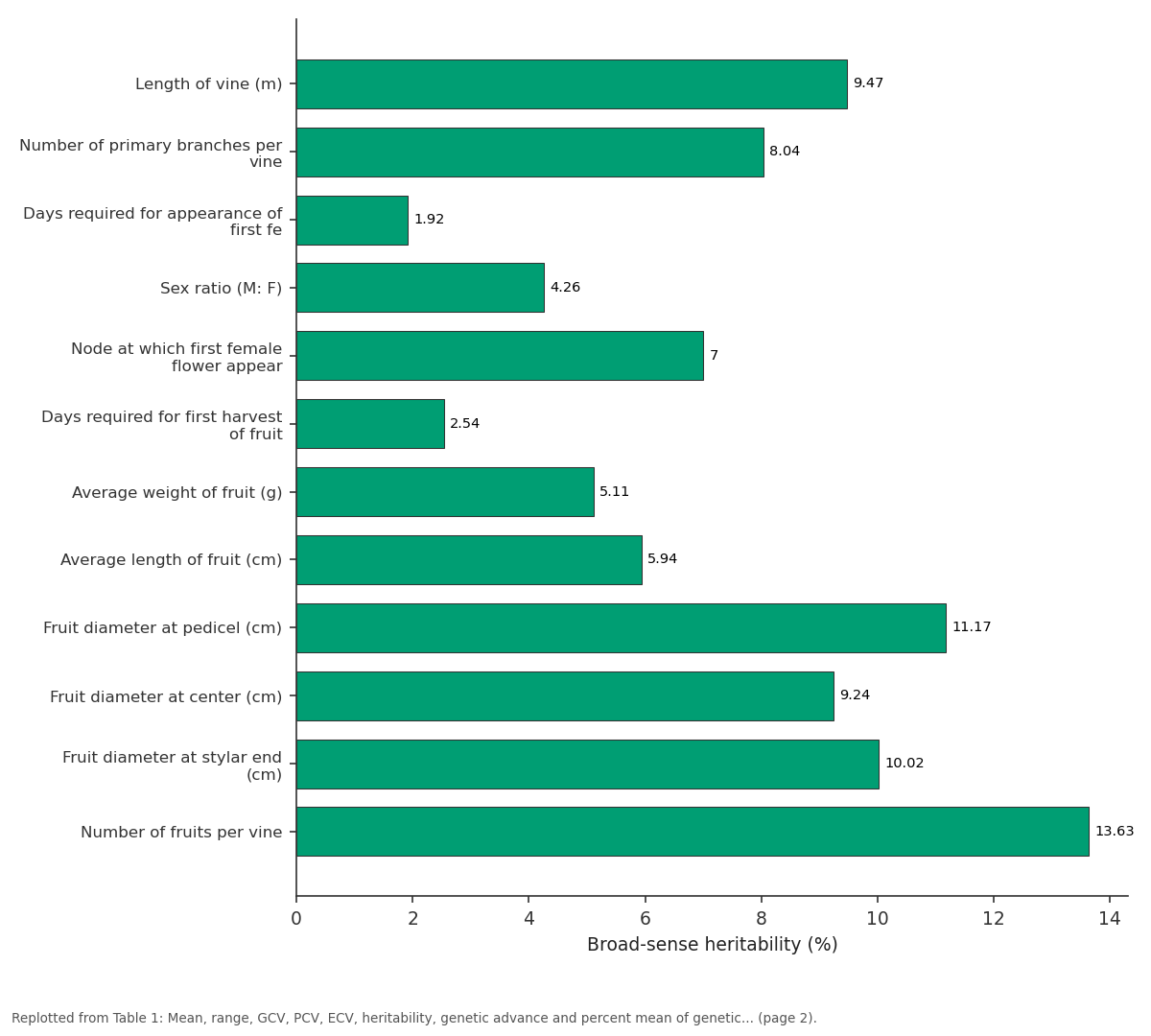
ECV (%): Length of vine (m) vs Number of primary... vs Days required for... vs Sex ratio (M: F) vs Node at which first...
Replotted from Table 1 (page 2) of the original paper. Every bar is the paper's own table value.
View source evidence ↗Figures & tables
From the original paper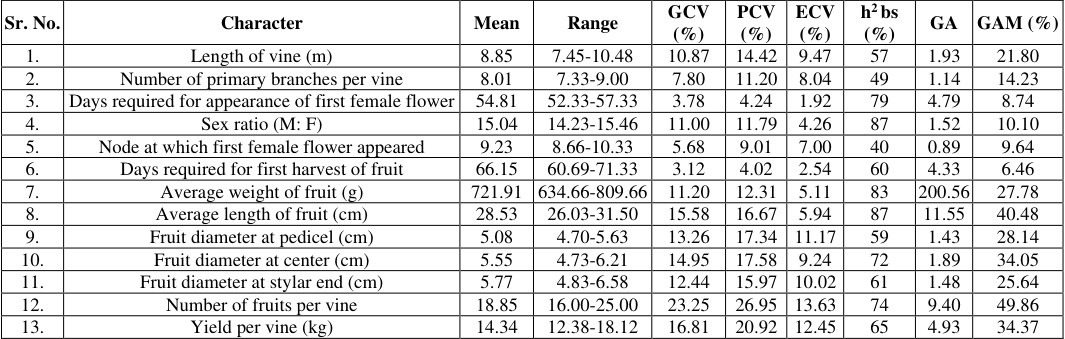 Table 1
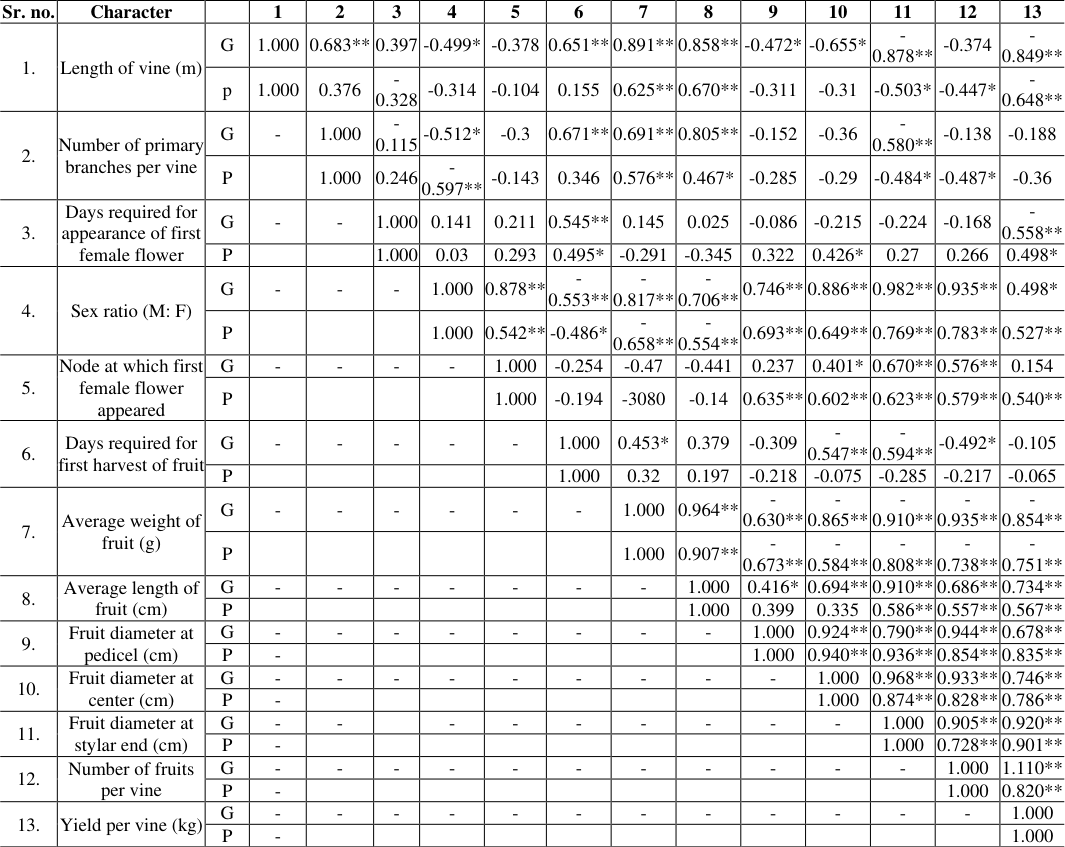 Table 2
Introduction
Calabash [Lagenaria siceraria (Molina) Standl.] is a widely cultivated vegetable belonging to the family Cucurbitaceae, characterized by a chromosome number of 2n=22. Due to its monoecious and andromonoecious floral nature, it predominantly undergoes crosspollination (Swiander and Maccollum, 1994) [24] . Originally domesticated in Africa (Singh, 1990) [20] , bottle gourd spread by floating seeds across seas to India, where it diversified into numerous indigenous varieties. From India, it further dispersed to regions including China, Indonesia, and as far as New Zealand. Although the cultivation area and production of bottle gourd have been rapidly increasing, breeding efforts aimed at crop improvement remain limited. There is a growing demand for varieties exhibiting traits such as early fruiting, higher yields, an elevated female-to-male flower ratio, medium-length cylindrical green fruits, presence of pubescence, and resistance to pests and diseases like fruit fly, downy mildew, powdery mildew, gummosis, and fusarium wilt. To facilitate the incorporation of these desirable horticultural traits, F4 progenies were evaluated for genetic variability, heritability, genetic advance, and trait correlations to support breeding and crop enhancement programs.
Materials and Methods
The present investigation was conducted at the All India Coordinated Research Project on Vegetable Crops, AICRP-VC, MPKV, Rahuri, located in Ahilyanagar district of Maharashtra. The experimental layout followed a Randomized Block Design (RBD) with three replications. The study material comprised five F₄ progenies developed from the cross Pusa Samrudhi × DHARWAD BOTTLE GOURD -5, each consisting of 20 plants along with their respective parental lines. The crop was planted using a spacing of 3 × 1 meters. Observations were recorded on randomly selected plants from the F₄ generation for key growth and yield-related traits, including vine length (m), number of primary branches per vine, days to appearance of the first female flower, sex ratio, node at which the first female flower appeared, days to first fruit harvest, number of fruits per vine, yield per vine (kg), average fruit weight (g), average fruit length (cm), and fruit diameters measured at the pedicel, center, and stylar end.
The estimation of GCV, PCV, as well as GA, was carried out using the method proposed by Johnson et al. (1955) [7] . The coefficients of variation were computed following the approach of Burton and De Vane (1953) [4] , and heritability (broad sense) was estimated as per the formula by Lush (1949) [9] . Correlation coefficients among the traits were calculated using the procedure outlined by Snedecor and Cochran (1967) [23] .
Results and Discussion
A substantial extent of variation was observed among the F₄ progenies for all recorded traits. Vine length ranged between 7.45 and 10.48 m, with considerable diversity also seen in traits such as primary branches per vine (7.33-9.00), days to first female flower (52.33-57.33), and sex ratio (14.23-15.46). The first female flower emerged between the 8.66th and 10.33rd node, while the time to first fruit harvest spanned from 60.69 to 71.33 days. Traits linked to productivity, including number of fruits per vine (16-25), fruit weight (634.66-809.66 g), and yield per vine (12.38-18.12 kg), also showed marked variability. Fruit-related dimensions like length and diameter at various positions (pedicel, center, stylar end) were also notably diverse. Genotypic (GCV), phenotypic (PCV), and environmental (ECV) coefficients of variation demonstrated wide ranges across most parameters, with traits such as number of fruits per vine, yield per vine, and fruit length exhibiting the highest variability. In general, PCV values slightly exceeded GCVs, indicating minimal environmental interference. These patterns align with earlier findings in bottle gourd and muskmelon by researchers like Reddy (1989) [18] , Pandit et al. (2009) [13] , and Mali (2015) [10] . Heritability in the broad sense ranged from moderate to high (40-87%), suggesting that genetic improvement via selection is feasible. Traits like fruit length and fruit number per vine showed high heritability coupled with high genetic advance as a percentage of the mean, indicating that additive gene action is predominant. On the other hand, yield per vine, fruit weight, and fruit diameters exhibited moderate genetic advance with high heritability, suggesting a mix of additive and non-additive genetic effects. Correlation analysis revealed that genotypic associations were generally stronger than phenotypic ones. Yield per vine displayed significant positive correlations with fruit length, number of fruits per vine, sex ratio, and fruit diameters, while vine length and average fruit weight had a negative influence on yield. These interrelationships offer valuable insights for selecting yield-contributing traits in breeding programs. Similar correlation trends have been reported by Kumar et al. (2007) [8] , Gupta et al. (2015) [5] , and others in bottle gourd and related cucurbits.
Figures and tables from the paper
| Sr. No. | Character | Mean | Range | GCV (%) | PCV (%) | ECV (%) | h2 bs (%) | GA | GAM (%) |
|---|---|---|---|---|---|---|---|---|---|
| 1. | Length of vine (m) | 8.85 | 7.45-10.48 | 10.87 | 14.42 | 9.47 | 57 | 1.93 | 21.80 |
| 2. | Number of primary branches per vine | 8.01 | 7.33-9.00 | 7.80 | 11.20 | 8.04 | 49 | 1.14 | 14.23 |
| 3. | Days required for appearance of first female flower | 54.81 | 52.33-57.33 | 3.78 | 4.24 | 1.92 | 79 | 4.79 | 8.74 |
| 4. | Sex ratio (M: F) | 15.04 | 14.23-15.46 | 11.00 | 11.79 | 4.26 | 87 | 1.52 | 10.10 |
| 5. | Node at which first female flower appeared | 9.23 | 8.66-10.33 | 5.68 | 9.01 | 7.00 | 40 | 0.89 | 9.64 |
| 6. | Days required for first harvest of fruit | 66.15 | 60.69-71.33 | 3.12 | 4.02 | 2.54 | 60 | 4.33 | 6.46 |
| 7. | Average weight of fruit (g) | 721.91 | 634.66-809.66 | 11.20 | 12.31 | 5.11 | 83 | 200.56 | 27.78 |
| 8. | Average length of fruit (cm) | 28.53 | 26.03-31.50 | 15.58 | 16.67 | 5.94 | 87 | 11.55 | 40.48 |
| 9. | Fruit diameter at pedicel (cm) | 5.08 | 4.70-5.63 | 13.26 | 17.34 | 11.17 | 59 | 1.43 | 28.14 |
| 10. | Fruit diameter at center (cm) | 5.55 | 4.73-6.21 | 14.95 | 17.58 | 9.24 | 72 | 1.89 | 34.05 |
| 11. | Fruit diameter at stylar end (cm) | 5.77 | 4.83-6.58 | 12.44 | 15.97 | 10.02 | 61 | 1.48 | 25.64 |
| 12. | Number of fruits per vine | 18.85 | 16.00-25.00 | 23.25 | 26.95 | 13.63 | 74 | 9.40 | 49.86 |
| 13. | Yield per vine (kg) | 14.34 | 12.38-18.12 | 16.81 | 20.92 | 12.45 | 65 | 4.93 | 34.37 |
Table text extracted from the original PDF; superscript letters are shown inline. The original table image is below.
View original table image
| Sr. no. | Character | — | 1 | 2 | 3 | 4 | 5 | 6 | 7 | 8 | 9 | 10 | 11 | 12 | 13 |
|---|---|---|---|---|---|---|---|---|---|---|---|---|---|---|---|
| 1. | Length of vine (m) | G | 1.000 | 0.683** | 0.397 | -0.499* | -0.378 | 0.651** | 0.891** | 0.858** | -0.472* | -0.655* | - 0.878** | -0.374 | - 0.849** |
| p | 1.000 | 0.376 | - 0.328 | -0.314 | -0.104 | 0.155 | 0.625** | 0.670** | -0.311 | -0.31 | -0.503* | -0.447* | - 0.648** | ||
| 2. | Number of primary branches per vine | G | - | 1.000 | - 0.115 | -0.512* | -0.3 | 0.671** | 0.691** | 0.805** | -0.152 | -0.36 | - 0.580** | -0.138 | -0.188 |
| P | 1.000 | 0.246 | - 0.597** | -0.143 | 0.346 | 0.576** | 0.467* | -0.285 | -0.29 | -0.484* | -0.487* | -0.36 | |||
| 3. | Days required for appearance of first female flower | G | - | - | 1.000 | 0.141 | 0.211 | 0.545** | 0.145 | 0.025 | -0.086 | -0.215 | -0.224 | -0.168 | - 0.558** |
| P | 1.000 | 0.03 | 0.293 | 0.495* | -0.291 | -0.345 | 0.322 | 0.426* | 0.27 | 0.266 | 0.498* | ||||
| 4. | Sex ratio (M: F) | G | - | - | - | 1.000 | 0.878** | - 0.553** | - 0.817** | - 0.706** | 0.746** | 0.886** | 0.982** | 0.935** | 0.498* |
| P | 1.000 | 0.542** | -0.486* | - 0.658** | - 0.554** | 0.693** | 0.649** | 0.769** | 0.783** | 0.527** | |||||
| 5. | Node at which first female flower appeared | G | - | - | - | - | 1.000 | -0.254 | -0.47 | -0.441 | 0.237 | 0.401* | 0.670** | 0.576** | 0.154 |
| P | 1.000 | -0.194 | -3080 | -0.14 | 0.635** | 0.602** | 0.623** | 0.579** | 0.540** | ||||||
| 6. | Days required for first harvest of fruit | G | - | - | - | - | - | 1.000 | 0.453* | 0.379 | -0.309 | - 0.547** | - 0.594** | -0.492* | -0.105 |
| P | 1.000 | 0.32 | 0.197 | -0.218 | -0.075 | -0.285 | -0.217 | -0.065 | |||||||
| 7. | Average weight of fruit (g) | G | - | - | - | - | - | - | 1.000 | 0.964** | - 0.630** | - 0.865** | - 0.910** | - 0.935** | - 0.854** |
| P | 1.000 | 0.907** | - 0.673** | - 0.584** | - 0.808** | - 0.738** | - 0.751** | ||||||||
| 8. | Average length of fruit (cm) | G | - | - | - | - | - | - | - | 1.000 | 0.416* | 0.694** | 0.910** | 0.686** | 0.734** |
| P | 1.000 | 0.399 | 0.335 | 0.586** | 0.557** | 0.567** | |||||||||
| 9. | Fruit diameter at pedicel (cm) | G | - | - | - | - | - | - | - | - | 1.000 | 0.924** | 0.790** | 0.944** | 0.678** |
| P | - | 1.000 | 0.940** | 0.936** | 0.854** | 0.835** | |||||||||
| 10. | Fruit diameter at center (cm) | G | - | - | - | - | - | - | - | - | - | 1.000 | 0.968** | 0.933** | 0.746** |
| P | - | 1.000 | 0.874** | 0.828** | 0.786** | ||||||||||
| 11. | Fruit diameter at stylar end (cm) | G | - | - | - | - | - | - | - | - | - | 1.000 | 0.905** | 0.920** | |
| P | - | 1.000 | 0.728** | 0.901** | |||||||||||
| 12. | Number of fruits per vine | G | - | - | - | - | - | - | - | - | - | - | - | 1.000 | 1.110** |
| P | - | 1.000 | 0.820** | ||||||||||||
| 13. | Yield per vine (kg) | G | - | - | - | - | - | - | - | - | - | - | - | - | 1.000 |
| P | - | 1.000 |
Table text extracted from the original PDF; superscript letters are shown inline. The original table image is below.
View original table image
References
27 in the original paper- Arunkumar KH, Ramanjinappa V, Hugar A. Association of yield and yield components in F2 population of bottle gourd (Lagenaria siceraria). Plant Archives. 2011;11(1):457-459.
- Arvindkumar N, Singh B, Kumar M, Naresh RK. Genetic variability, heritability and genetic advance for yield and its components in bottle gourd (Lagenaria siceraria). Annals of Horticulture. 2011;4(1):101-103.
- Badade DS, Warade SD, Gaikwad SK. Correlation studies in bottle gourd. Journal of Maharashtra Agricultural Universities. 2001;6(1):20-22.
- Burton GW, De Vane EH. Estimating heritability in tall fescue (Festuca arundinaceae L.) from replicated clonal material. Agron J. 1953;45:478-481.
- Gupta N, Bhardwaj ML, Singh SP, Sood S. Correlation and path analysis of yield and yield components in some genetic stocks of bitter gourd (Momordica charantia L.). SABRAO J Breeding Genet. 2015;47(4):475-481.
- Ibrahim EA. Variability, heritability and genetic advance in Egyptian sweet melon (Cucumis melo var. aegyptiacus L.) under water stress conditions. Int J Plant Breed Genet. 2012;6(4):238-244.
- Johnson HW, Robinson HF, Fatokun CA. Genetic advance in pea (Pisum sativum L.). Madras Agric J. 1955;67:387-390.
- Kumar S, Yadav JP, Srivastava JR, Yadav JR, Shukla IN, Mishra G, et al. Correlation and path coefficient analysis in bottle gourd (Lagenaria siceraria (Molina) Standl.). Progressive Research. 2007;2(1/2):165-166.
- Lush RL. Heritability of quantitative characters in farm animals. Hereditas (Suppl). 1949;35:365-387.
- Mali MD. Genetic studies in F3 and F4 generations of muskmelon (Cucumis melo L.) [PhD thesis]. Rahuri (India): Mahatma Phule Krishi Vidyapeeth; 2015.
- Munshi AD, Sirohi PS. Combining ability estimates in bottle gourd (Lagenaria siceraria). Vegetable Science. 2005;21:132-136.
- Narayan R, Singh SP, Sharma DK, Rastogi KB. Genetic variability and selection parameters in bottle gourd. Indian J Hortic. 1996;53(1):53-58.
- Pandit MK, Mahato B, Sakar A. Genetic variability, heritability and genetic advance for some fruit characters and yield in bottle gourd (Lagenaria siceraria (Molina) Standl.). Acta Hortic. 2009;809:221223.
- Rahuri (India): Mahatma Phule Krishi Vidyapeeth; 2010.
- Prasad R, Prasad A. A note on the heritability and genetic advance in bottle gourd (Lagenaria siceraria (Mol.) Standl.). Indian J Hortic. 1979;36(4):446-448.
- Rakhi R, Rajamony L. Variability, heritability and genetic advance in landraces of melon (Cucumis melo L.). J Trop Agric. 2005;43(1-2):79-82.
- Reddy BP, Begum H, Reddy MT. Variance component analysis of quantitative traits in muskmelon (Cucumis melo L.). Trakia J Sci. 2013;2:118-124.
- Reddy LM. Variability, heritability and genetic advance in tomato (Lycopersicon esculentum Mill.). Andhra Agric J. 1989;36(2-3):123-124.
- Sharma NK, Dhankhar BS, Tewatia AS. Correlation and path analysis in bottle gourd (Lagenaria siceraria (Mol.) Standl.). Haryana J Hortic Sci. 1993;22(1):6266.
- Singh AK. Cytogenetics and evolution in the Cucurbitaceae. London: Cornell University; 1990. p. 10-28.
- Singh KP, Choudhury DN, Mandal G, Saha BC. Genetic variability in bottle gourd (Lagenaria siceraria (Molina) Standl.). J Interacademicia. 2008;12(2):159163.
- Singh KP, Panda PK, Singh AK. Variability, heritability and genetic advance in ash gourd (Benincasa hispida). Haryana J Hortic Sci. 2002;31(12):139-140.
- Snedecor GW, Cochran WG. Statistical methods. 6 th ed. Bombay: Oxford and IBH Publishing Co.; 1967.
- Swiander JM, Ware GW, Maccollum JP. Vegetable crops. Danville (IL): Interstate Publishers; 1994. p. 323340.
- Torkadi SS, Musmade AM. Genetic variability studies in muskmelon (Cucumis melo L.). J Soils Crops. 2007;17(2):308-311.
- Yadav JR, Yadav A, Srivastava JP, Mishra G, Parihar NS, Singh PB. Study on variability, heritability and genetic advance in bottle gourd (Lagenaria siceraria (Molina) Standl.). Progressive Research. 2008;3(1):7072.
- Yadav YC, Kumar DS. Studies on genetic variability, correlation coefficient and path analysis in bottle gourd (Lagenaria siceraria (Molina) Standl.). Ann Hortic. 2012;5(1):80-89.