
Research article · 2025 · Full text
International Journal of Agriculture and NutritionContent analysis of types of animal husbandry information appeared in Marathi newspaper Agrowon
Volume 7(5) · Pages 27–29 · DOI: 10.33545/26646064.2025.v7.i5a.224 ↗
Research areasLinguistics and Language AnalysisEducational Methods and AnalysisDiscourse Analysis in Language Studies
Abstract
Author-writtenMost of farmers who read newspapers are interested in reading about farming-related topics. Newspapers can therefore be a useful tool for educating farmers about technology. As a result, there is potential for agricultural information to be published in regional newspapers. Investigating the study of covering of different agricultural areas is crucial, with a focus on horticulture and a range of sources for farm information. Therefore, the Agrowon daily is focused on rural areas and is regarded by farmers as a valuable source of knowledge on agricultural technology. The study of different agricultural and horticultural areas, the illustrations used in horticulture information, and the sources for articles in the Agrowon newspaper are the focus of the current research. A selection of the Agrowon newspaper's editions from June 1, 2008, to May 31, 2011 was taken into consideration for the purpose of the research. For the study, 122 newspapers were chosen at randomness. Both percentages and frequencies were used to convey the information. About 64.78 percent of Agrowon's publication was allocated to agricultural and horticultural content, while 24.04 percent was allocated to non-agricultural content. About 4.66% of advertisements were about agriculture and horticulture, and 6.52% were about non-agriculture. In terms of agricultural information, other information related to agriculture came in first (72.21%), followed by crop husbandry (13.55%), animal husbandry (10.15%), and agricultural policy (4.06%). The most prevalent four categories were general marketing (21.09%), cash crops (37.97%), animal husbandry general information (29.18%), and agricultural policies finance and insurance (70.54%). About 85% of agricultural advise generally contains details about growing crops technologies.
Summary
Source-checkedPlain-language reading of the full paper, prepared with AI and checked against the text. Each point links to the authors' own words.
Why it matters
- Newspapers serve as an effective tool for educating farmers because those who read them are typically interested in farming-related topics. View evidence ↗
- Agrowon is the first Marathi daily newspaper dedicated exclusively to agriculture, launched by the Sakal group on April 19, 2005. View evidence ↗
- Analyzing the content of agricultural newspapers can help improve the physical composition and quality of printed materials for farmers. View evidence ↗
The question
- The research aims to analyze the types of agricultural and horticultural information, the illustrations used, and the sources of articles in the Agrowon newspaper. View evidence ↗
What they did
- The study randomly sampled 122 editions of the Agrowon newspaper published between June 1, 2008, and May 31, 2011. View evidence ↗
- Researchers measured the frequency and physical space (in square centimeters) of agricultural, horticultural, and non-agricultural information and advertisements. View evidence ↗
- Data analysis was conducted using frequencies and percentages to allow for comparisons and inferences. View evidence ↗
What they found
- Agricultural and horticultural content made up 64.78% of the publication, while non-agricultural content accounted for 24.04%. View evidence ↗
- Within the animal husbandry category, general information was the most prevalent type of content at 29.18%. View evidence ↗
- Specific animal husbandry coverage was led by cows (16.73%), followed by miscellaneous animals (11.74%), buffalo (11.39%), poultry (10.68%), goats (7.47%), fisheries (5.69%), and sheep (4.63%). View evidence ↗
- Across all animal husbandry articles, care and management was the dominant topic (70.82%), while farm mechanization (12.10%), marketing (12.45%), and PHT (4.63%) received significantly less coverage. View evidence ↗
- Coverage for birds like emus and ducks was limited exclusively to handling and treatment (2.49%), with no other types of articles found. View evidence ↗
What it means
- The authors conclude that government extension organizations should use these findings to increase information supply in under-represented agricultural areas and those requested by farmers. View evidence ↗
- The authors note that there is a need for more focused publications regarding agricultural processing and mechanization. View evidence ↗
Visual summary
1 visualsIllustrations explain the paper; charts are replotted from the paper's own table values.
Per cent: Crop husbandry vs Animal husbandry vs Agricultural policies vs Other agricultural...
Replotted from Table 1 (page 2) of the original paper. Every bar is the paper's own table value.
View source evidence ↗Figures & tables
From the original paper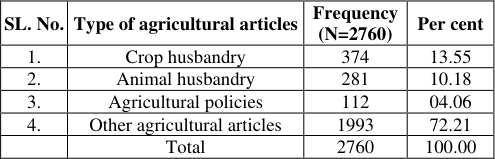 Table 1
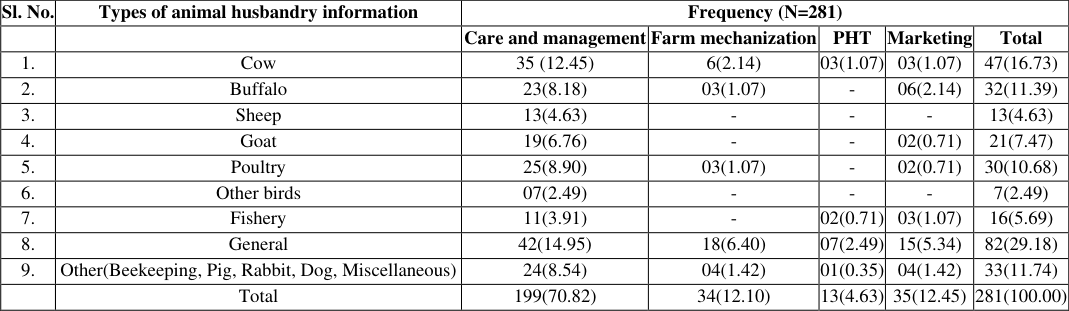 Table 2
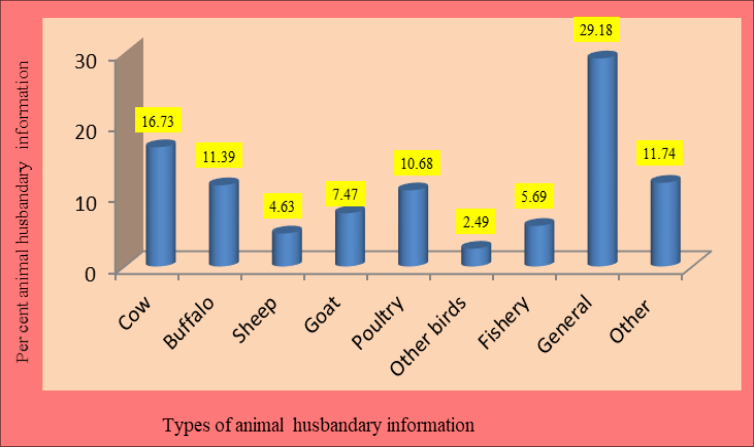 Figure 1
Introduction
Most of farmers who read newspapers have a curiosity in reading about farming-related topics. Newspapers can therefore be a useful tool for educating farmers about technologies. Newspapers in local languages have the potential to provide agricultural-related data (Kalantri et al., 1991) [3] . Examining the extent of the analysis of different agricultural data is crucial. Print media, out of all the mainstream media, are crucial in helping rural communities learn about farms. Newspapers serve a special function in print media since most farmers who read them have a curiosity in reading about farming. On April 19, 2005, the Sakal group of newspapers launched Agrowon, the first Marathi daily exclusively focused on agriculture. The most recent agricultural reports and views, political coverage that impacts farmers' social and economic lives, growth at the national, international, and state levels, farmer achievements, research and development, and new proposals on processing agricultural produce, market rates and trends, weather forecasting, and consumers are all included in Agrowon. In addition, Agowon includes a number of Central and State Government programs, agricultural science and technology, agricultural goods exports, and trade facilities and processes. When it comes to revising and providing farm data for farmers' advantage, this kind of study is believed to be very beneficial to authors, farm authors from State Agricultural Universities, Research Institutions, Developmental Divisions of Government, NGO's, and progressive farmers. The findings of the research will be helpful in enhancing the printed farm material's physical composition. The Maharashtra and Indian governments are placing a strong focus on horticultural growth initiatives.
Therefore, government extension organizations will benefit from the results of the current study, which places a greater focus on content analysis of agricultural data for placing greater emphasis on the information supply in areas that are not as well-known and on areas that farmers have requested in accordance with perceived needs.
Materials and Methods
Among the most well-known farms is Agrowon, and the Agrowon daily newspaper was specifically chosen for the purpose of the research. The sample size used in the study was approximately 122 newspapers, which were chosen at random from the 3 years of June 1 st , 2008 to May 31st, 2011. First, every newspaper issue was carefully examined, and the overall frequency and space addressed by information and advertisements (agricultural, horticultural, and non-agricultural) as well as the time covered by horticultural articles (fruits, vegetables, flowers, spices, and aromatic and medicinal crops) were measured in square centimeters. The figures are presented in terms of percentages and frequencies for easy comparison and to make significant inferences. Content analysis of the information: It is a technique for both observation and interaction analysis. It is a flexible research method for both social science and human communication studies. Where conclusions can be drawn by methodical, scientific analysis of information collected from archival documents. Content analysis of agricultural information: It relates to the classification of large and sub major agricultural regions from the article, the recognition of agricultural and nonagricultural data, and the classification of important farming and related areas in the newspaper. Animal husbandry: The handling and care of cows, buffalo, sheep, goats, poultry, other birds, fisheries, agricultural mechanization, processing, and marketing are all included in this category.
Results and Discussion
Results and Discussion
Articles published on Agricultural information in Agrowon newspaper
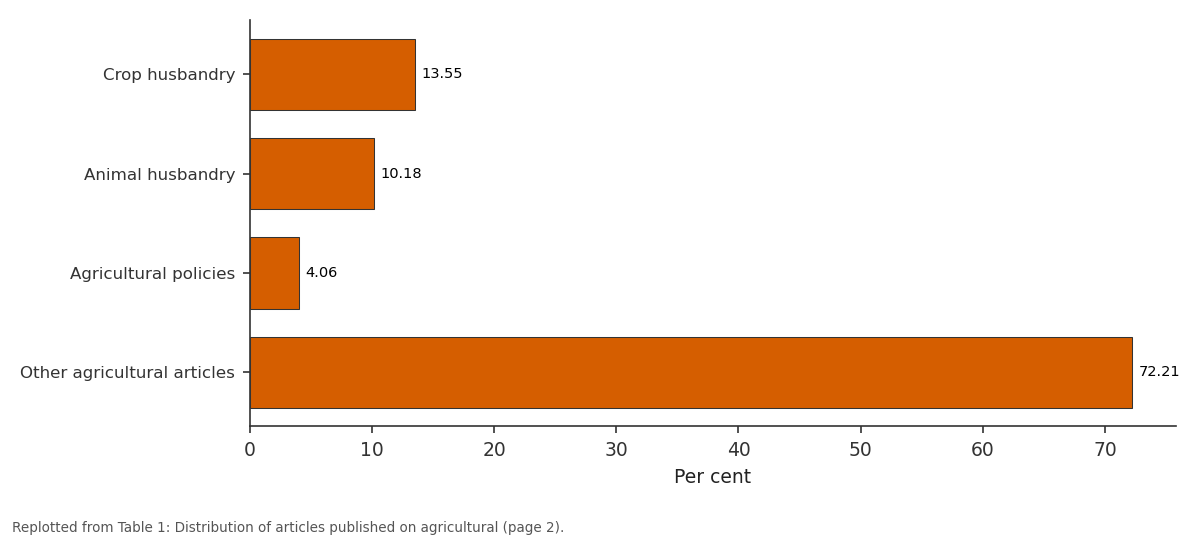
Based on the various regions, the agricultural data was divided into various categories. The frequencies of each category were calculated and are shown in the table. It was noted that, of all the farm-related data published in the Agrowon daily, other agricultural items accounted for the largest percentage (66.70 percent). Crop husbandry was the second most common sort of agricultural information (Mahajan SK et al, 2023) [9] , with Agrowon accounting for nearly one-seventh (13.55%) of all agricultural information. Animal husbandry received a somewhat low weight (10.18 percent). This indicates that agricultural management was given greater weight. Only 4.06 percent of the content was about agricultural policies.
Types of animal husbandry information appeared in Marathi newspaper Agrowon
Based on the kind of animal, the data on animal husbandry was divided into several divisions. The information about animal husbandry that was published in the Agrowon newspaper is displayed in the following table. It includes information about cows, buffalo, sheep, goats, poultry, other birds, fisheries, general information, and other topics. It was noted that, out of all the animal husbandry material in the Agrowon newspaper, overall content accounted for the largest percentage (29.18%). According to the table, broad information was followed by cows (16.73%), then additional articles about animal husbandry that covered topics including beekeeping, pigs, rabbits, dogs, and other topics (11.74%). Fishing (5.69 percent), sheep (4.63%), goat (7.47 percent), buffalo (11.39%), and poultry (10.68 percent) came next. The table showed that the most frequently asked questions about cattle was handling and care (12.45%), followed by agricultural mechanization (2.14%). However, PHT and marketing (1.07 percent) were not as well covered. Care and management came in first among buffalo (8.18%), followed by marketing (2.14%). There were no studies on PHT, and the region covered for farm mechanization was lower (1.07%). Only the care and management data (4.63%) was provided to the sheep. In goats, the most common knowledge was about marketing (0.71%) and care and management (6.76%). Other places, however, were not covered. Knowledge about management & treatment was most prevalent in poultry (8.90%). Less attention was paid to advertising (0.71%) and the automation of agriculture (1.07%). Only information on handling and treatment was provided for the other birds, such as emus and ducks (2.49 percent); data on other articles was not seen in Agrowon, thus there is room for further articles in this area. Caring and management came the first place among fisheries (3.91 percent). There was very little treatment of other topics, such as farm automation, processing, and marketing. Animal care and management accounted for the highest percentage of general data (14.95%), followed by agricultural machinery (6.40%), marketing (5.34%), and processing (2.49%). According to other data, management and care rank highest (8.54 percent), followed by marketing and agriculture mechanization (1.42 percent). As well as processing (0.35%). The results indicate that publications pertaining to processing and agriculture mechanization require more focus. The results are somewhat consistent with those of Abdullah (2000) [1] . On the other hand, Waghmare (2001) [10] and Nagane (2005) [5] confirm their findings.
Figures and tables from the paper
| SL. No. | Type of agricultural articles | Frequency (N=2760) | Per cent |
|---|---|---|---|
| 1. | Crop husbandry | 374 | 13.55 |
| 2. | Animal husbandry | 281 | 10.18 |
| 3. | Agricultural policies | 112 | 04.06 |
| 4. | Other agricultural articles | 1993 | 72.21 |
| Total | 2760 | 100.00 |
Table text extracted from the original PDF; superscript letters are shown inline. The original table image is below.
View original table image
| Sl. No. | Types of animal husbandry information | Frequency (N=281) | — | — | — | — |
|---|---|---|---|---|---|---|
| Care and management | Farm mechanization | PHT | Marketing | Total | ||
| 1. | Cow | 35 (12.45) | 6(2.14) | 03(1.07) | 03(1.07) | 47(16.73) |
| 2. | Buffalo | 23(8.18) | 03(1.07) | - | 06(2.14) | 32(11.39) |
| 3. | Sheep | 13(4.63) | - | - | - | 13(4.63) |
| 4. | Goat | 19(6.76) | - | - | 02(0.71) | 21(7.47) |
| 5. | Poultry | 25(8.90) | 03(1.07) | - | 02(0.71) | 30(10.68) |
| 6. | Other birds | 07(2.49) | - | - | - | 7(2.49) |
| 7. | Fishery | 11(3.91) | - | 02(0.71) | 03(1.07) | 16(5.69) |
| 8. | General | 42(14.95) | 18(6.40) | 07(2.49) | 15(5.34) | 82(29.18) |
| 9. | Other(Beekeeping, Pig, Rabbit, Dog, Miscellaneous) | 24(8.54) | 04(1.42) | 01(0.35) | 04(1.42) | 33(11.74) |
| Total | 199(70.82) | 34(12.10) | 13(4.63) | 35(12.45) | 281(100.00) |
Table text extracted from the original PDF; superscript letters are shown inline. The original table image is below.
View original table image
References
10 in the original paper- Abdullah MA. Content analysis of agricultural information appeared in Syrian farm weekly from Damascus, Syrian. Unpublished M.Sc. (Agri.) thesis. MPKV, Rahuri, 2000.
- Jadhav MC, Shinde SB. Content analysis of Marathi newspaper Agorwon with special reference to sources of farm information. J Agric Res Technol. 2012;37(1):86-87.
- Kalantri LB, Sinha RR, Kubde VR. Attitude of farmers towards newspaper as a source of agricultural information. Maharashtra J Extn Edn. 1991;10(2):158163.
- Khandekar P. A study of effectiveness of farm magazine as related to different categories of readers. Unpublished M.Sc. (Agri.) thesis. Division of Agricultural Extension, I.A.R.I., New Delhi, 1975.
- Nagane RB. Content analysis of agricultural information appeared in leading Marathi newspaper Lokmat from Western Maharashtra. Unpublished M.Sc. (Agri.) thesis. MPKV, Rahuri, 2005.
- Panhale PM. Content analysis of horticultural information appeared in regional leading Marathi newspaper Sakal from Maharashtra. Unpublished M.Sc. (Agri.) thesis. MPKV, Rahuri, 1993.
- Sonzaler S. Content and readability of the farmers section in Momento newspaper Zocastecase, Revista Fitotecinia Mexicana (Mexico), ENE, 1993 June, p. 2129.
- Sawant GK, Shinde SB. Coverage of information on watershed development in two Marathi newspapers from Maharashtra. Maharashtra J Extn Edn. 1999;18:335-337.
- Mahajan SK, Bangar RU, Mahajan MV. Attitude of farmers towards the use of information and communication technology on agricultural production and marketing. Int J Agric Extension Social Dev. 2023;6(1):44-46. DOI:10.33545/26180723.2023.v6.i1a.171
- Waghmare LB. A study of changes in selected farm articles on selected topics published in Shetkari: A leading farm magazine in Maharashtra. Unpublished M.Sc. (Agri.) thesis. MPKV, Rahuri, 2001.