
Research article · 2025 · Full text
International Journal of Agriculture and Food ScienceConsumers acceptance and cost analysis of spices-based ice cream: A proto type study
Volume 7(6) · Pages 76–79 · DOI: 10.33545/2664844x.2025.v7.i6b.441 ↗
Research areasNutrition, Health and Food Behavior
Abstract
Author-writtenA consumer study was carried out involving 124 participants consist of 96 male and 28 females, evaluated the acceptability of spices-based reduced-calorie ice cream. The experimental ice cream received an "excellent" rating from 86% of participants and "good" rating from 14% participants. This result demonstrating strong consumer preference, particularly for its spiced flavour. Cost aspects of the control and experiment ice cream was also evaluated and found that the cost of 1 liter of spices-based ice cream mix was Rs. 148.27 that was 7.52 Rs. higher than the control (vanilla flavoured) ice cream (Rs. 140.76).
Summary
Source-checkedPlain-language reading of the full paper, prepared with AI and checked against the text. Each point links to the authors' own words.
Why it matters
- High-calorie diets, such as those containing standard ice cream, are linked to an increased risk of obesity, diabetes, and cardiovascular diseases. View evidence ↗
- Reducing fat in ice cream often creates challenges with texture and flavor, which can make the product less acceptable to consumers. View evidence ↗
- Cinnamon and bay leaves are recognized for providing health benefits, including antioxidant, anticarcinogenic, and antidiabetic properties. View evidence ↗
The question
- The study aimed to evaluate the cost and consumer acceptance of a reduced-calorie ice cream formulated with cinnamon and bay leaves powder. View evidence ↗
What they did
- The experimental ice cream was made with 0.48% cinnamon and 0.39% bay leaves powder, with a target overrun of approximately 90%. View evidence ↗
- Consumer acceptance was measured via a survey of 124 participants from various societal segments in Amreli. View evidence ↗
- The researchers analyzed consumer acceptance data using percentages to standardize the results against the total sample size. View evidence ↗
- The cost analysis of the product was conducted following the methodology established by Gohil (2021). View evidence ↗
What they found
- All 124 survey participants indicated they would purchase the spice-based ice cream if it were sold at prevailing market prices. View evidence ↗
- The cost per liter of the spice-based ice cream (Rs. 148.28) was higher than that of the vanilla control ice cream (Rs. 140.76). View evidence ↗
What it means
- The authors conclude that the spice-based ice cream is market-viable due to its high consumer acceptability, despite a slight increase in production cost. View evidence ↗
- The authors note that current costs are based on the investigation and could be reduced through efficient overhead and utility management during large-scale production. View evidence ↗
Visual summary
2 visualsIllustrations explain the paper; charts are replotted from the paper's own table values.
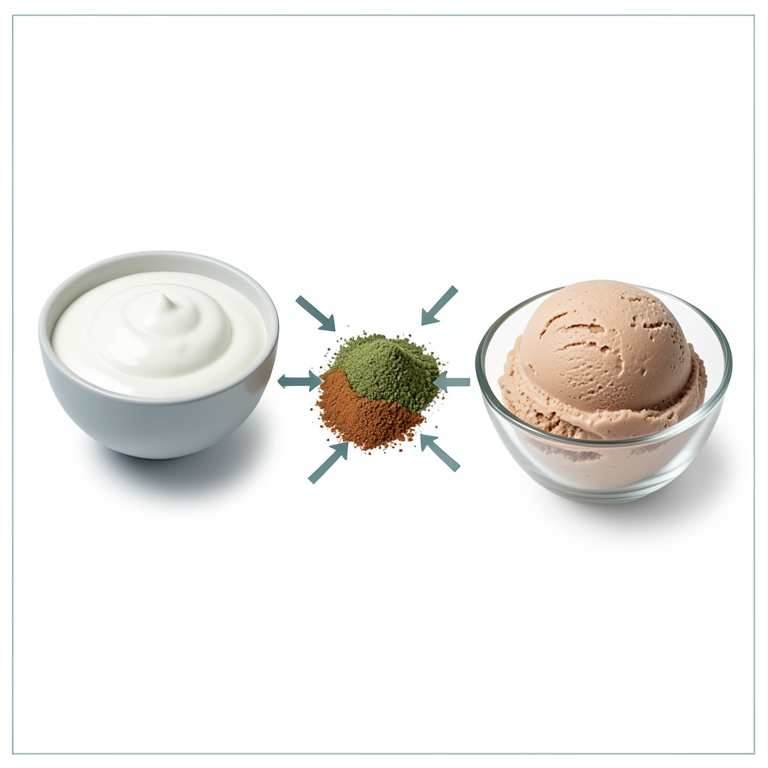
Product Formulation Concept
AI-generated conceptual illustration (Vanilla ice cream with cinnamon and bay leaf powder). It explains the idea and does not show study data.
View source evidence ↗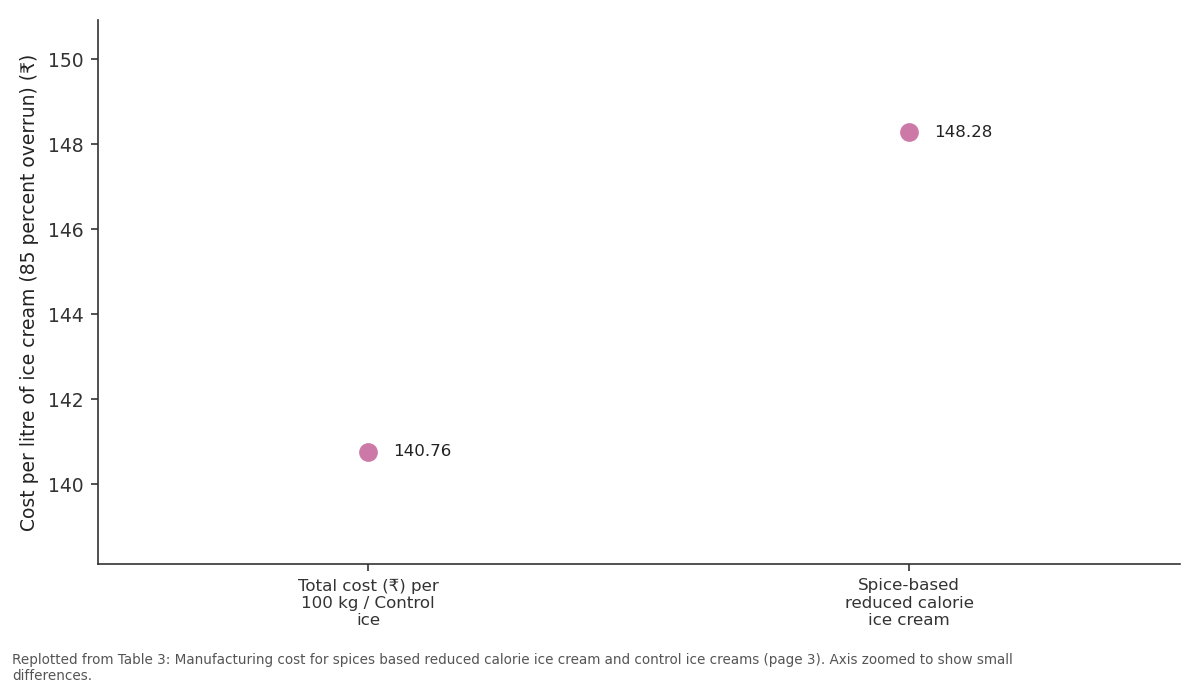
Cost per litre of ice cream (85 percent...: Total cost (₹) per 100... vs Spice-based reduced...
Replotted from Table 3 (page 3) of the original paper. Every bar is the paper's own table value.
View source evidence ↗Figures & tables
From the original paper Table 1
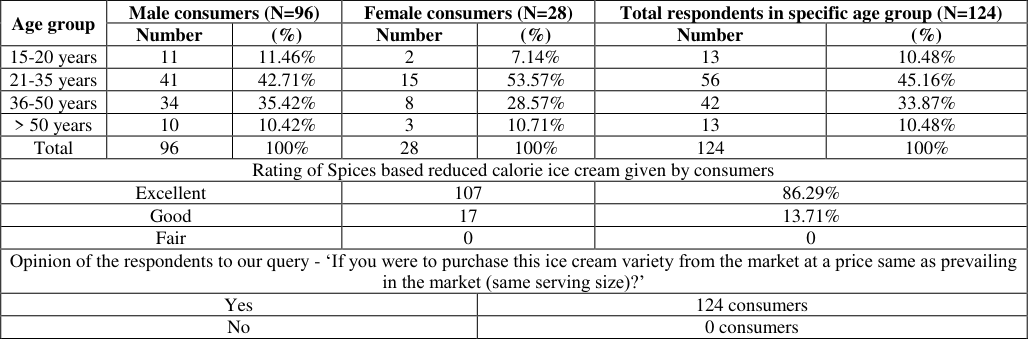 Table 2
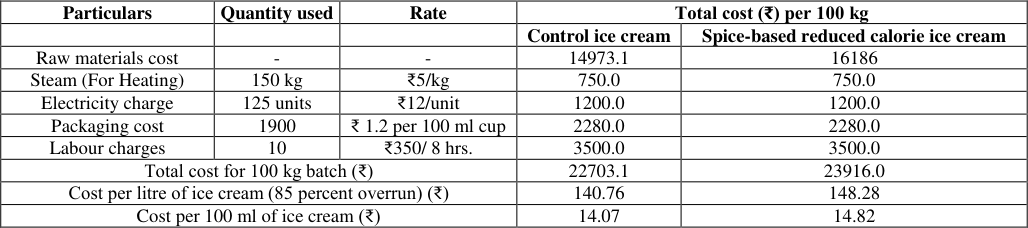 Table 3
Introduction
Ice cream contains about min. 10% milk fat and 15% sucrose, which plays an important role in ice cream in terms of sensory and physical qualities (Akbari et al., 2019) [1] . Consumption of such high calorie diet can lead to increase the occurrence of diseases like diabetes, obesity and cardiovascular disease conditions. However, fat plays an important role on the sensory attributes, body and texture as well as on appearance of the ice cream. Hence, low-fat ice cream formulation poses few complications in flavour and textural issues, which indirectly reduces the consumer acceptance (Zoulias et al., 2002) [14] .
To overcome these problems, some researchers have used hydrocolloid-based fat replacer in low-fat dairy products. Other than hydrocolloid-based fat replacers, polysaccharides, proteins and their combination successfully used to mimic the organoleptic and physical properties of fat molecules in ice cream (Zhao et al., 2023) [13] . Also, many workers attempted to formulate reduced calorie ice cream for calorie conscious consumers using suitable bulking agents, fat replacers and reduced calorie sweeteners (Arora et al., 2001; Limsuwan et al., 2014) [2,12] . Ice cream, also serve the purpose for a good carrier of functional components considering its ability to mask the off taste/ flavour of functional ingredient, if any, up to some extent. Furthermore, people now a days are shifting towards consumption of healthy food over conventional food products. To increase the functional properties office cream, some spices such as black pepper, cinnamon and ginger have been used by several researchers (Khawsud et al., 2020; Chamchan et al., 2017) [10,5] . Cinnamon and bay leaves have a close relationship with Indian culinary culture as well as it has traditional "Ayurveda Shastra" proved the health benefits of these two spices. Moreover, few researchers proved cinnamon and bay leaves have couple of functional and nutraceutical benefits like antidiabetic, anticarcinogenic and anti-oxidants (Cheng, et al., 2012; Singh et al., 2007) [6,8] . Considering all the facts present study was designed to evaluate the consumer acceptability and cost of spices-based ice cream using cinnamon and bay leaves powder.
Material and Methods
All ingredients (Fresh milk, skimmed milk powder (SMP), maltodextrin, polydextrose, maltitol, Whey Protein Concentrate (WPC), stabilizer and emulsifier blend, low-calorie sweetener and spices (cinnamon bark and bay leaves), paper cups and lids, wooden ice cream spoon available for ice cream production was purchased from the local market of Amreli or purchase from the authenticate suppliers.
Polydextrose, maltitol, WPC-80, stabilizer and emulsifier blend were procuredfrom Ice cream ingredient supplier Gujarat Enterprise, Ahmedabad, Gujarat. Ice cream was prepared using the method described by Kumar et al. (2018) [11] .
Cost analysis
Cost analysis was performed as per the method described by Gohil (2021) [7] .
Consumer acceptance analysis
A total of 124 respondents from Amreli, representing various segments of society, participated in the survey. A questionnaire form as shown in table 1, was provided to collect feedback and comments on the product. The demographic profiles of the participants, particularly age and gender, were considered.
| Parameter | Options / Responses |
|---|---|
| Name of the Consumer | |
| Designation (Please tick (√) appropriate option) | □ Student □ Academician □ Service Businessman □ Home maker |
| Gender | □ Male □ Female |
| Age (Years) (Please tick (√) appropriate option) | □ 15-20 □ 21-35 □ 36-50 □ >50 |
| Income per month (Please tick (√) appropriate option) | □ < 10,000 □ 10,000-40,000 □ 41,000-80,000 □ > 80,000 |
| Rate the ice cream | □ Excellent □ Good □ Fair |
Table text extracted from the original PDF; superscript letters are shown inline. The original table image is below.
View original table image
Statistical analysis
The consumer acceptance data was analyzed in percentage term to interpret and compare datasets by expressing values as proportions of a whole group and standardized to a base of 100%. The percentage was calculated by multiplying the number of respondents by 100 and dividing by the total sample size.
Results and discussion
The commercial feasibility of any new flavouring ingredient is largely determined by consumer response. Consumer Acceptance Trials (CAT) are critical in the introduction of newly developed product varieties to the market. In this context, a cinnamon and bay leaves added spiced ice cream prepared using 0.48% cinnamon and 0.39% bay leaves powder and processed to achieve approximately 90% overrun in a batch freezer, was assessed for market acceptance through a consumer survey conducted at Amreli, Gujarat. Responses of the consumers is given in Table 2. A total of 124 respondents from Amreli, representing various segments of society, participated in the survey. A multilingual questionnaire, as shown in Table 1, was provided to collect feedback and comments on the product. The demographic profiles of the participants, particularly age and gender, were considered. Several respondents shared their viewpoints on the sensory attributes of the ice cream, describing it as unique, vibrant, appealing and exotic or possessing a novel taste.
| Age group | Male consumers (N=96) | — | Female consumers (N=28) | — | Total respondents in specific age group (N=124) | — |
|---|---|---|---|---|---|---|
| Number | (%) | Number | (%) | Number | (%) | |
| 15-20 years | 11 | 11.46% | 2 | 7.14% | 13 | 10.48% |
| 21-35 years | 41 | 42.71% | 15 | 53.57% | 56 | 45.16% |
| 36-50 years | 34 | 35.42% | 8 | 28.57% | 42 | 33.87% |
| > 50 years | 10 | 10.42% | 3 | 10.71% | 13 | 10.48% |
| Total | 96 | 100% | 28 | 100% | 124 | 100% |
| Rating of Spices based reduced calorie ice cream given by consumers | ||||||
| Excellent | 107 | 86.29% | ||||
| Good | 17 | 13.71% | ||||
| Fair | 0 | 0 | ||||
| Opinion of the respondents to our query - ‘If you were to purchase this ice cream variety from the market at a price same as prevailing in the market (same serving size)?’ | ||||||
| Yes | 124 consumers | |||||
| No | 0 consumers |
Table text extracted from the original PDF; superscript letters are shown inline. The original table image is below.
View original table image
The cinnamon flavour was particularly well-received, with many participants expressing appreciation for its taste. Respondents also indicated a keen interest in exploring new varieties of ice cream, with some demonstrating awareness of the health benefits associated with spices and raw materials used. Out of total 124 consumers, 96 were male and 28 were female consumers. Total 107 consumers have given "excellent" rating to the prepared ice cream and 17 consumers have given "Good" rating. The spiced flavour was particularly well-received, with many participants expressing appreciation for its taste. Respondents also indicated a strong interest in exploring new varieties of frozen desserts, with some demonstrating awareness of the health benefits associated with the cinnamon and bay leaves. These factors suggest a promising potential for marketing the cinnamon and bay leaves added ice cream to a broader consumer base. From the survey it was observed that the prepared ice cream was innovative approach and consumers have appreciated the product and had a strong potential for commercialization. Brnawi et al., 2018 [4] conducted consumer survey for the prepared cinnamon bark and cinnamon leaf extract strawberry shake. He found that the consumer participants liked and wanted to purchase strawberry shakes with CEO from bark more than those with CEO from leaf. The cost analysis of a product is mostly determined by the raw materials required in its production. An attempt is made to estimate the cost of the product. Prices are based on the raw material price incurred during present investigation (Table 3). Cost of 100 ml vanilla flavoured ice cream was found to be Rs. 14.07 and spices based reduced calorie ice cream was Rs. 14.82. From the calculated price it was observed that the control ice cream was Rs. 0.75 or 5.34 percent cheaper than the experiment ice cream. However, in case of the large-scale production of spices-based reduced calorie ice cream; the cost can be reduced by efficient minimization of overhead as well as utilities expenses. Gohil (2021) [7] reported that the cost of spice-based frozen yoghurt was comparable to that of control frozen yoghurt, differing by only a 7.11% increase in the spice-based frozen yogurt. According to Baria (2021) [3] , estimated selling price for the control frozen dessert was Rs. 58.21 per liter brick and Rs. 5.82 per 100 ml cup, while for CR frozen dessert, it was Rs. 59.51 per liter and Rs. 5.95 per 100 ml cup. Large-scale production may further reduce costs due to higher capacity and multi-product processing. Kumar (2018) [11] calculated the final cost of a 100 ml serving of lemongrass-pista ice cream (with 90% overrun) at Rs. 13.50, compared to Rs. 9.00 for vanilla ice cream. The higher cost of lemongrass-pista ice cream was attributed to the addition of pistachio nuts, comprising 8% of the mix by weight.
| Particulars | Quantity used | Rate | Total cost (₹) per 100 kg | — |
|---|---|---|---|---|
| Control ice cream | Spice-based reduced calorie ice cream | |||
| Raw materials cost | - | - | 14973.1 | 16186 |
| Steam (For Heating) | 150 kg | ₹5/kg | 750.0 | 750.0 |
| Electricity charge | 125 units | ₹12/unit | 1200.0 | 1200.0 |
| Packaging cost | 1900 | ₹ 1.2 per 100 ml cup | 2280.0 | 2280.0 |
| Labour charges | 10 | ₹350/ 8 hrs. | 3500.0 | 3500.0 |
| Total cost for 100 kg batch (₹) | 22703.1 | 23916.0 | ||
| Cost per litre of ice cream (85 percent overrun) (₹) | 140.76 | 148.28 | ||
| Cost per 100 ml of ice cream (₹) | 14.07 | 14.82 |
Table text extracted from the original PDF; superscript letters are shown inline. The original table image is below.
View original table image
Conclusion
The cost per 100 ml of vanilla-flavored ice cream was Rs. 14.07compared to Rs. 14.82 for the spice-based reducedcalorie variant. These calculations indicated that the control ice cream (vanilla-flavored) was Rs. 0.75 less expensive than the spice-based reduced-calorie ice cream. The consumer study showed strong preference for the spicebased reduced calorie ice cream, with 86% rating as "excellent" and 14% as "good". Despite being 5.55% more expensive than the control, the experimental ice cream demonstrated high acceptability, particularly for its spiced flavor, highlighting its potential for consumer satisfaction and market viability.
Acknowledgement
AcknowledgementWe are thankful to Director of Research and Vice Chancellor of Kamdhenu University to provide permission to conduct this study. We are also thankful to principal and dean of College of Dairy Science, for providing whole hearted support to conduct this study. No external fund was provided during this study. There is no conflict of work.
References
9 in the original paper- Akbari M, Eskandari MH, Davoudi Z. Application and functions of fat replacers in low-fat ice cream: A review. Trends Food Sci Technol. 2019;86:34-40.
- Arora S, Nayak SK, Sindhu JS, Seth R. Artificial sweeteners in formulation of dairy products. Indian Food Ind. 2001;20(4):62-65.
- Baria B. Development of carotenoids delivery system for frozen dessert [Dissertation]. Karnal: National Dairy Research Institute, 2021.
- Brnawi WI, Hettiarachchy NS, Horax R, Phillips KG, Seo HS, Marcy J. Comparison of cinnamon essential oils from leaf and bark with respect to antimicrobial activity and sensory acceptability in strawberry shake. J Food Sci. 2018 Feb;83(2):475-480.
- Chamchan R, Sinchaipanit P, Disnil S, Jittinandana S, Nitithamyong A, On-nom N. Formulation of reduced sugar herbal ice cream using lemongrass or ginger extract. Brit Food J. 2017 Oct 2;119(10):2172-2182.
- Cheng DM, Kuhn P, Poulev A, Rojo LE, Lila MA, Raskin I. In vivo and in vitro antidiabetic effects of aqueous cinnamon extract and cinnamon polyphenolenhanced food matrix. Food Chem. 2012 Dec 15;135(4):2994-3002.
- Gohil M. Development of spice-based frozen yoghurt [dissertation]. Anand: Anand Agricultural University, 2021.
- Gurdip Singh GS, Maurya SM, Marimuthu PM, Murali HS, Bawa A. Antioxidant and antibacterial investigations on essential oils and acetone extracts of some spices. J Food Sci. 2007;72(2):114-121.
- Her BY, Sung HY, Choi YS. Effects of oligosaccharide-supplemented soy ice cream on oxidative stress and fecal microflora in streptozotocininduced diabetic rats. J Korean Soc. Food Sci Nutr. 2005;34(10):1536-1544.
Cited by 1
From OpenAlex, OpenCitations and reference lists read by Scinovex
- Spices and Essential Oils in Food Preservation: From Natural Additives to Active Packaging Systems ↗
Оlena Stabnikova, Viktor Stabnikov, Octavio Paredes‐López · Plant Foods for Human Nutrition · 2026
This review provides a systematic analysis of ten spices representing the largest share of global production, with a particular focus on their antimicrobial and antioxidant properties and their role in food preservation. These bioactive properties are of special importance for ensuring food safety, maintaining product quality, and extending shelf life. The review analyzes current approaches to the application of spices…
❝ 1PDF