
Research article · 2024 · Full text
International Journal of Geography Geology and EnvironmentGhaggar river watershed and its impact on their community life
Volume 6(2) · Pages 79–82 · DOI: 10.22271/27067483.2024.v6.i2a.365 ↗
Research areasSouth Asian Studies and ConflictsAgricultural Economics and PracticesLivestock Management and Performance Improvement
Abstract
Author-writtenThe Ghaggar Riverrnan intermittent river flowing through northern India holds historicalrnecological and socio-economic significance. This study explores the GhaggarrnRiver watershed focusing on its geographical characteristics environmentalrnimportance and impact on the lives of people residing in its vicinity. Mainlyrnemphasis is placed on water availability agriculture health migration andrneducation. The research underscores the relationship between watershed healthrnand community wellbeing while suggesting integrated water resource managementrnpractices to sustain both the river ecosystem and human livelihoods. Millions ofrnpeople's livelihoods are at risk due to watershed degradation in third-worldrnnations which also limits their ability to build strong agricultural and bases.rnRising human and animal populations are fast diminishing the basis of naturalrnresources. In a way these lands are being used beyond their carryingrncapability. Population growth puts strain on forests communal lands andrnmarginal agricultural lands which results in improper farming methods forestrnloss and increased grazing intensity that leave a desolate area producingrnundesired sediment and harming stream flow to towns downstream. The primaryrngoals to avoid the weakening of characteristic assets like water soil andrnvegetation. In a bigger sense watershed administration is an exertion tornpreserve the adjustment between human activities and components of the naturalrnenvironment such as vegetation land or water. “This GhaggarrnStream rises within the Sirmour Locale of Himachal Pradesh and streams for 320rnkm through the Indian States of Rajasthan, Punjab and Haryana some timernrecently entering Pakistan. It enters the state of Haryana within the PanchkularnLocale close Kalka voyages through the Panchkula Area to the Mohali Area inrnPunjab enters the Ambala Area of Haryana once more voyages through the PatialarnArea of Punjab once more enters the Kaithal Locale of Haryana once more voyagesrnthrough the Sangrur Locale of Punjab once more enters the Fatehabad Area ofrnHaryana.
Summary
Source-checkedPlain-language reading of the full paper, prepared with AI and checked against the text. Each point links to the authors' own words.
Why it matters
- The Ghaggar River is an intermittent waterway in northern India that is historically, ecologically, and socio-economically important. View evidence ↗
- Watershed degradation in developing nations threatens the livelihoods of millions and hinders the establishment of strong agricultural foundations. View evidence ↗
- Population growth leads to the over-use of forests and agricultural lands, resulting in poor farming practices and increased sediment that disrupts downstream stream flow. View evidence ↗
The question
- The study aims to explore the geographical characteristics and environmental importance of the Ghaggar River watershed and how it impacts local residents. View evidence ↗
- The research specifically emphasizes the effects of the watershed on education, health, migration, agriculture, and water availability. View evidence ↗
What they did
- The study focuses on the Ghaggar Stream, which originates in Himachal Pradesh and flows for 320 km through Haryana, Punjab, and Rajasthan before entering Pakistan. View evidence ↗
- One part of the investigation involved analyzing the physico-chemical attributes of water collected from eleven different sampling sites across the river. View evidence ↗
- Water samples were collected in May 2023 and transported to a laboratory for analysis. View evidence ↗
- The water quality analysis measured parameters including pH, temperature, dissolved oxygen, and various solids and oxygen demands (BOD, COD, TDS, TSS). View evidence ↗
What they found
- The river water was found to have an alkaline pH and total dissolved solids (TDS) levels that exceeded WHO permissible limits. View evidence ↗
- The river consistently receives untreated domestic, industrial, and municipal wastewater along its entire course. View evidence ↗
- Water scarcity forces families to move from farming to wage labor or urban migration, which negatively impacts children's educational stability. View evidence ↗
- Children in water-stressed households often miss school to help with chores, particularly during droughts or peak farming seasons. View evidence ↗
- Poor water quality has increased the prevalence of typhoid, diarrhea, and skin infections, which in turn harms children's school attendance and performance. View evidence ↗
- A lack of drinking water and functional toilets in schools leads to higher absenteeism and dropout rates, especially among adolescent girls. View evidence ↗
What it means
- The authors conclude that a sustainable future for the river and the community requires community participation and integrated watershed management practices. View evidence ↗
- The authors state that more localized studies are needed to further understand the conditions in villages along the river. View evidence ↗
Visual summary
1 visualsIllustrations explain the paper; they do not show study data.
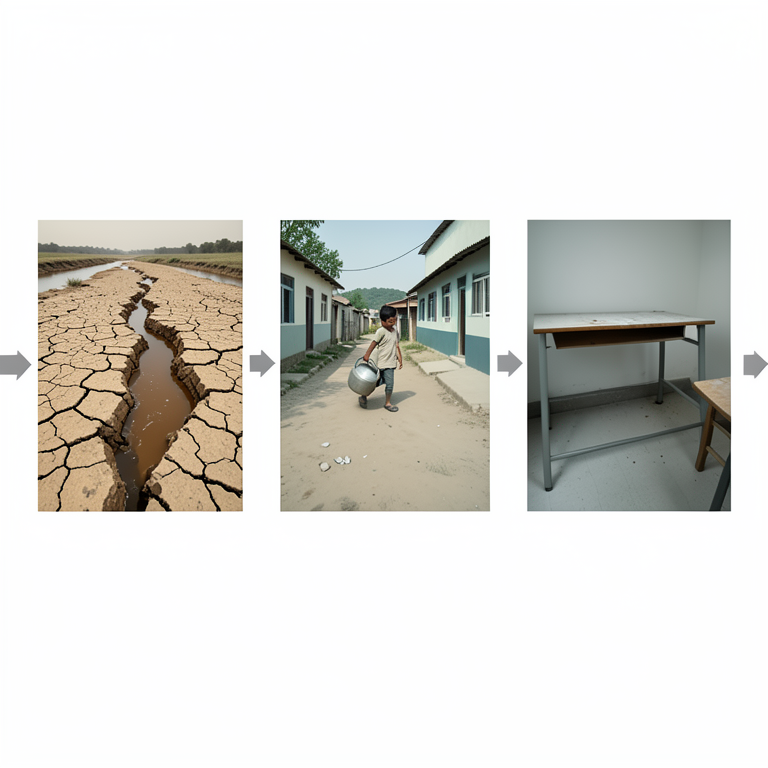
Cycle of Water Insecurity and Educational Decline
AI-generated conceptual illustration (Ghaggar river watershed landscape with rural village houses and a primary school). It explains the idea and does not show study data.
View source evidence ↗Introduction
Today the term 'Watershed' refers to all the land and water areas that produce runoff to a single place. A watershed is a geo-hydrological unit that empties into one location. The land and water areas that drain through any point on a designated channel are collectively referred to as the watershed above that point (often the outlets). To a certain extent the limits of a watershed specify the aerial extent of surface water drainage. Watershed borders usually meet at the lowest point on the ground where water exits the watershed and follow the highest ridgeline around the stream channels. Every body of water has a watershed including rivers, lakes, ponds, streams and estuaries. The topographic line where water flows in two separate directions is referred to as the boundary between watersheds. Two locations that are drained by different streams river systems or lakes are divided by an elevated line known as a watershed (Tidemann 1996) [9] . A watershed might be fairly broad and span thousands of miles or it can be relatively small and just represent one tributary within a larger system (i.e. Mississippi River Watershed). Sediment and other pollutants are transported and dumped into the receiving water body as rainwater or melted snow flows downhill in the watershed. The Ghaggar River known in historical texts as the Sarasvati originates in the Shivalik Hills of Himachal Pradesh and Haryana and flows through Punjab, Haryana and Rajasthan. Though it dries up during the summer months the river plays a vital role in recharging groundwater and supporting agriculture in semi-arid regions. This study investigates the characteristics of the Ghaggar River watershed and evaluates its socio-economic and cultural impact on the population with a particular focus on education health agriculture and migration patterns.
Literature Review
The Ghaggar River often associated with the ancient and possibly mythical Sarasvati River plays a significant role in shaping the ecological and socio-economic framework of northwestern India particularly in the states of Himachal Pradesh Haryana Punjab and Rajasthan. While the hydrological and environmental dimensions of the Ghaggar River basin have been extensively studied its socioeducational impact-particularly on pupil life-remains a relatively under-researched area. This literature review synthesizes existing scholarly works policy documents and regional studies that explore the interplay between watershed health rural livelihoods and educational access in the Ghaggar basin. The objective of the present investigation was to ascertain the physico-chemical attributes of water obtained from eleven discrete sampling sites spanning the whole Ghaggar River. In the month of May 2023, a selection of river water samples was collected and subsequently transported to a laboratory for the purpose of examination. Out of the total of eleven sampling sites samples were obtained from seven locations while the remaining four sites had experienced a depletion of water. The collected samples were analysed to assess the impact of various physical and chemical parameters on water quality. These parameters include temperature pH electrical conductivity (EC) total suspended solids (TSS) total dissolved solids (TDS) total hardness (TH) biochemical oxygen demand (BOD) chemical oxygen demand (COD) and dissolved oxygen (DO). The water of the Ghaggar River exhibits an alkaline pH level. The levels of total dissolved solids (TDS) were observed to exceed the permissible limits set by the World Health Organisation (WHO). The Ghaggar River in the selected research area consistently receives wastewater and/or municipal effluents from various domestic industrial and municipal origins throughout its entire trajectory (Bijendra Kumar Hoon 2023) [10] . The most important and fundamental need for life is water. It is a prerequisite for all activities that sustain life. The surface water found in rivers lakes ponds and dams is typically utilized for power generation, irrigation and drinking. Typically, untreated streams, rivers, wells and boreholes serve as the source of drinking water [1]. The element of water that must be present at the ideal level for the proper growth of plants and animals is referred to as the quality of the water. In order to survive and flourish aquatic species require a nutrient-rich habitat. The physico-chemical properties of the water body determine the productivity. the highest productivity attained at the optimal level of physical and chemical factors. Wetlands give people a lot of environmental goods and services Since the beginning of civilization these have been very important to the survival and growth of society. People in the area make money from wetlands by using the services they offer. Fishing and hunting are two of the most important ones. Other activities include watching birds and going on boats. People in the area have used the idea of ecotourism and the recreational value of wetlands to make money (Bergstrom 1990) [11] and these policies also help achieve the goals of sustainable development at the local and regional level. Wetlands are a good source of water and nutrients that are needed for life to grow (Schuyt 2005) [12] . Vascular plants take up a big part of most wetlands (macrophytes). A variety of macrophytes can make a wetland's habitat more diverse (Keddy 2000; Fennessy and Mitsch 2001) [13,14] . They play a vital role in primary productivity and nutrient cycling (Mitsch and Reeder 1991; Peakall and Burger 2003) [15,16] . Macrophytes in wetlands provide food for waterfowl and other animals that live there. The sediment doesn't move because the roots of the water plants hold it in place and keep it from being carried away (Carpenter and Lodge 1986) [17] . Wetlands can change the way water flows and can be used to get sediments and nutrients from the water (Howard-Williams 1983) [18] . Aquatic plants give oxygen to many creatures that live in and around water (Brix 1997) [19] . Oxygen is also used to kill microbes and turn toxic substances into raw materials that can be used (Reddy et al. 1989; Zhao et al. 2006) [20,21] . Wetlands are often termed as "biological supermarkets" or "kidneys of the landscape" (Mitsch and Gosselink 2000) [22] . Wetlands are the site of water purification. Wetland vegetation such as Scirpus validus (bulrush) Phragmites communis (common reed) and Typha latifola (cattail) are able to get rid of nitrogen which lowers the need for oxygen by living things and the total amount of suspended solids (Gersberg et al. 1986) [23] . The coastal marshes and their plants have been shown to reduce the height of storm surges (Barbier et al. 2013) [24] . Agriculture is a major sector in the economic development of India as it is the source of livelihood for majority of population. The Ghaggar a major river of Haryana originates from the Siwalik Hills of Himachal Pradesh and Haryana. The Ghaggar River flows from east to west and then takes a southwesterly course. During its westward journey a number of streams, streamlets, drains and tributaries debouch their load into the Ghaggar. After flowing through Morni Hills before entering the plains the Ghaggar River is joined by the Kaushalya Nadi in the foothills zone. The small streams viz. Kaushalya Jhajra and Ghaggar get combined together near Chandimandir to form the main Ghaggar River. Further at downstream sites various point and non-point sources are joining the Ghaggar River and discharging their untreated effluents into it. The area under investigation lies between North latitudes 30˚00′00″ to 30°50′00″ and East longitudes 76˚11′24″ to 77˚07′20″ Area under investigation covers parts of different districts of Haryana and Punjab like Panchkula, SAS Nagar (Mohali), Patiala, Ambala and Kaithal (Sukhdev Kundu 2012) [8] .
Socio-economic Impact on Rural Communities
The Ghaggar watershed supports predominantly agrarian communities where economic wellbeing is intrinsically tied to water availability. Verma (2015) [25] noted that the river's seasonal flow patterns have a direct bearing on agricultural productivity food security and income stability. Water scarcity often forces households to shift from agriculture to wage labor or migrate to urban areas which creates a ripple effect on children's access to stable education. Sharma and Kapoor (2019) [26] reported that children from water-stressed households frequently miss school to assist with household chores especially during peak agricultural seasons or periods of drought. The problem is particularly acute in regions where fetching water requires long-distance travel disproportionately affecting girls' school attendance.
Riverine Ecosystems and Public Health
Several studies correlate river degradation with public health challenges. Kumar and Kaushik (2018) [27] evaluated pollution levels in Ghaggar's water across various locations in Haryana and found high concentrations of nitrates industrial waste and microbial pathogens. The poor water quality has led to a spike in waterborne diseases such as diarrhea, typhoid and skin infections-conditions that indirectly affect children's school performance and attendance. Narayan (2020) [28] emphasizes that repeated illness in children due to contaminated water sources results in learning gaps and dropouts. Moreover, government health interventions remain inconsistent in these remote regions exacerbating the impact on educational continuity.
Educational Outcomes and Water Stress
The intersection between water insecurity and education has been studied in broader national contexts though rarely focused on the Ghaggar basin specifically. UNICEF India (2016) [29] concluded that children in water-scarce regions face multiple barriers to schooling: inadequate school sanitation reduced time for study due to domestic water collection duties and frequent absenteeism during illness outbreaks. These conditions are reflected in many villages along the Ghaggar River though more localized studies are needed. Chopra (2014) [30] links school infrastructure development directly to water availability. Schools lacking functional toilets or drinking water are often seen as unsafe especially for adolescent girls who are forced to miss classes or drop out after puberty. In the case of the Ghaggar basin informal reports and local NGO surveys suggest that water shortages affect not only school attendance but also the mental wellbeing of children who experience frequent displacement due to seasonal migration.
Watershed Management and Community Interventions
A number of policy reports highlight the potential of watershed development as a strategy for improving livelihoods and enabling educational access. The Ministry of Rural Development (2018) [31] recommends communityled watershed management to increase water retention enhance agricultural output and stabilize rural economies. Desai and Nambiar (2020) [32] describe successful interventions in Gujarat and Madhya Pradesh where watershed projects led to increased school attendance particularly when programs integrated water access with education health and gender awareness. These models provide replicable frameworks for the Ghaggar basin. In the context of the Ghaggar River Pandey et al. (2021) [33] argue for multi-stakeholder engagement involving local governments school administrations and water management agencies to ensure that environmental resilience is aligned with social development goals including universal primary education. The study reveals a complex and interlinked relationship between the Ghaggar River's ecological health and the socio-educational lives of people especially children. While hydrological and agricultural studies dominate existing research there is an emerging need to examine how water insecurity illness and migration directly and indirectly affect educational access learning quality and pupil wellbeing. A multidisciplinary community-driven approach to watershed and educational planning can bridge these gaps and ensure a more resilient future for the region's children
Conclusion
The Ghaggar River watershed plays a vital role in shaping the lives of people living in its vicinity. Though seasonal and fragile it supports agriculture provides water and holds cultural importance. However inconsistent river flow environmental degradation and climate variability adversely impact education health and livelihoods. By adopting integrated watershed management practices and community participation a sustainable future for both the river and its people can be ensured.
References
33 in the original paper- Singh R. Hydrology and river basin management in India. New Delhi: Sage Publications; 2018. p. 1-320.
- Sharma K. Impact of river drying on rural livelihoods: A study of Ghaggar region. J Rural Dev Stud. 2021;37:45-62.
- World Health Organization (WHO). Guidelines for drinking-water quality. 4th ed. Geneva: WHO; 2011. https://www.who.int/water_sanitation_health/publicatio ns/2011
- Bhattacharya S. Cultural landscapes of the SarasvatiGhaggar river. Indian Archaeol Rev. 2019;45:112-128.
- Khatun R. Water pollution: Causes, consequences, prevention method and role of WBPHED with special reference from Murshidabad district. Int J Sci Res Publ. 2017;7(8):269-277.
- Venkatesharaju K, Somashekar RK, Prakash KL. Study of seasonal and spatial variation in surface water quality of Cauvery river stretch in Karnataka. J Ecol Nat Environ. 2010;2(1):1-9.
- Pareek RK, Khan AS, Srivastva P, Roy S. Assessment of physicochemical properties of Ghaggar river. J Biol Chem Chron. 2018;4(1):19-25.
- Kundu S. Heavy metal pollution of Ghaggar river in upper reaches. Bull Environ Pharmacol Life Sci. 2012;1(2):7-10.
- Webb NJ, Tidemann CR. Mobility of Australian flyingfoxes, Pteropus spp. (Megachiroptera): evidence from genetic variation. Proceedings of the Royal Society of London. Series B: Biological Sciences. 1996 Apr 22;263(1369):497-502.
- Hoon BK. Assessment of physico-chemical parameters of Ghaggar River water in May 2023: impact of anthropogenic activities. Unpublished manuscript. 2023.
- Bergstrom JC. Benefits transfer: procedures, problems, and research needs. Water Resour Res 1990;26(5):1347-1354.
- Schuyt KD. Economic consequences of wetland degradation for local populations in Africa. Ecological Economics 2005;53(2):177-190.
- Keddy PA. Wetland ecology: principles and conservation. Cambridge: Cambridge University Press; 2000.
- Fennessy MS, Mitsch WJ. Creating and restoring wetlands: a whole-ecosystem experiment in self-design. BioScience 2001;51(10):843-852.
- Mitsch WJ, Reeder BC. Modeling nutrient retention of a freshwater coastal wetland: estimating the roles of primary productivity, sedimentation, and denitrification. Ecological Modelling 1991;54(1-2):151172.
- Peakall DB, Burger J. Methodologies for assessing exposure to metals: speciation, bioavailability of metals, and ecological risk. Ecotoxicology 2003;12(14):9-18.
- Carpenter SR, Lodge DM. Effects of submersed macrophytes on ecosystem processes. Aquatic Botany 1986;26:341-370.
- Howard-Williams C. P and N retention in wetlands. Water SA 1983;9(3):121-128.
- Brix H. Do macrophytes play a role in constructed treatment wetlands? Water Sci Technol 1997;35(5):1117.
- Reddy KR, Khaleel R, Overcash MR. Behavior and transport of microbial pathogens and indicator organisms in soils treated with organic wastes. J Environ Qual 1989;18(4):437-447.
- Zhao YQ, Sun G, Allen SJ. Purification capacity of a highly loaded laboratory-scale tidal flow reed bed system with effluent recirculation. Sci Total Environ 2006;363(1-3):229-236.
- Mitsch WJ, Gosselink JG. Wetlands. 3rd ed. New York: John Wiley & Sons; 2000.
- Gersberg RM, Elkins BV, Lyon SR, Goldman CR. Role of aquatic plants in wastewater treatment by artificial wetlands. Water Res 1986;20(3):363-368.
- Barbier EB, Georgiou IY, Enchelmeyer B, Reed DJ. The value of wetlands in protecting southeast Louisiana from hurricane storm surges. PLoS One 2013;8(3):e58715.
- Verma R. Socio-economic implications of water scarcity in the Ghaggar basin. Indian J Rural Dev 2015;34(1):55-69.
- Sharma M, Kapoor N. Educational challenges in waterscarce regions of northern India. J Hum Ecol 2019;65(3):191-198.
- Kumar A, Kaushik A. Assessment of water quality of River Ghaggar and its impact on health in Haryana. Int J Environ Sci 2018;9(4):345-352.
- Narayan S. Waterborne illnesses and educational disruptions: a study in North India. Health Educ J 2020;79(2):172-185.
- UNICEF India. Water, sanitation and hygiene in schools: a status report. New Delhi: UNICEF India; 2016. p. 1-65.
- Chopra R. Water infrastructure and school attendance: a rural study. J Dev Policy Pract 2014;2(2):117-130.
- Ministry of Rural Development. Watershed guidelines: enhancing livelihoods through participatory development. Government of India; 2018. p. 1-90.
- Desai R, Nambiar A. Watershed development and educational inclusion: evidence from Gujarat and Madhya Pradesh. Dev Stud Res 2020;7(1):1-15.
- Pandey A, Yadav R, Sharma V, Singh SK. Watershed management and educational outcomes: aligning environmental and social development goals. J Water Land Dev 2021;49(1-3):58-66.