
Research article · 2025 · Full text
International Journal of Agriculture and Food ScienceStudy on marketing of banana in Kaushambi district of Uttar Pradesh
Volume 7(5) · Pages 355–356 · DOI: 10.33545/2664844x.2025.v7.i5f.423 ↗
Research areasBanana Cultivation and ResearchAgricultural Economics and PracticesFood Science and Nutritional Studies
Abstract
Author-writtenThis study looks at the marketing and processing methods used by banana growers in Uttar Pradesh's Kaushambi area. It is essential to comprehend the potential and difficulties in banana processing and marketing given the rising demand for processed fruits and changing market conditions. The district's 100 banana growers were surveyed using a standardised interview schedule. Analytical instruments such as Garrett's Ranking Technique, cost and margin analysis, and percentage analysis were used. The results show that although most farmers use conventional marketing methods, very few process bananas because of a lack of facilities and connections to markets. A little portion of consumer rupees goes to farmers, while marketing expenses are very significant. The absence of processing facilities, price volatility, and post-harvest losses are the main obstacles. To increase farmers' incomes and decrease losses, the report suggests training for value addition, investing in local processing facilities, and creating effective marketing connections.
Summary
Source-checkedPlain-language reading of the full paper, prepared with AI and checked against the text. Each point links to the authors' own words.
Why it matters
- Bananas are a critical fruit crop in India and serve as a primary income source for small and marginal farmers. View evidence ↗
- The Kaushambi district of Uttar Pradesh is a significant banana-growing region due to its favorable agroclimatic conditions. View evidence ↗
- Banana farmers face reduced revenues because most produce is sold fresh without value addition, a problem exacerbated by poor infrastructure and unorganized marketing. View evidence ↗
The question
- The study aims to analyze the socioeconomic profiles of banana growers, identify marketing channels, calculate costs and price spreads, and evaluate processing and marketing constraints. View evidence ↗
What they did
- The study surveyed 100 randomly selected banana cultivators from major growing blocks in the Kaushambi district of Uttar Pradesh using purposive sampling. View evidence ↗
- The researchers employed percentage analysis, cost and margin analysis, and Garrett's Ranking Technique to analyze the data. View evidence ↗
What they found
- The socio-economic profile shows that 46% of growers are aged 31-50, 40% have secondary education, 55% have small farms (1-2 ha), and 50% earn between Rs. 10,000-30,000 per month. View evidence ↗
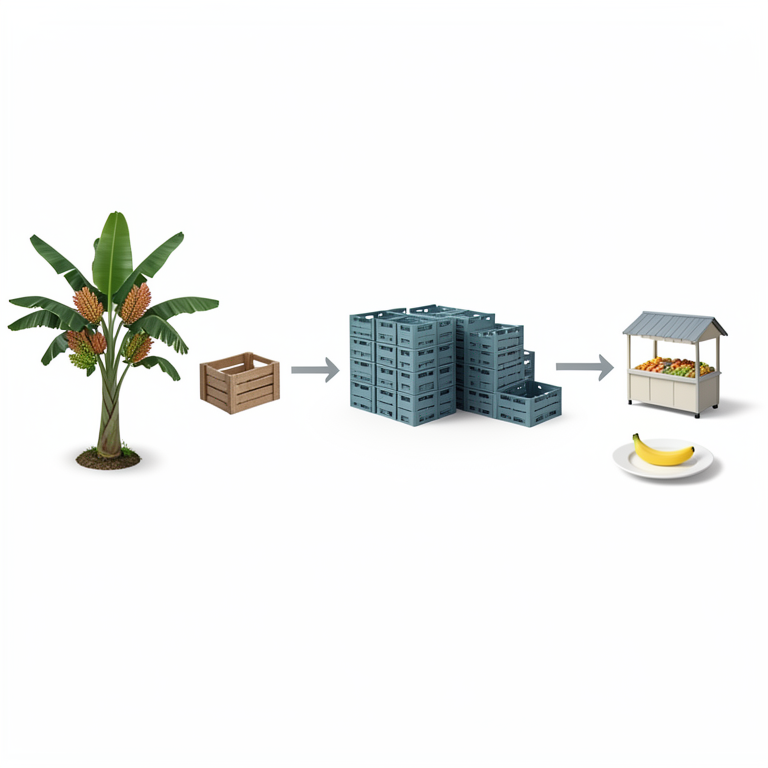
- The most common marketing channel is Channel I (Farmer → Local Trader → Wholesaler → Retailer → Consumer), which is preferred for ease of access despite providing lower returns. View evidence ↗
- With a farmer's selling price of ₹800 and a consumer price of ₹1400 per quintal, the producer's share in the consumer rupee is 57.1%, with marketing costs at ₹150 per quintal. View evidence ↗
- The top constraints identified by Garrett Ranking are the lack of processing units (Rank I, score 72.3), price fluctuation (Rank II, score 65.1), and post-harvest losses (Rank III, score 59.2). View evidence ↗
- Most farmers rely on conventional marketing, and very few engage in banana processing due to a lack of market connections and facilities. View evidence ↗
What it means
- The authors conclude that sustainable income growth for banana farmers requires investments in value addition, training, and public-private partnerships. View evidence ↗
- The authors recommend establishing local processing and cold storage units, providing training on value-added products like chips and pulp, and developing Farmer-Producer Organizations (FPOs). View evidence ↗
Visual summary
3 visualsIllustrations explain the paper; charts are replotted from the paper's own table values.
Banana Marketing Channels
AI-generated conceptual illustration (banana fruit bunches and crates). It explains the idea and does not show study data.
View source evidence ↗
Farmer Constraints Hierarchy
AI-generated conceptual illustration (banana plants and harvested banana bunches). It explains the idea and does not show study data.
View source evidence ↗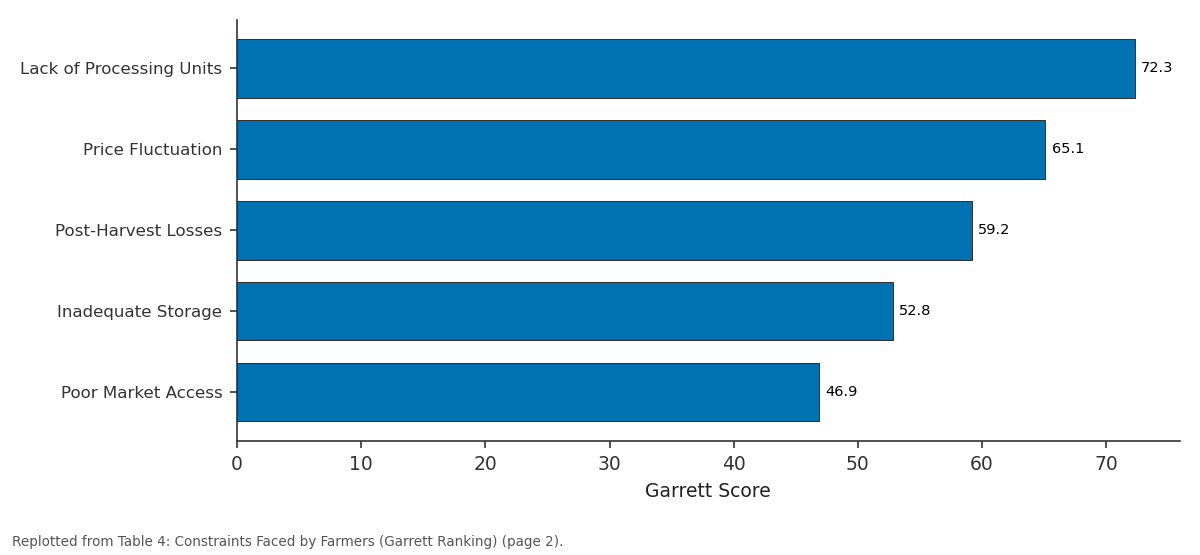
Garrett Score: Lack of Processing Units vs Price Fluctuation vs Post-Harvest Losses vs Inadequate Storage vs Poor Market Access
Replotted from Table 4 (page 2) of the original paper. Every bar is the paper's own table value.
View source evidence ↗Figures & tables
From the original paper Table 1
 Table 2
 Table 3
 Table 4
Results
show that although most farmers use conventional marketing methods, very few process bananas because of a lack of facilities and connections to markets. A little portion of consumer rupees goes to farmers, while marketing expenses are very significant. The absence of processing facilities, price volatility, and post-harvest losses are the main obstacles. To increase farmers' incomes and decrease losses, the report suggests training for value addition, investing in local processing facilities, and creating effective marketing connections.
Keywords: Banana, processing, marketing channels, cost and margin, Kaushambi district
Introduction
A major source of income for small and marginal farmers, bananas are one of the most significant fruit crops grown in India. Kaushambi district in Uttar Pradesh has become a major banana-growing area because of its ideal agroclimatic conditions. Processing, post- harvest management, and marketing provide significant obstacles for farmers despite high output. Farmers receive reduced revenues since a large amount of food is sold fresh with little value added.
The problem is made worse by a lack of organised marketing, inadequate infrastructure, and a shortage of cold storage. The objectives of this study are to examine the socioeconomic characteristics of banana growers, pinpoint current marketing avenues, calculate marketing expenses and price differentials, and appraise processing and marketing limitations. Making recommendations for practical institutional and regulatory changes to increase profitability and lower losses is the aim.
Materials And Methods
The research was conducted in Kaushambi district, Uttar Pradesh. A purposive sampling method was used to select banana cultivators from the major banana-growing blocks. A total of 100 respondents were selected randomly. Data Collection Tools Structured interview schedule. Field observations. Discussions with local traders and cooperatives.
Analytical Techniques 1. Percentage Analysis. 2. Marketing Cost, Margin, and Price Spread Calculation. 3. Garrett’s Ranking Technique for constraint analysis. 4.
Formula: Per cent position = 100(Rij - 0.5)/Nj. NAAS Rating: 4.97 IJAFS 2025; 7(5): 355-356 Sanjeev Pal P. G. Research Scholar, Department of Agricultural Economics, SHUATS, Naini, Prayagraj, Uttar Pradesh, India Dr.
Mukesh Maurya Assistant Professor, Department of Agricultural Economics, SHUATS, Naini, Prayagraj, Uttar Pradesh, India Sanjeev Pal P. G. Research, Department of Agricultural Economics, SHUATS, Naini, Prayagraj, Uttar Pradesh, India https://www.agriculturaljournals.com
Results And Discussion
Table 1: Socio-Economic Profile of Banana Growers Category Frequency Percentage (%) Age (31-50 years) 46 46% Education (Secondary) 40 40% Farm Size (Small: 1-2 ha) 55 55% Income (Rs. 10,000-30,000/month) 50 50% Discussion: Most farmers are in their productive years, moderately educated, and cultivate small land holdings, indicating limited capital and mechanization. Table 2: Existing Marketing Channels for Bananas Marketing Channel Description Channel I Farmer → Local Trader → Wholesaler → Retailer → Consumer Channel II Farmer → Commission Agent → Retailer → Consumer Channel III Farmer → Processing Unit → Packager → Retail Chain Observation: Channel I is the most common due to ease of access, though it offers lower returns to farmers. Table 3: Marketing Cost, Margin, and Price Spread Item Amount (Rs./Quintal) Farmer's Selling Price ₹800 Marketing Cost ₹150 Wholesaler Margin ₹200 Retailer Margin ₹250 Consumer Price ₹1400 Producer’s Share in Consumer Rupee 57.1%
| Item | Amount (Rs./Quintal) |
|---|---|
| Farmer's Selling Price | ₹800 |
| Marketing Cost | ₹150 |
| Wholesaler Margin | ₹200 |
| Retailer Margin | ₹250 |
| Consumer Price | ₹1400 |
| Producer’s Share in Consumer Rupee | 57.1% |
Table text extracted from the original PDF; superscript letters are shown inline. The original table image is below.
View original table image
| Marketing Channel | Description |
|---|---|
| Channel I | Farmer → Local Trader → Wholesaler → Retailer → Consumer |
| Channel II | Farmer → Commission Agent → Retailer → Consumer |
| Channel III | Farmer → Processing Unit → Packager → Retail Chain |
Table text extracted from the original PDF; superscript letters are shown inline. The original table image is below.
View original table image
| Category | Frequency | Percentage (%) |
|---|---|---|
| Age (31-50 years) | 46 | 46% |
| Education (Secondary) | 40 | 40% |
| Farm Size (Small: 1-2 ha) | 55 | 55% |
| Income (Rs. 10,000-30,000/month) | 50 | 50% |
Table text extracted from the original PDF; superscript letters are shown inline. The original table image is below.
View original table image
Discussion
High marketing costs and margins reduce the farmer’s share. Streamlining intermediaries could enhance profitability. Table 4: Constraints Faced by Farmers (Garrett Ranking) Constraint Garrett Score Rank Lack of Processing Units 72.3 I Price Fluctuation 65.1 II Post-Harvest Losses 59.2 III Inadequate Storage 52.8 IV Poor Market Access 46.9 V
| Constraint | Garrett Score | Rank |
|---|---|---|
| Lack of Processing Units | 72.3 | I |
| Price Fluctuation | 65.1 | II |
| Post-Harvest Losses | 59.2 | III |
| Inadequate Storage | 52.8 | IV |
| Poor Market Access | 46.9 | V |
Table text extracted from the original PDF; superscript letters are shown inline. The original table image is below.
View original table image
Discussion
Infrastructure limitations and market risks are the top challenges. Post-harvest losses further reduce income.
Conclusion
The research draws attention to the major processing and marketing difficulties that the banana producers in the Kaushambi area confront. The majority of farmers depend on conventional methods, which restricts their ability to make money. The main limitations include post-harvest losses, price instability, and a lack of processing infrastructure. Sustainable income growth depends on addressing these problems through value-added investment, training, and public-private partnerships.
Recommendations 1. Set up local banana processing and cold storage units through government-private sector collaboration. 2. Conduct training programs on value addition (banana chips, pulp, powder). 3. Develop farmer-producer organizations (FPOs) to enhance collective bargaining and direct marketing. 4.
Implement MSP-like schemes or price support mechanisms for bananas during glut periods. 5. Strengthen road and market infrastructure in banana- growing areas for better connectivity.
References
5 in the original paper- Yadav R, Tiwari M. Marketing channels and constraints in banana marketing. Indian J Agric Mark. 2020;34(2):105-112.
- Kumar V. Post-harvest losses in fruits: a case of banana in Eastern UP. J Agribus Rural Dev. 2019;29(1):45-51.
- Singh D, Prasad R. Role of processing in enhancing banana farmer income. Fruit Sci Res. 2021;38(4):123- 129.
- Government of Uttar Pradesh. Banana Cluster Development Report - Kaushambi. Lucknow: Department of Horticulture and Food Processing; 2023.
- FAO. Banana market review and outlook. Rome: Food and Agriculture Organization of the United Nations; 2022.