
Research article · 2025 · Full text
International Journal of Biology SciencesIncidence and Intensity of infestation by Columbicola columbae, Colpocephalum turbinatum, Companulotes bidentatus compare and Hohorstiella lata (Phthirapterans) on pigeons of Jaunpur District of Uttar Pradesh
Volume 7(5) · Pages 12–18 · DOI: 10.33545/26649926.2025.v7.i5a.339 ↗
Research areasAgricultural pest management studiesAgricultural Practices and Plant GeneticsLivestock and Poultry Management
Abstract
Author-writtenThe present was carried out to document information incidence and intensity of infestation by Columbicola columbae, Colpocephalum turbinatum, Companulotes bidentatus compar and Hohorstiella lata are varies according to seasonal variation. Prevalence and intensity of infestation of phthirapterans lice reported higher in summer (June & July) and lowest in winter (December). Incidence and intensity of infestation of above phthirapterans lice are also depend upon feather condition, hygienic condition, age and breed of pigeon.
Summary
Source-checkedPlain-language reading of the full paper, prepared with AI and checked against the text. Each point links to the authors' own words.
Why it matters
- There is a lack of comprehensive documentation regarding the prevalence of phthirapteran ectoparasites on birds in India. View evidence ↗
- Different species of pigeon lice vary in how harmful they are to the host's weight, vitality, and productivity. View evidence ↗
The question
- The study aimed to determine the prevalence and intensity of infestation by four phthirapteran species on pigeons in the Jaunpur district of Uttar Pradesh during 2004. View evidence ↗
What they did
- The study examined a total sample size of 1,200 pigeons. View evidence ↗
- Lice intensity was recorded via 5-minute observations per species using a coding system ranging from Very Light (1-25 lice) to Very Heavy (over 100 lice). View evidence ↗
What they found
- Overall, 76% of the 1,200 examined pigeons were infested with at least one species of phthiraptera. View evidence ↗
- Among the species, C. columbae had the highest prevalence (73.2%), while H. lata had the lowest (38.6%). View evidence ↗
- Pigeons in poor health showed higher prevalence rates for all four lice species compared to healthier birds. View evidence ↗
- Infestation was more common in older birds (above 19 months) than in younger birds (1-6 months) across all four species. View evidence ↗
- Poor hygienic conditions were associated with higher infestation rates for all four lice species compared to good hygienic conditions. View evidence ↗
- For C. columbae, infestation peaked in June 2004 at 96.6%, compared to a minimum of 52.7% in January 2004. View evidence ↗
- H. lata infestation also peaked in June 2004 (71.6%) and reached its lowest point in January 2004 (14.3%). View evidence ↗
What it means
- The authors concluded that phthirapteran lice infestation is highest during the summer months (June and July) and lowest in winter (December). View evidence ↗
- The authors state that the specific factors causing fluctuations in incidence rates can only be proven through experiments in strictly controlled conditions with a statistically adequate number of pigeons. View evidence ↗
Visual summary
1 visualsIllustrations explain the paper; they do not show study data.
Seasonal Infestation Cycle
AI-generated conceptual illustration (Rock pigeons (Columba livia) and avian lice (Phthirapterans)). It explains the idea and does not show study data.
View source evidence ↗Figures & tables
From the original paper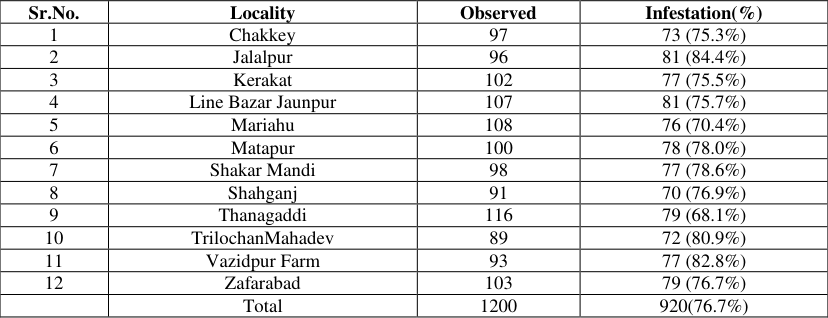 Table 1
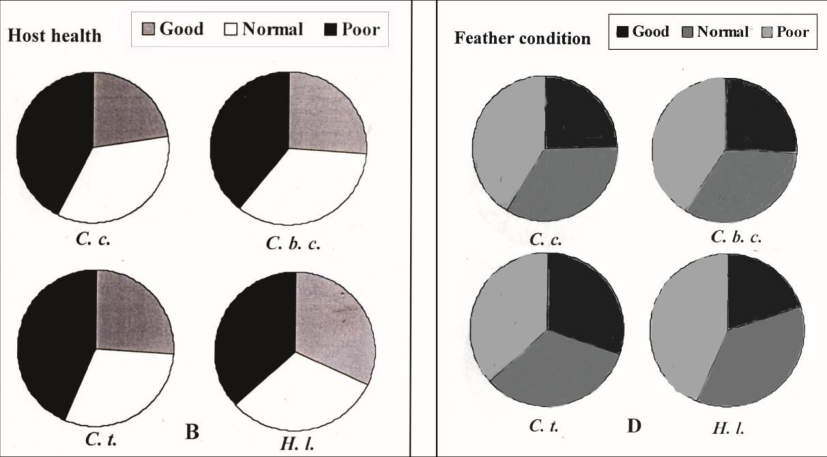 Figure 1
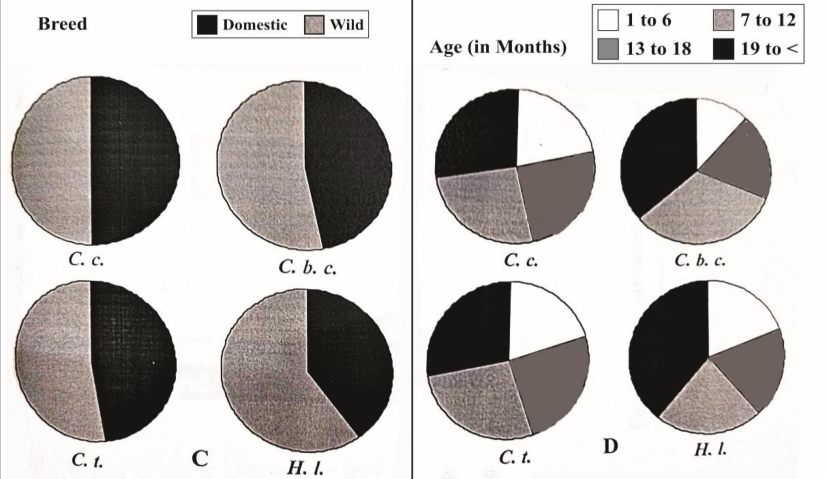 Figure 3
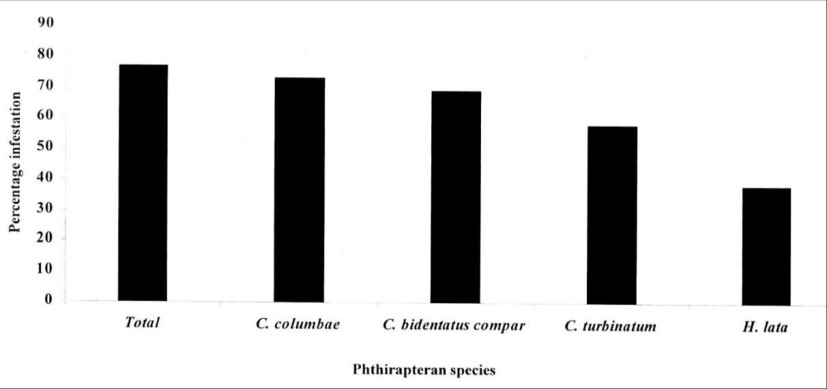 Figure 4
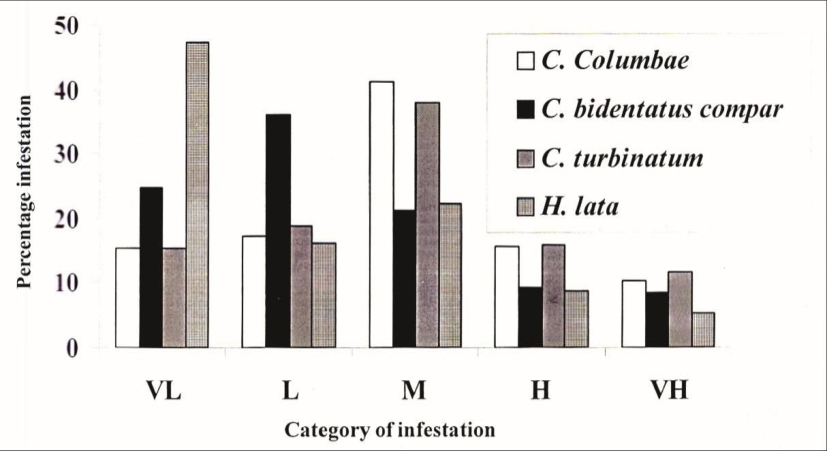 Figure 5
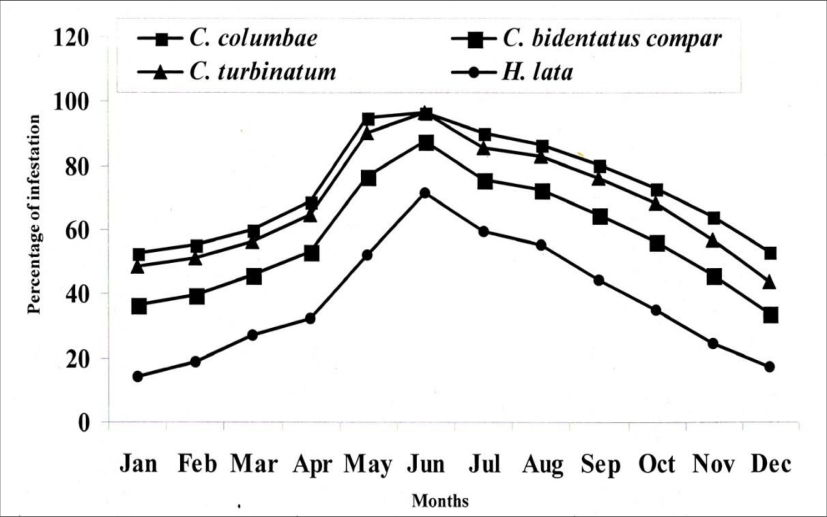 Figure 5
Introduction
Information on the prevalence and intensity of infestation of different phthirapteran ectoparasites on certain avian host viz. sparrows (Hoyle 1938) [12] starlings (Boyd 1951) [21] , blackbirds, orange crowned warblers (Foster 1969), auks (Eveleigh & Threlfall, 1976) [7] procellariiform birds (Fowler et al., 1984) [15] , wood ducks, Wilson`s petrels and storm petrels (Fowler & Price 1987) [22] , manx shear waters (Fowler & Shaw 1989) [16] , five shore bird species (Hunter & Colwell, 1994) [19] , Flea (Galloway TD 2018) fly catchers (Potti & Merino 1995) [20] , bee eaters, has become available. Only a few workers have examined birds belonging to different orders from this point of view (Ash 1960, Brown (1970) has made attempt to study the prevalence rate of four phthirapteran species infesting Pigeons of Boston (U.S.A.). Rekasi et al, 1997 [17] and Rozsa 1997 [17] have discussed the pattern in abundance of avian lice. The prevalence rate of phthirapteran ectoparasites on Indian birds is not well documented (Chandra et al, 1990 [38] , Trivedi et al (1992) [10] recorded the prevalence and intensity of phthiraptera on poultry birds of deharadun. Prevalence of poultry shaft louse, Menopongallinae on poultry birds on Garhwal was noted by Saxena et al. (2004) have noted the different phthirapteran species of henes of Rampur. Present studies deals with the prevalence and intensity of infestation of four phthirapteran species Columbicola columbae & Colpocephalum turbinatum on pigeons of Jaunpur district (Uttar Pradesh) during the year 2004.
Material and Methods
Twelve locality of Jaunpur district (Table 1) were surveyed to record the prevalence and intensity of infestation of four pigeon lice (eg. Columbicola columbae, Colpocephalum turbinatum, companulotes bidentatus compare and Hohorstiella lata) during January 2004 to December 2004. The examined hosts (Columba livia) were domestic as well as wild.
| Sr.No. | Locality | Observed | Infestation(%) |
|---|---|---|---|
| 1 | Chakkey | 97 | 73 (75.3%) |
| 2 | Jalalpur | 96 | 81 (84.4%) |
| 3 | Kerakat | 102 | 77 (75.5%) |
| 4 | Line Bazar Jaunpur | 107 | 81 (75.7%) |
| 5 | Mariahu | 108 | 76 (70.4%) |
| 6 | Matapur | 100 | 78 (78.0%) |
| 7 | Shakar Mandi | 98 | 77 (78.6%) |
| 8 | Shahganj | 91 | 70 (76.9%) |
| 9 | Thanagaddi | 116 | 79 (68.1%) |
| 10 | TrilochanMahadev | 89 | 72 (80.9%) |
| 11 | Vazidpur Farm | 93 | 77 (82.8%) |
| 12 | Zafarabad | 103 | 79 (76.7%) |
| Total | 1200 | 920(76.7%) |
Table text extracted from the original PDF; superscript letters are shown inline. The original table image is below.
View original table image
Worker (Creighton et al 1947) [1] have adopted different coding system for recording the intensity of lice while studying the economic effects of parasitism and eradication measures. In the present study the coding system of Harshbarger & Raffensperger (1961) [3] was adopted along with some modification of Derylo (1974) [4] . During the Present studies prevalence and infestation rate was recorded by timed visual counts as the birds belonged to the private owners/birds keepers. The surveyor had to record the prevalence and intensity of lice infestation without causing any harm to the birds. Hence, the birds legs were tied with rubber band/thread and both the wings, were held by the assistant (in upright position). Bird`s feathers were deflected manually and the presence of lice was observed with the help of magnifying torch. Lice were taken out and placed in vials containing 70% alcohol. Each infested bird was again subjected to 5 minutes observation (for each species) to record the number of lice by coding system (1-25 lice VL, 26-50 lice L, 51-75 lice M, 76-100 lice H, and > 100 lice VH) Observation A total of 1200 pigeons examined during January 2004 to December 2004 in twelve localities of Jaunpur district, 76% were found infested with one or other species of phiraptera (Table 1). Prevalence rate of C. columbae was highest (73.2%) followed by C. turbinatum (68.7%) C. bidentatus compar (57.8), while H. Lata exhibited low rate of prevalence (38.6%), (Figure 1). Out of 1200 pigeons examined, 513 were males and 687 females. Prevalence rate of three species e.g., C. columbae (70.6 and 75.1%), C. turbinatum (66.6 and 70%) and C. bidentatuscompar (56.7 and 58.5%) remained more are less similar on two sexes of the host (fig. 2). However, prevalence rate of H. lata was marginally lower on male birds in contrast to females (34.1 and 41.3%). Thus host sex exerted nil to lesser effect on prevalence rate of different phthirapteran species (Figure 2). An attempt has been made to record the general health (physical condition) of examined host under one of three heads(good, normal and poor). The categorization was solely arbitrary (first glance impression).At least 20.8% pigeons were apparentely in good condition, while 44.4% appeared normal in health and 34.5% place in poor category. The prevalence rate of C. columbae, C. turbinatum, C. bidentatus compare and H. lata remained higher on poor birds (89.1, 88.2, 65.9 and 42.3% respectively) in comparision to healthier ones (47, 52.6, 43.8 and 36.5%, respectively) (Figure 2). In order to observe the impact of crowding on incidence rate, the mode of captivity of examined birds, were also noted. Only 6.4% pigeons were found rared singly, 23.8% in groups of 2-5 and 69.8% in biger groups (more than 6). Bigger groups were found more prevalent (C. Columbae-78.6%, C. bidentatus compar 65.4%, C. turbinatum-71.4% and H. lata-41.3%) in comparison to singly reared (40.3, 35.1, 37.7 and 24.7%, respectively) (Figure 2). Feather condition of examined birds has also been taken in consideration by placing them into one of the three categories (good, normal and poor). Those birds having considerably damaged/ruffled feathers (may be due to continuous preening by host, to get rid of lice) were placed in 'poor' category. Prevalence rate of C. columbae, C. turbinatum, C. bidentatus compare and H. lata was distinctly higher on 'poor plumage' category (80.8, 72.2, 63.5 and 42.6%) in contrast to 'good plumage' category 948.6, 58.9, 40.2 and 19.6%, respectively), (Figure 2). Attempt has been made to record the impact of host feather colour on incidence rate of phthiraptera. As many as 33.1% pigeons had white feathers, 52.5% gray and rest 14.4% placed in other colour (mixed type) category. Prevalence rate of C. columbae on the three groups remained nearly similar (72.2 to 74.3%) (Figure 3), C. bidentatus compare (57.2 to 57.9%) and C. turbinatum (67.1 to 70.1%) also exhibited similar prevalence rate on all the three groups. Prevalence of was considerably higher on mix type category (45.1%) in comparision to other two categories (36.8 and 37.3%), (Figure 3). About 57% pigeons were found domestic breed while 43% wild. Three lice species C. bidentatus compar C. (54.5% and 62.1%), C. turbinatum (65.5% and 72.7%) and H. lata (31.3% and 47.4%) exhibited considerable variation in prevalence rate between domestic and wild breed while C. columbae noted similar (73.1% and 73.3%) in both the category (Figure 3). The hygienic conditions (around the area of maintenance) has noted by placing the infested pigeons in of the three categories-good, average and poor. The incidence rate of all the four species (C. columbae, C. bidentatus compare, C. turbinatum and H. lata) exhibits higher infestation in poor category (82.6%, 64.8%, 78.6% and 41.7% respectively) in comparison to good hygienic condition (40.7%, 33.7%, 34.5% and 15.9% respectively), (Figure 3). The impact of age on the prevalence of pigeon lice were recorded by placing the host in one of the following categories-1-6, 7-12, 13-18 and above 19 months in age. Maximum incidence occurred in aged (above 19 months) birds (C. columbae-80.6%, C. bidentatus compare-78.5%, C. turbinatum-75.5% and H. lata-60.8%) in contrast to younger (1-6 months) birds (62.1%, 25.3%, 54% and 30.5% respectively) (fig. 3). As far as intensity of infestation of C. columbae is concerned, maximum percentage of infested birds (41.2%) bore medium infestation, followed by light (17.2%) and high infestation category (15.8%). Nearly similar percentage of birds exhibited very light infestation (15.4%). State of very heavy infestation was noted on 10.4% infested birds (Figure 4). The intensity of infestation of C. turbinatum on infested pigeon remained more are less similar to C. columbae. Percentage of birds carrying very light, light, medium, heavy and very heavy infestation remained 15.4, 18.9, 38, 15.9 and 11.8% respectively (Figure 4). Maximum percentage of pigeons infested with C. bidentatus compar carried in light infestation (36.2%), followed by very light (24.7%) and medium infestation category (21.2%). Thus, more than 80% pigeons had under very light to medium infestation. Very heavy infestation was recorded only 8.5% pigeons (Figure 4). Most of the pigeon infested with H. lata bore very light infestation (47.3%). Light and medium infestation was noted on 16.1 and 22.4% birds respectively. Percentage of pigeons with heavy and very heavy infestation of H. lata remained quite lower (8.9 and 5.2% respectively), (Figure 4). An attempt has also been made to derive information mean monthly incidence of different species, from the data. All the species exhibited nearly similar trend of seasonal population fluctuation during different months of the year 2004 (Figure 5). In case of C. columbae minimum incidence was noted in January 2004 (52.7%). It gradually builds up during succeeding four months reaching maximum (96.6%) in June 2004. Thereafter, it started decreasing gradually and reached lowest level (53.2%) in December 2004 (Figure 5). In case of C. turbinatum. the incidence was 48.4% in January 2004. It continued rising till June 2004 (96.6%), but exhibited gradual decline thereafter and become lowest in December. Likewise, C. bidentatus compar exhibited lowest incidence in December 2004 (33.9%). It was 36.3% in January 2004, which increase till June 2004 (87.9%). It started declining thereafter during succeeding six months, reaching 45.9% in November 2004 (Figure 5). In case of H. lata, lowest incidence was noted in January 2004 (14.3%). It continued rising till June 2004 (71.6%) but reduced from July 2004 to December 2004 (59.5% to 17.4%, respectively) (Figure 5). Thus, the above said result indicates about the lice population and seasonal atmosphere.
Discussion
The degree of harmfulness of different phthirapterans species of pigeons (in term of loss of weight, viatality and productivity of host birds) is quite variable. M. stramineus(reported by Brown, 1970) [11] was not found upon the pigeons of Jaunpur district, but prevalence of other haematophagus lice (C. turbinatum and H. lata) were found considerable higher in this area. Earlier, Brown (1970) [11] gave some indication about the incidence rate of different ectoparasite on pigeons belong to Boston in U.S.A. and in Uttaranchal respectively. Four phthirapterans species (e.g. C. columbae, C. bidentatus compar, H. lata, C. turbinatum recorded along their prevalence rate as 49.7, 45.7, 1.4, and 0.02% respectively) has been reported from U.S.A. The occurance of Menacanthus stramineus on the pigeons of Jaunpur has not been noted during present studies. However, another amblyceran, C. turbinatum occurred very frequently and ranked second in the order of prevalence rate (C. columbae-73.2% > C. turbinatum-68.7% > C. bidentatus compare-57.8% > H. lata-38.3%). Out of these four species, C. columbae and C. bidendatus compare are feather feeding, sluggish Ischnocera while other two are amblycerans. C. turbinatuma non-heamatophagous, feather deeding species cannibalism (Nelson, 1971) [5] While H. lata is an active exclusively heamatophagous (consumes host blood in addition to feather derivatives) species. Obviously, this species must be potentially most harmful (with respect to health and productivity of host birds). Incidentally, the prevalence rate of this louse on pigeons of Jaunpur has been found to be the lowest (as compared to other three lice species). The impact of host sex, weight and age (on the incidence of avian lice) has been noted occasionally by few workers (Eveleigh &Threlfall, 1976; Potti & Merino, 1995) [7,20] . In case of domestic ungulates incidence rate of phthirapteran species has been reported to higher on females. However, in case of avian phthiraptera, authors have provided conflicting reports on the subject (Ash, 1960) [14] . During present studies sex related difference in the prevalence rate of different species remained more or less negligible. Poor health of host found more prevalent than the birds having good and normal health. It may be due to the sluggish nature of the host during unhealthy condition. Singly reared birds exhibited comparatively lower incidence than those maintained in groups (2-5 or more than 6). As per expectation the pigeons with poor plumage exhibited higher prevalence rate of (in case of all four species) than other two categories. Although, it is difficult to ascertain whether the pigeons having poor plumage are more prone to lice infestation or heavy infestation results in greater destruction of feathers as lousy hosts perform frequent preening and are also engaged in the body, in order to get rid of lice, Saxena et al. (1995) [8] also found higher incidence of M. gallinae on poultry with poor plumage. Saxena et al. (1995) [8] did not find any impact of host feather colour on the prevalence rate of M. gallinae. Slight differences in prevalence rate of different species recorded during present studies with respect to feather colours of pigeons may be circumstantial and evidently the feather colour appears to have nil to negligible effect. The prevalence rate of phthirapterans were found equal in domestic as well as wild breed pigeons. The impact of host age on prevalence rate of lice appears to be quite evident. In the present study the incidence rate gradually increased with age and remained about 1.5 time higher in older birds (above 19 months) than the younger ones (1-6 month in age). The actual cause behind these finding is difficult to ascertain at present and need more investigation. In accordance with the general belief, the neatly maintained bird showed lesser prevalence than poorly or normally maintained host. During present studies prevalence rate remained higher during the month of Jun. Avian lice generally peak in summers (Eveleigh &Threlfall, 1976 and Saxena et al, 1995) [7,38,21] . Apart from environmental factors (temperature, relative humidity, phooperiod, rainfall etc.). Many biological factors (moulting, grooming, preening, nestling, breeding, deformities etc.) reportedly influence louse population. However, factors responsible for fluctuation in incidence rate can only be demonstrated by conducting experiment under extremely controlled condition (after harbouring statistically adequate number of pigeons). The intensity of infestation exhibited normal distribution pattern in case of C. columbae and C. turbinatum. However in case of H. lataand also C. bidentatus compare most of infested hosts (more than 80%) bore very high, light and moderate infestation. On the other hand, percentage of very heavily and heavily infested host remained considerably lower.
References
47 in the original paper- Creighton JT, Hetrick LA, Hunt PT, Dunean DU. The application of chlorinated hydrocarbon to the soil and roots effectively controls lice on poultry. Poult Sci. 1947;31(6):713-715.
- Warren DC, Eaton R, Smith H. Influence of infestation of body lice on egg production in the hen. Poult Sci. 1948;27(11):641-642.
- Harshbargar JC, Raffensperger EM. An evaluation of coding system for estimating populations of the shaft louse, Menopon gallinae. J Econ Entomol. 1961;54(1):74-76.
- Derylo A. Studies on economic harmfulness of Mallophaga (I). Med Wet. 1974;30(7):353-357.
- Nelson BC. Successful rearing of Colpocephalum turbinatum (Phthiraptera). Nature (Lond). 1971;232(5318):255.
- Brown NS. Distribution of Menacanthus stramineus in relation to chicken's surface temperature. J Parasitol. 1970;56(4):1205.
- Eveleigh ES, Threfall W. Population dynamics of lice (Mallophaga) on auks (Alcidae) from Newfoundland. Can J Zool. 1976;54(7):1694-1711.
- Saxena AK, Kumar A, Singh SK, Surman. Prevalence of Menopon gallinae Linne (Phthiraptera, Amblycera) on poultry birds of Garhwal. J Parasit Dis. 1995;19(2):69-72.
- Boyd EM. A survey of parasitism of starling, Sturnus vulgaris L, in North America. J Parasitol. 1951;57(1):56-84.
- Trivedi MC, Saxena AK, Rawat BS. Incidence of Mallophaga on poultry in Dehradun (India). Angew Parasitol. 1992;33(1):69-78.
- Brown NS. Distribution of Menacanthus stramineus in relation to chicken's surface temperature. J Parasitol. 1970;56(4):1205.
- Hoyle WL. Transmission of poultry parasites by birds (House sparrow and chickens). Trans Kans Acad Sci. 1938;41:379-384.
- Galloway TD. Biodiversity of ectoparasites: lice (Phthiraptera) and fleas (Siphonaptera). In: Foottit RG, Adler PH, editors. Insect biodiversity: science and society. 2 nd Ed. Hoboken, NJ: Wiley, 2018, p. 457-482.
- Dougherty ER, Carlson CJ, Bueno VM, Burgio KR, Cizauskas CA, et al. Paradigms of parasite conservation. Conserv Biol. 2016;30(4):724-733.
- Fowler JA, Millar CJ, Cohen S. Ectoparasitic population from breeding and wandering storm petrels. Birds Study. 1984;31(2):126-130.
- Fowler JA, Shaw GJ. The Mallophaga of many shearwaters, Puffinus P. from Ynys Enlli, Wales. Seabird. 1989;12(1):14-19.
- Rekasi J, Rozsa L, Kiss BJ. Pattern in the distribution of avian lice (Phthiraptera: Amblycera, Ischnocera). J Avian Biol. 1997;28(2):150-156.
- Kristofic J, Manas P, Sustek K. Ectoparasites of beeeaters (Merops apiaster) and arthropods in their nests. Biologia Bratislava. 1996;51:557-570.
- Hunter JE, Colwell MA. Phthirapteran infestation of five shorebird species. Wilson Bull. 1994;106(3):400403.
- Potti J, Merino S. Louse loads of pied flycatchers: effects of host sex, age, condition, and relatedness. J Avian Biol. 1995;26(3):203-208.
- Boyd EM. A survey of parasitism of starling, Sturnus vulgaris L., in North America. J Parasitol. 1951;57(1):56-84.
- Fowler JA, Price RA. A comparative study of the ischnoceran Mallophaga of Wilson's Petrel Oceanites oceanicus and British storm petrel Hydrobates pelagicus. Seabird. 1987;12(1):43-49.
- Agrawal GP, Gupta PD. Effect of low temperature on viability of eggs of Falcolipeurus frater (Giebel) (Mallophaga: Ischnocera). H.D. Srivastava Common. 1970;621-636.
- Agarwal GP, Saxena AK. Studies on seasonal dynamics of Lipeurus lawrensistropicalis Peters (Phthiraptera: Ischnocera) infesting poultry birds. Zeitschrift für Angewandte Entomologie. 1979;88(5):470-476.
- Agarwal GP, Saxena AK. Feeding behavior of Lipeurus lawrensistropicalis Peters (Phthiraptera: Ischnocera) infesting poultry birds. Zeitschrift für Angewandte Entomologie. 1980;89(5):425-427.
- Agarwal GP, Saxena AK. Oviposition in Lipeurus lawrensistropicalis Peters, an ischnoceran Phthiraptera. Zool Mag. 1982;31:18-22.
- Alicata TE, Kartman L, Mishida T, Palafox AL. Efficacy of certain sprays in control of lice and mites of chickens. J Econ Entomol. 1947;40(6):922-923.
- Allen NN, Dicke RJ. Cattle lice control by clipping. J Econ Entomol. 1954;45(6):970-973.
- Amin OM, Madbouly MH. Distribution and seasonal dynamics of a tick, a louse fly, and a louse infesting dogs in the Nile valley and delta of Egypt. J Med Entomol. 1973;10(3):295-298.
- Amin-Bajbee SM, Lee CC, Mohna SS. Parasites of the house crow (Corvus splendens). J Vet Malaysia. 1993;5(1):50-60.
- Ansari MAR. Mallophaga found on domestic fowl, Gallus domesticus Linn., in Punjab. Indian J Entomol. 1943;5:129-142.
- Ansari MAR. Mallophaga (Amblycera) infesting birds in the Punjab (India). Proc Natl Acad Sci India. 1951;17:127-203.
- Ansari MAR. Synoptic table for the determination of Mallophaga infesting the domestic fowl (Gallus gallus domesticus). Indian J Entomol. 1955;17(2):245-270.
- Arora GL, Chopra NP. Observations on the life history of Lipeurus lawrensistropicalis Peters (Mallophaga: Ischnocera). Res Bull Panjab Univ Sci. 1959;10(11):179-187.
- Askew RR. Parasitic insects. London: Heinemann Educational Books; 1971.
- Ash JS. A study of the Mallophaga of birds with particular reference to their ecology. Ibis. 1960;102(1):93-110.
- Chandra S, Agarwal GP, Saxena AK. Distribution of Mallophaga on the body of Acridotheres tristis (Aves). Angew Parasitol. 1989;30:39-42.
- Chandra S, Agarwal GP, Singh SPN, Saxena AK. Seasonal changes in a population of Menacanthus eurysternus (Mallophaga, Amblycera) on the common myna, Acridotheres tristis. Int J Parasitol. 1990;20(9):1063-1065.
- Chandra S, Maurya N, Singh SK. Site specificity of chicken body louse Eo Menacanthus stramineus (Insecta, Phthiraptera, Amblycera, Menoponidae). Rudolstädter Naturh Schriften. 2004;12:143-146.
- Charnley HW. Population dynamics of Bovicola bovis with notes on Hypoderma bovis, Hatch 476. Ann Rep July 1, 1967. Unpublished.
- Heath ACG. The biology and survival of starved cattle and goat biting lice (Mallophaga) at different temperatures and relative humidities. N Z Entomol. 1973;5:330-334.
- Hindle E. Notes on Rickettsia. Parasitology. 1921;13(2):152-159.
- Hoi H, Darolová A, König C, Kristofík J. The relation between colony size, breeding density, and ectoparasitic loads of adult European bee-eaters (Merops apiaster). Écoscience. 1998;5(2):156-163.
- Hopkins DE. In vitro colonization of the sheep biting louse, Bovicola ovis. Ann Entomol Soc Am. 1970;63(4):1196-1197.
- Hopkins DE, Chamberlain WF. In vitro colonization of the goat biting lice, Bovicola crassipes and B. limbata. Ann Entomol Soc Am. 1969;62(4):826-828.
- Hopkins DE, Chamberlain WF. Sheep biting louse: Notes on the biology of lice reared off the host. Ann Entomol Soc Am. 1972;65(5):1182-1184.
- Hopkins GHE. The host associations of the lice of mammals. Proc Zool Soc Lond. 1949;119(2):387-604.