
Research article · 2025 · Full text
International Journal of Agriculture and Food ScienceStudy on consumer's perception towards organic product (Jaggery) in Patna, Bihar
Volume 7(5) · Pages 312–314 · DOI: 10.33545/2664844x.2025.v7.i5e.417 ↗
Research areasAgricultural Economics and Practices
Abstract
Author-writtenThis study investigates consumer perceptions towards organic jaggery in Patna, Bihar, focusing on their socio-economic profiles, awareness levels, and consumption habits. A total of 100 respondents were surveyed from 12 villages in Patna, using both qualitative and quantitative research methods. The study reveals that 35% of respondents are aware of organic jaggery and prefer it due to its health benefits, such as higher mineral content, improved digestion, and absence of harmful chemicals. However, key challenges in promoting organic jaggery include its higher price (₹80-100 per kg compared to ₹50-60 per kg for conventional jaggery), limited availability in rural areas, and a lack of consumer awareness, particularly in less urbanized regions. The study employed the Garrett Ranking method, which identified high production costs as the primary constraint, followed by low market availability and insufficient marketing efforts. To overcome these challenges, the study suggests strategies such as increasing awareness through targeted campaigns, expanding distribution channels, and providing subsidies to reduce costs. The findings highlight the potential for organic jaggery to become a staple in Patna’s market, but substantial efforts are needed to make it more accessible and affordable, thus contributing to better health outcomes and sustainable agriculture in the region.
Summary
Source-checkedPlain-language reading of the full paper, prepared with AI and checked against the text. Each point links to the authors' own words.
Why it matters
- Global demand for organic products is rising as consumers seek options free from synthetic additives due to health and environmental concerns. View evidence ↗
- Organic jaggery is an attractive healthy alternative because it is produced without synthetic chemicals, pesticides, or fertilizers. View evidence ↗
- In Patna, the combination of sustainable food demand and health awareness creates a viable market for organic jaggery. View evidence ↗
The question
- The study aims to examine consumer socio-economic profiles, their perceptions of organic jaggery, and the factors influencing its consumption. View evidence ↗
What they did
- The researchers surveyed 100 respondents across 12 villages in Patna using a mix of qualitative and quantitative methods. View evidence ↗
- Primary data collection involved a structured questionnaire that assessed buying behavior, perception, education, and income. View evidence ↗
- The study analyzed data using Likert scales, percentage analysis, and Garrett's Ranking Technique. View evidence ↗
What they found
- The primary consumer group for organic jaggery in the study consists of individuals aged 31-50, representing 42% of respondents. View evidence ↗
- A significant portion of the surveyed consumers are educated, with 45% being graduates and 38% having completed high school. View evidence ↗
- A large majority of consumers (85%) perceive organic jaggery to be healthier than conventional jaggery. View evidence ↗
- Consumer confidence is reflected by the 70% of respondents who are willing to pay a premium price for organic jaggery. View evidence ↗
- There is a distribution gap, as only 40% of respondents believe organic jaggery is available in their local markets. View evidence ↗
- There is a strong demand for education, with 90% of respondents stating that more awareness about organic jaggery is needed. View evidence ↗
- Using Garrett's Ranking, high production costs (score of 76.4) were identified as the primary constraint for producers. View evidence ↗
- Price is a significant barrier, with organic jaggery costing ₹80-100 per kg compared to ₹50-60 per kg for conventional jaggery. View evidence ↗
What it means
- The authors conclude that organic jaggery is currently primarily a product for affluent and highly educated segments of the population. View evidence ↗
- The authors state that expanding the market requires coordinated efforts from retailers, government bodies, and producers to address price and awareness barriers. View evidence ↗
Visual summary
2 visualsIllustrations explain the paper; charts are replotted from the paper's own table values.
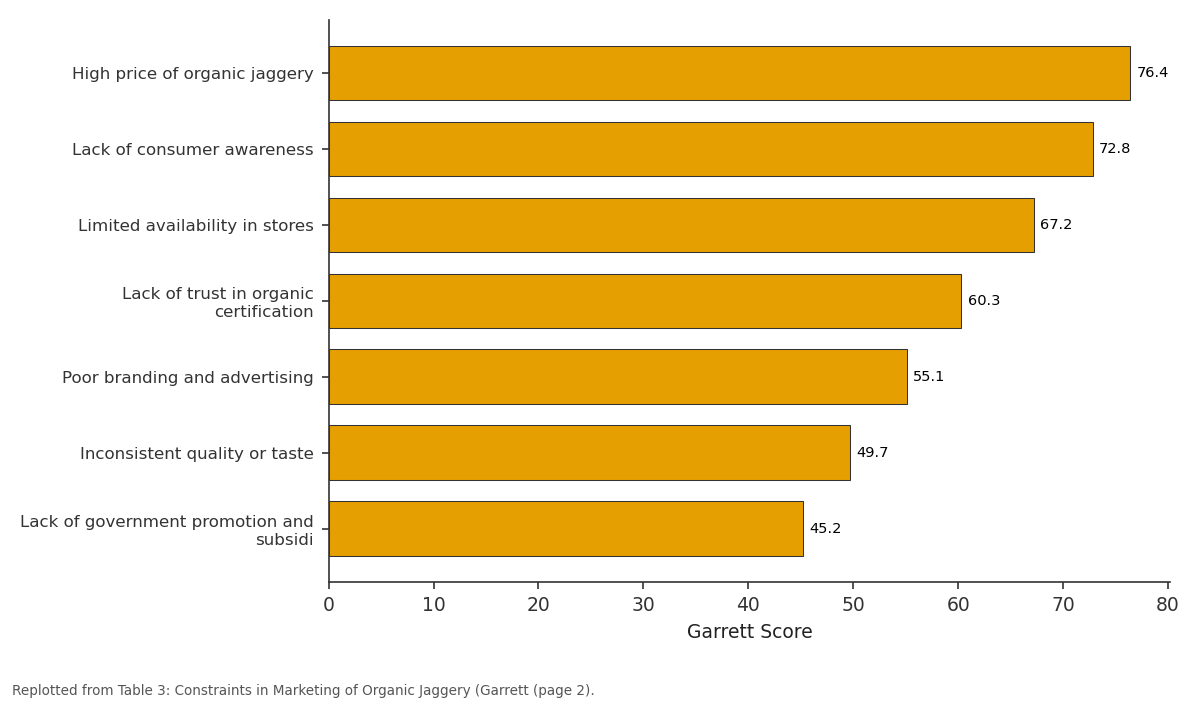
Garrett Score: High price of organic... vs Lack of consumer... vs Limited availability in... vs Lack of trust in... vs Poor branding and...
Replotted from Table 3 (page 2) of the original paper. Every bar is the paper's own table value.
View source evidence ↗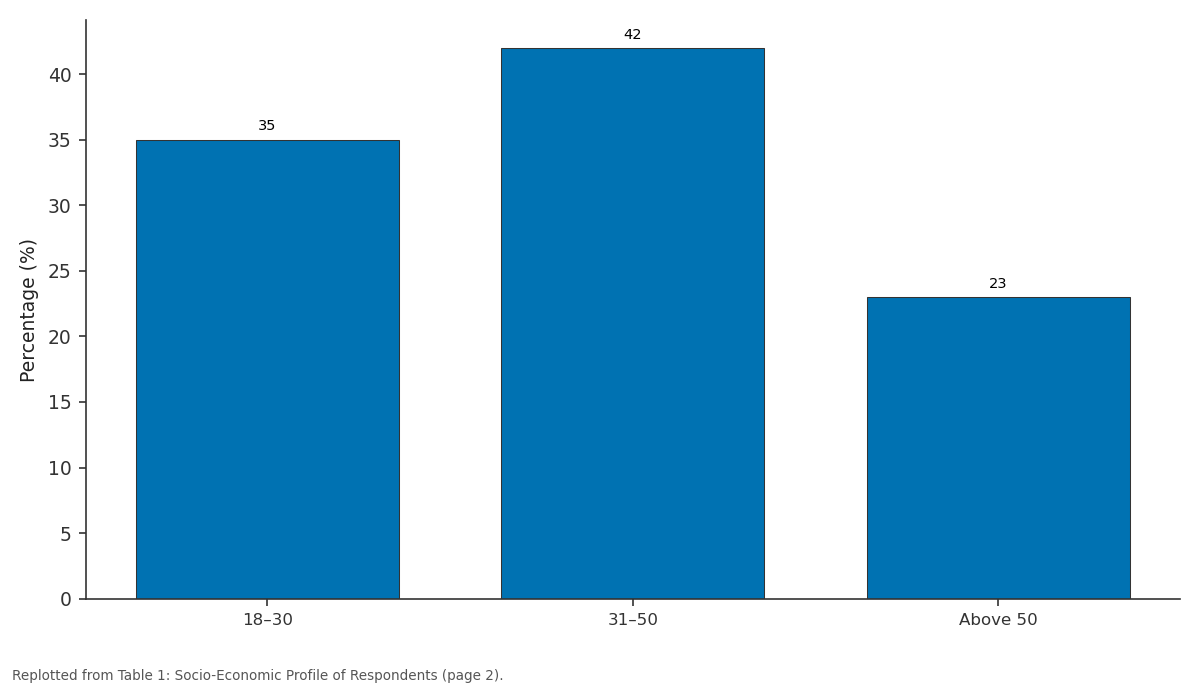
Percentage (%): 18–30 vs 31–50 vs Above 50
Replotted from Table 1 (page 2) of the original paper. Every bar is the paper's own table value.
View source evidence ↗Figures & tables
From the original paper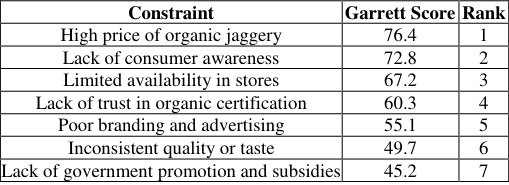 Table 3
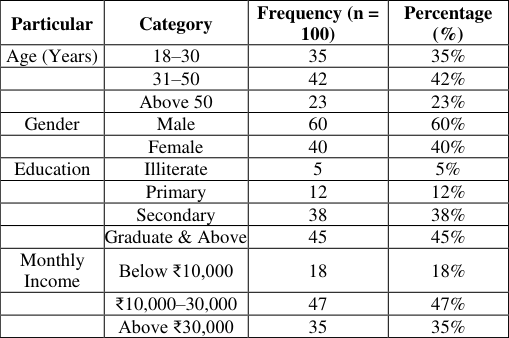 Table 1
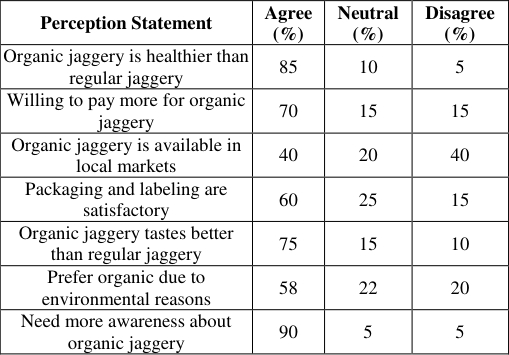 Table 2
Introduction
The demand for organic products has witnessed a steady surge globally in recent years. Driven by growing concerns about health, sustainability, and environmental impacts, consumers are increasingly favoring products that are free from harmful chemicals and synthetic additives. Organic agriculture offers a solution by producing food in a way that maintains ecological balance, conserves biodiversity, and avoids the use of artificial fertilizers and pesticides. Organic jaggery is produced without the use of synthetic pesticides, fertilizers, or chemicals, making it an appealing option for those seeking healthier alternatives. The production process of organic jaggery is rooted in ancient traditions, where local farmers rely on natural methods to cultivate sugarcane and produce jaggery. By adhering to organic farming principles, organic jaggery aims to offer a product that is not only free from harmful chemicals but also produced in a sustainable manner that benefits the environment. The increasing demand for organic food products in urban centers, especially among the middle class, has given rise to a niche market for organic jaggery in India. Organic jaggery is gaining popularity due to its health benefits and chemical-free processing. In urban centers like Patna, increasing health awareness and demand for sustainable foods make organic jaggery a viable market opportunity. However, the growth of this niche product is hampered by various constraints like lack of awareness, high cost, and limited distribution. This study explores the socio-economic characteristics of consumers, their perceptions toward organic jaggery, and the factors that facilitate or hinder its consumption.
Research Methodology:
The study was conducted in Patna District, Bihar, an area with a growing market for organic products, where urban consumers were increasingly interested in healthier and eco-friendly food choices. A total of 100 consumers were randomly selected. Primary data were gathered through a structured questionnaire focusing on income, education, perception, and buying behavior. Secondary data were collected from journals, government publications, and online sources. The study reveals that the majority of respondents belong to the age group of 31-50 years (42%), indicating that the primary consumers of organic jaggery are within this age range. This group is typically more health-conscious and likely to make informed decisions about food choices. A high percentage of respondents (45%) are graduates, and 38% have completed high school. This suggests that a large portion of consumers in Patna may have sufficient knowledge and understanding of the health benefits associated with organic products. 47% of respondents belong to the income range of ₹10,000-₹30,000, a key income group for urban markets like Patna. This segment has some disposable income but is still sensitive to price differences, especially for organic products. Need more awareness about organic jaggery 90 5 5
Analytical Tools Used Percentage analysis Likert scale Garrett's Ranking Technique
Analytical Tools Used Percentage analysis Likert scale Garrett's Ranking Technique
Results and Discussion
Table 2 represents that significant majority (85%) of consumers believe organic jaggery is healthier than regular jaggery, With 70% agreeing to pay more for organic jaggery, it indicates strong consumer confidence in its benefits and perceived value. Only 40% feel that organic jaggery is available in local markets, revealing a potential gap in distribution and accessibility. 60% are content with the packaging and labeling, although a notable 25% remain neutral, indicating room for improvement. 75% believe organic jaggery tastes better than regular jaggery. A remarkable 90% express the need for more awareness about organic jaggery, emphasizing an opportunity for education and marketing to further boost adoption. Table 3 suggested that High production costs (76.4) were the biggest challenge for producers. Organic farming practices, while beneficial for the environment, increase the production cost of jaggery, which is then passed on to consumers. Lack of consumer awareness (72.8) continues to be a major barrier. Even if organic jaggery is available, many consumers are unaware of its benefits or the existence of the product. Limited availability (67.2) was another significant constraint. This indicates that consumers who are aware of organic jaggery may not always have access to it due to poor distribution networks and limited retail presence.
| Perception Statement | Agree (%) | Neutral (%) | Disagree (%) |
|---|---|---|---|
| Organic jaggery is healthier than regular jaggery | 85 | 10 | 5 |
| Willing to pay more for organic jaggery | 70 | 15 | 15 |
| Organic jaggery is available in local markets | 40 | 20 | 40 |
| Packaging and labeling are satisfactory | 60 | 25 | 15 |
| Organic jaggery tastes better than regular jaggery | 75 | 15 | 10 |
| Prefer organic due to environmental reasons | 58 | 22 | 20 |
| Need more awareness about organic jaggery | 90 | 5 | 5 |
Table text extracted from the original PDF; superscript letters are shown inline. The original table image is below.
View original table image
| Constraint | Garrett Score | Rank |
|---|---|---|
| High price of organic jaggery | 76.4 | 1 |
| Lack of consumer awareness | 72.8 | 2 |
| Limited availability in stores | 67.2 | 3 |
| Lack of trust in organic certification | 60.3 | 4 |
| Poor branding and advertising | 55.1 | 5 |
| Inconsistent quality or taste | 49.7 | 6 |
| Lack of government promotion and subsidies | 45.2 | 7 |
Table text extracted from the original PDF; superscript letters are shown inline. The original table image is below.
View original table image
Conclusion
The research on consumer perception towards organic jaggery in Patna, Bihar, has provided significant insights into the growing demand for organic products, particularly organic jaggery, which is considered a healthier alternative to refined sugar. One of the key conclusions drawn from the study is that socio-economic factors such as income, education, and occupation play a critical role in determining consumers' willingness to purchase organic jaggery. Consumers with higher levels of education and income are more likely to be aware of the benefits of organic jaggery and are willing to pay the higher price associated with it. This suggests that organic jaggery is primarily a product for the upper-middle-class and affluent segments of Patna's population.
The high production costs of organic jaggery emerged as the most significant barrier to its widespread adoption, as highlighted by Garrett's ranking in the study. The cost of production for organic jaggery is higher due to the use of traditional farming methods, absence of chemical fertilizers, and the time-consuming nature of organic farming practices.
The study identified that while many consumers were aware of the health benefits of organic jaggery, there was a lack of awareness about its superior quality compared to traditional jaggery. This indicates the need for targeted awareness campaigns to educate consumers about the nutritional advantages of organic jaggery. the organic jaggery market in Patna is at a pivotal stage. There is a strong demand for organic alternatives, but the market's expansion is hindered by price sensitivity, limited availability, and insufficient consumer awareness. Overcoming these barriers were require a concerted effort from producers, government bodies, and retailers
Figures and tables from the paper
| Particular | Category | Frequency (n = 100) | Percentage (%) |
|---|---|---|---|
| Age (Years) | 18–30 | 35 | 35% |
| 31–50 | 42 | 42% | |
| Above 50 | 23 | 23% | |
| Gender | Male | 60 | 60% |
| Female | 40 | 40% | |
| Education | Illiterate | 5 | 5% |
| Primary | 12 | 12% | |
| Secondary | 38 | 38% | |
| Graduate & Above | 45 | 45% | |
| Monthly Income | Below ₹10,000 | 18 | 18% |
| ₹10,000–30,000 | 47 | 47% | |
| Above ₹30,000 | 35 | 35% |
Table text extracted from the original PDF; superscript letters are shown inline. The original table image is below.
View original table image
References
12 in the original paper- Agarwal A, Saxena R. Consumer perceptions of organic food: A study on consumer preferences and behaviors. J Food Sci Technol. 2020;57(5):1823-1831.
- Agarwal M, Gupta P. A review on organic jaggery: Production, health benefits, and consumer acceptance. Int J Food Sci Nutr. 2019;69(4):478-484.
- Bansal S. Trends in consumer behavior towards organic food products. Agric Econ Res Rev. 2021;34(2):120130.
- Bhatia S, Kumar V. Socio-economic factors influencing the consumption of organic products in India. Indian J Mark. 2018;48(5):45-54.
- Chakraborty S, Singh R. Perception and awareness of organic food: A study in urban areas of Bihar. J Rural Dev. 2017;36(1):33-44.
- Chandran R. Organic jaggery and its market potential in India. Int J Agribus Rural Dev. 2020;8(4):67-78.
- Das A, Kumar M. The growing demand for organic jaggery in India: A market survey. Agribusiness J. 2019;12(3):210-20.
- Dey S, Nayak P. The rise of organic products in India: A comprehensive market analysis. Consum Res J. 2021;8(2):120-30.
- Ghosh P, Chatterjee S. Organic jaggery: An emerging alternative to refined sugar. J Agric Food Chem. 2020;68(7):5014-5023.
- Gupta S. Constraints in the organic food market: A case study of Bihar. Asian J Agric Econ. 2022;19(3):450-61.
- Jain S, Sharma K. Consumer perceptions of organic products in India: A focus on jaggery. Indian J Consum Stud. 2018;5(1):40-50.
- Jha A, Singh R. Trends in organic jaggery consumption in urban India: A survey. Food Qual Saf J. 2020;3(4):175-181.