
Research article · 2025 · Full text
International Journal of Agriculture and Food ScienceAn analytical study on the marketing of sugarcane in Lakhimpur District of Uttar Pradesh
Volume 7(5) · Pages 273–275 · DOI: 10.33545/2664844x.2025.v7.i5d.408 ↗
Research areasAgricultural Economics and PracticesLivestock Management and Performance ImprovementSugarcane Cultivation and Processing
Abstract
Author-writtenThis study analyzes the marketing structure and challenges of sugarcane farmers in Lakhimpur District, Uttar Pradesh, which is a key sugarcane-producing region in India. Based on primary data collected from 100 respondents selected from one block and several villages, the research explores the socio-economic profile, marketing channels, price spread, and constraints in sugarcane marketing. Findings reveal that 65% of farmers sell directly to sugar mills, while 20% use commission agents, and 15% sell through local traders and jaggery processors. Though direct sale to sugar mills provides standard pricing, delays in payment (15-30 days) and transportation issues are major concerns. In contrast, selling to traders or jaggery units ensures immediate cash payment but at a lower price. The socio-economic analysis shows that 74% of respondents are male, with 48% aged between 31-50 years. Education levels are mostly primary to secondary, and around 62% of respondents are marginal or small farmers (less than 2 hectares). Sugarcane contributes over 70% of household income for most farmers. Using Garrett Ranking, the most critical marketing constraints identified are: Delayed payments from mills (mean score: 72.6), Lack of transport facilities (mean score: 65.4), Low price realization (mean score: 60.3) Price spread analysis shows that the producer’s share in consumer rupees is highest in direct marketing (~92%) and lowest in trader-mediated sales (~76%). The study suggests timely mill payments, better rural transport, and support for cooperative marketing to improve efficiency and farmer welfare.
Summary
Source-checkedPlain-language reading of the full paper, prepared with AI and checked against the text. Each point links to the authors' own words.
Why it matters
- Sugarcane is vital to India's rural economy, and while Uttar Pradesh is the leading producer, its farmers struggle with market inefficiencies and poor pricing. View evidence ↗
- Marketing sugarcane is difficult because the crop is bulky, perishable, seasonal, and has high water content. View evidence ↗
- Because sugarcane is primarily sold to mills rather than consumers, the marketing system is often monopolistic, reducing the bargaining power of farmers. View evidence ↗
The question
- The study aims to examine the sugarcane marketing landscape specifically within the Mohammadi block of Lakhimpur Kheri. View evidence ↗
What they did
- The researchers randomly selected five villages and interviewed 100 sugarcane farmers, categorizing them by landholding size. View evidence ↗
- Data collection involved structured interviews, focus group discussions, and personal observations regarding socio-economics, production, and marketing. View evidence ↗
- The study used arithmetic means and Garrett's ranking technique to analyze data and prioritize marketing constraints. View evidence ↗
What they found
- The surveyed farmers were predominantly male (89%) with an average age of 47.25 years, and 62% had education beyond the primary level. View evidence ↗
- With an average landholding of 2 hectares, most farmers in the study are categorized as small to medium-scale. View evidence ↗
- Private sugar mills (34%) and cooperative mills (28%) are the dominant marketing channels for farmers. View evidence ↗
- Jaggery units (Kolhus) provide the highest price per quintal at ₹340. View evidence ↗
- Kolhus are the most efficient channel, featuring the lowest marketing cost (₹15), the highest producer's share (68%), and the highest efficiency (80%). View evidence ↗
- Commission agents are the least efficient, resulting in the lowest producer's share (62%) and a marketing efficiency of 71.4%. View evidence ↗
- The highest price spread (₹190) occurs with commission agents due to multiple intermediaries. View evidence ↗
What it means
- The authors recommend improving the system by strengthening Farmer Producer Organizations (FPOs), adopting digital payments, improving rural infrastructure, and modernizing Kolhu units. View evidence ↗
Visual summary
1 visualsIllustrations explain the paper; charts are replotted from the paper's own table values.
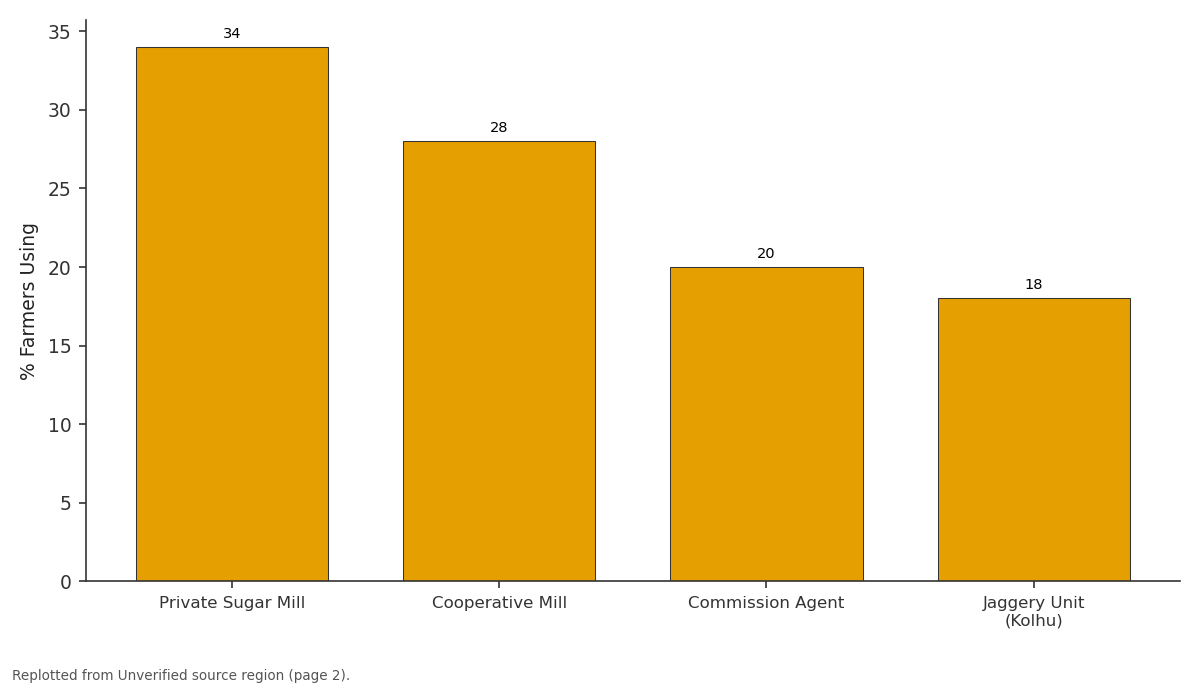
% Farmers Using: Private Sugar Mill vs Cooperative Mill vs Commission Agent vs Jaggery Unit (Kolhu)
Replotted from a table (page 2) of the original paper. Every bar is the paper's own table value.
View source evidence ↗Introduction
Sugarcane plays a pivotal role in India’s rural economy. Uttar Pradesh is India’s top sugarcane-producing state, yet farmers face production risks, market inefficiencies, and poor price realization. This study aims to examine the marketing landscape in Lakhimpur Kheri, focusing on the Mohammadi block. Sugarcane is a long-duration crop with high input costs, but it also offers significant economic returns under the right conditions.
The marketing of sugarcane, however, poses significant challenges due to its bulkiness, perishability, seasonality, and high water content. Unlike many crops, sugarcane is mostly sold to sugar mills and not directly to consumers. Therefore, marketing systems for sugarcane often become monopolistic or semi-monopolistic, with limited competition and bargaining power for farmers. The Lakhimpur Kheri district of Uttar Pradesh, often referred to as the “Sugar Bowl of India,” is one of the largest sugarcane-producing regions in the country.
With favorable agro- climatic conditions and several sugar mills, sugarcane dominates the cropping pattern of the district. However, despite high production levels, sugarcane farmers in the region continue to face multiple challenges particularly in the marketing of their produce. This includes issues such as delayed payments, lack of price transparency, dependency on sugar mills, and inefficient market infrastructure. Objectives 1.
To analyze the socio-economic profile of sugarcane farmers. 2. To estimate marketing cost, trader margin, price spread, marketing efficiency, and producer’s share in consumer rupee. 3. To analyze the key constraints in sugarcane marketing and suggest policy interventions. NAAS Rating: 4.97 IJAFS 2025; 7(5): 273-275 Gaurav Katiyar Research Scholar (P.G), Department of Agricultural Economics, SHUATS, Naini, Prayagraj, Uttar Pradesh, India Dr.
Pritesh Dwivedi Assistant Professor, Department of Agricultural Economics, SHUATS, Naini, Prayagraj, Uttar Pradesh, India Gaurav Katiyar Research Scholar (P.G), Department of Agricultural Economics, SHUATS, Naini, Prayagraj, Uttar Pradesh, India https://www.agriculturaljournals.com cultivation as the primary source of livelihood. With 18.6 years of farming experience, these farmers have a strong traditional knowledge base, but they remain exposed to the risks associated with sugarcane price volatility. Marketing Channels and Price Received Marketing Channel % Farmers UsingAvg. Price (₹/quintal) Private Sugar Mill 34% ₹330 Cooperative Mill 28% ₹320 Commission Agent 20% ₹310 Jaggery Unit (Kolhu) 18% ₹340
Discussion
Private and cooperative mills dominate the sugarcane marketing channels, accounting for 34% and 28% of the market share, respectively. These mills are favored due to their accessibility and the standardization of processing. Despite this, Kolhus (jaggery units) offer a better price per quintal (₹340), which makes them attractive to farmers. However, Kolhus are restricted by their limited processing capacity, preventing them from handling large quantities of sugarcane, thus serving as a supplementary channel.
The commission agents, although involving a middle layer, pay a lower price (₹310) due to their role in further intermediation. Marketing cost, margin, efficiency and producer share Producer’s Share (%) Channel Marketing Cost (₹) Trader Margin (₹) Marketing Efficiency (%) Private Mill ₹18 ₹35 66% 78.5 Cooperative Mill ₹20 ₹30 65% 76.2 Commission Agent ₹25 ₹45 62% 71.4
Methodology
Selection of Area and Respondents: Lakhimpur Kheri was purposively selected due to its prominence in sugarcane production. The Mohammadi block, with its proximity to sugar mills and jaggery units, was chosen for its diverse marketing channels and varied farmer types. Five villages (Rampur Banjaria, Tilhwa, Mahgawan, Sikandarpur, Gaura) were randomly selected for the study. A total of 100 sugarcane farmers were interviewed, categorized by landholding size (marginal, small, medium, and large) to assess the influence of land size on marketing behavior.
Data Collection: Primary data was collected using a structured interview schedule, covering socio-economic characteristics, sugarcane production details, marketing practices, constraints, and farmer suggestions. Focus Group Discussions (FGDs) and personal observations were conducted to gain qualitative insights into farmer experiences and marketing practices. Secondary data was obtained from government agencies, sugar mills, and research publications. Marketing Channels and Analysis: The study examined four marketing channels: direct sales to cooperative/private mills, through commission agents, and to jaggery producers. Data on marketing costs, margins, and price spread were analyzed using formulas like marketing margin and producer's share in consumer’s rupee.
Statistical tools such as arithmetic mean and Garrett’s ranking technique were used to analyze consumer behavior and prioritize factors affecting marketing efficiency. Analytical Tools 1. Acharya’s marketing efficiency formula: MME = FP/ MC+MM 2. Garrett ranking: Per cent position = 100 (Rij-0.5) /Nj 3.
Margin analysis: Price to Consumer-Price to Producer *100 Price to Consumer 4. Marketable Surplus: P - {C + Cf + W + S} 5. Marketing Cost: Cf+ Cm1+ Cm2+ Cm3+ + Cmn
Results And Discussion
Socio-Economic Profile of Respondents Kolhu ₹15 ₹20 68% 80.0
Discussion
Kolhus have the highest producer's share (68%) and the lowest marketing cost (₹15), contributing to the highest marketing efficiency (80%). This is because Kolhus minimize the number of intermediaries, directly benefiting the farmers. However, their limited processing capacity and the need for localized markets restrict their scalability. On the other hand, commission agents incur high costs and margins, leading to a low producer's share (62%) and lower marketing efficiency (71.4%).
Private and cooperative mills offer a balanced trade-off, with relatively good efficiency and moderate costs. These mills are dominant due to their capacity to process larger quantities, but they also reduce the price received by the farmer in exchange for logistical convenience. Price Spread Analysis Channel Consumer Price (₹/quintal) Net Price to Farmer (₹) Price Spread (₹) Private Mill ₹500 ₹330 ₹170 Cooperative Mill ₹490 ₹320 ₹170 Commission Agent ₹500 ₹310 ₹190 Kolhu ₹500 ₹340 ₹160
Discussion
Price spread is a crucial metric for understanding the value chain in sugarcane marketing. Kolhus present the lowest price spread (₹160), resulting in higher value realization for farmers. This suggests that, Socio-Economic Variable Category/Mean Value Average Age (years) 47.25 Gender (% Male) 89% Education Level 62% above primary level Annual Household Income (₹) ₹1,21,000 Average Landholding (ha) 2.0 Farming Experience (years) 18.6 Family Size (members) 5.4
Discussion
The respondents in the study are predominantly middle-aged (average age of 47.25 years) and male (89%), with a relatively high percentage (62%) having education levels above primary school. The average landholding of 2 hectares indicates that most farmers belong to the small to medium-scale category, reflecting their vulnerability to market fluctuations. The annual household income of ₹1,21,000 indicates a moderate dependency on sugarcane https://www.agriculturaljournals.com while Kolhus might not be able to handle large volumes of sugarcane, they offer better income opportunities for those who can access them. In contrast, commission agents cause the highest price spread (₹190), primarily due to the additional layers of intermediaries involved in the process.
This reduces the final value received by the farmers. Mills (both private and cooperative) result in similar price spreads (₹170), reflecting a relatively standardized process, though not the most favorable for farmers. Constraints in Sugarcane Marketing (Garrett Ranking Method) dominate the market, although Kolhus (jaggery units) offer higher prices (₹340 per quintal). However, Kolhus are limited by their small processing capacity.
The marketing costs and margins reveal that Kolhus provide the highest producer's share (68%) and the lowest cost (₹15), while commission agents have the highest price spread (₹190) and lowest producer's share (62%).The main constraints in the marketing system include delayed payments, inadequate transport, low price realization, and exploitation by middlemen. To improve the system, the study recommends strengthening FPOs, promoting digital payment systems, enhancing rural infrastructure, and supporting Kolhu units with modern equipment.
Discussion
The major constraint in sugarcane marketing is the delay in payment, which was ranked highest by the respondents. This issue is particularly acute in private mills, where farmers often face significant delays before receiving their payments. Inadequate transport facilities and low price realization are also significant barriers, as they affect the efficiency and profitability of the marketing process. The exploitation by middlemen (ranked 4th) is a concern, as they often take advantage of price asymmetries, further reducing the net income of farmers.
Problems like weighment disputes, lack of storage, and lack of market information were also identified, suggesting the need for improvements in transparency, infrastructure and communication. Standardization and grading systems could help reduce inefficiencies and ensure fairer pricing for farmers. Payment delays are a critical barrier, particularly in private mills. Transport inefficiencies and lack of transparency during weighment reduce net returns.
Awareness creation and institutional mechanisms can mitigate these challenges. Suggestions for Improvement Promote FPOs to aggregate produce, negotiate better prices and reduce dependency on middlemen. Encourage use of e-NAM and digital payment systems for transparency and quicker payments. Develop rural infrastructure, including roads and storage, to improve market access. Provide market intelligence on prevailing prices and buyer demand to aid informed decisions. Support Kolhu units with modern equipment and credit to scale up operations.
Summary
and Conclusion This study examines the sugarcane marketing system in Lakhimpur district, Uttar Pradesh. The farmers in the region are primarily middle-aged males (average age of 47.25 years) with moderate education and farming experience (18.6 years). Most farmers own small to medium-sized landholdings (average of 2 hectares) and depend heavily on sugarcane for their livelihood, with an annual household income of ₹1,21,000. Private and cooperative sugar mills
References
5 in the original paper- Government of Uttar Pradesh Agriculture Portal
- Ministry of Agriculture and Farmers’ Welfare Reports
- Indian Journal of Agricultural Marketing
- Sugarcane Breeding Institute Annual Reports
- Singh R. Sugarcane Economics in Northern India, AgriMarketing Journal. 2020;18(3). Constraint Garrett Score Rank Delay in Payment 72.6 1 Inadequate Transport 65.2 2 Low Price Realization 61.8 3 Middlemen Exploitation 58.3 4 Weighment Disputes 55.4 5 Lack of Storage Facilities 52.0 6 Lack of Market Information 49.8 7 No Grading/Standardization 45.5 8