
Research article · 2025 · Full text
International Journal of Agriculture and Food ScienceMarket dynamics and economic analysis of organic tomato in a developing region: Evidence from Prayagraj, Uttar Pradesh
Volume 7(5) · Pages 206–208 · DOI: 10.33545/2664844x.2025.v7.i5c.400 ↗
Research areasAgricultural Economics and Practices
Abstract
Author-writtenPurpose: This study investigates the socio-economic conditions, marketing channels, and economic viability of organic tomato production in Prayagraj, Uttar Pradesh, a developing region with growing organic demand. Design/methodology/approach: A structured survey was conducted with 180 respondents, including organic tomato farmers, traders, and consumers. Data collected focused on socio-economic characteristics, marketing channels, costs, margins, price spreads, and marketing efficiency. Findings: The study finds that organic tomato cultivation is primarily carried out by middle-aged, semi-educated farmers with small to medium landholdings. Marketing inefficiencies and high intermediary margins pose significant challenges, with a dominant share of the market controlled by traditional retailer channels (70%). The emerging role of e-commerce offers potential for reducing intermediary margins. The marketing efficiency ratio (MER) of 1.5 suggests room for improving the value chain through better direct-to-consumer models. Originality/value: This paper provides novel insights into the organic tomato supply chain in Prayagraj, a region characterized by small-scale organic farming. It highlights the need for policy interventions to improve marketing efficiency, reduce intermediary costs, and promote e-commerce solutions to enhance profitability for farmers.
Summary
Source-checkedPlain-language reading of the full paper, prepared with AI and checked against the text. Each point links to the authors' own words.
Why it matters
- Organic farming in India is growing because consumers are more health-conscious and want environmentally sustainable products. View evidence ↗
- While tomatoes are a staple vegetable in India, organic varieties are becoming a specialized niche product in urban areas. View evidence ↗
- Rural organic farming is hindered by high production costs, inefficient marketing, and low profitability for farmers. View evidence ↗
The question
- The study aims to examine the socio-economic status, marketing routes, and economic viability of organic tomato farming in Prayagraj, Uttar Pradesh. View evidence ↗
What they did
- Researchers used a structured questionnaire to collect primary data from 180 participants: 120 farmers, 30 traders, and 30 consumers. View evidence ↗
- A stratified sampling technique was employed to ensure representation across various socio-economic groups. View evidence ↗
- The study measured socio-economic traits, marketing channels, costs, margins, price spreads, and overall marketing efficiency. View evidence ↗
What they found
- Most organic tomato farmers in the region are middle-aged, with 61% falling between 31 and 50 years old. View evidence ↗
- The majority of farmers (58%) operate on small landholdings of less than 2 acres. View evidence ↗
- Annual income for most farmers is relatively low, with 70% earning between ₹20,000 and ₹60,000. View evidence ↗
- The market is dominated by traditional retailer channels, which account for 70% of sales. View evidence ↗
- E-commerce platforms represent an emerging alternative, currently accounting for 15% of marketing channels. View evidence ↗
- Total marketing costs are ₹20 per kg, which makes up 50% of the overall cost structure. View evidence ↗
- The Marketing Efficiency Ratio (MER) is 1.5, meaning consumers receive ₹1.50 in value for every ₹1 spent on marketing. View evidence ↗
What it means
- The authors conclude that promoting e-commerce and direct-to-consumer sales is necessary to reduce costs and increase farmer income. View evidence ↗
- The authors recommend government support for organic certification, the creation of farming clusters, and the promotion of Farmer Producer Organizations (FPOs). View evidence ↗
- The potential of e-commerce is limited by current challenges in logistics, customer awareness, and the reliability of online platforms. View evidence ↗
Visual summary
3 visualsIllustrations explain the paper; charts are replotted from the paper's own table values.
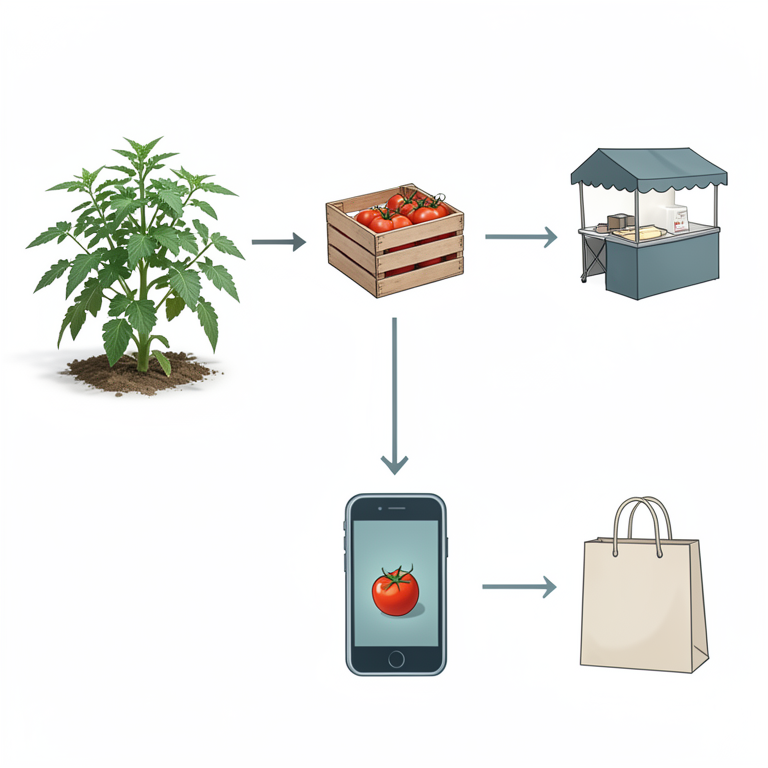
Organic Tomato Supply Chain Comparison
AI-generated conceptual illustration (organic tomato plants and fruits). It explains the idea and does not show study data.
View source evidence ↗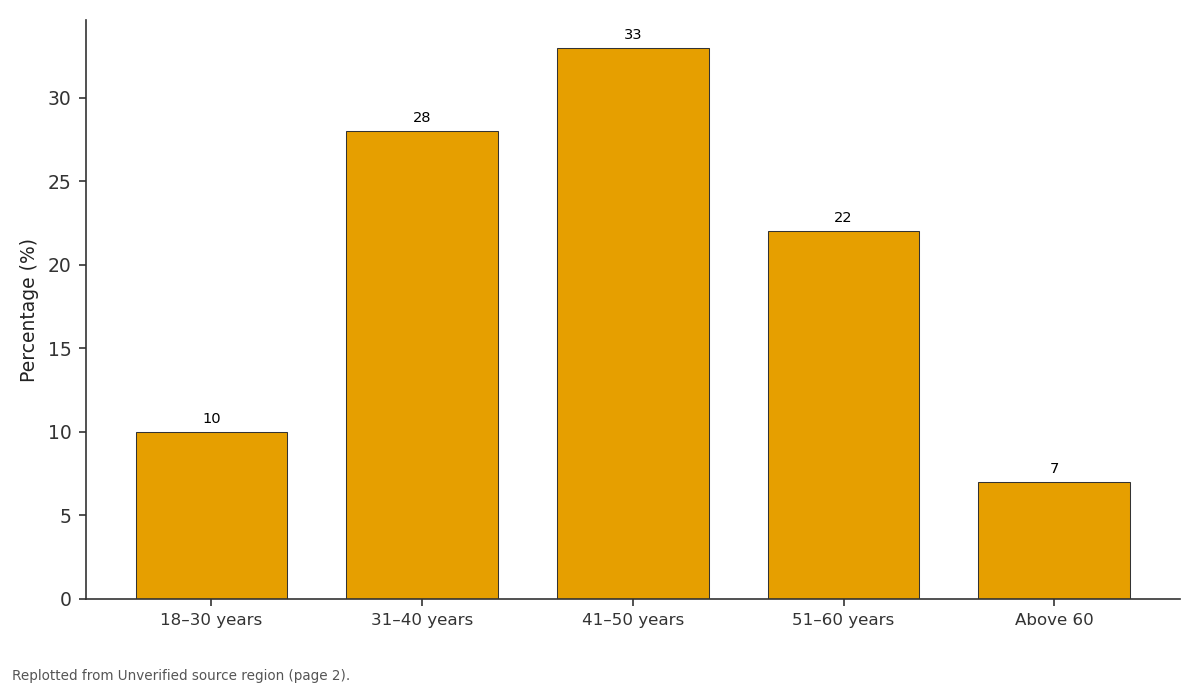
Percentage (%): 18–30 years vs 31–40 years vs 41–50 years vs 51–60 years vs Above 60
Replotted from a table (page 2) of the original paper. Every bar is the paper's own table value.
View source evidence ↗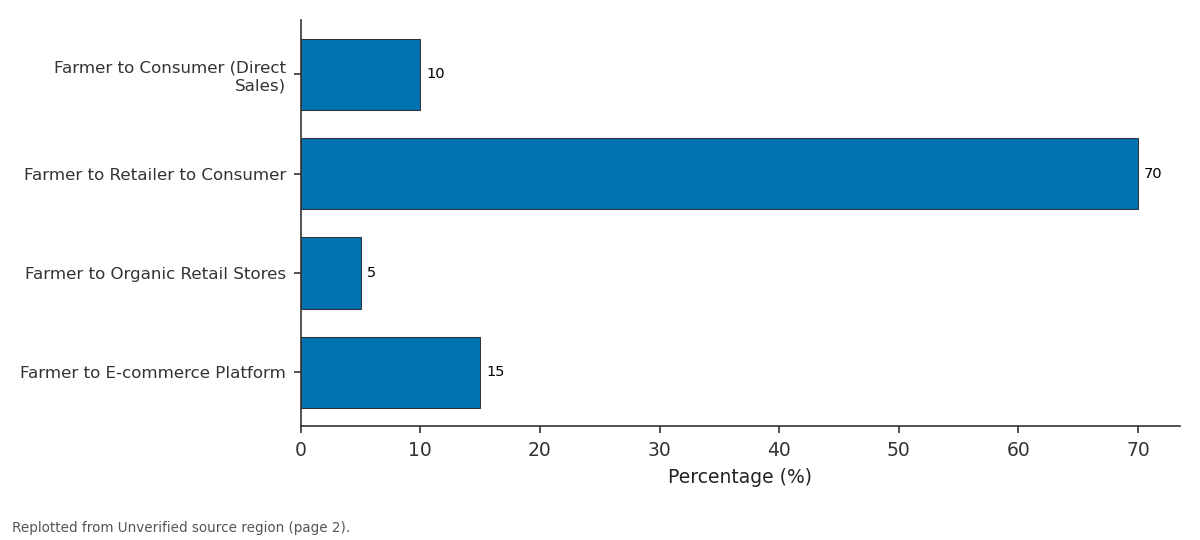
Percentage (%): Farmer to Consumer... vs Farmer to Retailer to... vs Farmer to Organic... vs Farmer to E-commerce...
Replotted from a table (page 2) of the original paper. Every bar is the paper's own table value.
View source evidence ↗Introduction
Organic agriculture in India has gained significant traction due to rising health consciousness and consumer demand for environmentally sustainable products. Tomatoes are one of the most widely cultivated and consumed vegetables in India, and organic tomatoes are emerging as a niche product in urban markets. However, the organic farming sector in rural areas faces numerous challenges, including high production costs, inefficient marketing channels, and low farmer profitability. This study examines the market dynamics of organic tomato production in Prayagraj, Uttar Pradesh. It explores the socio-economic profile of farmers involved in organic tomato cultivation, evaluates the marketing channels, and assesses the economic efficiency of these marketing channels. The findings aim to identify constraints in the organic tomato value chain and suggest strategies for enhancing market efficiency and farmer income.
Methodology
Primary data was collected using a structured questionnaire from 180 respondents, including 120 organic tomato farmers, 30 traders, and 30 consumers. A stratified sampling technique was used to ensure that different socio-economic groups were represented. The survey included questions related to socio-economic status, landholdings, income levels and marketing channels. Organic tomato farmers in Prayagraj predominantly have small landholdings, with 58% of the farmers owning less than 2 acres of land. This is consistent with the pattern of organic farming in India, where small and marginal farmers dominate the sector. The predominance of small landholdings suggests that organic farming is often practiced by resource-constrained farmers who are seeking to reduce costs and improve sustainability. However, smaller landholdings may limit the farmers' ability to scale up production, which can have implications for profitability and market reach.
Results and Discussion
Results and Discussion
Socio
Socio
Income Level
Income Level
Number of Respondents
Percentage (%) ₹20,000 -₹40,000 70 39% ₹40,000 -₹60,000 55 31% ₹60,000 -₹80,000 30 17% ₹80,000 and above 25 13%
The income level of organic tomato farmers in Prayagraj is relatively low, with the majority of farmers earning between ₹20,000 and ₹60,000 annually (70% of respondents). This aligns with the notion that organic farming, particularly for tomatoes, is often a secondary source of income rather than the primary livelihood. The relatively low income levels also point to the financial challenges faced by organic farmers, such as high production costs, marketing inefficiencies, and limited access to premium markets that would offer higher returns. These figures suggest that organic tomato farming remains a viable option for supplementary income but is not yet a full-fledged economic activity for most farmers. Most farmers earn between ₹20,000 and ₹60,000 annually, suggesting that organic tomato farming remains a secondary source of income for many.
Marketing Channels
Marketing Channel Percentage (%) Farmer to Consumer (Direct Sales) 10% Farmer to Retailer to Consumer 70% Farmer to Organic Retail Stores 5% Farmer to E-commerce Platform 15%
The marketing channels for organic tomatoes in Prayagraj reveal a heavy reliance on traditional retailer-based models.
The dominant channel is farmer-to-retailer-to-consumer, accounting for 70% of the sales. This reliance on middlemen increases the cost of tomatoes for consumers and reduces the income that farmers receive from their produce. The presence of multiple intermediaries between farmers and consumers not only increases the price spread but also reduces the profitability for the farmers. On a positive note, there is emerging potential for e-commerce platforms (15%) to provide an alternative, direct-to-consumer marketing channel. E-commerce has the ability to bypass traditional middlemen, thereby reducing marketing costs and increasing the share of profits that reach farmers. However, for e-commerce to reach its full potential, challenges such as logistics, customer awareness, and reliable online platforms must be addressed. Direct sales from farmer to consumer are minimal (10%), indicating that while it is a more profitable option, it is not widely adopted, likely due to logistical and market access constraints faced by farmers. Organic retail stores account for only 5% of the marketing channels, which indicates that specialized organic stores are still underdeveloped in the region. The cost breakdown shows that the farm gate cost, which includes production costs, is the largest component (₹12 per kg or 30% of the total cost). Transportation and storage costs contribute ₹5 per kg (12.5%), while packaging and handling costs are ₹3 per kg (7.5%). The total marketing cost of ₹20 per kg represents 50% of the cost structure, which is substantial given the relatively low income levels of farmers. The Marketing Efficiency Ratio (MER) of 1.5 suggests that for every ₹1 spent on marketing, consumers are receiving ₹1.50 worth of value. While this indicates that there is some efficiency in the current system, there is certainly room for improvement. The relatively low MER indicates that the value chain could benefit from a reduction in intermediary costs and a more direct link between farmers and consumers.
Marketing Costs and Efficiency
Marketing Costs and Efficiency
Marketing Efficiency Ratio (MER)
Marketing Efficiency Ratio (MER)
Implications and Strategies for Improvement Improving Marketing Efficiency
One of the key findings of this study is the significant room for improving marketing efficiency. The high role of intermediaries reduces the profitability of organic tomato farming in Prayagraj. Direct marketing models, such as farmer-to-consumer sales through farmers' markets or ecommerce platforms, could improve the efficiency of the supply chain by cutting down the number of middlemen and reducing overall marketing costs.
E-commerce as an Emerging Channel
E-commerce platforms have the potential to revolutionize the marketing of organic tomatoes in Prayagraj. Direct access to urban consumers who are increasingly interested in organic produce could allow farmers to capture higher prices for their produce. However, challenges such as infrastructure, delivery logistics, and digital literacy need to be addressed to fully realize the potential of e-commerce. Additionally, farmers may need support in setting up online sales channels and gaining certification for organic produce, which can increase consumer trust.
Government and Policy Support
Government intervention can play a significant role in improving the situation for organic tomato farmers in Prayagraj. Providing support for organic certification, establishing organic farming clusters, and promoting farmer producer organizations (FPOs) can help streamline the supply chain. Government-backed initiatives for branding and marketing organic tomatoes could enhance the visibility of the produce, thereby opening new avenues for sales. Moreover, subsidies or financial assistance for marketing infrastructure and technology adoption (e.g., e-commerce platforms and online payment systems) could help farmers reduce costs and increase their income.
Expanding Direct-to-Consumer Models
Promoting direct sales to consumers through farmers' markets, community-supported agriculture (CSA) programs, and partnerships with organic retail stores could also help reduce intermediaries and improve the share of profits retained by farmers. For this to succeed, farmers need to be supported with training, market access, and infrastructure for storage, packaging, and transportation.
Conclusion
In conclusion, organic tomato farming in Prayagraj is an emerging sector, but faces significant challenges related to marketing inefficiencies, high intermediary margins, and limited market access. Although organic tomato cultivation is a promising and sustainable farming practice, the socioeconomic conditions of farmers and inefficiencies in the marketing channels reduce its overall profitability. The study highlights the need for innovative marketing solutions such as direct-to-consumer sales and the promotion of ecommerce platforms, which can help reduce costs and improve income for farmers. Support from the government and the private sector in the form of infrastructure development, certification, and branding initiatives will be crucial to enhance the viability and growth of the organic tomato sector in Prayagraj.
References
4 in the original paper- Kumar R, Singh M. The economics of organic farming in India: A case study of Haryana. Indian J Agric Econ. 2019;74(4):567-759.
- Patel P, Chawla A, Rajput R. E-commerce and organic produce marketing in India: A new opportunity. Agribus Rev. 2021;29(1):42-58.
- Sharma A, Gupta V. Marketing barriers in organic agriculture in India. Asian J Agribus. 2020;18(2):99115.
- Ram D, Saini PK, Bhati J. Chapter-2 Organic Farming in India: Opportunities, Challenges and Perspectives. Research and Review. 2022;21:21.