
Research article · 2025 · Full text
International Journal of Agriculture and Food ScienceRole of potassium in cultivation of salt affected soils irrigated with saline groundwater by triticale wheat crop
Volume 7(5) · Pages 195–198 · DOI: 10.33545/2664844x.2025.v7.i5c.397 ↗
Research areasAgricultural Science and Fertilization
Abstract
Author-writtenA field experiment was carried out during 2016, 2017 and 2018 seasons at Al-Tuwaitha Research Station, 30 km southeast of Baghdad, to study effect of some potassium fertilizer levels on growth and yield of triticale wheat grown in calcareous soil with salinity of 17.4 dS.m-1. Saline well water (4.33 dS.m-1) was used to irrigate plants. Four fertilizer levels were used: fertilization with nitrogen and phosphorus at rate 150 and 80 kg. ha-1 respectively as F0 (control), fertilization with three levels of K 100, 150, 200 kg. ha-1 (F1, F2 and F3).So, for all levels added 150 and 80 kg.ha-1 of N and P respectively. The results of two seasons showed a significant increase in the dry matter and grain yield of the triticale wheat crop during fertilization with the selected levels of K. The increase in grain yield as a mean for the three seasons was 8.84%, 24.26%, and 46.0% for F1, F2, and F3 compared to the F0 .. This clearly shows the positive and effective role of the potassium fertilizer used to increase triticale wheat tolerance to salinity and yield enhancement.
Summary
Source-checkedPlain-language reading of the full paper, prepared with AI and checked against the text. Each point links to the authors' own words.
Why it matters
- Salinity in soil and irrigation water is a major cause of declining crop production in arid and semi-arid regions. View evidence ↗
- Triticale wheat is a hybrid of durum wheat and rye grass, combining wheat's productivity with the environmental resistance of grass. View evidence ↗
- Previous research indicates that macro nutrients, particularly potassium, can improve the growth, yield, and nutritional status of plants under salt stress. View evidence ↗
The question
- The study aimed to determine the optimal potassium level for the growth and yield of triticale wheat grown in salt-affected soils and irrigated with saline groundwater. View evidence ↗
What they did
- The field experiment was conducted over three seasons (2016, 2017, and 2018) at the Al-Tuwaitha Research Station near Baghdad in calcareous soil with a salinity of 17.4 dS.m-1. View evidence ↗
- The study used four fertilizer treatments: a control (F0) with 150 kg N and 80 kg P per hectare, and three potassium levels (F1: 100, F2: 150, F3: 200 kg K per hectare), all receiving the same N and P. View evidence ↗
- Plants were irrigated using saline well water with an electrical conductivity of 4.33 dS.m-1. View evidence ↗
- The experiment utilized a Randomized Complete Block Design (RCBD) with three replications and 5m² experimental units. View evidence ↗
What they found
- Potassium fertilization significantly increased the potassium-to-sodium (K:Na) ratio in leaves, rising from 0.68 in the control (F0) to 1.72 in the highest K treatment (F3). View evidence ↗
- The calcium-to-sodium (Ca:Na) ratio increased from 0.62 in the control to 1.08 (F1), 1.30 (F2), and 1.54 (F3). View evidence ↗
- In the first season, grain yield increased from 1.12 t. ha-1 (control) to 1.39 t. ha-1 (F3), with increases of 10.50% (F1), 23.84% (F2), and 47.42% (F3). View evidence ↗
- Across the three seasons, the mean increase in grain yield was 8.84% for F1, 24.26% for F2, and 46.0% for F3 compared to the control. View evidence ↗
What it means
- The authors conclude that potassium fertilizer effectively enhances the salinity tolerance and yield of triticale wheat. View evidence ↗
- The authors noted slight variations in yield between seasons, which they attributed to differing climatic conditions. View evidence ↗
Visual summary
3 visualsIllustrations explain the paper; charts are replotted from the paper's own table values.
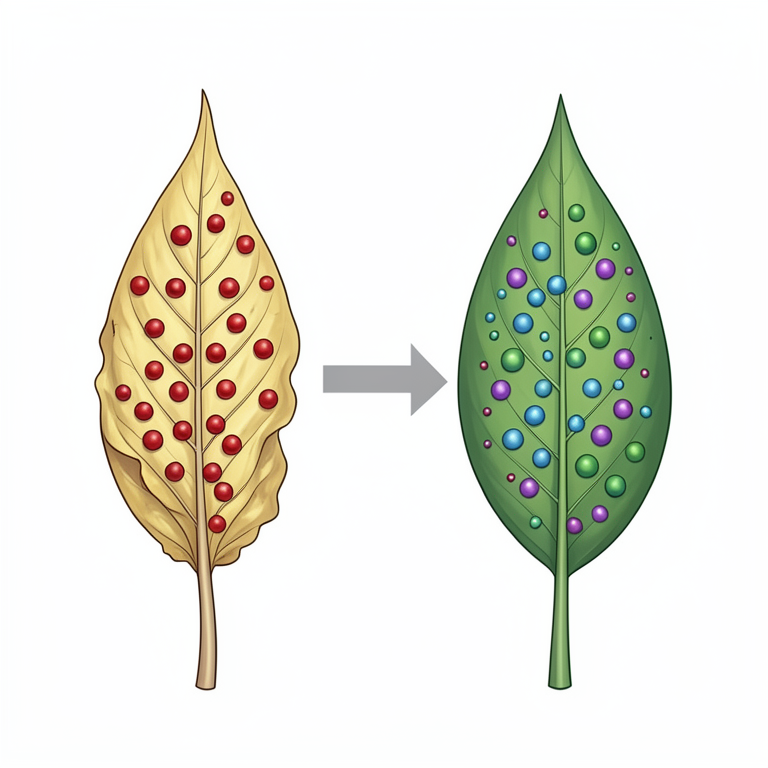
Nutrient Ratio Shift
AI-generated conceptual illustration (triticale wheat leaves). It explains the idea and does not show study data.
View source evidence ↗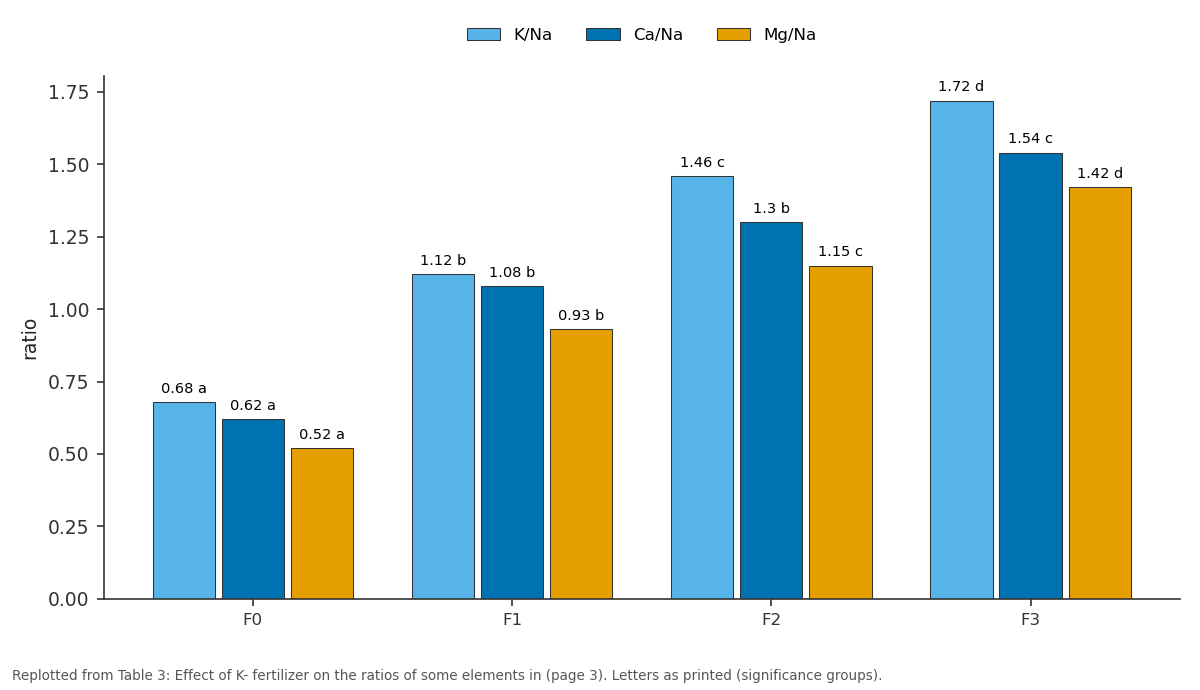
K/Na and Ca/Na and more: F0 vs F1 vs F2 vs F3
Replotted from Table 3 (page 3) of the original paper. Every bar is the paper's own table value.
View source evidence ↗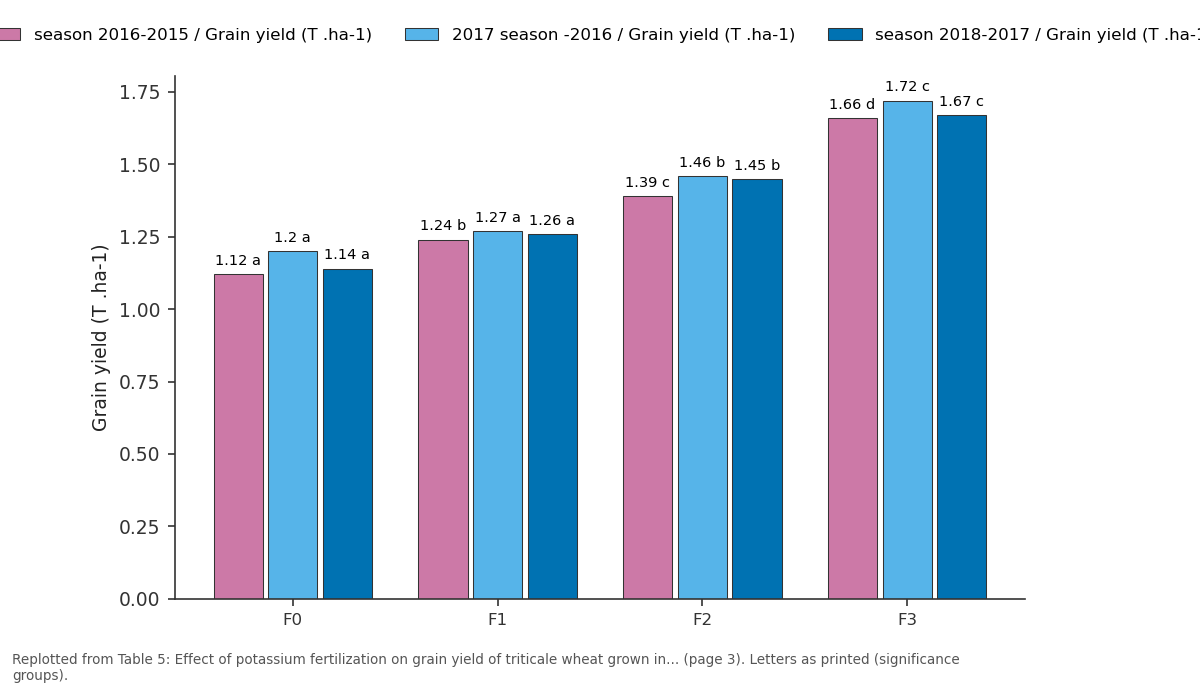
season 2016-2015 / Grain yield (T .ha-1) and 2017 season -2016 / Grain yield (T .ha-1) and more: F0 vs F1 vs F2 vs F3
Replotted from Table 5 (page 3) of the original paper. Every bar is the paper's own table value.
View source evidence ↗Figures & tables
From the original paper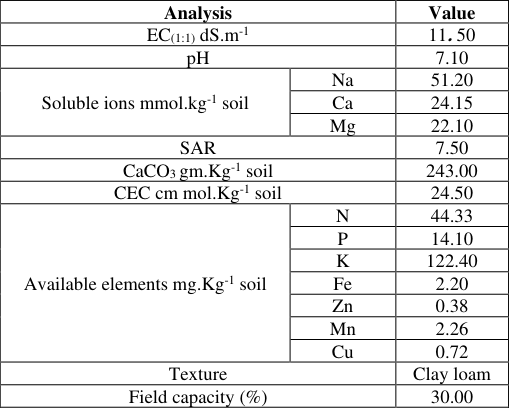 Table 1
 Table 2
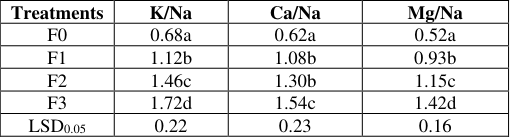 Table 3
 Table 4
 Table 5
Introduction
Saline stress resulting from soil or irrigation water salinity is one of the most important obstacles to the decline in agricultural crop production in arid and semi-arid areas. Under these conditions, there are several appropriate mechanisms or strategies to mitigate the damage to plant growth and improve its yield, including coexistence with salinity by developing varieties that tolerate salinity through breeding and improvement programs or using halophytic plants in cultivation or following appropriate irrigation and fertilization methods using a number of fertilizer applications with some macro nutrients, especially potassium and micronutrients. Several studies in this field have confirmed the effective role of these nutrients in improving the growth and yield of plants exposed to salt stress conditions in addition to improving their nutritional status. Triticosecale Witt is a forage grain crop and is a hybrid between durum wheat Triticum durum and rye grass Secale cereale L. Therefore, it combines the productive qualities of wheat and the qualities of grass that are resistant to harsh environmental conditions. The aim of the research is to find the optimum level of potassium suitable for the growth and yield of triticale wheat in salt affected soils and irrigated with saline groundwater.
Materials and Methods
A field experiment was carried out at Al-Tuwaitha Research Station/Agricultural Research Center, Scientific Research Commission, Ministry of Higher Education and Scientific Research / Iraq, 30 km southeast of Baghdad, the soil texture was clay loam, classified as a Typic Torrifluvent (Soil Survey Staff, 2006). Before starting the experiment, soil samples were taken from the surface layer (0-30 cm), air dried, sieved through a 2.0 mm mesh, and analyzed according to Richards (1954) and page et al. (1982) as shown in Table (1). Wheat triticale seeds were sown on during the three growing seasons 2015-2016, 2016-2017 and 2017-2018 in rows with a rate of 120 kg. ha-1. Recommended fertilization was added with nitrogen and phosphorous in the amount of 150 kg N. ha-1 and 80 kg P. ha-1 for all treatments. Phosphorous was added at sowing as triple super phosphate, while nitrogen fertilizer was added after sowing as a urea in three parts, 30% tillering stage, 40% at booting stage, and 30% at stem extension stage of plant growth. Irrigation was carried out using well water of salinity of (4.33 dS.m-1), its properties are shown in Table (2). Water was pumped to the panels in specific quantities in each irrigation by a series of plastic tubes and a special pump for that. The weeding process was performed whenever needed. The experiment was laid out using R.C.B.D. with three replications, the experimental unit area (2 x 2.5 = 5m2) includes ten lines length of 2.5 m and a distance of 20 cm between each line and another and 1m separators was left between the plots.
Fertilization treatments included the following combinations:
1. Traditional soil fertilization with nitrogen and phosphorus elements in an amount of 150 kg N. ha -1 and 80 kg P. ha -1 (comparison) and symbolized by F0, and all treatments were given the same amount. 2. Soil fertilization with K in an amount of 100 kg K. ha -1 and symbolized by F1. 3. Soil fertilization with K in an amount of 150 kg. ha -1 + F0 and symbolized by F2. 4. Soil fertilization with K in an amount of 200 kg. ha -1 + F0 and symbolized by F3.
Potassium
Added in the form of potassium sulphate (K2SO4) in three parts at the tillering, booting and stem extension of plant growth stages. The following equation was used to calculate the fertilizer efficiency (Yaduvanshi, 1984):
Fertilizer efficiency for production = Production for fertilized treatment -Production for control treatment / Production for comparison treatment * 100
The grain yield was adopted to calculate the fertilizer efficiency.
Results and Discussion
Results and Discussion
Soil and Irrigation Water Properties
Table (1) shows some of the physical and chemical properties of the soil used in the study the soil before implementing the experiments. It is clear that the soil is salt affected and has an electrical conductivity measured by 1:1 soil: solution ratio extract is 11.50 dS.m -1 , and the pH value reached 7.10, and its sodium adsorption ratio (SAR) was 7.50 which is within the appropriate limits for the growth of most plants. So, the soil is classified as a saline alkali soil according to US Soil Salinity Laboratory Staff (Richards, 1954). Also, it is noted that the soil content of available nutrients ranges from poor such as nitrogen, potassium, iron and zinc to medium such as phosphorus and good such as manganese and copper.
On the other hand, it is noted from Table (2) that the irrigation water is relatively of salt content with EC 4.33 dS.m -1 , pH is 7.3 and SAR is 8.60, which is within the appropriate limits for the growth of most plants (Rhoades, 1992). Therefore, the ground water of the land area used for irrigation is classified as saline water of class S2 according to Soil Salinity Laboratory Staff classification of irrigation (Richards, 1954).
Table 1 shows the physical and chemical properties of the soil used in this study. Soil salinity as measured by 1:1 soil: solution ratio extract is 28.6 dS.m-1, pH is <7.5 and SAR is 20.3. Accordingly, the soil is classified as a saline alkali soil according to US Soil Salinity Laboratory Staff (Richards, 1954). Irrigation water is relatively of high salt content with EC 5.8, SAR is 12.6, and pH is 7.3. Therefore, the ground water of the region used for irrigation is classified as saline water of class S2 according to Soil Salinity Laboratory Staff classification of irrigation (Richards, 1954).
| Analysis | — | Value |
|---|---|---|
| EC(1:1) dS.m-1 | 11. 50 | |
| pH | 7.10 | |
| Soluble ions mmol.kg-1 soil | Na | 51.20 |
| Ca | 24.15 | |
| Mg | 22.10 | |
| SAR | 7.50 | |
| CaCO3 gm.Kg-1 soil | 243.00 | |
| CEC cm mol.Kg-1 soil | 24.50 | |
| Available elements mg.Kg-1 soil | N | 44.33 |
| P | 14.10 | |
| K | 122.40 | |
| Fe | 2.20 | |
| Zn | 0.38 | |
| Mn | 2.26 | |
| Cu | 0.72 | |
| Texture | Clay loam | |
| Field capacity (%) | 30.00 |
Table text extracted from the original PDF; superscript letters are shown inline. The original table image is below.
View original table image
The effect of potassium fertilizer on the ratios of some elements in the leaves of triticale wheat Table (3) shows the effect of potassium fertilization on the ratios of potassium/sodium, calcium/sodium, and magnesium/sodium in triticale wheat leaves at the flowering stage. It is noted that the levels of potassium used significantly affected the ratio of potassium to sodium (K:Na) in the leaves of wheat plants, as a significant increase in this ratio was observed from 0.68 in the control treatment F0 to 1.72 in the fertilization treatment F3. The results show that all treatments differed significantly in the ratio of potassium to sodium. The results of Table (3) also indicate that the treatments used in the study significantly affected the ratio of calcium to sodium (Ca:Na) in the leaves of the plant, as the average of this ratio in the control treatment reached 0.62, while it increased to 1.08, 1.30, and 1.54 for treatments F1, F2, and F3, respectively. It is noted that treatments F1 and F2 did not differ significantly from each other, and it was also noted that treatment F3 significantly outperformed all treatments. As for the ratio of magnesium to sodium (Mg:Na), it is noted from the same table that the same trend occurred, as it reached 0.57 in the control treatment and increased to 1.42 in the treatment F3.These results confirm the effective role of potassium levels used in encouraging the absorption of calcium, magnesium and potassium while reducing sodium absorption, which led to improving the ratios of potassium/sodium, calcium/sodium and magnesium/sodium. These results are consistent with what a number of researchers have found that soil or foliar fertilization with potassium led to improving the absorption of these elements in plants exposed to salt stress conditions. The effect of potassium fertilization on the dry matter and grain yield of triticale wheat Tables 4 and5 show the effect of the levels of potassium fertilization used on the yield of triticale wheat grown in salt-affected soil irrigated with well water for three consecutive seasons. It is clear from this that the use of soil fertilization with potassium led to a significant increase in the dry matter and grain yields under the significance (P<0.05), as is evident from the results of the first season (2015-2016), as the dry matter yield increased by a percentage of 39.35% when fertilizing with the F3 treatment, which gave a yield of 6.25 t. ha -1 compared to traditional fertilization (control F0). It is noted from the same table that the effect of potassium levels had a significant effect on the grain yield, as the yield ranged between 1.12 t. ha -1 in the control treatment and 1.39 t .ha -1 in the F3 treatment. The percentage of increase in the grain yield reached 10.50%, 23.84% and 47.42% for the F1, F2 and F3 treatments, respectively, compared to the control treatment F0. The same trend occurred in the behavior of these treatments for both indicators in the dry matter and grain yield for the subsequent season 2016-2017 (Tables 4 and5), as the treatments had a significant effect on the yield and treatment F3 gave the highest dry matter yield reaching 6.34 t.h -1 and for grains 1.72 t.h -1 . The percentage of increase in grain yield were 5.76%, 21.82% and 43.73% for F1, F2 and F3 treatments, respectively, compared to the control F0. So, noting slight quantitative changes in the yield between the two seasons, which may be due to the variation in climatic conditions from one season to another. The same trend also occurred in the third season (2017-2018) for both indicators, dry matter and grain yield. The percentages of increase in dry matter yield were 19.96%, 32.54% and 34.27%, and in grain yield were 10.27%, 27.13% and 46.88% for treatments F1, F2 and F3, respectively, compared to the comparison treatment F0. In general, slight changes were observed between the three seasons in dry matter and grain yield, which may be attributed to the variation in climatic conditions from one season to another (Massimi et al., 2016). These results confirm the effectiveness of potassium fertilization in increasing the tolerance of triticale wheat to salinity and improving its yield Hasanuzzaman et al., 2018). When calculating the efficiency of fertilizers and as an average for three seasons, we note that they were, in order, 46.0%, 24.26%, and 8.84% for treatments F3, F2, and F1, respectively, which again shows the level of potassium effectiveness in the grain yield of triticale wheat growing in salt affected soil.
Figures and tables from the paper
| EC dS.m-1 | — | pH | Soluble Ions mmol.L-1 | — | — | — | — | — | SAR |
|---|---|---|---|---|---|---|---|---|---|
| Na+ | Ca+2 | Mg+2 | Cl-1 | SO4-2 | HCO3 | ||||
| 4.33 | 7.20 | 26.0 | 1.10 | 8.05 | 30.0 | 13.2 | 5.0 | 8.60 |
Table text extracted from the original PDF; superscript letters are shown inline. The original table image is below.
View original table image
| Treatments | K/Na | Ca/Na | Mg/Na |
|---|---|---|---|
| F0 | 0.68a | 0.62a | 0.52a |
| F1 | 1.12b | 1.08b | 0.93b |
| F2 | 1.46c | 1.30b | 1.15c |
| F3 | 1.72d | 1.54c | 1.42d |
| LSD0.05 | 0.22 | 0.23 | 0.16 |
Table text extracted from the original PDF; superscript letters are shown inline. The original table image is below.
View original table image
| Treatment | season 2016-2015 | — | 2017-2016 | — | 2018-2017 | — |
|---|---|---|---|---|---|---|
| T .ha-1 | Yield change (%) | T .ha-1 | Yield change (%) | T .ha-1 | Yield change (%) | |
| F0 | 4.48a | --- | 4.86a | --- | 4.61a | --- |
| F1 | 5.44b | 21.43 | 5.73b | 17.90 | 5.53b | 19.96 |
| F2 | 6.00c | 33.93 | 6.10c | 25.51 | 6.11c | 32.54 |
| F3 | 6.25d | 39.51 | 6.34d | 30.45 | 6.19c | 34.27 |
| LSD0.05 | 0.113 | 0.148 | 0.225 |
Table text extracted from the original PDF; superscript letters are shown inline. The original table image is below.
View original table image
| Treatment | season 2016-2015 | — | 2017 season -2016 | — | season 2018-2017 | — |
|---|---|---|---|---|---|---|
| Grain yield (T .ha-1) | Yield change (%) | Grain yield (T .ha-1) | Yield change (%) | Grain yield (T .ha-1) | Yield change (%) | |
| F0 | 1.12a | --- | 1.20a | ---- | 1.14a | --- |
| F1 | 1.24b | 10.50 | 1.27a | 5.76 | 1.26a | 10.27 |
| F2 | 1.39c | 23.84 | 1.46b | 21.82 | 1.45b | 27.13 |
| F3 | 1.66d | 47.42 | 1.72c | 43.73 | 1.67c | 46.88 |
| LSD0.05 | 0.12 | 0.14 | 0.17 |
Table text extracted from the original PDF; superscript letters are shown inline. The original table image is below.
View original table image
References
19 in the original paper- Al-Ghrairi SM. Alleviation of the adverse effect of salt stress on growth and yield of wheat by using foliar application [PhD thesis]. Baghdad: Agric. College, Baghdad Univ.; 2011.
- Al-Samerria IK, Al-Ghrairi SM, Rahi HAS. Induction of antioxidant enzymes in wheat (Triticum spp.) grown under salt stress. Baghdad J Sci. 2013;10:832-843.
- Al-Ghrairi SM, Al-Samerria IK, Rahi HAS. Effect of salt stress and foliar application of some nutrients on K and Ca accumulation, distribution, and its relation to International Journal of Agriculture and Food Science https://www.agriculturaljournals.com peroxidase enzyme activity in leaves of wheat. Iraqi J Sci Tech. 2014;5:20-29.
- Al-Ghrairi SM, Al-Obaidi HSH, Atyiah AH, Khudhair SA, Nafal AA, Jassam OH, et al. Effect of potassium and some micronutrients and quantity of irrigation water on growth and yield of millet (Panicum miliaceum L.). Iraqi J Soil Sci. 2016;16(1):68-79.
- Al-Ghrairi SM, Razzaq IB, Al-Hasani AAM, Khudhier SA, Jasim BA, Mousa RA. Effect of some fertilizer combinations on growth and yield of wheat grown in salt-affected soil. In: The 10th Scientific Conference for Agricultural Research; 2017; Baghdad, Iraq.
- Al-Temimi AFH, Al-Ghrairi SM, Al-Ghrairi F, Razaq IB. Effect of potassium and micronutrients fertilization on activity of catalase enzyme and yield of wheat grown in salt affected soils. Dyson Appl Sci. 2020;1:81-87.
- Al-Ghrairi SM, Jawad AA, Mahdi HH, Mouhamad RS, Al-Azawi GS, Khudhier SA. Effect of foliar application calcium on growth and yield of wheat (Triticum aestivum L.) in salt-affected soil. Syrian Agric Res J. 2023;10(3). Accepted for publication.
- Abd El-Hady BA. Effect of zinc application on growth and nutrient uptake of barley plant irrigated with saline water. J Appl Sci Res. 2007;3(6):431-436.
- Cakmak I. The role of potassium in alleviating detrimental effects in plants. J Plant Nutr. 2005;168:521-530.
- Genc Y, McDonald GK, Tester M. Re-assessment of tissue Na⁺ concentration as a criterion for salinity tolerance in bread wheat. Plant Cell Environ. 2007;30:1486-498.
- Manal FM, Thalooth AT, Khalifa RKM. Effect of foliar spraying with uniconazole and micronutrients on yield and nutrients uptake of wheat plants grown under saline condition. Am Sci J. 2010;6(8):398-404.
- Massimi M, Al-Rifaee M, Alrusheidat J, Al-Dakheel A, Ismail F, Al-Ashgar Y. Salt-tolerant triticale (× Triticosecale Witt) cultivation in Jordan as a new forage crop. Am J Exp Agric. 2016;12(2):1-7.
- Page AL, Miller RH, Keeney DR, editors. Methods of soil analysis. Part 2: Chemical and microbiological properties. Agron Ser No. 9. Madison: Am Soc Agron, Soil Sci Soc Am Inc.; 1982.
- Richards A. Diagnosis and improvement of saline and alkali soils. Washington: USDA; 1954. Agric. Handbook no. 60.
- Rhoades JD, Kandiah A, Mashal AM. The use of saline water for crop production. Rome: FAO; 1992. Irrigation and Drainage Paper 48.
- Yaduvanshi HS. Interaction between phosphorus uptake by plant [PhD thesis]. Baghdad: College of Agriculture, Baghdad Univ.; 1984. Cited in: Ali NS. 1997.
- Zaman B, Niazi BH, Athar M, Ahmad M. Response of wheat plants to sodium and calcium ion interaction under saline environment. Int J Environ Sci Technol. 2005;2(1):7-12.
- Ma Q, Bell R, Scanlan C, Sarre G, Brennan R. Growth and yield responses in wheat and barley to potassium supply under drought or moderately saline conditions in south-west Western Australia. Crop Pasture Sci. 2015.
- Hasanuzzaman M, Bhuyan MHMB, Nahar K, Hossain MS, Al Mahmud J, Hossen MS, et al. Potassium: a vital regulator of plant responses and tolerance to abiotic stresses. Agronomy. 2018;8(3):31.