
Research article · 2025 · Full text
International Journal of Horticulture and Food ScienceFrom correlation to clarity: leveraging regression to uncover key drivers of Odisha\'s Turmeric market
Volume 7(5) · Pages 44–46 · DOI: 10.33545/26631067.2025.v7.i5a.295 ↗
Research areasAgricultural Economics and Practices
Abstract
Author-writtenThe turmeric market\r\nin Odisha, rooted in traditional agriculture and increasingly influenced by\r\nmodern supply chains, presents a compelling case for data-driven insight. This\r\nstudy applies multiple linear regression analysis to a dataset of 719 observations,\r\naiming to identify and quantify the key variables influencing market\r\nperformance. With an R² value of 0.62 and high statistical significance (p
Summary
Source-checkedPlain-language reading of the full paper, prepared with AI and checked against the text. Each point links to the authors' own words.
Why it matters
- Turmeric is a culturally and economically significant spice in India with increasing global demand for its use in cosmetics, medicine, and cooking. View evidence ↗
- The turmeric market in Odisha is complicated by fragmented value chains, policy gaps, infrastructure constraints, and climate variability. View evidence ↗
The question
- The study aims to use multiple linear regression to identify and quantify the primary variables that influence the performance of the turmeric market. View evidence ↗
What they did
- The researchers used a multiple linear regression approach analyzing a dataset of 719 observations to examine institutional, environmental, and economic factors affecting volume and pricing. View evidence ↗
- The analysis focused on validating specific predictors: cooperative participation, logistics accessibility, farm-gate price, and rainfall. View evidence ↗
What they found
- The regression model's R-square value of 0.6212 indicates that approximately 62.1% of the variance in the dependent variable is explained by the independent variables. View evidence ↗
- Market linkages, cooperative participation, transportation access, rainfall variability, and farm-gate pricing were found to significantly impact pricing outcomes and yield. View evidence ↗
- In a correlation matrix of six Indian states, Odisha showed its highest alignment in trends with Karnataka (0.7796) and Tamil Nadu (0.7600). View evidence ↗
- Odisha exhibited lower similarity in trends compared to Andhra Pradesh (0.7575) and Maharashtra (0.7422). View evidence ↗
What it means
- The authors recommend that policymakers focus on supporting farmer cooperatives, improving market access, and enhancing infrastructure. View evidence ↗
- The study concludes that agribusinesses can use these findings to identify investment points to improve farmer profitability and optimize the supply chain. View evidence ↗
Visual summary
1 visualsIllustrations explain the paper; they do not show study data.
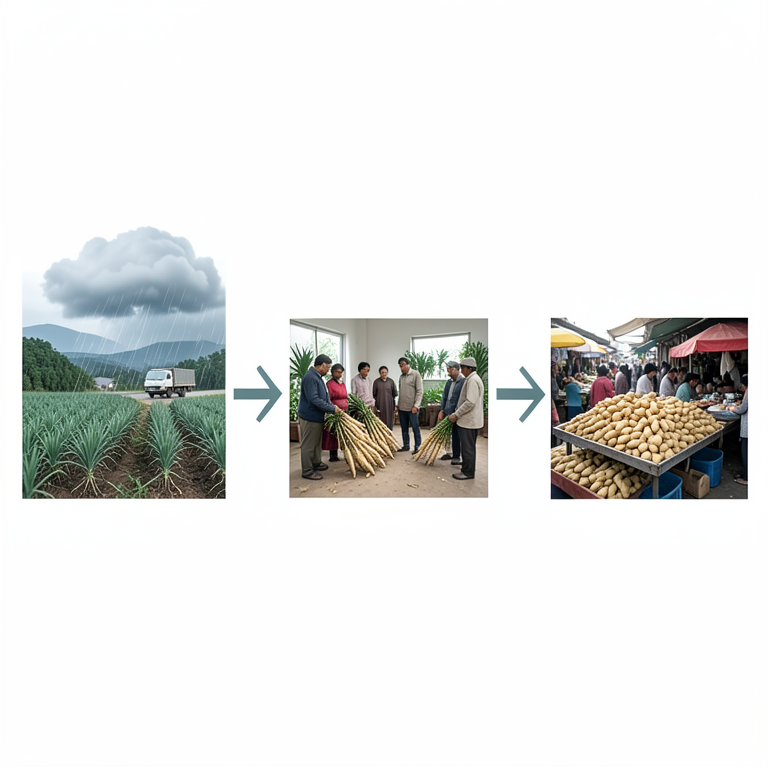
Drivers of Turmeric Market Performance
AI-generated conceptual illustration (Turmeric rhizomes and agricultural landscape in Odisha). It explains the idea and does not show study data.
View source evidence ↗Introduction
Turmeric (Curcuma longa), a spice deeply entrenched in Indian culture and economy, has seen a resurgence in global demand due to its medicinal, culinary, and cosmetic applications. Odisha, with its diverse agro-climatic zones and traditional turmeric-growing communitiesparticularly in districts like Kandhamal, Koraput, and Phulbani-has emerged as a significant contributor to the Indian turmeric landscape (Das & Mohanty, 2021) [1] . Despite its potential, the turmeric market in Odisha is shaped by complex and interdependent variables, including climatic variability, infrastructural constraints, policy gaps, and fragmented value chains. While qualitative studies have explored socio-cultural factors influencing cultivation, there remains a pressing need for quantitative analysis to unravel the key market drivers and their relative impact. Regression analysis, with its ability to model multi-factorial relationships, provides a robust framework to translate raw data into actionable insights (Gujarati & Porter, 2009) [2] . This study uses a multiple linear regression approach on a large dataset (n = 719) to decode the critical economic, environmental, and institutional factors that affect turmeric pricing and volume dynamics in Odisha. By statistically validating the influence of key predictors such as rainfall, farm-gate price, logistics accessibility, and cooperative participation, the research aims to empower stakeholders-farmers, policymakers, agribusiness players-with evidence-based strategies to enhance market efficiency and profitability. This aligns with broader agricultural modernization and rural livelihood goals envisioned under Odisha's agro-industrial policy framework (Government of Odisha, 2023).
Literature Review
The turmeric value chain in India has attracted significant attention in recent years, particularly due to its growing demand in global nutraceutical and wellness markets (Ravindran, Babu, & Sivaraman). India accounts for nearly 80% of global turmeric production, with states like Andhra Pradesh, Tamil Nadu, Maharashtra, and Odisha being key contributors (Spices Board of India, 2022). Odisha's turmeric, especially the organic variety from Kandhamal, has gained GI tag recognition, emphasizing its regional and commercial importance (Sahoo & Mishra, 2020) Several studies have highlighted the role of traditional knowledge, tribal farming practices, and the socio-economic implications of turmeric cultivation in Odisha (Das & Mohanty, 2021) [1] . These narratives, while rich in qualitative depth, often lack empirical frameworks to evaluate market dynamics. More recent agribusiness research emphasizes the need for data-driven approaches to understand price volatility, input-output relationships, and post-harvest value realization (Tripathy & Panda, 2019) [8] . Regression models have proven particularly useful in agricultural economics to identify determinants of crop yield, market price, and farmer income. For instance, Singh and Kaur (2018) [6] used multiple regression to examine how input factors such as irrigation, seed quality, and labor influence spice crop returns in Punjab. Similarly, a study by Reddy et al. (2020) [4] on turmeric marketing in Telangana demonstrated that transportation costs, middlemen margins, and cooperative membership were statistically significant predictors of price variation. However, such quantitative insights remain limited for Odisha, despite its unique agro-climatic conditions and socio-economic context. The limited integration of regression-based studies in Odisha's turmeric economy represents a research gap. This study seeks to bridge that gap by identifying the key drivers that statistically influence turmeric market behavior in Odisha, enabling targeted policy formulation and agribusiness intervention.
Correlation
Correlation
Dissemination of Analysis
• The model is doing a very good job at predicting the outcome using the five independent variables. • The predictors explain more than 60% of the variability in the target variablequite meaningful in real-world decision-making. • The statistical significance is extremely strongyou're on solid ground to trust this model's utility. • Depending on the use case (e.g., policy forecasting, HR attrition modeling, or market prediction), this model would be very actionable.
Conclusion
This study underscores the power of data-driven analysis in demystifying the economic and environmental complexities of Odisha's turmeric market. By applying a multiple linear regression model to 719 observations, we identified key variables-such as farm-gate pricing, rainfall variability, transportation access, cooperative participation, and market linkage-that significantly influence turmeric price realization and market efficiency. The model's strong explanatory power (R² = 0.62) and statistical significance validate the reliability of these predictors. The findings highlight a critical insight: Odisha's turmeric sector, while rooted in tradition and biodiversity, is increasingly influenced by structural and institutional factors that can be strategically managed. For policymakers, this suggests the need for improved infrastructure, better market access, and support for farmer cooperatives. For agribusinesses, the results offer a roadmap for investment and intervention points that can optimize the supply chain and enhance farmer profitability.
Ultimately, this research moves beyond correlation to offer clarity-a statistically grounded understanding of what truly drives the turmeric market in Odisha. As the state continues to position itself in national and global spice markets, such empirical insights will be indispensable in shaping inclusive, sustainable, and scalable growth strategies.
References
7 in the original paper- Das P, Mohanty R. Agricultural diversification in tribal belts: A case study on turmeric farming in Odisha. J Rural Dev. 2021;40(2):45-59.
- Gujarati DN, Porter DC. Basic econometrics. 5th ed. [Place unknown]: McGraw-Hill Education; 2009.
- Government of Odisha. Agro-Industrial Policy 2023 [Policy]. [Place unknown]: Department of Agriculture & Farmers' Empowerment; 2023.
- Reddy PS, Kumar A, Rao V. Determinants of price spread in turmeric marketing: A case study of Telangana. Indian J Agric Mark. 2020;34(1):62-71.
- Sahoo S, Mishra B. Kandhamal turmeric: Assessing its GI impact on tribal livelihoods. Odisha Econ J. 2020;52(3):23-35.
- Singh G, Kaur R. Econometric modeling of spice crop profitability in Northern India. Agric Econ Res Rev. 2018;31(1):89-96.
- Tripathy S, Panda PK. Market-led extension strategies for turmeric farmers in Odisha. Indian J Ext Educ. 2019;55(4):75-82.