
Research article · 2025 · Full text
International Journal of Agriculture and Food ScienceEffect of different sowing methods on growth and yield of cotton: A review
Volume 7(5) · Pages 43–46 · DOI: 10.33545/2664844x.2025.v7.i5a.378 ↗
Research areasResearch in Cotton Cultivation
Abstract
Author-writtenCotton (Gossypium hirsutum L.) plays a vital role in economy and it is the lifeline of the textile industry in the country. Agronomic practices play a significant role in growth and yield of plant. In various agronomic practices sowing methods play significant role in obtaining good crop yields. To explore the agronomic growth and yield of cotton under different sowing methods the following case studied has been studied. The review paper comprised of various method of sowing. Plant height, number of bolls per plant (opened and unopened), average boll weight (g), number of sympodial and monopodial branches per plant and yield significantly affected by different sowing methods.
Summary
Source-checkedPlain-language reading of the full paper, prepared with AI and checked against the text. Each point links to the authors' own words.
Why it matters
- Cotton is a critical cash crop and the primary foundation for the textile industry. View evidence ↗
- The method of planting is a key agronomic factor because it establishes the crop stand and manages plant competition for light to maximize yield. View evidence ↗
- Sowing methods and the uniformity of plant distribution significantly impact both the yield of seed cotton and the quality of the fibers. View evidence ↗
The question
- The objective of this review is to explore how different sowing methods affect the agronomic growth and yield of cotton. View evidence ↗
What they did
- The review analyzes various sowing methods and their effects on parameters including plant height, boll count, boll weight, branch numbers, and overall yield. View evidence ↗
What they found
- Bed-furrow planting resulted in a 33% increase in seed cotton yield compared to flat planting. View evidence ↗
- Ridge sowing achieved a higher seed cotton yield of 1729 kg/ha compared to 1683 kg/ha for flat sowing. View evidence ↗
- In cotton-wheat rotations, bed sowing was significantly better than flat sowing, providing a 35% higher seed cotton yield. View evidence ↗
- Furrow-bed seeding increased lint yield by 25% over flat seeding. View evidence ↗
- Using a bed maker Bt sowing machine increased cotton yield by 12.3% compared to a three-tyne sowing drill, performing similarly to ridge sowing. View evidence ↗
- Pit planting resulted in the highest plant height (152.0 cm), while ridge and flat planting resulted in the lowest (119.6 cm). View evidence ↗
- The bed maker Bt sowing machine produced the highest plant height (204.2 cm), which was statistically similar to ridge sowing (202.1 cm). View evidence ↗
- Compared to flat sowing, ridge sowing improved plant height (143.98 cm), boll count (32.18 total), and seed cotton yield (13.28 kg/ha). View evidence ↗
- Pit planting led to the maximum increase in plant height (152 cm) and the number of monopodial (4.7) and sympodial (22.6) branches per plant. View evidence ↗
What it means
- The authors conclude that bed and ridge sowing methods, followed by pit planting, have the most significant positive effect on cotton growth and yield. View evidence ↗
- The authors suggest that future research at the molecular level is needed to evaluate correlations between variety and yield. View evidence ↗
Visual summary
1 visualsIllustrations explain the paper; they do not show study data.
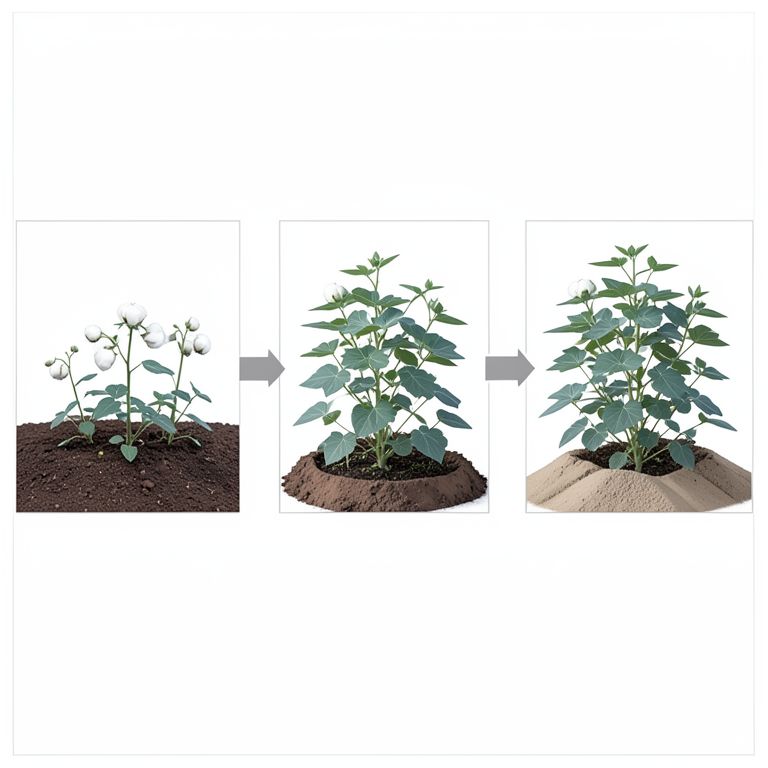
Comparison of Sowing Methods
AI-generated conceptual illustration (Cotton plants (Gossypium hirsutum) in soil). It explains the idea and does not show study data.
View source evidence ↗Figures & tables
From the original paper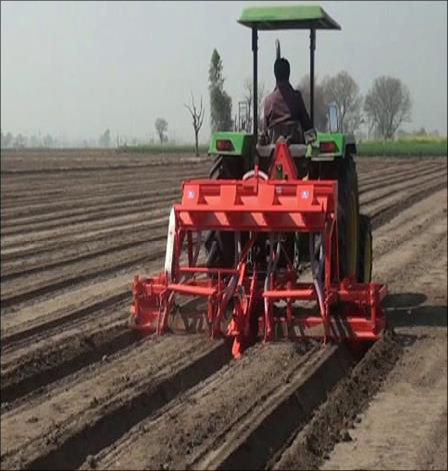 Figure 1
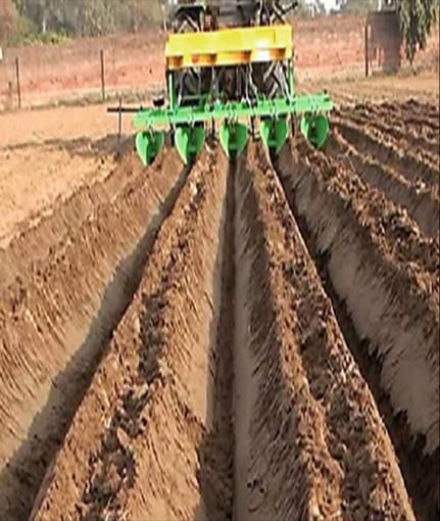 Figure 2
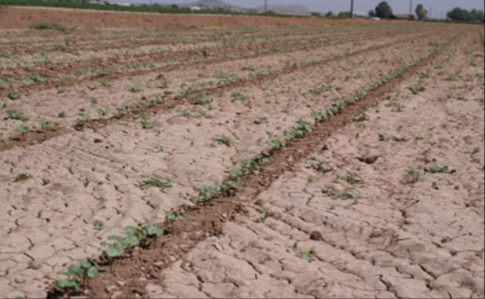 Figure 3
Introduction
Cotton is one of the most important fibre and cash crop of India and plays a dominant role in the industrial and agricultural economy of the country. There are four cultivated species of cotton viz. Gossypium arboreum, G. herbaceum, G. hirsutum and G. barbadense. Among these species the first two is diploid (2n=26) and are native to old world and the last two species are tetraploid (2n=52) and are also referred to as New World Cottons. Lint percentage of cotton is 33% and their fibre maturity is measured by Arealo-meter. Cotton holds a top position as the important global fibre crop, primarily serving the textile industry (Saini et al., 2010; Yadav et al., 2017; Yadav et al., 2018) [25] . Due to its vital role in agriculture, industrial development and employment generation, it is an important fibre crop of India (Singh et al., 2018) [27] . Plant growth and development depends upon favourable soil conditions and sowing method which have suitable soil moisture content, temperature and method or technique of sowing. Therefore, an effective sowing method is required that may use such tillage system which improves the soil physical properties and enhance the germination, plant growth and development as well as yield (Krause et al., 2009) [19] . Cotton plants respond significantly to sowing methods, the uniformity of their distribution over the sowing area, considerably affecting the seed cotton yield and fibre quality traits (Ozpinar and Isik, 2004 [4,21,22,23] . India has the largest cotton area in the world with about 11 million hectares accounting for one-fourth of the global cotton area. Among many agronomic factors responsible for cotton growth and yield, the planting method has prime importance because it not only helps in establishing the appropriate crop stand but also facilitates the conversion of light energy by balancing plant to plant competition in order to produce maximum crop yield (Ali et al. 2012) [2] Based on cotton growing conditions, the sowing methods showed varied responses and effectiveness in production. Therefore, it is crucial to establish the soil and climatic conditions suitable to what type of sowing method to ensure the optimum seed cotton yield. Cotton cultivation on ridges across the slopes conserves more water, reduces soil erosion and improves yield. Among many agronomic factors responsible for cotton growth and yield, the planting method has prime importance because it not only helps in establishing the appropriate crop stand but also facilitates the conversion of light energy by balancing plant to plant competition in order to produce maximum crop yield (Ali et al. 2012) [2] .
The placement of seed at correct depth is very important for proper germination and for obtaining optimum plant population per unit area of the crop especially under dry land farming where soil moisture is at greater depth (Khambalkar et al., 2010) [17] . Cotton-wheat cropping system is the most prevalent cottonbased system in Punjab (Singh et al., 2019) [28] , in which cotton is raised during summer season (Singh et al., 2018) [27] . Anwar et al. (2003) [3] reported that 33% higher seed cotton yield was observed from bed-furrow planting as compared with flat planting. Similarly, Hussain et al. (2003) [14] concluded that ridge sowing produced significantly higher seed cotton yield (1729 kg/ha) than flat sowing (1683 kg/ha). Flat planted cotton was lower yielding than cotton planted on raised beds (Boquet et al. 2005) [5] .
Discussion
Irfan et al (2020) [16] studied an experiment which comprised of two tillage systems viz conventional tillage (one-time disc harrow + two cultivations + planking) and deep tillage (chiseling twice + one cultivation + planking) along with three sowing methods viz flat sowing, ridge sowing and bed sowing. The result showed that the bed sowing exhibited higher yield contributing traits such as number of opened bolls per plant and boll weight as compared to ridge and flat sowing. [20] evaluated an experiment to check the effect of sowing methods on fibre yield and quality parameters of the upland cotton and founds that the two-line sowing method with plant spacing (80×11×2×10×1) and plant density (200,000 ha-1) contributed to an increase in the seed cotton yield (4.76 t/ha). The highest seed cotton yield could refer to the topmost plant density and the largest number of bolls per unit area, which were 32%-33% more than the traditional cotton sowing technology. In an experiment of different planting method pit planting, bed planting, ridge planting and line sowing with varied inter row spacing observed that the cotton seed weight was not affected significantly by different sowing methods while maximum seed cotton yield (2944.5 kg ha) was produced by flat sowing (Ehsanullah et al. 2017) [12] . Ali and Ehsanullah et al. (2007) [1] concluded that flat planting with each row earthing up gave higher seed cotton yield than bed and ridge plantings. Bed sowing method was significantly superior to flat sowing method with 35% higher seed cotton yield in cotton-wheat rotation (Chauhan et al. 2007) [6] . Similarly furrow-bed seeded cotton increased lint yield by 25% compared with flat seeded cotton (Dong et al., 2008) [11] . Field experiment was conducted to study the growth, productivity and quality and root characteristics of Bt. Cotton under different planting methods viz. T1: Cotton sowing drill (Three Tynes), T2: Cotton sowing drill (Four Tynes), T3: Ridge sowing and T4: Bed maker. It was observed that the bed maker Bt sowing machine treatment gave significantly higher cotton yield (12.3%) over cotton sowing drill (Three Tynes) but it was statistically similar with ridge sowing (Dhillon et al. 2019) [9] . On the basis of results of two-year field experimentation, it is concluded that Bt cotton can be raised with preparing the field by ploughing followed by blade harrowing & planking and sow the crop on ridge for achieving higher yield and net realization. (Pusa 1121 +line sowing) showed the best values as compared to all the other treatments. The method of sowing shows the significant impact on the growth and yield parameters as depicted on the final yield. Treatment T4 (Basmati 1509 + line sowing) also showed similar results which may be due the positive varietal difference with different sowing methods. Further, the molecular level research may be required to evaluate the variety and yield correlations. A field experiment was conducted to assess the effect of different methods and weed management practices on seed cotton yield. The experiment comprised of six sowing methods viz. Flat sowing by drill and weeding twice, Flat sowing and each row earthing up, Flat sowing and alternate row earthing up, dibbling on both sides of bed at proper moisture regime and weeding twice, dibbling on both sides of bed in dry condition and followed by irrigation and weeding twice and planting in flat and mulching up Flat sowing by drill and every row earthing up proved to be the best sowing method by giving maximum seed cotton yield of 3542 kg ha - 1 with minimum weed density of only 12 plants m -2 and biomass of 10 g m-2 (Cheema et al. 2008) [7] . Whereas in an experiment which was conducted to evaluate the effect of three cotton planting patterns at five plant densities on cotton growth, yield, and fibre quality noted that planting pattern did not influence any plant structure or yield variables, seed cotton or lint yield, lint percentage, lint or seed index, and fibre quality (Stephenson and Barber 2011) [29] . Ridge sowing of cotton has been found to improve the soil physical properties such as increased soil moisture content and decreased root penetration resistance and also enhances the emergence and seed cotton yield (Gursoy et al. 2011) [35] .
Effect on different method of sowing on yield of cotton Makhmadjanov et al. (2025)
Effect on different method of sowing on yield of cotton Makhmadjanov et al. (2025)
Effect of different sowing methods on growth factor of cotton plant
Ehsanullah, et al. (2017) [12] conducted an experiment with treatment combination of different sowing methods including pit planting (1 m × 1 m pits), bed planting (75 cm apart beds), ridge planting (75 cm apart ridges) and line sowing with varied inter row spacing (R × R) viz. 25, 50 and 75 cm. It was observed that the highest plant height (152.0 cm) was observed when the crop was sown in pits. Whereas, lowest plant height (119.6cm) was observed in ridge planting and flat planting. In an experiment Dhillon et al. (2019) [9] founds that the Bed maker Bt sowing machine treatment resulted highest plant height (204.2cm) and dry matter accumulation but were statistically at par with ridge sowing (202.1cm) and significantly higher than other planting methods. A field experiment was studied to evaluate the influence of different sowing methods and planting densities on growth, yield, quality and economic returns of cotton. Sowing methods included pit planting (1 m × 1 m pits), bed planting (75 cm apart beds), and ridge planting (75 cm apart ridges). Sowing methods significantly affected growth and yield of cotton. Pit planting imposed maximum increase in plant height (152 cm), number of monopodial branches (4.7) and sympodial branches (22.6) per plant, number of unopened (9.4) and opened bolls (41.1) per plant, and average boll weight (3.0 g) of cotton (Ehsanullah et al 2017) [12] . Khan et al (2012) [18] conducted a study to evaluate the effects of planting methods on root development, crop allometry, water use efficiency (WUE), productivity and economic returns of different maize (Zea mays L.) different planting methods includes beds, ridges, and flat sowing. Ridge sowing was better followed by bed sowing. Well-developed root system, with longer primary root, a greater number of lateral roots and higher root growth rate planted on ridges, which led to higher productivity (5.45 t ha -1 ) and WUE (1.345 kg m -2 ), in all the maize hybrids. There was a significant effect of different sowing methods on the lint index of cotton. Highest lint index was observed when the crop was sown with bed maker Bt sowing machine but it was statistically at par with ridge sowing and significantly higher than other plant methods during both the years (Dhillon BS, et al., 2019) [9] .
Conclusion
Sowing method play a significant role in growth and yield of the crop. According to the result the yield and growth of the plant greatly influenced by different sowing method. Among the different sowing methods every method plays their own role like ridge-furrow and bed sowing effect growth and yield by increasing water use efficiency and less weed competition, line to line sowing and broadcasting method effect by effecting plant population. However, the growth and yield of the plant highly affected by the bed and ridge sowing method followed by pit planting as compare to the other method of sowing.
Figures and tables from the paper
References
35 in the original paper- Ali L, Ehsanullah. Water use efficiency of different planting methods in cotton (Gossypium hirsutum L.). J Agric Res. 2007;45(4):299-306.
- Ali M, Ali L, Waqar MQ, Ali MA. Bed planting: A new crop establishment method for wheat in cotton-wheat cropping system of Southern Punjab. Int J Agric Appl Sci. 2012;4(1):8-14.
- Anwar MM, Gill MI, Zaki MS. Effect of bed-furrow planting on cotton crop. Pak Cottons. 2003;47:41-46.
- Balkcom KS, Price AJ, Santen VE, Delaney DP, Boykin DL, Arriaga FJ, et al. Row spacing, tillage system, and herbicide technology affects cotton plant growth and yield. Field Crops Res. 2010;117(2-3):219-225.
- Boquet DJ. Cotton in ultra-narrow row spacing: plant density and nitrogen fertilizer rates. Agron J. 2005;97:279-87.
- Chauhan SK. Seeding technique under saline water irrigation for cotton-wheat rotation. Bhartiya Krishi Anusandhan Patrika. 2007;22(4):273-6.
- Cheema MS, Nasrullah M, Akhtar M, Ali L. Comparative efficacy of different planting methods and weed management practices on seed cotton yield. Pak J Weed Sci Res. 2008;14(3-4):153-9.
- Deng ZY, Zhang Q, Pu JY, Liu DX, Guo H, Wang QF, et al. Impact of climate warming on crop planting and production in Northwest China. Acta Ecol Sinica. 2008;28(8):3760-8.
- Dhillon BS, Brar JS, Singh H. Influence of different planting methods on growth, productivity and root characteristics of BT cotton in south-west Punjab. J Pharmacogn Phytochem. 2019;8(1):1680-3.
- Dhir A, Pal RK, Kingra PK, Mishra SK. Effect of sowing date, row spacing and orientation on growth and yield of Bt cotton hybrid in southwest Punjab. Agric Res J. 2021;58(3):446-50.
- Dong H, Li W, Tang W, Zhang D. Furrow seeding with plastic mulching increases stand establishment and lint yield of cotton in saline field. Agron J. 2008;100(6):1640-6.
- Ehsanullah, Shahzad AM, Anjum SA, Zohaib A, Ishfaq M, Warraich EA. Effect of different sowing methods and planting densities on growth, yield, fibre quality and economic efficacy of cotton. Pak J Agric Res. 2017;30(1).
- Haliloğlu H, Cevheri Çİ, Beyyavaş V. The effect of defoliant application on yield and yield components of some cotton (L.) cultivars at timely and late sowing. Int J Agric Environ Food Sci. 2020;4(2):157-64.
- Hussain T, Tariq MJ, Siddiqui BN. Effect of different irrigation levels on the yield and yield components of cotton (Gossypium hirsutum L.) under two sowing methods. J Biol Sci. 2003;3:655-9.
- Hussain S, Ali H, Hussain GS. Growth, productivity and net returns of Advanced Cotton (Gossypium hirsutum L.) cultivars as influenced by sowing time under the agroclimatic conditions of Southern Punjab, Pakistan. Appl Ecol Environ Res. 2020;18(6):7843-7852.
- Irfan M, Ali H. Various tillage systems and sowing methods affect growth and yield related characters of cotton. J Arable Crops Mark, 2020.
- Khambalkar VP, Nage SM, Rathod CM, Gajakos AV, Dahatonde S. Mechanical sowing of safflower on broad bed furrow. Aust J Agric Eng. 2010;1(5):184-7.
- Khan MB, Rafiq R, Hussain M, Farooq M, Jabran K. Ridge sowing improves root system, phosphorous uptake, growth and yield of maize (Zea mays L.) hybrids. J Anim Plant Sci. 2012;22:309-17.
- Krause U, Koch HJ, Maerlaender B. Soil properties affecting yield formation in sugar beet under ridge and flat cultivation. Eur J Agron. 2009;31(1):20-8.
- Makhmadjanov S, Tokhetova L, Daurenbek N, Aliev A, Kostakov A, Tagaev A, et al. Effect of sowing methods on fiber yield and quality parameters of the upland cotton (Gossypium hirsutum L.). SABRAO J Breed Genet. 2025;57(1):230-40.
- Menefee D, Smith DR, Zwonitzer M, Collins HP. Effects of row spacing and potassium foliar applications on yield of cotton. Agrosyst Geosci Environ. 2023;6:e20432.
- Mert M, Aslan E, Akişcan Y, Emin M. Response of cotton (Gossypium hirsutum L.) to different tillage systems and intra-row spacing. Soil Tillage Res. 2006;85(1-2):221-228.
- Ozpinar S, Isik A. Effect of tillage, ridging and row spacing on seedling emergence and yield of cotton. Soil Tillage Res. 2004;75(1):19-26.
- Qamar R, Ur-Rehman A, Javeed HMR, Saqib M, Shoaib M, Ali A, et al. Influence of sowing time on cotton growth, yield and fiber quality. Int J Biol Biotechnol. 2016;13(1):59-67.
- Saini SP, Manchanda JS, Singh P. Conjoint and separate application effect of coal fly ash and farm yard manure on cotton (Gossypium hirsutum) yield, plant nutrient concentration and soil properties. Environ Ecol. 2010;28(3B):2011-2017.
- Showalter AM, Heuberger S, Tabashnik BE, Caniere Y. A primer for using transgenic insecticidal cotton in developing countries. J Insect Sci, 2009, p. 6.
- Singh G, Singh P, Sodhi GPS. Farmers' perception towards pigeon pea cultivation as an alternate to Bt cotton in South-western Punjab. Indian J Ext Educ. 2018;54:171-179.
- Singh P, Singh G, Sodhi GPS. Applying DEA optimization approach for energy auditing in wheat cultivation under rice-wheat and cotton-wheat cropping systems in north western India. Energy. 2019;181:18-28.
- Stephenson DO, Barber LT. Effect of twin-row planting pattern and plant density on cotton growth, yield, and fibre quality. J Cotton Sci. 2011;15(3):243-50.
- Tariq M, Fatima Z, Iqbal P, Nahar K, Ahmad S, Hasanuzzaman M. Sowing dates and cultivars mediated changes in phenology and yield traits of cottonsunflower cropping system in the arid environment. Int J Plant Prod. 2021;5(2):291-302.
- Venugopalan MV, Sankaranarayanan K, Blaise D, Nalayini P, Prahraj CS, Gangaiah B. Bt cotton (Gossypium sp.) in India and its agronomic requirements-A review. Indian J Agron. 2009;54(4):343360.
- Vishwanath. Response of late sown Bt cotton (Gossypium hirsutum L.) to plant spacings, fertilizers levels and NAA under irrigation. Abstr Karnataka J Agric Sci. 2007;20(4).
- Zhao YZ. Climate in Liaoning and cotton production. Liaon Agric Sci. 1981;5:1-5.
- Kour S, Sajaan S, Gaikwad DS, Kumar A, Neetu. Impact of different sowing methods on growth and yield attributes of direct-seeded rice (Oryza sativa L.) in alluvial soils of Punjab, India. Plant Arch. 2018;18(2):1385-90.
- Gursoy S, Sessiz A, Karademir E, Karademir C, Kolay B, Urğun M, et al. Effects of ridge and conventional tillage systems on soil properties and cotton growth. Int J Plant Prod. 2011;5(3):227-36.