
Research article · 2025 · Full text
International Journal of Agriculture and Food ScienceEffect of spacing and phosphorus level on growth, yield and economics of mustard
Volume 7(5) · Pages 110–113 · DOI: 10.33545/2664844x.2025.v7.i5b.383 ↗
Research areasAgricultural Science and Fertilization
Abstract
Author-writtenOne of the most important oilseed crops grown worldwide, mustard (Brassica spp.) makes a substantial contribution to the production of edible oil. Agronomic elements including plant spacing and phosphorus fertilization affect mustard's growth, yield, and financial viability. In addition to lowering intra-plant competition and increasing plant vigor, proper spacing guarantees the effective use of light, nutrients, and soil moisture. However, phosphorus has a direct impact on crop productivity as it is essential for root development, energy transfer, enzyme activation, and seed formation. According to a number of studies, a moderate spacing (such as 30 cm by 10 cm or 45 cm by 15 cm) enhances plant height, biomass accumulation, and siliqua production by offering an ideal balance between plant population and resource availability. Plant density is increased by closer spacing, but competition for vital resources may result, lowering total output per hectare. Because there are fewer plants per unit area, wider spacing can lower total seed yield even though it is good for the growth of individual plants. Applying phosphorus at the right amounts (40–80 kg P₂O₅/ha) greatly increases mustard growth by boosting root multiplication, nutrient uptake, and photosynthetic efficiency. Phosphorus-deficient soils have been linked to reduced seed output, delayed flowering, and stunted development. However, excessive phosphorus application can result in nutrient imbalances and financial losses and may not always result in increased production. According to economic calculations, phosphorus levels and plant spacing should be chosen to optimize net returns and cost-benefit ratios. In addition to increasing mustard yield and oil content, balanced phosphorus fertilization and appropriate spacing also guarantee improved input usage, which lowers production costs and boosts profitability.
Summary
Source-checkedPlain-language reading of the full paper, prepared with AI and checked against the text. Each point links to the authors' own words.
Why it matters
- Mustard (Brassica spp.) is a globally significant oilseed crop that contributes substantially to edible oil production. View evidence ↗
- In India, rapeseed mustard is the second most important oilseed crop, following soybeans. View evidence ↗
- Phosphorus is critical for mustard productivity because it supports seed formation, enzyme activation, energy transfer, and root development. View evidence ↗
The question
- The study examines how phosphorus fertilization and plant spacing influence the growth, yield, and economic viability of mustard. View evidence ↗
What they did
- Standard spacing guidelines in India for mustard varieties and hybrids are 30 x 10 cm and 45 x 10 cm, respectively. View evidence ↗
- Phosphorus application levels between 40 and 80 kg P₂O₅/ha are noted to significantly increase mustard growth. View evidence ↗
What they found
- Increasing phosphorus levels from 0 kg/ha (P0) to 60 kg/ha (P3) increased biological yield from 40.06 to 50.97 qha-1 and seed yield from 11.28 to 15.63 qha-1. View evidence ↗
- Seed yield increased with every increment of phosphorus application up to 60 kg/ha, reaching 15.63 q/ha. View evidence ↗
- A moderate spacing of 40 cm x 15 cm is reported to improve oil content and seed yield by promoting balanced reproductive and vegetative growth. View evidence ↗
- Wider spacing of 45 cm x 20 cm leads to higher individual seed weight and improved root proliferation and branching. View evidence ↗
- Phosphorus levels exceeding 50 kg P₂O₅ per hectare can inhibit the uptake of iron and zinc and disrupt the overall nutrient balance. View evidence ↗
What it means
- The authors conclude that combining ideal plant spacing with proper phosphorus application optimizes yield potential and increases gross returns and net returns. View evidence ↗
- The authors recommend site-specific phosphorus control and proper plant spacing to ensure economic viability and sustainable productivity in mustard farming. View evidence ↗
Visual summary
2 visualsIllustrations explain the paper; charts are replotted from the paper's own table values.
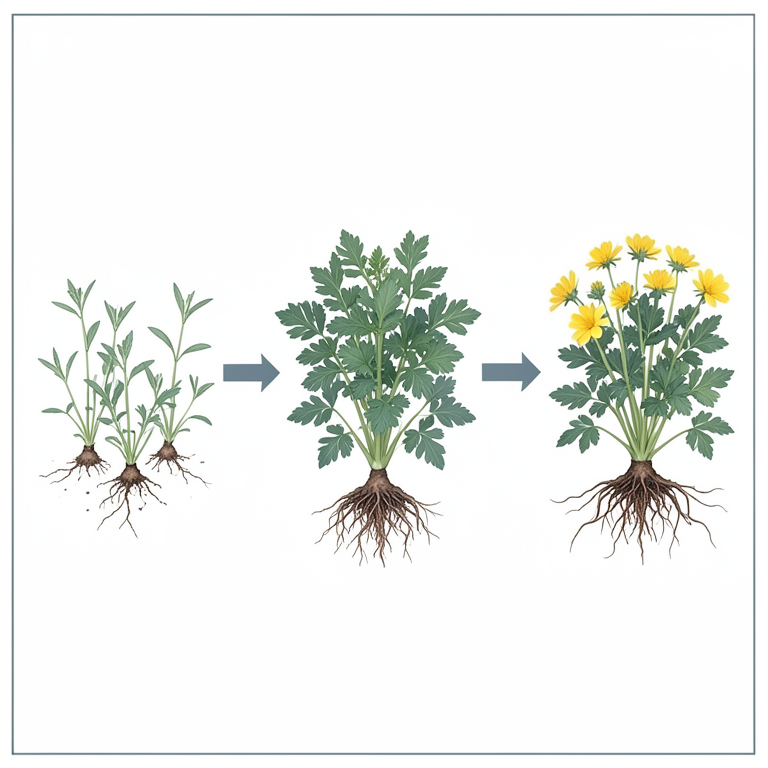
Synergy of Spacing and Phosphorus
AI-generated conceptual illustration (mustard plants). It explains the idea and does not show study data.
View source evidence ↗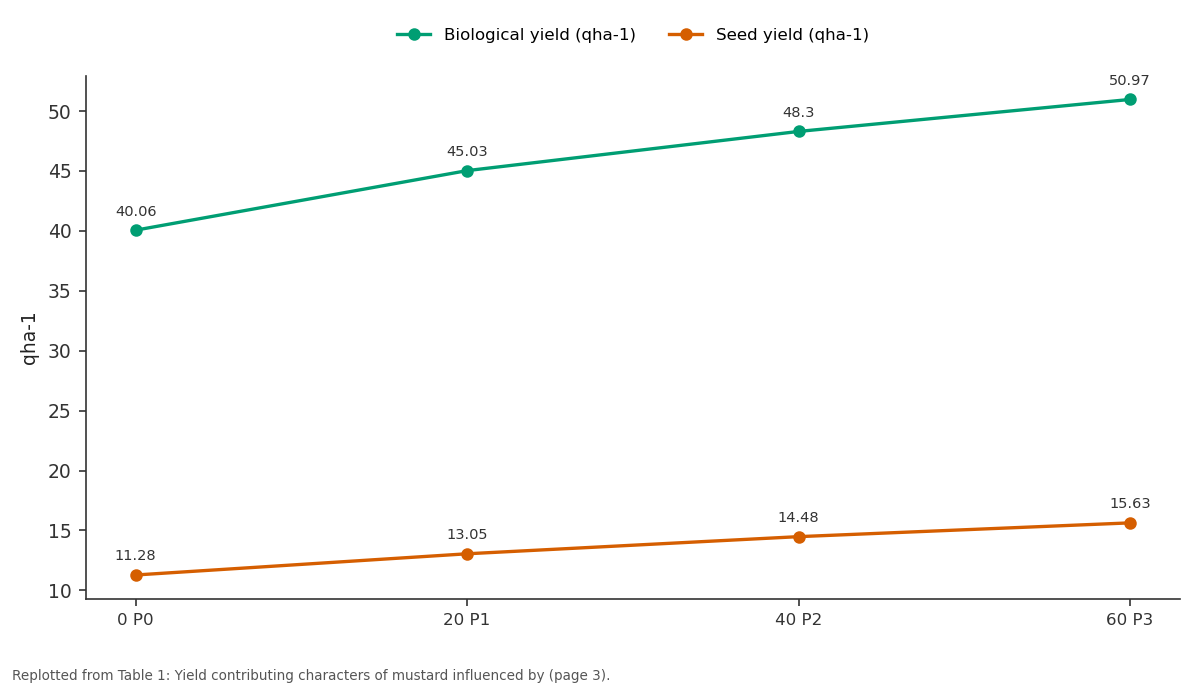
Biological yield (qha-1) and Seed yield (qha-1): 0 P0 vs 20 P1 vs 40 P2 vs 60 P3
Replotted from Table 1 (page 3) of the original paper. Every bar is the paper's own table value.
View source evidence ↗Figures & tables
From the original paper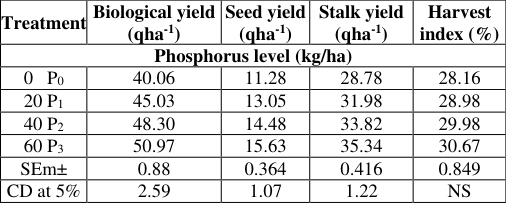 Table 1
Introduction
Brassica spp., or mustard, are members of the crucifereae family. Additionally, compared to other legumes, the protein and carbs in mung beans breakdown more quickly. Mustard contains between 33 and 49 percent oil, making it a nutritious food. An estimated 23.46 million metric tons (MMT) of edible oil are being consumed in India, with an average consumption of 16 kg per person. By 2025, this usage is expected to increase to 30 million tons. In India, the rapeseed mustard group of crops ranks second in importance among oilseed crops, after soybeans. In the globe, India is the third-largest producer (12.6%) of rapeseed mustard after China and Canada, and the second-largest grower (21.1%) after Canada (Choudhary et al., 2023) [2] . According to Rathi et al. (2019) [11] , the top mustard-growing states in India are Rajasthan (40.82%), Haryana (13.33%), Madhya Pradesh (11.76%), Uttar Pradesh (11.40%), and West Bengal (8.64%). A number of vitamins and minerals, including as calcium, magnesium, phosphorus, potassium, and several B-vitamins, are also present in mustard seeds. Omega-3 fatty acids, which are found in mustard seeds, are good for the heart. By raising Good Cholesterol (HDL) and Decreasing Bad Cholesterol (LDL), these fats help lessen the risk of heart disease. Because of their magnesium and potassium content, they have been demonstrated to help control blood pressure by enhancing circulation and lowering hypertension. Glucosinolates found in mustard seeds decompose into isothiocyanates.
International Journal of Agriculture and Food Science https://www.agriculturaljournals.com
These substances have been investigated for their ability to stop the proliferation of cancer cells and stop the development of cancer, especially in the breast, lungs, and colon. Additionally, it contains a wealth of antiinflammatory and antioxidant components that can help calm the skin, lessen acne, and delay the signs of premature aging. Because of its moisturizing and anti-aging qualities, mustard oil is frequently found in skincare products. Pharmaceuticals and the food and beverage industries make extensive use of mustard oil. It also explains a number of uses, including the manufacture of soap and antibacterial and antifungal chemicals. Additionally, oil is utilized to prepare food and enhance its flavor. The mustard crop currently provides 17.84% of the world's yearly edible oil (Chauhan SK., 2017) [3] . Therefore, correct spacing, fertilizer dosage, and other more sustainable production approaches are necessary for improved mustard crop and product yield. Plant spacing, which dictates competition for resources, canopy structure, and total yield potential, has a major impact on mustard growth and productivity. Another crucial factor that can be changed to maximize productivity per unit of land area is plant density. Variety, growth habit, and agroclimatic conditions all affect the ideal plant density when planted with the right geometry (Sondhiya et al., 2019) [16] . Plant density and spacing are inversely related; that is, the overall plant density falls as plant spacing increases and vice versa. Plant density is typically calculated using the formula:
Plant Density = Total Number of Plants / Total Area Where meters or centimeters are used to measure plant and row spacing. For each leaf stratum to intercept sunlight, the ideal row spacing is essential. This will raise the pace at which photosynthesis occurs, which will increase the creation of dry matter, which will ultimately increase crop output. One of the key elements to ensuring a better translocation of photosynthesis, which results in a higher crop production, is the establishment of an ideal plant population by maintaining appropriate row spacing (Kumar et al., 2023) [8] .
Because it influences competition for vital resources like sunlight, water, and nutrients, proper spacing is important. The ideal distance may differ depending on the location. Ants compete more fiercely for moisture and nutrients when there is a greater plant population and closer plant spacing. However, too broad spacing may have failed to fully utilize the nutrients and allowed weeds to proliferate, resulting in a low yield (Dewangan et al., 2012) [5] .
Finding the right density for best productivity is crucial because the ideal spacing varies according on the crop, growth patterns, and climatic factors. In order to prevent overcrowding, it is essential to modify the plant population by planting technique. Beyond an ideal threshold, a higher plant population per unit area causes competition among the plants for natural resources, which weakens the plants and may result in serious lodging (Jangir et al., 2017) [7] .
In India, the standard spacing guidelines for mustard varieties and hybrids are 30 × 10 cm and 45 × 10 cm, respectively. Because of the fierce intra-specific competition for light, water, and nutrients, a closer spacing of 30 cm x 10 cm produces a bigger plant population per unit area, increasing biomass accumulation, but also reducing individual plant development, branching, and seed weight.
Because of the limited aeration within the crop canopy, this high-density planting strategy may further increase vulnerability to disease. By optimizing light interception, photosynthetic efficiency, and nutrient intake, a moderate spacing of 40 cm x 15 cm promotes balanced vegetative and reproductive growth, which in turn improves seed yield and oil content. Although the phosphorus use efficiency per plant is higher, a smaller plant population may result in a marginal decrease in overall seed yield per unit area. This is because a wider spacing of 45 cm × 20 cm promotes improved root proliferation, increased primary and secondary branching, and higher individual seed weight, all of which contribute to superior seed quality and oil percentage. According to comparative research, in ideal agro-climatic circumstances, a 40 cm x 15 cm spacing frequently offers the best yield-to-quality ratio.
In Indian agriculture, phosphorus is known as the "KING PIN" (Solanki et al., 2015) [15] . Indian soil is low, medium and high in availability of phosphorus and the total concentration of phosphorus in soil surface varies from 0.02 to 0.10%. Because it contains a lot of Adenosine Triphosphate (ATP), it functions as an energy currency for living cells. Strong root and shoot growth is encouraged by phosphorus. In addition to enhancing seed size and facilitating the growth of nitrogen-fixing bacteria, phosphorus also aids in seed production, appropriate seed filling in seed or silica, and seed maturity and oil content.
A lack of phosphorus in the soil inhibits the growth of mustard and rapeseed plants' roots and shoots, which typically results in a loss in dry matter. Phosphorus deficiency will postpone crop maturity and slow down overall plant growth. Because of its mobility inside the plant, phosphorus is absorbed in the early stages of growth and then redirected for use in the creation of seeds. Sufficient phosphorus enhances crop quality and causes early maturity and fast growth (Ransing et al., 2022) [10] .
Phosphorus concentrations have varying effects on mustard yield, growth, and economics. One important macronutrient that affects mustard's growth, development, and yield is phosphorus (P). The plant responds physiologically and biochemically differently to varying phosphorus treatment quantities. Low phosphorus levels, usually less than 20 kg P₂O₅ per hectare, limit photosynthetic efficiency, hinder root growth, and decrease nutrient intake, which lowers biomass accumulation and seed output. In order to achieve the best possible plant growth and reproductive performance, moderate phosphorus application between 30 and 40 kg P₂O₅ per hectare improves root growth, speeds up enzymatic activities, and encourages effective energy transfer processes. [6] In contrast, excessive phosphorus levels exceeding 50 kg P₂O₅ per hectare can disrupt nutrient balance, inhibit the uptake of other essential nutrients like zinc and iron, and contribute to environmental pollution through phosphorus leaching and runoff. After nitrogen, phosphorus, potassium, and thirteen other crucial earth crust elements, sulfur came in fourth place as a supplementary source of macronutrients (Mishra et al. 2010) [9] . In oil seed crops, sulfur is a necessary ingredient for oil synthesis. It is a component of methionine, chlorophyll, cystine, and cystiene. Singh and associates, 2018. Sulfur is a crucial component for the activation of enzymes, the production of chlorophyll, and the content of glucosinolate in mustard. It also contributes to the improvement of mustard yield metrics and has a notable impact on the oil content, fatty acid content, and glucosinolate content of mustard. Ray and associates, 2015. Sulphur is constituent of coenzyme A, ferredoxin, vitamin thiamine and biotin. It is crucial for maintaining the structure of proteins and gives mustard, onions, and garlic their strong smell because of volatile molecules that include sulfur. On the other hand, when S is lacking, new leaves turn yellow and grow slowly with slender stems. Crops employ ammonium sulphate gypsum, or SSP, as a source of sulfur. According to (Solanki et al., 2018) [14] , the mustard crop in Rajasthan produced the maximum grain yield with the usage of phosphorus, sulfur, and phosphorus-solubilizing bacteria at 50 kg/ha P2O5, the highest stover output was 50.4 q/ha, and the highest seed production was 19.7 q/ha. According to Upadhyay et al. (2018), the application of 40 kg S/ha resulted in higher plant height, siliqua number per plant, dry matter per plant, number of siliqua per plant, stover production, and seed yield in Uttar Pradesh compared to lesser doses or no doses. The quantity and weight of pods per plant as well as the weight of 1000 grains rose when phosphorus was applied because it enhanced the symbiotic nitrogen fixation capacity. Therefore, these yield characteristics may have produced a plant with a much greater seed output, which may have contributed to the higher seed yield per hectare. The corresponding seed yields for control, 20, 40, and 60 kg P 2 O 5 /ha were 11.28, 2.53, 13.05, 14.48, and 15.63 q/ha. This indicate that seed yield considerably increased with every increment in the amount of phosphorus application up to 60 kg /ha. According to Zalak Chauhan and Patel (2020) [18] , biological yields, nitrogen and sulfur content, and uptake from seed and stover were not significantly affected by phosphorus levels. The highest phosphorus content in seed (0.60%) and stover (0.21%), as well as the phosphorus uptake by seed (14.37 kg/ha) and stover (10.56 kg/ha), were reported substantially after a 75 kg P 2 O 5 /ha (P2) phosphorus application. Because phosphorus is essential for the synthesis of DNA and RNA and is a key component of phosphoproteins, it may be the cause of the higher phosphorus content seen in seeds and stover. N and P cause an improvement in the concentration of nutrients in seed and stover. The large increase in P uptake by seed and stover could be related to the fact that P encourages the early root development and growth and thereby efficient utilization of nutrients from the deeper soil. This data is collected from the Response of Different Levels of Nitrogen and Phosphorus on Yield and Economics of Mustard (Brassica L.) under climatic Conditions of Agra Region Avinash Singh et al. (2024) [2] . In addition, higher dry weight/plant 17 g, plant height 101 cm, number of siliqua/plant 566.5, seed yield 15.5 q/ha, net return 32892.6/ha, and oil content 39.4% were found with the application of 45 kg S/ha in the mustard crop in Uttar Pradesh. Yadav et al. (2014) [17] also found that higher dry weight/plant 16.9 g, plant height 100.3 cm, number of siliqua/plant 570.5, seed yield 15.4 q/ha, net return 32892.6/ha, and oil content 39.6% with supply of 60 kg P2O5/ha. At 60 DAS, the highest plant height (100.38 cm) and dry weight (16.96g) were measured. Compared to 40 and 20 kg P ha -1 , the number of seed siliqua-1 13.09 and the number of silique plant-1 were significantly greater with 60 kg ha -1 phosphorus. Since 60 kg of phosphorus ha -1 may be one of the better growth and yield features at this phosphorus level, the seed and stover output was also noted to be much greater. According to Yadav et al. (2014) [17] , the oil content (39.32%) was also noticeably greater at 60 kg ha - 1 phosphorus, which may be because the plant underwent improved metabolic processes.
Nutrient
Nutrient
Conclusion
The relationship between spacing and phosphorus levels has a major impact on mustard (Brassica spp.) growth, production, and financial returns. In addition to lowering intra-plant competition and increasing photosynthetic efficiency, optimal plant spacing guarantees effective use of light, nutrients, and moisture. Proper phosphorus application enhances biomass accumulation, seed yield, and oil content by encouraging root growth, nutrient uptake, and enzymatic activity. Appropriate phosphorus levels also promote metabolic and hormonal balance, which improves reproductive growth. Phosphorus application and ideal spacing together economically optimize yield potential, leading to increased net returns, gross returns, and a positive benefit-cost ratio. On the other hand, overuse of phosphorus or incorrect spacing can result in nutrient imbalances, decreased profitability, and inefficient use of resources. Therefore, in order to achieve sustainable productivity and economic viability in mustard cultivation, site-specific phosphorus control and maintaining proper plant spacing are crucial.
Acknowledgement
AcknowledgementThe authors are highly thankful to the Dr. Lokendra Kashyap, Dean, Faculty of Agriculture for their support in writing this manuscript.
Figures and tables from the paper
References
18 in the original paper- Ahmed F, Ahmed IM, Mokarroma N, Begum F, Jahan A. Physiological and yield responses of some selected International Journal of Agriculture and Food Science https://www.agriculturaljournals.com rapeseed/mustard genotypes of temperature stress. Bangladesh Agron J. 2019;22(1):47-56.
- Avinash Singh SP, Maurya V, Singh V. Response of different levels of nitrogen and phosphorus on yield and economics of mustard (Brassica L.) under climatic conditions of Agra region. Indian Res J Ext Edu. 2024;22(1).
- Chauhan SK. Performance of mustard genotype in saline water irrigation in semi-arid zone of western Uffar Pradesh. Annals of Plant and Soil Research. 2017;19(3):336-337.
- Choudhary RL, Jat RS, Singh HV, Dotaniya ML, Meena MK, Meena VD, et al. Effect of superabsorbent polymer and plant bio-regulators on growth, yield and water productivity of Indian mustard (B. juncea) under different soil moisture regimes. Journal of Oilseed Brassica. 2023;14:11-1.
- Dewangan CK, Dewangan DK, Chandrakar CK, Chandrakar AK, Manu D. Effect of planting geometry and stage of harvesting and their interaction on yield attributes and seed yield of Rabi fennel under South Gujarat condition. Journal of Progressive Agriculture. 2012;3(2):25-28.
- Harmanpreet Kaur Gill, Arshveer Singh Brar, Gurpreet Singh. Impact of phosphorus and sulphur on yield and quality of mustard: A review. The Pharma Innovation Journal. 2021;10(4):954-957.
- Jangir R, Arvadia LK, Sunil Kumar. Growth and yield of mustard, dry weight of weeds and weed control efficiency influenced by different planting methods and weed management. International Journal of Current Microbiology and Applied Sciences. 2017;6(7):25862593.
- Kumar PP, Singh DD, Yadav A, Singh S, Mishra A, Singh AK. Effect of date of sowing and planting geometry on growth and yield of Indian mustard (Brassica juncea L.). The Pharma Innovation Journal. 2023;12(6):2638-2640.
- Mishra VS, Maurya D, Gupta G. Effect of sulphur and phosphorus and their interaction on mustard crop. Asian Sciences. 2010;5(2):79-84.
- Ransing SS, Kadu PR, Ramteke PR. Effect of conjoint use of fertilizers and soil amendments on soil fertility and yield of groundnut. Annals of Plant and Soil Research. 2022;24(1):41.
- Rathi N, Bikram Singh, Hooda VS, Harender, Mohammed Mohsin. Impact of different doses of fertilizer and crop geometry on growth, seed and oil quality, consumptive water use, water use efficiency and soil moisture extraction in late sown Indian mustard crop. International Journal of Plant and Soil Science. 2019;27(6):1-7.
- Ray K, Sengupta K, Pal AK, Banerjee H. Effects of sulphur fertilization on yield, quality and sulphur uptake under varied irrigation regimes of Indian mustard. Plant Soil Environment. 2015;61(1):6-10.
- Singh V, Lodhi M, Verma NK. Effect of phosphorus and sulphur levels on growth and yield of mustard (Brassica juncea Coss.) variety 'Varuna'. Agricultural Science Digest. 2008;28(1):59-60.
- Solanki RL, Sharma M, Indoria D. Effect of sulphur, phosphorus and phosphorus solubilizing bacteria on Indian mustard (Brassica juncea) and micronutrient availability in soil. J Indian Society Soil Sci. 2018;66(4):415-419.
- Solanki RL, Sharma M, Indoria D. Effect of phosphorus, sulphur and PSB on yield of Indian mustard. Journal of the Indian Society of Soil Science. 2015;66(4):415-419.
- Sondhiya R, Pandey R, Namdeo KN. Effect of plant spacings on growth, yield and quality of mustard genotypes. Annals of Plant and Soil Research. 2019;21(2):172-1.
- Yadav S, Singh BN, Singh MM. Effect of phosphorus and sulphur on Indian economics, development and yield (Brassica juncea Coss.). Plant Archives. 2014;14(1):379-381.
- Zalak Y Chauhan, Patel DK, Bhabhor K. Effect of nitrogen, phosphorus and sulphur on yield, nutrient uptake and soil fertility after harvest of mustard. Int J Curr Microbiol App Sci. 2020;9(06):3506-3512.
Cited by 1
From OpenAlex, OpenCitations and reference lists read by Scinovex
- Effect of phosphorus level and spacing on growth and yield of mustard (Brassica juncea L.)
Akshay K. Pradhan, Shraddha Rawat · International Journal of Advanced Biochemistry Research · 2025
A field experiment was carried out during Rabi season- 2024, at crop research farm of Department of Agronomy at Sam Higginbottom University of Agriculture, Technology and Sciences, Prayagraj (U.P.) India. The experiment was entitled as “Effect of Phosphorus Level and Spacing on growth and yield of Mustard (Brassica juncea L.)”. The experiment was laid out in randomized block design (RBD) which consisted of ten treatment and replicated thrice viz. T1: Phosphorus 30 kg/ha + Spacing 25 cm × 15 cm, T2: Phosphorus 30 kg/ha + Spacing 35 cm × 15 cm, T3: Phosphorus 30 kg/ha + Spacing 45 cm × 15 cm, T4