
Research article · 2025 · Full text
International Journal of Agriculture and Food ScienceSocio-economic characteristics with knowledge and attitude of perceived by respondents of women regarding women empowerment schemes in Bikaner district of Rajasthan
Volume 7(5) · Pages 15–18 · DOI: 10.33545/2664844x.2025.v7.i5a.374 ↗
Research areasAgricultural Economics and PracticesSocial and Economic Development in IndiaAgricultural risk and resilience
Abstract
Author-writtenContext: Women empowerment refers to increasing the spiritual, political, social, educational, gender or economic strength of individuals and communities of women. Policies on Women empowerment exist at the national, state and local (Panchayat) levels in many sectors, including health, education, economic opportunities, and gender based violence and political participation. Hence the Government of India launched many schemes especially for women and the constraints faced by them in gaining the benefits of the selected schemes Objective: To find out the relationship of socio-economic characteristics with knowledge and attitude of respondents regarding women empowerment schemes. Methods: The study was conducted in both rural and urban area. For rural area out of nine Panchayat samiti Bikaner Panchayat samiti was selected, from Bikaner one gram Panchayat namely Husangsar was selected and two villages namely Husangsar and Nagasar were selected. For urban area out of two zones i.e. (east and west) two wards namely ward no. 58 (east zone) and ward no. 39 (west zone). Thirty respondents were selected from each village and each ward thus selecting 120 respondents. Results & Discussion: Correlation between knowledge of rural and urban women with age (r=0.235 & 0.281), caste (r=0.483 & 0.425), education (r=0.315 & 0.424), mass media utilization (r=0.410 & 0.394), Extension personnel contact (r=0.395 & 0.295) was positive and significant at 1 and 5 percent levels of significance whereas family type and annual income of rural and urban women were non-significantly correlated. Social participation of urban women with knowledge was also non-significantly correlated. Correlation between attitude of rural and urban women with age (r=0.222 & 0.293), caster (r=0.289 & 0.496), education (r=0.377 & 0.414), mass media utilization (r=0.340 & 0.310), Extension personnel contact (r=0.367 & 0.278) was positive and significant at 1 and 5 percent levels of significance whereas family type and annual income of rural and urban women were non-significantly correlated. Social participation of urban women with attitude was also non-significantly correlated. The findings of the data reveals the fact that there was a positive significant relationship between age, caste, education, family size, mass media exposure, and extension personal contact with knowledge and attitude about women empowerment schemes. Significance: The findings of this study have vast practical utility. This study would be useful for the stakeholders, policy makers, governmental and non- governmental agencies, cooperatives, and other inventories which are working for the development of women. Ministry of rural development, Government of India has taken initiatives for empowerment of women to all the rural poor families i.e. BPL and available decent quality of life. Various women empowerment schemes have initiatives which emerges as an important strategy for empowering women by providing loan subsidy to members of SHG and also enables livelihood opportunities for village women through microcredit with existing banks in the area..
Summary
Source-checkedPlain-language reading of the full paper, prepared with AI and checked against the text. Each point links to the authors' own words.
Why it matters
- Women empowerment is defined as the process of increasing the economic, social, educational, political, gender, and spiritual strength of women and their communities. View evidence ↗
- Empowerment policies are implemented across national, state, and local levels, targeting sectors such as health, education, political participation, and economic opportunities. View evidence ↗
- Government schemes use strategies like microcredit and loan subsidies for Self-Help Group (SHG) members to create livelihood opportunities for village women. View evidence ↗
The question
- The study aimed to determine how various socio-economic characteristics relate to women's knowledge and attitudes toward empowerment schemes. View evidence ↗
What they did
- The research was conducted in both rural and urban areas within the Bikaner district of Rajasthan. View evidence ↗
- A total of 120 women were randomly selected, with 30 participants each from two villages (Husangsar and Nagasar) and two urban wards (East zone 58 and West zone 39). View evidence ↗
- The researchers used the correlation coefficient (r value) to analyze the relationship between independent socio-economic variables and the dependent variables of knowledge and attitude. View evidence ↗
What they found
- Age showed a positive and significant relationship (at the 5% level) with knowledge of empowerment schemes for both rural (r=0.235) and urban (r=0.281) women. View evidence ↗
- Education was positively and significantly correlated with knowledge, at the 5% level for rural women (r=0.315) and the 1% level for urban women (r=0.424). View evidence ↗
- Mass media exposure had a positive and significant relationship with knowledge, specifically at the 1% level for rural women (r=0.410) and the 5% level for urban women (r=0.394). View evidence ↗
- Contact with extension personnel was positively and significantly correlated with knowledge at the 5% level for both rural (r=0.395) and urban (r=0.295) women. View evidence ↗
- Family type and annual income showed no significant relationship with the knowledge of empowerment schemes for either rural or urban respondents. View evidence ↗
- Education was positively and significantly correlated with attitude toward schemes, at the 5% level for rural women (r=0.377) and the 1% level for urban women (r=0.414). View evidence ↗
What it means
- The authors conclude that age, education, family size, mass media exposure, and extension personnel contact are positively related to both the knowledge and attitude of women regarding empowerment schemes. View evidence ↗
- The authors recommend increasing awareness through campaigns, training, and improved publicity via print, electronic, and social media. View evidence ↗
- The study was exploratory, limited to the Bikaner district of Rajasthan, and restricted to a small number of variables due to resource and time constraints. View evidence ↗
Visual summary
1 visualsIllustrations explain the paper; charts are replotted from the paper's own table values.
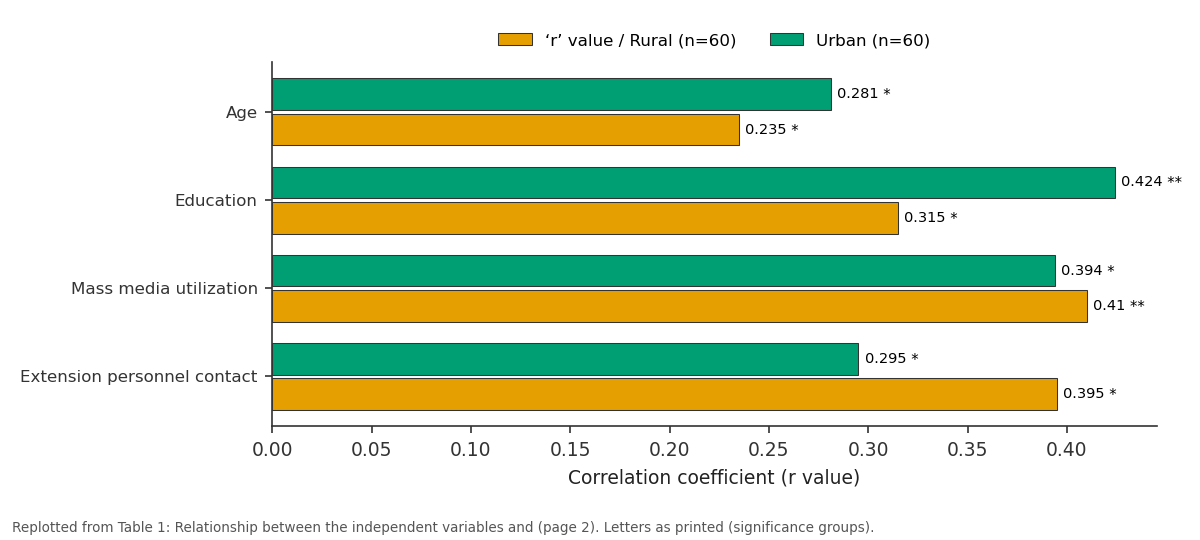
‘r’ value / Rural (n=60) and Urban (n=60): Age vs Education vs Mass media utilization vs Extension personnel...
Replotted from Table 1 (page 2) of the original paper. Every bar is the paper's own table value.
View source evidence ↗Figures & tables
From the original paper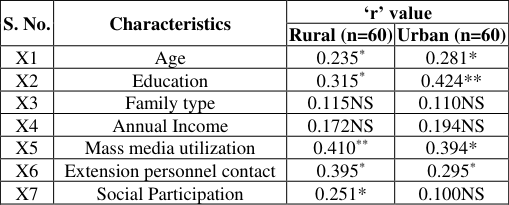 Table 1
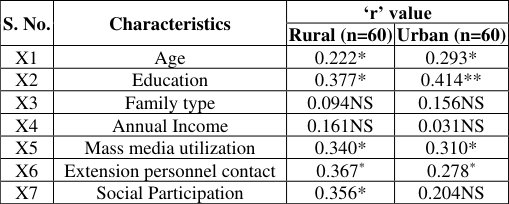 Table 2
Introduction
Women Empowerment Schemes are structured initiatives, typically launched by the government or related institutions, to enhance the status of women in society by providing them with access to resources, opportunities, education, employment, and legal rights, thereby fostering self-reliance and equality.
The objectives of women empowerment are to enhance education and literacy among women, improve health and nutrition for mothers and girls, encourage financial independence through skill development and entrepreneurship, ensure safety and security by addressing gender-based violence, promote women's participation in governance and decision-making and create awareness of legal rights and entitlements (Rani, 2021) [3] . Empowerment is a process from being unpowered to being empowered. Speculating of empowerment pressures two main perspectives on this process: namely one more individualistic, namely through women's individual capacities and free exercise of personal choice and one more specific, namely through collective behavior and the adherence to cultural norms which emphasize communal growth. In a poor family, girls are the main victims; they are malnourished and are denied the opportunity of better education and other facilities. But if they are financially independent or they have greater control over the resources then they exhibit greater autonomy both in the household and in public here and are no longer victims of poverty (Rani, 2021) [3] . Lack of awareness about legal and constitutional provisions and failure in realizing it, is another factor that hinders the process of empowerment. Most of the women are not aware of their legal rights. Even women who are aware lack the courage to take the legal step. The regulation which affects women most is their situation in marriage and inheritance. As far as the rights of inheritance are concerned, women generally do not try to inherit land left by their parents if brothers are alive.
Methodology
The present study was conducted in rural and urban area of Bikaner district of Rajasthan. which was purposively selected due to the convenience and easy approachability and also no such research study has been conducted in this area. Secondly, Bikaner district comes under arid zone and vast variability of traditional and indigenous practices was found in this area. A total of 120 respondents were selected for the study purpose. 30 women from each village and ward i.e. Husangsar and Nagasar, ward no. (East zone 58) and (West zone 39) were randomly selected. The correlation coefficient ('r' value) was used to measure the relationship between dependent and independent variables. The correlation coefficient between two groups was calculated by using the following formula:
Results
Relationship between the independent variables and knowledge level of respondents regarding various women empowerment schemes. 1 disclosed that there were was a positive and significant relationship at 5 percent level between age and knowledge of the rural and urban respondents about the various women empowerment schemes investigated in the study with correlation coefficient value (r= 0.235* and 0.281* respectively). Education and Knowledge: Table 1 showed that there were was a positive and significant relationship at 5 percent level and 1 percent level between education and knowledge of the rural respondents and urban respondents about the various women empowerment schemes investigated in the study with correlation co-efficient value (r= 0.315* and 0.424** respectively). Family type and Knowledge: Table 1 revealed that there was non-significant relationship between family type and knowledge of the rural and urban respondents about the various women empowerment schemes investigated in the study with correlation co-efficient value (r= 0.115 and 0.110 respectively). Annual family income and Knowledge: Table 1 disclosed that there was non-significant relationship between annual income and knowledge of the rural and urban respondents about the various women empowerment schemes investigated in the study with correlation co-efficient value (r= 0.172 and 0.194 respectively). Mass media exposure and Knowledge: Table 1 proved that there were was a positive and significant relationship at 1 percent and 5 percent level between mass media exposure and knowledge of the rural and urban respondents about the various women empowerment schemes investigated in the study with correlation co-efficient value (r= 0.410** and 0.394* respectively). Extension personnel contact and Knowledge: Table 1 disclosed that there were was a positive and significant relationship at 5 percent level between extension personal contact and knowledge of the rural and urban respondents about the various women empowerment schemes investigated in the study with correlation co-efficient value (r= 0.395* and 0.295 * respectively). Social participation and Knowledge: Table 1 disclosed that there was significant relationship at 5 percent level between social participation and knowledge of the rural respondents about the various women empowerment schemes investigated in the study with correlation co-efficient value (r=0.251*), whereas that there was non-significant relationship between social participation and knowledge of the urban respondents about the various women empowerment schemes investigated in the study with correlation co-efficient value (r= 0.100).
| S. No. | Characteristics | ‘r’ value | — |
|---|---|---|---|
| Rural (n=60) | Urban (n=60) | ||
| X1 | Age | 0.235* | 0.281* |
| X2 | Education | 0.315* | 0.424** |
| X3 | Family type | 0.115NS | 0.110NS |
| X4 | Annual Income | 0.172NS | 0.194NS |
| X5 | Mass media utilization | 0.410** | 0.394* |
| X6 | Extension personnel contact | 0.395* | 0.295* |
| X7 | Social Participation | 0.251* | 0.100NS |
Table text extracted from the original PDF; superscript letters are shown inline. The original table image is below.
View original table image
Relationship between the independent variables and attitude level of respondents regarding various women empowerment schemes Age and Attitude: Table 2 disclosed that there were was a positive and significant relationship at 5 percent level between age and attitude of the rural and urban respondents about the various women empowerment schemes investigated in the study with correlation co-efficient value (r= 0.222* and 0.293* respectively).
| S. No. | Characteristics | ‘r’ value | — |
|---|---|---|---|
| Rural (n=60) | Urban (n=60) | ||
| X1 | Age | 0.222* | 0.293* |
| X2 | Education | 0.377* | 0.414** |
| X3 | Family type | 0.094NS | 0.156NS |
| X4 | Annual Income | 0.161NS | 0.031NS |
| X5 | Mass media utilization | 0.340* | 0.310* |
| X6 | Extension personnel contact | 0.367* | 0.278* |
| X7 | Social Participation | 0.356* | 0.204NS |
Table text extracted from the original PDF; superscript letters are shown inline. The original table image is below.
View original table image
Education and Attitude: Table 2 showed that there were was a positive and significant relationship at 5 percent and 1 percent level between education and attitude of the rural and urban respondents about the various women empowerment schemes investigated in the study with correlation coefficient value (r= 0.377* and 0.414** respectively).
Family type and Attitude: Table 2 revealed that there was non-significant relationship between family type and attitude of the rural and urban respondents about the various women empowerment schemes investigated in the study with correlation co-efficient value (r= 0.094 and 156 respectively).
Annual family income and Attitude: Table 2 disclosed that there was non-significant relationship between annual income and attitude of the rural and urban respondents about the various women empowerment schemes investigated in the study with correlation co-efficient value (r= 0.161 and 0.031 respectively).
Mass media exposure and Attitude: Table 2 proved that there were was a positive and significant relationship at 5 percent level between mass media exposure and attitude of the rural and urban respondents about the various women empowerment schemes investigated in the study with correlation co-efficient value (r= 0.340* and 0.310 respectively).
Extension personnel contact and Attitude: Table 2 disclosed that there were was a positive and significant relationship at 5 percent level between extension personal contact and attitude of the rural and urban respondents about the various women empowerment schemes investigated in the study with correlation co-efficient value (r= 0.367* and 0.278 respectively). 2 disclosed that there was significant relationship at 5 percent level between social participation and attitude of the rural respondents about the various women empowerment schemes investigated in the study with correlation co-efficient value (r= 0.356*), whereas that there was non-significant relationship between social participation and attitude of the urban respondents about the various women empowerment schemes investigated in the study with correlation coefficient value (r= 0.204).
Discussion
It could be concluded that the finding of the above data that the variable age, caste, education, mass media exposure, and extension personal contact had positive relationship with knowledge of both rural and urban respondent about various women empowerment schemes. the findings of the study was found parallel to the studies of Sharma, et al. (2012) [4] , Ramjiyani (2013) [2] , Singh (2014) [5] , and Vaishali (2019) [7] . Likewise, age, caste, education, mass media exposure, and extension personal contact had positive relationship with attitude of both rural and urban respondents about various women empowerment schemes. The findings of the study was found parallel to the studies of Tidke, et al. (2012) [6] , Bhat, et al. (2014) [1] , Singh (2014) [5] , and Vaishali (2019) [7] . The study was exploratory in nature and conducted only in Bikaner district, Rajasthan. It was restricted to only a few variables due to limited time and resources. The variables were measured by putting questions to each maize grower.
Conclusion
It can be concluded that age, education, family size, mass media exposure and extension personnel contact had positive relationship with both knowledge as well as attitude of respondents about various women empowerment schemes. Awareness need to be created among women regarding various women empowerment schemes through trainings, campaign etc. Implementing agencies should look into the proper publicity of the programme through social media, electronic media and print media
References
5 in the original paper- Bhat MA, Wani IA, Ahrar A, Ahamad M. Empowerment of women through Self-Help Group in Madhya Pradesh. A Sociological Study. J Soc Sci. 2014 Jan;19(1):80-84.
- Rani S. A Study on Women Empowerment in India. Int J Modern Trends Sci Technol. 2021 Nov;7(11):120124.
- Sharma P, Kishore S, Semwal J. Is janani surksha yojana (JSY) awareness a reflection of healthy pregnancy outcome? Difference in rural areas and urban slums. Natl J Community Med. 2012 Apr-Jun;3(2):187192.
- Singh VS. Study on awareness and knowledge regarding JSY among ANC registered women in a primary health centre of tribal area of Thane District of Maharashtra. Int J Res Med Sci. 2014 Jan;2(1):122-126.
- Tidke GR, Rathod MK, Mandave RP. Knowledge and adoption of farmers about the management of borer complex in pigeon pea. Int J Ext Educ. 2012;8:71-76.
Social participation and Attitude: Table
Social participation and Attitude: Table