
Research article · 2025 · Full text
International Journal of Agriculture and Food ScienceSmart irrigation prediction system for garden plants
Volume 7(5) · Pages 06–09 · DOI: 10.33545/2664844x.2025.v7.i5a.372 ↗
Research areasGreenhouse Technology and Climate ControlSmart Agriculture and AIWireless Sensor Networks and IoT
Abstract
Author-writtenWater scarcity and inefficient irrigation practices pose significant challenges to sustainable agriculture and gardening. Excessive water usage leads to depletion of resources, while insufficient irrigation hampers plant growth. This research presents a smart irrigation prediction system that utilizes machine learning to optimize water management. By analyzing key environmental factors such as temperature, humidity, sunlight exposure, and soil moisture levels, the system accurately predicts water requirements and evaporation rates. Additionally, it recommends the most efficient irrigation methods tailored to different plant species and environmental conditions. The proposed solution not only conserves water but also enhances plant health by maintaining optimal hydration levels. Implemented as a user-friendly web-based tool, this system empowers gardeners and farmers to make informed irrigation decisions, ultimately contributing to sustainable agriculture and responsible water usage. The integration of artificial intelligence in irrigation planning represents a step forward in addressing global water conservation challenges while ensuring productive and healthy plant growth.
Summary
Source-checkedPlain-language reading of the full paper, prepared with AI and checked against the text. Each point links to the authors' own words.
Why it matters
- Water scarcity and inefficient irrigation methods are major obstacles to sustainable gardening and agriculture. View evidence ↗
- Improper irrigation leads to either resource depletion through overwatering or stunted plant growth through underwatering. View evidence ↗
- Agricultural threats are exacerbated by a reliance on manual estimations and fixed irrigation schedules. View evidence ↗
The question
- The study aims to develop a smart irrigation prediction system using machine learning to optimize how water is managed. View evidence ↗
- The research specifically seeks to use Random Forest regression models to estimate evaporation rates, water requirements, and the best irrigation techniques. View evidence ↗
What they did
- The system analyzes environmental and agricultural parameters, including temperature, humidity, rainfall, sunlight hours, soil moisture, and plant type. View evidence ↗
- The dataset used for model development was divided into 80% for training and 20% for testing. View evidence ↗
- Three distinct Random Forest Regressor models were created to predict water requirements, evaporation rates, and the most suitable irrigation type. View evidence ↗
- The system was implemented as a web-based application that combines machine learning models with a Gemini API-powered chatbot. View evidence ↗
What they found
- The model for predicting water requirements showed high accuracy with an R² score of 0.89. View evidence ↗
- The evaporation rate and irrigation type prediction models achieved R² scores of 0.86 and 0.81, respectively. View evidence ↗
- Analysis of feature importance identified temperature as the most critical factor influencing transpiration and water evaporation. View evidence ↗
- The AI-based system reduced water usage by 27% compared to manual irrigation methods. View evidence ↗
- Average water use per plant dropped from 5.2 liters/day with traditional manual irrigation to 3.8 liters/day with the AI-based system. View evidence ↗
What it means
- The authors conclude that the system effectively optimizes water use by providing accurate AI-driven predictions for irrigation types, evaporation, and water needs. View evidence ↗
- The system's ability to generalize may be limited because the dataset does not fully capture all plant species variations or all climatic regions. View evidence ↗
- The model does not explicitly include critical factors such as water retention capacity and soil porosity. View evidence ↗
Visual summary
3 visualsIllustrations explain the paper; charts are replotted from the paper's own table values.
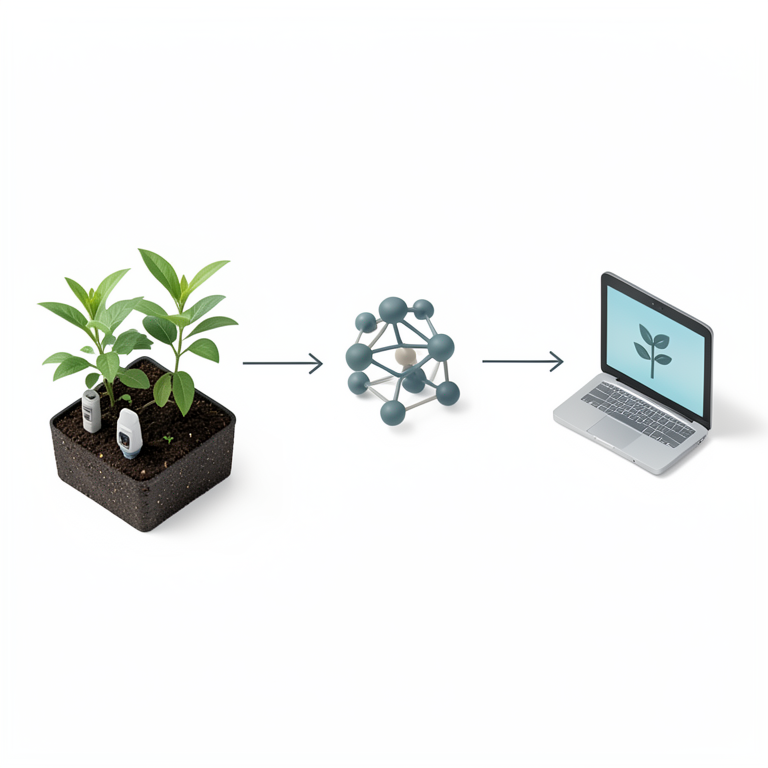
System Architecture Flow
AI-generated conceptual illustration (garden plants in a smart irrigation system). It explains the idea and does not show study data.
View source evidence ↗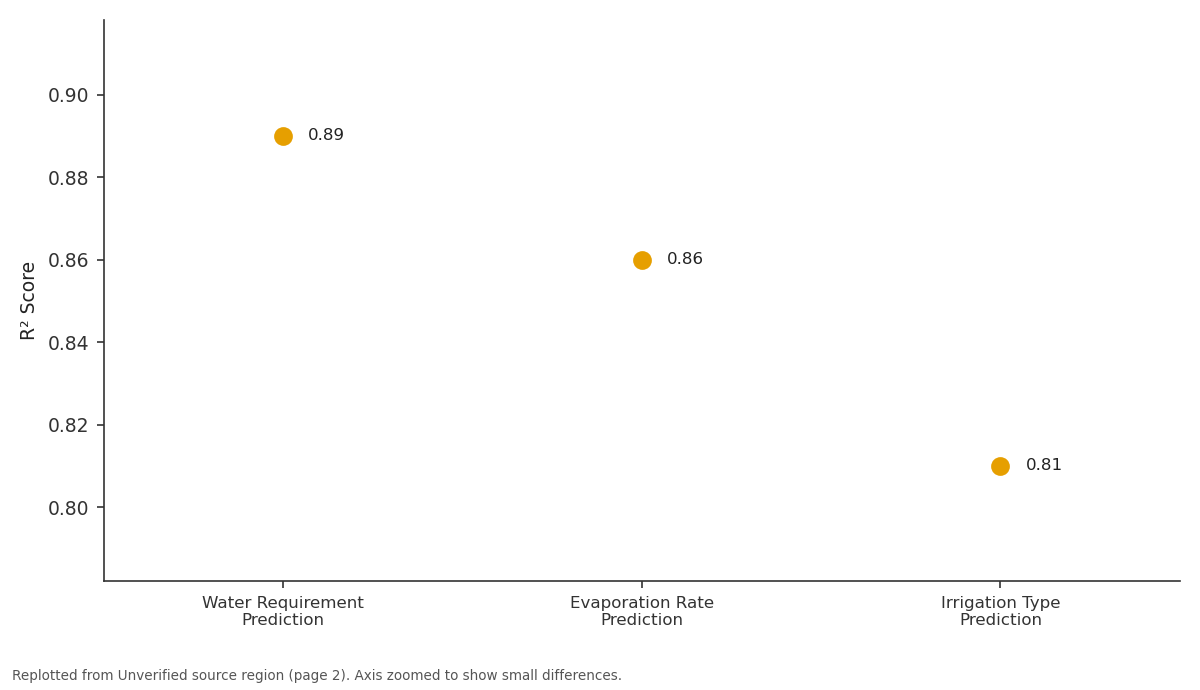
R² Score: Water Requirement... vs Evaporation Rate... vs Irrigation Type...
Replotted from a table (page 2) of the original paper. Every bar is the paper's own table value.
View source evidence ↗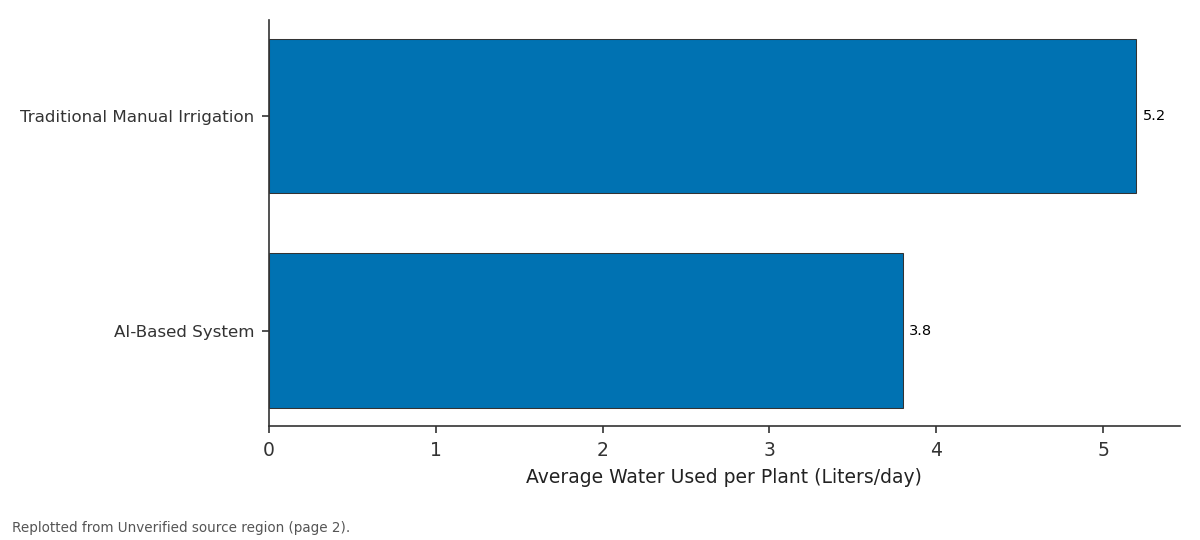
Average Water Used per Plant (Liters/day): Traditional Manual... vs AI-Based System
Replotted from a table (page 2) of the original paper. Every bar is the paper's own table value.
View source evidence ↗Introduction
Water scarcity and inefficient irrigation practices threaten agriculture, leading to overwatering or underwatering due to reliance on fixed schedules and manual estimations. Smart irrigation systems, powered by machine learning, provide data-driven solutions by analyzing environmental factors such as temperature, humidity, rainfall, and sunlight exposure. This research develops a machine learning-based irrigation prediction system using Random Forest regression models to estimate water requirements, evaporation rates, and optimal irrigation techniques. Implemented as a web-based tool, the system enables farmers and gardeners to make real-time, informed irrigation decisions, reducing water wastage, enhancing plant health, and promoting sustainable agriculture.
Methodology 2.1 Dataset Description
The irrigation system analyzes various agricultural and environmental parameters to determine optimal water requirements. Key features include plant type, soil moisture, temperature, humidity, rainfall, sunlight hours, days since last irrigation, water required (liters/day), and irrigation type. The dataset was compiled from agricultural research, IoT monitoring systems, and environmental databases. Preprocessing techniques were applied to improve data quality.
Data Preprocessing
To ensure accuracy, data preprocessing involved:
• Encoding Categorical Variables: Plant Type, Plant Name, and Irrigation Type were numerically transformed using Label Encoding. • Handling Missing Values: Numerical values (e.g., temperature, soil moisture) were filled using mean imputation, while categorical data (e.g., Irrigation Type) used mode imputation.
• Feature Scaling: Since Random Forest does not require scaling, only outliers were managed.
The dataset was split into 80% training and 20% testing for model development.
Model Development
Three Random Forest Regressor models were developed:
• Water Requirement Prediction Model: Estimates daily plant water needs based on environmental conditions. • Evaporation Rate Prediction Model: Predicts water loss due to temperature, sunlight, and humidity. • Irrigation Type Prediction Model: Suggests the most suitable irrigation method if relevant data is available.
Each model was trained on 80% of the data and saved for future predictions.
Model Training & Evaluation Metrics
Model accuracy was evaluated using:
• Mean Absolute Error (MAE): Measures prediction accuracy.
• R² Score: Assesses model reliability.
System Implementation 3.1 Web-Based Interface Design
The Garden Plant Irrigation System is a web-based application integrating machine learning models with a Gemini API-powered chatbot for intelligent irrigation guidance. The frontend, built with HTML, CSS, and JavaScript, offers a user-friendly experience, while the backend, using Python (Flask/FastAPI), handles user inputs and runs predictive models. The chatbot enhances interaction by answering irrigation-related queries, making the system more accessible and efficient.
Prediction Workflow & User Interaction
Users input plant type, species, temperature, humidity, rainfall, sunlight hours, and days since last irrigation. The chatbot provides real-time insights based on these parameters. The system follows a structured workflow: 1. Data Processing: Inputs are encoded, structured, and fed into machine learning models.
Water Requirement Prediction: The Water
Requirement Model estimates the plant's daily water needs.
Evaporation Rate Calculation: The Evaporation
Model predicts water loss based on environmental factors.
Final Irrigation Volume: Adjusts the water
requirement based on the evaporation rate.
Irrigation Type Recommendation (If Available):
The Irrigation Type Model suggests the most effective irrigation method. 6. Results & Chatbot Assistance: Users receive water requirement, evaporation rate, and irrigation type recommendations, with chatbot explanations.
System Benefits
• AI-Powered Precision Irrigation: Reduces water wastage and optimizes plant hydration. • Chatbot-Driven Assistance: Provides instant, expert recommendations on irrigation. • Sustainable Water Management: Ensures responsible water use and conservation.
• Mobile-Friendly & Accessible: Works across devices, allowing on-the-go irrigation planning.
Results and Discussion
The Garden Plant Irrigation System was evaluated based on its prediction accuracy, feature importance, and impact on water conservation. Standard regression metrics, including R² Score and Mean Absolute Error (MAE), were used to assess model performance. A comparative analysis with traditional irrigation methods highlights its advantages in precision irrigation and resource efficiency.
Model Performance Evaluation
Model Performance Evaluation
Feature Importance Analysis
Feature importance analysis revealed temperature as the most significant factor affecting water evaporation and transpiration. Humidity, plant type, rainfall, and sunlight exposure also influenced water requirements, ensuring optimized irrigation based on environmental conditions.
Impact on Water Conservation
The AI-based system significantly enhances water conservation by dynamically adjusting irrigation based on real-time data. The system prevents overwatering, reduces evaporation losses, and promotes sustainable irrigation practices. A comparison with manual irrigation showed a 27% reduction in water usage, demonstrating its potential for large-scale application.
Irrigation Method
Irrigation Method
Comparison with Traditional Methods & Discussion
Unlike traditional irrigation, which follows fixed schedules, the proposed AI system dynamically adjusts water usage based on real-time environmental factors. Precision irrigation, automation, and chatbot-driven assistance make it a more efficient and user-friendly alternative. The system can be further improved by integrating IoT-based soil sensors and automated irrigation controls for a fully autonomous irrigation solution.
Challenges and Limitations
While the Garden Plant Irrigation System improves water efficiency and irrigation accuracy, several challenges must be addressed for better scalability, adaptability, and user adoption. These challenges include data limitations, environmental variability, model generalization, and integration with existing irrigation systems.
Data Availability and Quality
The accuracy of the system depends on comprehensive and diverse datasets, but certain limitations exist. The dataset may not fully represent all climatic regions, leading to inaccuracies in some areas. Additionally, plant species variations are not entirely captured, which may affect generalization. Seasonal changes, such as droughts or heavy rainfall periods, can impact irrigation needs, requiring continuous updates, IoT sensor integration, and weather APIs to improve accuracy and reliability.
Model Adaptability and Environmental Factors
For broader applicability, the model must account for variations in soil conditions, evaporation losses, and sudden weather changes. Factors such as soil porosity and water retention capacity influence irrigation but are not explicitly included. Additionally, wind speed and soil texture affect evaporation rates, making it essential to refine predictions further. Integrating geospatial analysis, real-time sensor data, and weather forecasting APIs can enhance model adaptability and accuracy.
User Adoption and Technological Barriers
The system's effectiveness depends on user accessibility and ease of use, but certain barriers exist. Limited technical knowledge among some users, especially in rural areas, may affect adoption. Traditional farmers may be hesitant to trust AI-based irrigation recommendations, preferring manual methods. Additionally, the system requires an internet connection for real-time predictions, which may not be accessible in remote locations. Implementing offline functionality, multilingual support, and a simplified user interface can enhance user adoption.
Integration with Existing Irrigation Systems
Many users already utilize drip irrigation, sprinkler systems, or manual watering methods, making integration a challenge. Some irrigation setups may not support automated AI-driven adjustments, requiring additional infrastructure. Additionally, high implementation costs could limit adoption among small-scale farmers. Since different farms have unique layouts, tailored AI recommendations are necessary for better adaptability. Developing low-cost IoT-based solutions will improve compatibility with traditional irrigation systems and enhance adoption.
Future Scope
The Garden Plant Irrigation System provides a promising approach to sustainable water management in agriculture. However, future enhancements should focus on real-time adaptability, AI model improvements, and broader accessibility to maximize its efficiency and scalability.
IoT Sensor Integration for Real-Time Monitoring
Integrating IoT-based soil sensors will significantly improve the system's accuracy by providing real-time soil moisture, temperature, and nutrient data. This will allow dynamic adjustments to irrigation recommendations, helping detect anomalies such as overwatering, leaks, or dry soil. Additionally, IoT integration will enable automation by linking the system to smart irrigation controllers, reducing manual intervention and ensuring more efficient water use.
Adaptive AI Models for Seasonal Variations
Currently, the system relies on historical data, which may not fully account for seasonal and climate variations.
Enhancing the AI models to incorporate real-time weather forecasting APIs will allow the system to adjust irrigation schedules based on expected temperature and rainfall changes. Furthermore, self-learning AI models can improve predictions over time by analyzing user feedback and environmental conditions, ensuring that water distribution remains optimized across different regions and weather patterns.
Large-Scale Agricultural Expansion
While the system is currently optimized for home gardening and small-scale farming, expanding it for commercial agriculture will enhance its impact. Future improvements should include scalability across large farms, integrating multiple IoT sensors in different zones for more precise irrigation control. Additionally, automated irrigation control systems can be implemented to adjust watering schedules based on AI recommendations, while water distribution optimization algorithms can ensure equitable and efficient use of resources.
Advanced Chatbot Capabilities
Enhancing the Gemini API-powered chatbot will make the system more interactive and user-friendly. Future updates could include voice-enabled assistance to allow hands-free operation, multilingual support for broader accessibility, and AI-driven plant disease detection by enabling users to upload plant images for diagnosis. Moreover, integration with smart home assistants like Google Assistant and Alexa could provide voice-controlled irrigation recommendations, making the system even more convenient and accessible.
Blockchain for Data Security
As the system collects user inputs and environmental data, ensuring data security and privacy is essential.
Implementing blockchain technology will help store data securely by preventing unauthorized access and ensuring transparency. Additionally, decentralized irrigation recordkeeping will allow farmers to track their water usage history, while integration with government water conservation policies could promote sustainable practices through verifiable and tamper-proof irrigation logs.
Conclusion
The Garden Plant Irrigation System optimizes water usage through AI-driven predictions, offering accurate recommendations for water requirements, evaporation rates, and irrigation types. By integrating machine learning models and a Gemini API-powered chatbot, the system enhances user interaction and enables real-time irrigation guidance, supporting sustainable gardening and farming. Despite its high accuracy and water-saving potential, challenges remain, including data limitations, environmental variability, and user adoption barriers. These can be addressed by incorporating IoT sensor data, adaptive AI models, and smart irrigation controllers. Improving offline accessibility, multilingual support, and blockchain-based security will enhance usability across diverse regions. Future developments should focus on large-scale agricultural expansion, predictive crop analytics, and integration with government water conservation programs.