
Research article · 2025 · Full text
International Journal of Biology SciencesReview on advances in sperm preservation: Freeze-drying as an alternative to cryopreservation
Volume 7(4) · Pages 93–95 · DOI: 10.33545/26649926.2025.v7.i4b.333 ↗
Research areasReproductive Biology and Fertility
Abstract
Author-writtenSperm preservation is a vital component of assisted reproductive technologies (ART), livestock breeding programmes, and conservation efforts for endangered species. Although cryopreservation in liquid nitrogen (LN₂) remains the gold standard, it poses significant challenges, including prohibitive costs, contamination risks, and logistical complexities. In response, freeze-drying, or lyophilization, has emerged as a promising alternative, enabling long-term sperm storage at ambient temperatures while maintaining DNA integrity. This review provides an in-depth examination of the principles, benefits, and limitations of freeze-drying in comparison to conventional cryopreservation. We discuss key factors influencing the efficiency of freeze-drying, including the role of protective additives such as trehalose, EDTA (Ethylenediaminetetraacetic Acid), and EGTA (Ethylene glycol-bis (β-aminoethyl ether)-N,N,N′,N′-tetraacetic acid), optimal storage conditions, and precise rehydration techniques. Furthermore, we highlight successful applications of freeze-dried sperm across various species and outline future directions for optimising this technology in both veterinary and human reproductive medicine. By exploring the potential of freeze-drying, this review aims to contribute to the advancement of sperm preservation techniques and their applications in biomedicine and conservation.
Summary
Source-checkedPlain-language reading of the full paper, prepared with AI and checked against the text. Each point links to the authors' own words.
Why it matters
- Sperm preservation is essential for livestock breeding, endangered species conservation, and assisted reproductive technologies. View evidence ↗
- While cryopreservation in liquid nitrogen is the current standard, it is limited by high costs, logistical difficulties, and risks of contamination. View evidence ↗
- Cryopreservation can be damaging to sperm, with roughly 40-50% of spermatozoa sensitive to the stress of freezing. View evidence ↗
The question
- The review aims to evaluate freeze-drying as an alternative to cryopreservation and examine recent progress in protecting sperm DNA. View evidence ↗
What they did
- Freeze-drying (lyophilization) preserves biological materials by using vacuum conditions to remove water via sublimation. View evidence ↗
- The lyophilization process consists of three phases: initial freezing, primary drying (sublimation), and secondary drying to eliminate remaining moisture. View evidence ↗
What they found
- Freeze-drying allows biological materials to be stabilized at ambient temperatures, removing the requirement for constant cryogenic storage. View evidence ↗
- Compared to cryopreserved samples, freeze-dried sperm exhibits lower lipid peroxidation levels and reduced oxidative stress. View evidence ↗
- Freeze-dried sperm cannot fertilize eggs naturally after rehydration and must be used with intracytoplasmic sperm injection (ICSI). View evidence ↗
- Protective additives improve outcomes: trehalose maintains acrosome integrity, while EDTA and EGTA protect DNA from DNase-induced damage. View evidence ↗
- Storage at 4°C provides long-term stability, while storage at -80°C may extend preservation for decades. View evidence ↗
- Freeze-drying has been successfully used to produce offspring in a wide range of species, including mice, rabbits, rats, primates, dogs, cats, horses, hamsters, and boars. View evidence ↗
What it means
- Future research needs to prioritize the optimization of lyophilization for human clinical use and wildlife conservation. View evidence ↗
Visual summary
1 visualsIllustrations explain the paper; they do not show study data.
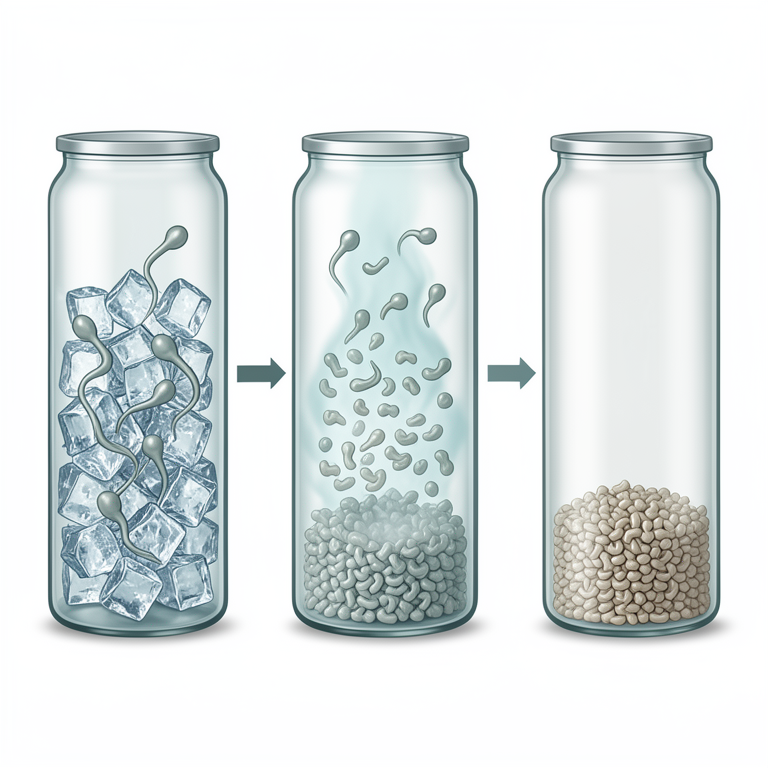
The Three Phases of Lyophilization
AI-generated conceptual illustration (mammalian sperm cells in a laboratory vial). It explains the idea and does not show study data.
View source evidence ↗Introduction
The use of artificial insemination (AI) with frozen-thawed semen in certain species, such as buffalo, is limited due to poor sperm survivability after thawing, resulting in significant sperm damage (Das, 2021) [3] . Cryopreservation, despite its widespread use, can cause substantial damage to spermatozoa, with approximately 40-50% of sperm being sensitive to freezing stress (Polge et al., 1949) [20] . As an alternative, freeze-drying has emerged as a promising method, which involves removing water through sublimation, allowing for storage at 4°C or room temperature (Kaneko & Serikawa, 2012) [11] . This review assesses the potential of freeze-drying as a sperm preservation method, comparing its effectiveness with cryopreservation and discussing recent advancements in DNA protection techniques.
Cryopreservation: Current Status and Limitations
Cryopreservation involves cooling sperm to -196°C in liquid nitrogen, effectively halting metabolic activity and preserving sperm viability for extended periods. The addition of cryoprotectants, such as glycerol, plays a crucial role in mitigating ice crystal formation during the freezing process, which can cause significant damage to sperm cells (Polge et al., 1949) [20] . However, cryopreservation has notable limitations that impact its practical application. The requirement for a continuous supply of liquid nitrogen poses significant logistical and financial challenges, particularly in regions with limited infrastructure. For instance, India alone consumes an estimated 40 million liters of liquid nitrogen annually for artificial insemination procedures, highlighting the scale of this issue (Das, 2021) [3] . Furthermore, the use of cryoprotectants can be toxic to sperm cells at high concentrations, potentially leading to DNA damage. Contamination risks also remain a concern, underscoring the need for stringent handling and storage protocols. Despite these challenges, cryopreservation allows for indefinite storage of sperm and maintains high embryo development rates, making it a valuable technique in assisted reproduction.
Nevertheless, these limitations have driven the search for alternative sperm preservation methods that can offer comparable efficacy with reduced logistical and financial burdens.
Freeze-Drying (Lyophilization) as an Alternative Principles of Freeze-Drying
Freeze-drying, or lyophilization, is a sophisticated dehydration process that preserves biological materials by removing water through sublimation under vacuum conditions (Kwon et al., 2004) [14] . The technique involves three critical phases: initial freezing of the sample, primary drying where frozen water sublimates directly from solid to vapor phase, and secondary drying to remove residual moisture. This method maintains the structural and functional integrity of biological specimens by avoiding the damaging effects of liquid water removal, making it particularly valuable for sperm preservation. The process requires precise control of temperature and pressure parameters to ensure optimal preservation while minimizing cellular damage. A key advantage of freeze-drying is its ability to stabilize biological materials at ambient temperatures, eliminating the need for continuous cryogenic storage (Kaneko & Serikawa, 2012) [11] .
Historical Development of Freeze-Drying
The application of freeze-drying technology to sperm preservation has evolved through several key milestones. The foundational work began with early dehydration experiments on microorganisms (Flosdorf & Kimball, 1939) [4] , leading to the first successful freeze-drying of fowl semen (Polge et al., 1949) [20] . Subsequent advances included pioneering studies with human sperm (Sherman, 1954) and bull spermatozoa (Bialy & Smith, 1957) [1] . A major breakthrough occurred in 1998 with the birth of live offspring from freeze-dried mouse sperm, demonstrating the technique's reproductive potential (Wakayama & Yanagimachi, 1998) [25] . While the method requires ICSI for successful fertilization (Kwon et al., 2004) [14] , its ability to maintain sperm DNA integrity during storage at refrigerator temperatures (4°C) or even ambient conditions has established freeze-drying as a practical alternative to conventional cryopreservation. These developments have positioned lyophilization as a valuable tool for long-term preservation of genetic material across multiple species.
Advantages over Cryopreservation
Freeze-drying offers several benefits, including costeffectiveness and logistical convenience. By eliminating the need for liquid nitrogen, it enables room-temperature storage and simplifies transportation. Furthermore, freezedried sperm shows reduced oxidative stress, with lower lipid peroxidation levels compared to cryopreserved samples, potentially preserving sperm quality (Shahba et al., 2016) [23] .
Limitations
A significant limitation of freeze-dried sperm is its inability to fertilize eggs naturally after rehydration, requiring the use of intracytoplasmic sperm injection (ICSI) for fertilization. Additionally, DNA fragmentation is a concern, although the use of chelating agents like EDTA or EGTA has been shown to help minimize this risk and preserve DNA integrity (Kaneko & Nakagata, 2006) [10] .
Critical Factors Affecting Freeze-Drying Success Protective Additives
Certain additives have been shown to enhance sperm preservation during freeze-drying. Trehalose helps maintain acrosome integrity (Men et al., 2013) [16] , while chelating agents like EDTA and EGTA protect against DNaseinduced DNA damage (Kusakabe et al., 2001) [13] . These additives play a key role in preserving sperm functionality and DNA integrity during the lyophilization process.
Storage Conditions
Optimal storage conditions are crucial for maintaining the integrity of freeze-dried sperm. Research indicates that storage at 4°C can provide long-term stability (Kaneko & Serikawa, 2012) [11] , while even lower temperatures, such as -80°C, may further extend preservation duration, potentially for decades (Kawase et al., 2007) [12] .
Rehydration Techniques
Rehydrating freeze-dried sperm with pure water to the original suspension volume can help restore structural integrity (Gil et al., 2014) [6] . Additionally, incorporating DNA protectants into the rehydration medium may further enhance fertilization potential (Olaciregui & Gil, 2017) [18] .
Applications Across Species
Freeze-dried sperm has been successfully used to produce offspring in several species, demonstrating its potential as an alternative to conventional cryopreservation. Following the initial success with mice (Wakayama & Yanagimachi, 1998) [25] , the technique has been effectively applied across diverse species including rabbits (Liu et al., 2004) [15] , rats (Hirabayashi et al., 2005; Kaneko & Serikawa, 2012) [8,11] , primates (Sanchez-Partida et al., 2008) [22] , dogs (Olaciregui et al., 2015) [19] , cats (Ringleb et al., 2011) [21] , horses (Choi et al., 2011; Olaciregui et al., 2015) [2,19] , hamsters (Muneto & Horiuchi, 2011) [17] , and boars (García et al., 2014; Men et al., 2013) [5,11] . In livestock species, particularly bulls (Hara et al., 2014) and buffalo (Shahba et al., 2016) [7,23] , freeze-drying has shown promise, although blastocyst development rates can vary and DNA damage remains a concern in some cases. The technique has also been extended to wild animal conservation efforts (Kaneko et al., 2014) [9] , demonstrating its broad applicability across mammalian species. These successful applications highlight freeze-drying as a viable alternative to traditional sperm cryopreservation methods, particularly in situations where liquid nitrogen storage is impractical.
Future Perspectives
The applications of freeze-dried sperm are diverse and farreaching. In human reproductive medicine, freeze-drying could simplify storage by eliminating the need for liquid nitrogen, although ICSI would still be required. In wildlife conservation, freeze-drying offers a practical solution for preserving genetic material from endangered species. Furthermore, research into sperm preservation techniques could have implications for space exploration, where genetic material needs to be stored for extended periods under extreme conditions (Kaneko et al., 2014) [9] .
Conclusion
Freeze-drying is a promising alternative to traditional cryopreservation for sperm preservation, offering benefits
References
25 in the original paper- Bialy G, Smith VR. Freeze-drying of bovine spermatozoa. J Dairy Sci. 1957;40(7):739-745.
- Choi YH, Varner DD, Love CC, Hartman DL, Hinrichs K. Production of live foals via intracytoplasmic injection of lyophilized sperm and sperm extract in the horse. Reproduction. 2011;142(4):529.
- Das B. Why liquid nitrogen is critical to the Indian animal husbandry sector. The Times of India. 2021 Oct 21. Available from: https://timesofindia.indiatimes.com/blogs/voices/whyliquid-nitrogen-is-critical-to-the-indian-animalhusbandry-sector/
- Flosdorf EW, Kimball AC. Studies with H. pertussis: II. Maintenance of Cultures in Phase I. J Bacteriol. 1940;39(3):255-261.
- García A, Gil L, Malo C, Martínez F, Kershaw-Young C, de Blas I. Effect of different disaccharides on the integrity and fertilising ability of freeze-dried boar spermatozoa: a preliminary study. CryoLetters. 2014;35(4):277-285.
- Gil L, Olaciregui M, Luño V, Malo C, González N, Martínez F. Current status of freeze-drying technology to preserve domestic animals' sperm. Reprod Dom Anim. 2014;49(Suppl 4):72-81.
- Hara H, Tagiri M, Hwang IS, Takahashi M, Hirabayashi M, Hochi S. Adverse effect of cake collapse on the functional integrity of freeze-dried bull spermatozoa. Cryobiology. 2014;68(3):354-360.
- Hirabayashi M, Kato M, Ito J, Hochi S. Viable rat offspring derived from oocytes intracytoplasmically injected with freeze-dried sperm heads. Zygote. 2005;13(1):79-85.
- Kaneko T, Ito H, Sakamoto H, Onuma M, InoueMurayama M. Sperm preservation by freeze-drying for the conservation of wild animals. PLoS One. 2014;9(11):e113381.
- Kaneko T, Nakagata N. Improvement in the long-term stability of freeze-dried mouse spermatozoa by adding of a chelating agent. Cryobiology. 2006;53(2):279-282.
- Kaneko T, Serikawa T. Long-term preservation of freeze-dried mouse spermatozoa. Cryobiology. 2012;64(3):211-214.
- Kawase Y, Hani T, Kamada N, Jishage KI, Suzuki H. Effect of pressure at primary drying of freeze-drying mouse sperm reproduction ability and preservation potential. Reproduction. 2007;133(4):841-846.
- Kusakabe H, Szczygiel MA, Whittingham DG, Yanagimachi R. Maintenance of genetic integrity in frozen and freeze-dried mouse spermatozoa. Proc Natl Acad Sci USA. 2001;98(24):13501-13506.
- Kwon IK, Park KE, Niwa K. Activation, pronuclear formation, and development in vitro of pig oocytes following intracytoplasmic injection of freeze-dried spermatozoa. Biol Reprod. 2004;71(5):1430-1436.
- Liu JL, Kusakabe H, Chang CC, Suzuki H, Schmidt DW, Julian M, et al. Freeze-dried sperm fertilization leads to full-term development in rabbits. Biol Reprod. 2004;70(6):1776-17181.
- Men NT, Kikuchi K, Nakai M, Fukuda A, Tanihara F, Noguchi J, et al. Effect of trehalose on DNA integrity of freeze-dried boar sperm, fertilization, and embryo development after intracytoplasmic sperm injection. Theriogenology. 2013;80(9):1033-1044.
- Muneto T, Horiuchi T. Full-term development of hamster embryos produced by injecting freeze-dried spermatozoa into oocytes. J Mamm Ova Res. 2011;28(1):32-39.
- Olaciregui M, Gil L. Freeze-dried spermatozoa: a future tool? Reprod Dom Anim. 2017;52(Suppl 2):248-254.
- Olaciregui M, Luño V, Gonzalez N, De Blas I, Gil L. Freeze-dried dog sperm: Dynamics of DNA integrity. Cryobiology. 2015;71(2):286-290.
- Polge C, Smith AU, Parkes AS. Revival of spermatozoa after vitrification and dehydration at low temperatures. Nature. 1949;164(4172):666-667.
- Ringleb J, Waurich R, Wibbelt G, Streich WJ, Jewgenow K. Prolonged storage of epididymal spermatozoa does not affect their capacity to fertilise in vitro-matured domestic cat (Felis catus) oocytes when using ICSI. Reprod Fertil Dev. 2011;23(6):818-825.
- Sánchez-Partida LG, Simerly CR, Ramalho-Santos J. Freeze-dried primate sperm retains early reproductive potential after intracytoplasmic sperm injection. Fertil Steril. 2008;89(3):742-745.
- Shahba MI, El-Sheshtawy RI, El-Azab AS, AbdelGhaffar AE, Ziada MS, Zaky AA. The effect of freezedrying media and storage temperature on ultrastructure and DNA of freeze-dried buffalo bull spermatozoa. Asian Pac J Reprod. 2016;5(6):524-235.
- Sherman JK. Freezing and freeze-drying of human spermatozoa. Fertil Steril. 1954;5:357-371.
- Wakayama T, Yanagimachi R. Development of normal mice from oocytes injected with freeze-dried spermatozoa. Nat Biotechnol. 1998;16(7):639-641.
Cited by 1
From OpenAlex, OpenCitations and reference lists read by Scinovex
- Freeze-drying of sperm: A promising alternative to cryopreservation
Richakumari M Patel, Kirankumar H Parmar, Meet T Chaudhari, Bhautik Saripadiya, Chirayu N Patel · International Journal of Advanced Biochemistry Research · 2025
The long-term preservation of mammalian spermatozoa is essential for assisted reproduction, livestock breeding, genetic resource conservation and protection of endangered species. Although cryopreservation in liquid nitrogen (LN₂) is a conventional method, its dependence on continuous LN₂ supply, high maintenance costs and vulnerability to natural disasters highlight the need for robust, low-cost alternatives. Freeze-drying (lyophilization) has emerged as a promising LN₂-independent preservation strategy, enabling stable storage of sperm at room or refrigeration temperatures. Initially used fo