
Research article · 2022 · Full text
International Journal of Biology SciencesWrightia tinctoria R.Br. (Sweet Indrajao): A potential ethnomedicinal plant of Sonbhadra district, Uttar Pradesh, India
Volume 4(2) · Pages 198–199 · DOI: 10.33545/26649926.2022.v4.i2c.330 ↗
Research areasEthnobotanical and Medicinal Plants StudiesNatural product bioactivities and synthesisPhytochemistry and Bioactive Compounds
Abstract
Author-writtenWrightia tinctoria R. Br. belongs to the family Apocyanacea is commonly known as Sweet Indrajao, and Pala indigo internationaly and as Indrajava in Sonbhadra district of Uttar Pradesh. This plant is used by the indeginous people of the region against various ailments such as jaundice, malaria, psoriasis, itching and many diseases. The survey of various literature reveals promising compounds that aid in the treatment and is used in Indian system of medicines like Ayurveda, Siddha and Unani system of medicines. The plant is considered to be rich secondary metabolites such as alkaloids, saponins, phenolics, indigotin, indirubin, wrightial and sterols.
Summary
Source-checkedPlain-language reading of the full paper, prepared with AI and checked against the text. Each point links to the authors' own words.
Why it matters
- Wrightia tinctoria, known as Sweet Indrajao or Pala indigo, is a plant found in the Sonbhadra district of Uttar Pradesh, India. View evidence ↗
- Indigenous populations in the region use this plant to treat several conditions, including malaria, jaundice, and psoriasis. View evidence ↗
- Literature indicates that the plant contains compounds useful for treatment and is integrated into traditional Indian medical systems such as Unani, Siddha, and Ayurveda. View evidence ↗
The question
- The study aims to record and document ethnomedicinal information about Wrightia tinctoria through repeated surveys in the Sonbhadra district. View evidence ↗
What they did
- The survey was conducted in the Sonbhadra district, located on the Vindhyan Plateau at elevations between 315 m and 485 m. View evidence ↗
- The study gathered information from various local tribes, including the Gond, Bhil, Baiga, and others inhabiting the region. View evidence ↗
- The paper references phytochemical studies to identify the plant's chemical composition, including steroids, alkaloids, and phenolics. View evidence ↗
What they found
- For the treatment of psoriasis, leaf powder mixed with coconut oil is applied to the body after bathing. View evidence ↗
- Jaundice is traditionally treated by administering the juice of tender leaves for 5 days after two meals. View evidence ↗
- Malarial fever is treated using powdered leaves administered after two meals. View evidence ↗
- Wounds are treated with a mixture of leaf paste and turmeric powder. View evidence ↗
- Bark paste is used as a traditional treatment for leprosy by applying it to the affected area. View evidence ↗
- The stem of the plant is utilized as a toothbrush to address gum problems and toothaches. View evidence ↗
- Plant latex is applied externally to the vagina to facilitate easier delivery. View evidence ↗
- The plant is reported to possess various pharmacological activities, including anticancer, antidiabetic, and anti-inflammatory properties. View evidence ↗
What it means
- The authors conclude that Wrightia tinctoria is a promising candidate for future drug development. View evidence ↗
- The authors recommend further exploration of the plant's therapeutic potential to discover more effective medicines. View evidence ↗
Visual summary
1 visualsIllustrations explain the paper; they do not show study data.
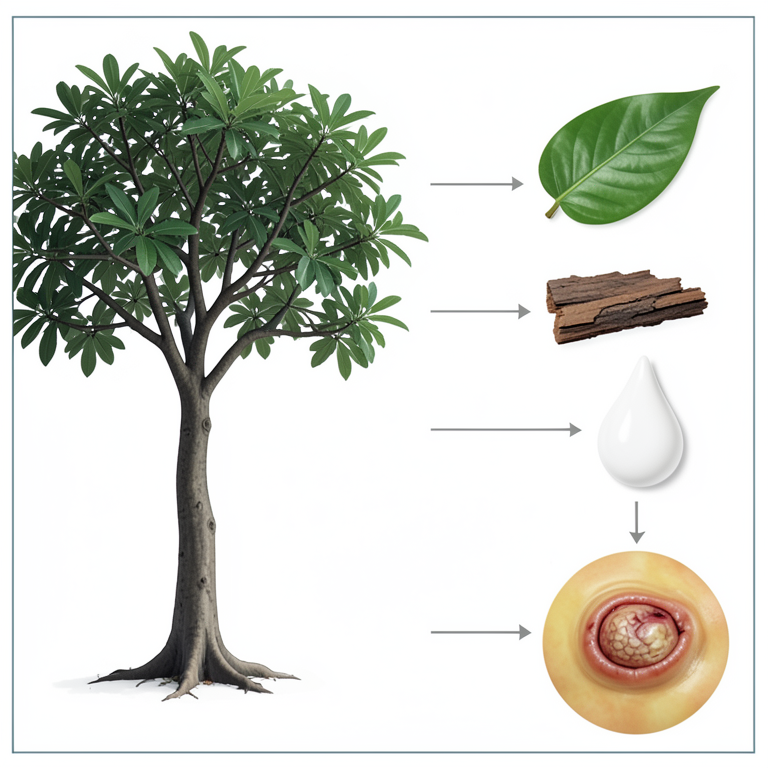
Plant Part Usage Map
AI-generated conceptual illustration (Wrightia tinctoria tree). It explains the idea and does not show study data.
View source evidence ↗Figures & tables
From the original paper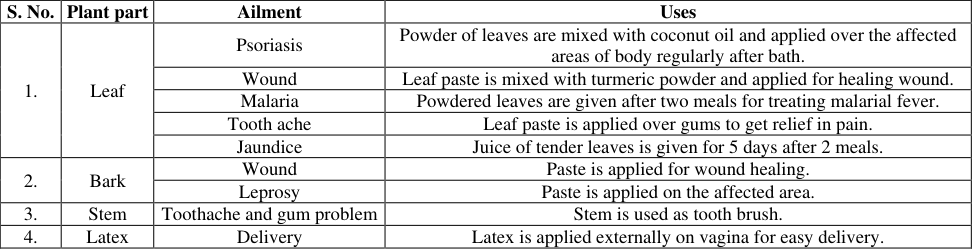 Table 1
Introduction
W. tinctoria is a small deciduous tree, 5-8 m tall and has a scaly, smooth bark. Leaves are variable, 6-15 cm X 3-6 cm, elliptic-lanceolate or oblong-lanceolate, acuminate, glabrous or the young leaves puberous beneath, base acute or rounded; main nerves 6-12 pairs and petioles 3-4 mm long. Flowers are white, fragrant, in lax terminal cymes, bracts minute, ovate. Calyx is glabrous, glandular inside, segments or teeth 2.2-5.0 mm long, oblong, rounded at the apex and with membranous margins.
Corolla tube is short, 2.5-3.0 mm long, white, lobes 6-8 mm long, oblong and obtuse. Corona consists of numerous linear scales, some inserted with the filaments and some on the corolla-lobes. Stamens are at the top of the corolla tube. Filaments are short, dilated, anthers exserted, sagittate conniving around and adhering to the stigma.
The ovary is of 2 carpels, free or connate; ovules many in each carpel. Fruits are made of 2-distinct pendulous, follicles 20-40 cm long, cylindrical, slightly tapering to both ends, glabrous, striate, cohering at first at the tip only. Seeds are 1.2-2.0 cm long, pointed at the apex with deciduous coma often more than 3.0-3.7 cm long at the base (Naik, 1998; Singh, N.P et al, 2001) [1, 5]. The whole plant or its specific parts (bark, leaf, seed and root) are known to have medicinal properties and have a long history of use by indigenous communities in India (K.M., Nadkarni, 1976) [2].
Phytochemical studies have shown that it contains alkaloids, triterpenoids, steroids, flavonoids, phenolics, carbohydrates, lipids etc. Wrightia tinctoria has been allotted to have good analgesic, anti-inflammatory, anthelmintic, antiulcer, antidysentric, antidiabetic, anticancer, antipyretic activities as well as active in the treatment of psoriasis (Kale, Niraj et al. 2021) [3]. The district Sonbhadra lies in Vindhyan Plateau between 23◦ 45’ to 24◦ 34’N latitude and 82◦ 45’ to 83 ◦23’E longitude and elevation above the mean sea level ranges between 315 m to 485 m (Singh et al., 1992) [6]. This area is inhabited by several tribes such as Gond, Mushar, Bhil, Agariya, Baiga, Bhuiya, Chero, Kharwar, Panika, Pahariya and Patari (Singh, A.K et al. 2002) [7].
The aborigines use this plant against various ailments and mention its promising affect. Ethnomedicinal informations were recorded during repeated survey of district and some useful informations are mentioned in this paper in tabulated form: IJBS 2022; 4(2): 198-199 Juhi Singh Deen Dayal Upadhyay Government P.G College Saidabad, Prayagraj, Uttar Pradesh, India Juhi Singh Deen Dayal Upadhyay Government P.G College Saidabad, Prayagraj, Uttar Pradesh, India https://www.biologyjournal.net Table 1: Showing traditional medicinal uses of different parts of a plant for treating various ailments S. No. Plant part Ailment Uses 1.
| S. No. | Plant part | Ailment | Uses |
|---|---|---|---|
| 1. | Leaf | Psoriasis | Powder of leaves are mixed with coconut oil and applied over the affected areas of body regularly after bath. |
| Wound | Leaf paste is mixed with turmeric powder and applied for healing wound. | ||
| Malaria | Powdered leaves are given after two meals for treating malarial fever. | ||
| Tooth ache | Leaf paste is applied over gums to get relief in pain. | ||
| Jaundice | Juice of tender leaves is given for 5 days after 2 meals. | ||
| 2. | Bark | Wound | Paste is applied for wound healing. |
| Leprosy | Paste is applied on the affected area. | ||
| 3. | Stem | Toothache and gum problem | Stem is used as tooth brush. |
| 4. | Latex | Delivery | Latex is applied externally on vagina for easy delivery. |
Table text extracted from the original PDF; superscript letters are shown inline. The original table image is below.
View original table image
Leaf Psoriasis Powder of leaves are mixed with coconut oil and applied over the affected areas of body regularly after bath. Wound Leaf paste is mixed with turmeric powder and applied for healing wound. Malaria Powdered leaves are given after two meals for treating malarial fever. Tooth ache Leaf paste is applied over gums to get relief in pain.
Jaundice Juice of tender leaves is given for 5 days after 2 meals. 2. Bark Wound Paste is applied for wound healing. Leprosy Paste is applied on the affected area. 3. Stem Toothache and gum problem Stem is used as tooth brush. 4.
Latex Delivery Latex is applied externally on vagina for easy delivery.
Conclusion
W. tinctoria is a valuable medicinal plant having a variety of the important secondary metabolites as alkaloids, saponins, phenolics, indigotin, indirubin, wrightial and sterols (Khyade, Mahendra, 2014) [4]. Based on the facts, it is concluded that this plant species may form a good potential source in the drug development. The therapeutic potential of the plant should be explored more as it seems to be reservoir of many more chemical constituents which may be source of many effective medicines in coming future.
References
7 in the original paper- Naik VN. Flora of Marathwada. Aurangabad: Amrut Prakashan; 1998. p. 528-529.
- Nadkarni KM. Indian Materia Medica. Bombay: Popular Prakashan; 1976. p. 1296.
- Kale N, Rathod S, More S, Shinde N. Phyto- pharmacological profile of Wrightia tinctoria. Asian Journal of Research in Pharmaceutical Sciences. 2021;11(4):301-308.
- Khyade M. Wrightia tinctoria R.Br.: A review on its ethnobotany, pharmacognosy and pharmacological profile. Journal of Coastal Life Medicine. 2014;2(10):826-840.
- Singh NP, Lakshminarasimhan P, Kartikeyan S, Prasanna PV. Flora of Maharashtra State: Dicotyledons. Calcutta: Botanical Survey of India. 2001;1:327-328.
- Singh JS, Singh VK. Phenology of seasonally dry tropical forests. Current Science. 1992;63(11):684-688.
- Singh AK, Raghuvanshi AS, Singh JS. Medical ethnobotany of tribals of Sonaghati of Sonbhadra district, Uttar Pradesh. Indian Journal of Ethnopharmacology. 2002;81(1):45-50.