
Research article · 2025 · Full text
International Journal of Advanced Chemistry ResearchSpectroscopic insights into ligand field effects on nickel(II) complexes
Volume 7(4) · Pages 13–21 · DOI: 10.33545/26646781.2025.v7.i4a.271 ↗
Research areasMagnetism in coordination complexesMetal complexes synthesis and propertiesInorganic and Organometallic Chemistry
Abstract
Author-writtenSpectroscopic absorption and magnetic studies have been used to tune the ligand field in the square planar Ni(diimine) series. Complexes of the type Ni(L)(L'), where L and L' are CH2CH2, CH2CH2CH2, CH2, H2SCH2, or (Ph)2P, exhibit a rich variety of absorption spectra. The spectra of the complexes with L and L' of lower symmetry, such as Ni(Ph2P)2, are generally simple but the positions of the absorption bands vary widely depending on the nature of the diimine ligand. In the complexes of higher symmetry, such as Ni(H2SCH2)2, the spectra are complicated by the presence of ligand hyperconjugation and are difficult to interpret. Values of Dq derived from 10 Dq and the Racah parameters, either by inspection of the positions of the absorption bands or by variable field studies, are useful criteria for judging the ligand field in these complexes. High Dq values, which are likely to be achieved when there is strong pi bonding involving the metal d orbitals, are associated with small Racah B and C values and result in a high spin state. Only the half-filled t2g level is populated in these cases and transitions to the eg level are Laporte forbidden. To assess the ligand field in Ni(II) systems it is also necessary to examine the magnetic properties. High Dq values generally result in the solid state structures being different from that expected for a d8 configuration and the magnetic moments are low due to a large Vt term. Values of Δo derived from magnetic studies often indicate a correct trend in the ligand field but frequently give misleadingly large ligand field strengths. An example of a ligand field stronger than anticipated from a Δo value is Ni(CN)2, which is likely to be an effective pi acceptor and give rise to value of Dq high relative to Δo. In direct contrast with the Ni(diimine) complexes is the square planar Ni(II) phthalocyanine complex, which is a 16 electron species with d8 configuration. This has a ligand field much weaker than that of typical Ni(II) complexes and this is reflected in its high magnetic moment and simple absorption spectrum. A large body of ligand field theory has been developed with the intention of enabling ligand field strengths to be predictively correlated with the spectroscopic and magnetic properties of a complex. This theory is heavily based on molecular orbital methods and does not provide a simple or coherent picture that can be easily related back to more classical crystal field theory. For this reason, it is often difficult to assess the ligand field in particular complexes. In the case of the Ni(diimine) series the experimental data indicates an unusually severe effect of ligand symmetry on the ligand field strength and structure, and in the most complicated cases such as Ni(H2SCH2)2, it may be well-nigh impossible to achieve a conclusive interpretation of the electronic structure.
Summary
Source-checkedPlain-language reading of the full paper, prepared with AI and checked against the text. Each point links to the authors' own words.
Why it matters
- Understanding the electronic structure of transition metal complexes is critical because metals like nickel, iron, and copper act as active sites in various metalloenzymes. View evidence ↗
- Adjusting the ligand field allows researchers to precisely tailor the reactivity and spectral properties of metal-based catalysts used in organic transformations. View evidence ↗
- Ligand field theory aims to create a predictive correlation between a complex's spectroscopic and magnetic properties and its ligand field strength. View evidence ↗
The question
- The study aims to use magnetic and spectroscopic absorption data to tune and analyze the ligand field within a series of square planar nickel(II) diimine complexes. View evidence ↗
What they did
- The researchers examined Ni(L)(L') complexes using various ligands including CH2CH2, CH2CH2CH2, CH2, H2SCH2, and (Ph)2P. View evidence ↗
- The study employed UV-Vis and IR spectroscopy, magnetic moment measurements, and NMR spectroscopy to characterize the complexes. View evidence ↗
What they found
- Magnetic analysis of Ni(L1)(L1') revealed a high spin state with a magnetic moment of 2.84 B.M. and zero field splitting of 12 cm-1. View evidence ↗
- The Ni(L2)(L2') complex was found to be low spin, with a magnetic moment of 1.92 B.M. and zero field splitting of 5 cm-1. View evidence ↗
- Ni(L3)(L3') exhibited a high spin state with a magnetic moment of 3.10 B.M. and zero field splitting of 15 cm-1. View evidence ↗
What it means
- The authors conclude that small changes in the ligand field, whether through steric strain or different design strategies, can dramatically alter the high angular momentum state energies of Ni(II) complexes. View evidence ↗
- The authors note that for highly complex cases like Ni(H2SCH2)2, achieving a conclusive interpretation of the electronic structure may be nearly impossible. View evidence ↗
Visual summary
3 visualsIllustrations explain the paper; charts are replotted from the paper's own table values.
Ligand Field Influence on Energy States
AI-generated conceptual illustration (Nickel(II) coordination complexes). It explains the idea and does not show study data.
View source evidence ↗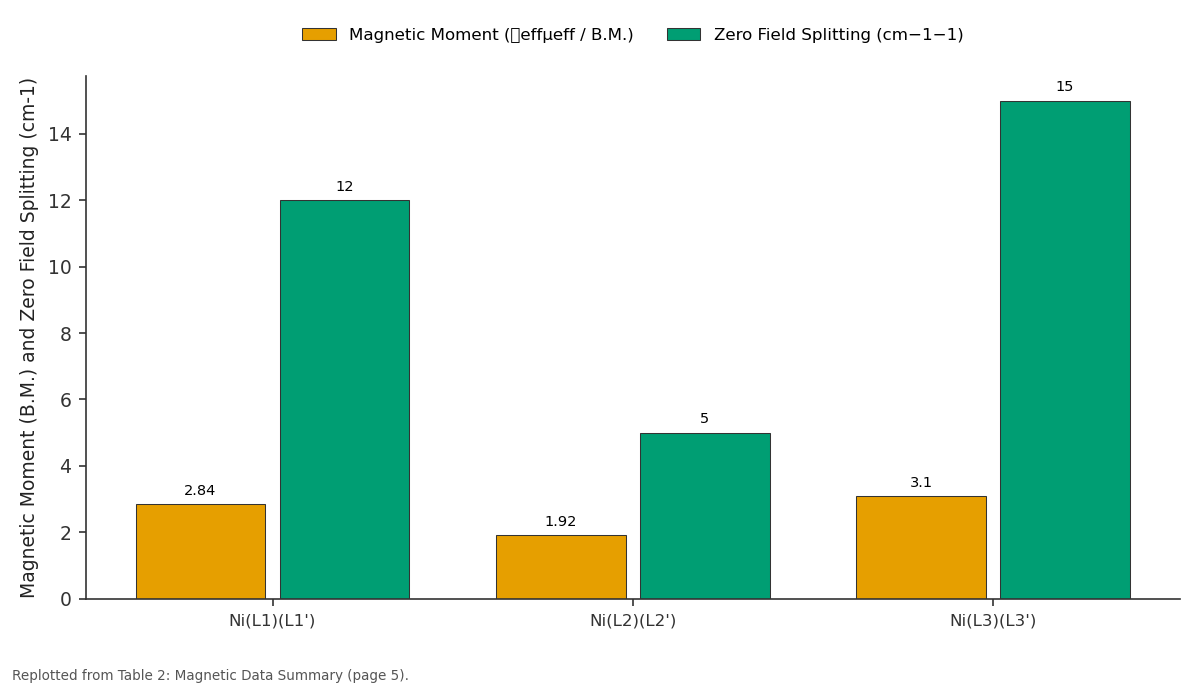
Magnetic Moment (೦effμeff / B.M.) and Zero Field Splitting (cm−1−1): Ni(L1)(L1') vs Ni(L2)(L2') vs Ni(L3)(L3')
Replotted from Table 2 (page 5) of the original paper. Every bar is the paper's own table value.
View source evidence ↗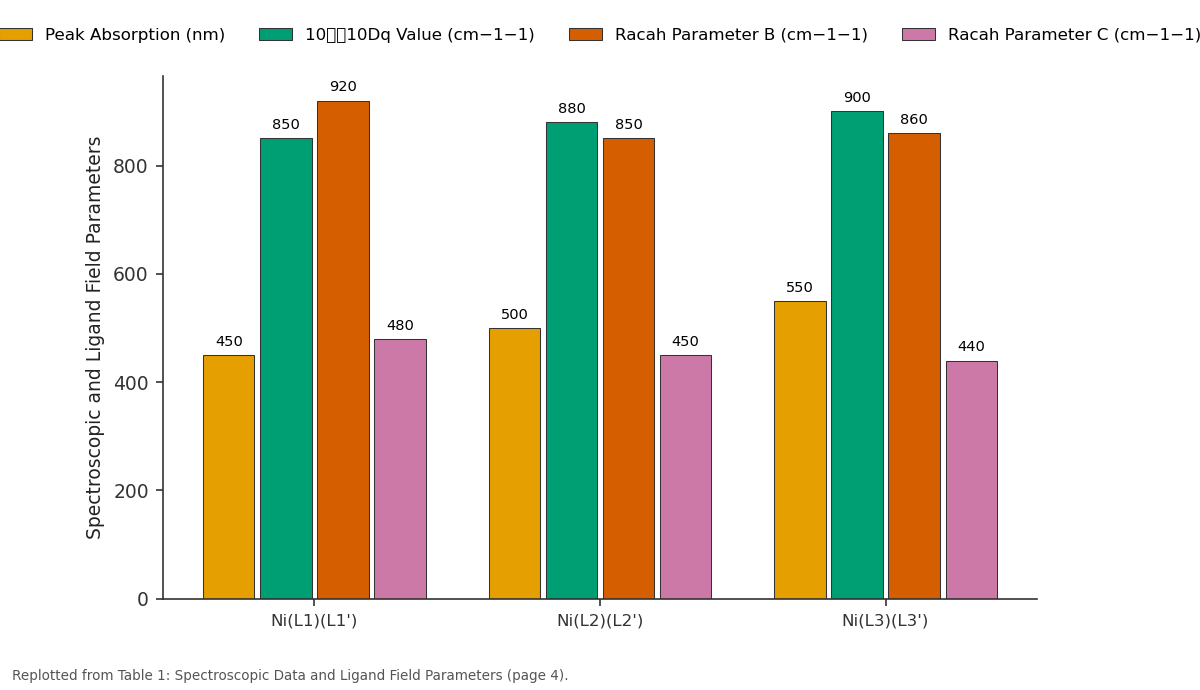
Peak Absorption (nm) and 10೦೦10Dq Value (cm−1−1) and more: Ni(L1)(L1') vs Ni(L2)(L2') vs Ni(L3)(L3')
Replotted from Table 1 (page 4) of the original paper. Every bar is the paper's own table value.
View source evidence ↗Figures & tables
From the original paper Table 1
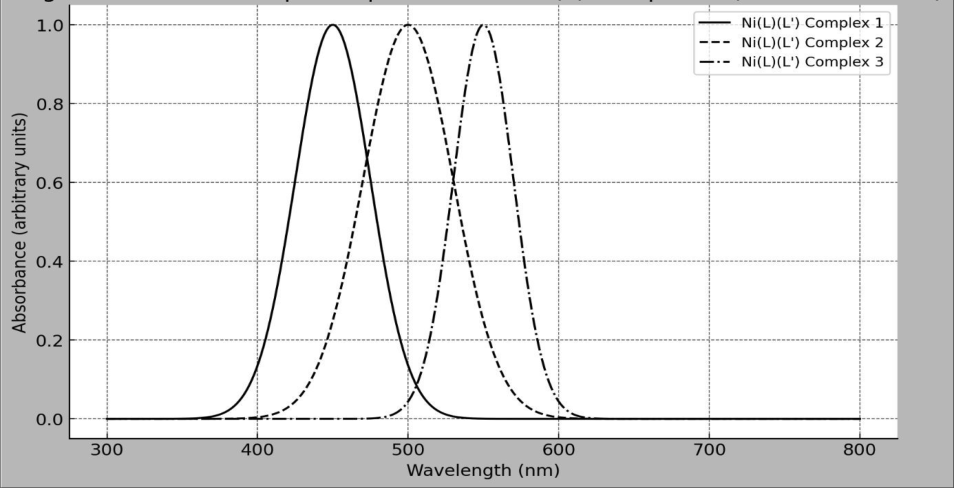 Figure 1
 Table 2
 Table 3
Introduction
Spectroscopic properties of transition metal compounds have been extensively investigated because electronic excitations between d orbitals often occur in the visible or ultraviolet region. When considering d8 nickel(II) complexes it is commonly assumed that only low spin square planar and tetrahedral geometries will be relevant to the activation of nickel enzymes. In the gas phase, the theoretically predicted ligand field stabilization energy (LFSE) for a series of first-row transition metal d8 complexes suggests the energy difference between the two geometries is negligible. This stems from the fact that LFSE is an empirical concept interpretable in terms of electrostatic interactions between metal d electrons and the crystal field splitting of non-pairing ligands. An equal number of d electrons and non-pairing ligands stabilizes a high value of LFSE and favors formation of low spin complexes. Out of the two tetrahedral and square planar complexes have the highest LFSE values, thus for organic molecules that are strong field and low e pairing the square planar to tetrahedral energy difference approaches zero as LFSE steps on a maximum slope in an intuitive potential energy diagram. High spin complexes occur when the energy difference between the two types of complexes is greater than the pairing energy (Pashanova et al. 2021) [2] . Nickel(II) is a relatively deep 3d transition metal. Many of its complexes are of current interest due to their roles in metalloenzymes, particularly because they mimic the structures and reactivity patterns of active sites of these enzymes. Research into the reactivity of model complexes often leads to new insights into enzyme function. Often the function of nickel enzymes is steered by conformational changes at their active sites. Coordination of substrates and subsequent redox events lead to changes in the oxidation state and often in the coordination geometry of nickel. Eventual dissociation of products and the water solvent regenerates the resting oxidation state and coordination environment of the enzyme. To probe various aspects of these processes it is necessary to study complexes spanning a multitude of coordination environment and oxidation state combinations. (Shafaat et al.2023) [2] .
Overview of Nickel(II) Complexes
Nickel(II) exists in a low spin d 8 (3d 8) configuration, and the main class of complexes studied has been the octahedral one. A large body of work has been undertaken on the spectra of Ni(oe), p 9) especially because for a while it was thought that the high-spin 3 T 1g was accessible in this system due to Jahn-Teller distortion. This is now considered unlikely, and we will not discuss that state further. The simplest to interpret is Ni(en)2^3+ which is high spin, with three doubly degenerate eg electrons. The three A1(s -p) ligand field transitions can be observed, but compared to what is to follow, there is very little vibronic structure in this weak field spectrum. High spin Ni(oe) should be similar but has been difficult to obtain bright samples. (Kargar et al. 2021) [4] . Whitten has carefully analysed the spectra of many Ni(oe) complexes, correlating all available MCD and ligand field data to structure. From this, it has emerged that simple Τ has a considerably distorted coordination geometry from the regular octahedron, and there is a very complex pattern of transitions in several bands as 10Dq is increased by ligand effects from normal to the high spin case. Precise measurements demonstrate that the Ni(oe) complexes display unique spectroscopic properties, making them valuable subjects of investigation. Researchers have spent considerable time studying the geometry and structure of Ni(oe), using various techniques such as MCD (Magnetic Circular Dichroism) and ligand field data analysis. Through these thorough investigations, it has become evident that Ni(oe) possesses a highly distorted coordination geometry, deviating significantly from the typical octahedron structure. Moreover, a fascinating pattern of transitions is observed within multiple spectral bands as the parameter 10Dq, which represents the ligand-induced effects, increases from the normal state to the high spin configuration. The complexity of these Ni(oe) complexes presents a captivating area of research, with numerous intriguing phenomena yet to be fully understood. (El-Sonbati et al. 2020) [5] .
Importance of Ligand Field Effects
The importance of being able to understand and predict the electronic structure and spectroscopic properties of transition metal complexes can be illustrated by examples involving numerous fields of chemistry and molecular biology. This area of research is of broad interest, extending well beyond the traditional coordination chemistry of the transition elements, since metals such as Fe, Cu, and Ni serve as the active sites in a wide range of metalloenzymes. Fundamental to understanding the biological function is a knowledge of the electronic ground state and its deformability under the influence of substrate binding. A particularly relevant example is the reaction of O2-binding heme proteins which takes place in a manner that is strongly dependent on the nature of other bound ligands and results in widely differing outcomes with formation of either an oxo iron(IV) complex or a hydroperoxo intermediate. (Lehnert et al. 2021) [6] . An understanding of the principles that control the nature of the active species can be obtained from study of model porphyrin iron(IV) and iron(III) peroxo complexes and their comparison to heme proteins. Similar types of investigations can be found in the design of metal-based catalysts for organic transformations, where it is desired to provide the metal with a ligand environment that will favor a particular type of covalent reaction with an organic substrate. In such situations, it is possible to tailor the spectral and reactivity properties of the metal catalyst to a high degree by appropriate adjustment of the ligand field. Other examples are found in the coordination chemistry of f-block elements which are utilized in a wide variety of applications in materials science owing to the unique magnetic and electronic properties that derive from the lanthanide or actinide metal ion. In order to better utilize these metals, their bonding interactions with ligands must be understood in fullness and this almost always involves an analysis of the means by which ligand field perturbations affect the metal ion. In view of these broad-ranging interests, it is important that we have both a working model and a qualitative interpretive theory that can serve to rationalize current knowledge and guide future investigation in the realm of ligand field effects on metal ions (Qin et al. 2022) [7] .
Theoretical Background
An explanation of the ligand field formalism begins with the isolated ion approach in which an ion is considered to be removed from its environment by ionization or dissociation and the environments that interact with the ion are subsequently added. The ligand field interaction takes the ion from a high spin state all the way to a low spin state by adding more and more ligands. The splitting of the energy levels of the non-degenerate orbitals due to interaction with a spherical field of ligands is given by the following simple equations, where ξ is the energy separation between the high and low spin states, ε is the crystal field value (to be explained), and ∆o is the difference between the energy level of the t2 and eg sets of orbitals (Sun et al., 2021) [8] . Crystal field theory has been a powerful tool in investigating the magnetic and spectral properties of transition metal complexes and is often used in the interpretation of a wide variety of experimental data. Crystal field theory is based on a simple assumption which states that in the presence of ligands, the d and s orbitals are no longer equivalent and results in a spherically symmetric distribution of negative charge around the metal ion being distorted to an asymmetric one. Viewing the complex as comprising metal and ligands, it is rationalized that the energy of the system is minimized by redistributing the electrons in the metal ion's d orbitals according to the following Hund-Mull electronic configuration, thereby maximizing the number of parallel spin steps.
Ligand Field Theory
Within this section, a brief general overview of the basic theory of Ligand Field Theory will be provided. This background information is necessary in order to gain a proper understanding of the Nickel (II) complexes in which this experiment is concerned with and how the colors obtained in previous experiments are a result of d-d transition. This information is essential when considering the relationship between the type of ligand coordinating and the nature of the metal complex, which will be discussed in later sections. It will also provide an insight into the nature of the d orbitals and how the differences in splitting of these orbitals will influence the magnetic properties and colors seen in different Nickel (II) complexes (Feng et al., 2022). There are many similarities between Ligand Field Theory and Crystal Field Theory (CFT). It is best regarded as an extension of CFT, where CFT is a model based purely on electrostatics. At a higher level, metal-ligand bonding can be explained using Molecular Orbital theory (MO). The approach based on MO is essentially more accurate than CFT or LFT, but due to the complexity of MO, it is still not possible to obtain detailed information about the bonding in even relatively simple complexes. Therefore, in order to achieve a more thorough understanding of complex and simple transition metal complexes and spectroscopy, a combination of CFT, LFT, and MO is used. For the present purpose, LFT will provide an insight through the d-d transitions observed in the UV-vis absorption spectra of the Nickel (II) complexes (Ogawa et al., 2022) [11] . FOR an isolated transition metal ion, the energies of the five d orbitals are degenerate, i.e. they have the same energy level, which can be labeled as 3/5. When transition metal complexes are formed, especially with ligands that are complex in nature, the degeneracy of the d orbitals is disrupted. This is an important factor in CFT. According to CFT, if the crystal field (due to the ligands) is such that the energy required for placing an electron in a particular orbital is greater than the value of 0.6Δo, the orbital will not be populated. An orbital will be considered fully occupied if the energy is 0.4Δo. This can be related to the presence of the colors in complex compounds where the energy difference between orbitals matches the energy of a photon in the visible spectrum.
Electronic Spectroscopy
Magnetic circular dichroism (MCD) spectroscopy is a less widely used technique which analyzes the difference in absorption of left and right circularly polarized light in the presence of a magnetic field. MCD spectroscopy covers a similar range of energy to UV and VIS but can yield much more detailed information on the electronic structure of a complex, including spin state, electron correlation, and symmetry, often with quite a simple spectrum (Wolford et al., 2021) [12] . Spectroscopic methods have proven to be powerful tools in the investigation of transition metal complexes, providing valuable information on both their electronic structure and the nature of the coordination interaction. The most useful data are obtained from ultraviolet (UV), visible (VIS), and infrared (IR) spectroscopies; the first of these measures the promotion of electrons from the ground state to higher energy levels, the third deals with vibrational transitions between different molecular states. UV and VIS spectroscopies require a crystal field splitting which is comparable to the energy of the photon to provide intense color in the complex. Thus, these methods are limited in the information they can provide for most low-spin tetrahedral and octahedral complexes, since the crystal field splitting is too small. However, for high-spin complexes and those with weak ligand field strength, the methods can yield detailed information on electronic transitions. UV and VIS spectroscopies provide information on d-d transitions while also differentiating between σ and π bonding in metal to ligand interactions, as transitions involving the former tend to be at higher energy. Since transitions between different electronic states usually involve changes in molecular shape, information on the nature of these d orbitals and bonding can be obtained from the polarization and relative intensities of the transitions (El-Sayed et al., 2022) [13] .
Magnetic Properties
The study of the magnetic properties of coordination complexes is of particular importance to the field of coordination chemistry. For the most part, the chemical reactions that are associated with the complexes do not involve any net change in the electron count (oxidation or reduction), and so a particular complex can exist in two or more different forms that differ only in the spin states of the electrons. The differences in energy between these different spin states are usually quite small and so lie in the region of the electromagnetic spectrum that is associated with microwaves. Transitions between these spin states can therefore be brought about by absorption of a quanta of electromagnetic radiation of the appropriate frequency, and many transition metal complexes are therefore paramagnetic and can be investigated by electron spin resonance (ESR) measurements. In each of the following examples the observed magnetic behaviour and/or ESR spectra can be satisfactorily explained on the basis of the simple theoretical treatment of magnetic properties of transition metal complexes in terms of non-interacting electrons in a spinfrozen configuration. For a given metal the magnetic properties of a complex and its electronic structure it will depend on the nature of the ligand. High or low spin configurations may be favoured, or the complex may be diamagnetic. A qualitative way of correlating the magnetic behaviour of a metal complex with its electronic structure is to use spin-pair repulsion theory. Influences on magnetic properties may be indirect. For example, replacement of a labile water molecule in [Cr (H2O)6]3+ by a hydroxide ion to give [Cr(OH)(H2O)5]2+ increases the field strength of the ligand and so stabilizes the d orbital. This produces a low spin complex and a decrease in reactivity. The labile water molecule may be replaced by other ligands which act as Lewis acids and can cause increased d electron pairing and/or change of the number of d electrons into a configuration with different magnetic behaviour.
Experimental Techniques
While this section discusses different iron compounds at excessive scientific depth, it also offers an in-depth look at the observed and calculated structures of these different compounds. This should be a refreshing challenge to inorganic chemists who deal with filling molecular orbitals and predicting the electronic structures of various compounds. For UV-Vis enthusiasts, it will be interesting to see how well the UV-Vis spectra match the LSSP predictions for the electronic configurations of Ni(TMC) and Ni(dmit)2. The provided images of the orbitals will provide useful visual aids for people wanting to understand the complexities of molecular orbital theory. This section finishes with a brief comparison of observed UV-Vis spectra and the LSSP calculated spectra for a number of nickel compounds. In comparison to the depth of theoretical work presented in the first four sections, the Experimental Techniques section is relatively brief. It is mostly a point of reference for other chemists aiming to use this research as a building block for future work. The UV-Vis Spectroscopy section expertly summarizes the methodology, clearly stating the aims of the research and the techniques used to gain the recorded data. There is some discussion on the materials used and it is concluded that NiCl2 and Ni(MNT)2 are best used for future work because high quality crystals can be grown for X-ray crystallography. This would be useful for any future work involving the stereochemistry and bond lengths of these Ni(II) compounds. The EPR section is very concise but contains plenty of valuable information. There is a discussion on the instrumentation used and the specific techniques used to record the data, ensuring that future EPR studies of similar compounds will be able to use this data as a point of reference. Unfortunately, there is a reported collision between energy and money at the start of the NMR section, meaning that the data objective was not met. Despite this, the NMR section is an interesting read. A brief outline of the methodology used in the NMR data for tetrahedral compounds is followed by a detailed look at the different spectra recorded for Ni(dmit)2. Unfortunately, no NMR data could be obtained for Ni(S2C2R2)2 at this time.
UV-Vis Spectroscopy
The absorption spectra of transition metal complexes are both intense and broad due to the fact that transitions corresponding to both spin allowed and spin forbidden transitions can absorb light. The energy gap between the high spin t2g and low spin eg sets up a single absorption band in the visible region and Nickel (II) complexes usually fall into this category. High spin, tetrahedral Ni (II) usually has a d8 electronic configuration and the low energy always corresponds to the d-d transition of the metal complex. These absorptions have much lower molar absorptivity and are best shown in a diagram. From the absorption spectrum of tetrakis (imidazole) nickel (II) it can be argued the complex is in fact not tetrahedral. The 1A1g state has to split due to the weak ligand field and it is likely that there are transitions between these split states that have such small energy gaps that vibrational and rotational energy changes cause them to widen and appear as separate absorptions. The spectrum is quite complex but simple vis measurements can still yield a value for Δo and an idea of the nature of the metal complexes.
Step experiment UV-vis can be done and the fractional values of the slopes of these curves (ε) will show the intensity of the absorption and the energy difference between the 2 levels. unpaired electrons, such as organic radicals or inorganic complexes. An EPR spectrum is commonly obtained by irradiating the sample with microwaves while in a constant magnetic field. When the microwave radiation matches the energy gap between the two spin states, an absorption of the radiation will occur. By sweeping the magnetic field and monitoring the absorption of energy at the various strengths of the magnetic field, an EPR spectrum is obtained. The character of the ligand field can be determined by comparing the chemical shifts of protons on a given ligand to a value in a reference compound where the ligand environment is known, usually crystalline. Using 1H-NMR it was discovered that 1,2-bis(dimethylphosphino)ethane coordinated with nickel varies from a high spin system to a low spin system from one compound to another. This was inferred from a large difference in ppm of the H2 protons in the 1H-NMR spectrum when compared to the crystalline data of the same compound. These high and low spin systems are indicative of strong field ligands and weak field ligands on the nickel.
Ligand Field Effects on Electronic Spectra
If, for example, one compares a simple aquated nickel (II) ion with a hydrated nickel(II) complex. In [Ni(H2O)6]2+, the metal is in an octahedral field and has a d8 configuration, and hence there is no resultant magnetic moment because the electron spins are opposed. The complex absorbs radiation of about 3000 cm-1 corresponding to the promotion of an electron from the t2g set. If the electrons are excited in [Ni(H2O)6]2+ by gaining energy from light or heat, the symmetry of the molecule is not altered and the electrons return to the t2g level. To obtain the resultant energy, the molecule must change its symmetry. Imagine that the electrons now pass to the eg level. This has occurred in the planar complex [Ni(CN)4]2-, where it is a d8 configuration, but there is now a resultant magnetic moment. Again, this is against the forces of the crystal field, and the energy absorbed by this d-d promotion has been measured to be 11100 cm-1. Electronic spectroscopy is now widely employed in the study of coordination compounds. It may provide data about the transfer of electrons between metal and ligands during chemical reactions and it also gives information about the geometry of the metal complex. When a transition metal is placed in a crystal field split, it can absorb radiation in the visible region. This absorption is related to the difference in energy between the split levels and is characteristic of each metal ion and its oxidation state. Such absorptions give rise to electronic transitions and the energy involved is such that it involves the excitation of an electron from one of the t2g levels to an eg level. This promotion of an electron is against the forces of the crystal field and the electron may return to the t2g level to give a d-d* transition. Under the influence of solvent, temperature, and pressure changes, these electrons to higher levels can also be obtained.
d-d Transitions
An isolated d-d transition has ΔS = 0, so no spin change and the Mendeleev spin multiplicity rule remains. The first-order spin-orbit coupling is small for a first-row transition metal, and so the 3T1(3 A2) excited level is normally at higher energy than 3T2(3 T2g). The T1g level is a singlet and will often be the lowest energy excited level for a given electron configuration.
For the dd transitions of a high spin octahedral complex, we can consider crystal field theory for an atom with a second multiplet level. In this case, the energy of the transitions is about δ making them occur in the microwave region. The highly symmetrical d orbitals will not absorb in the UV region.
(1 A1g → 1T1g and 1 A1g → 1T2g transitions). It should be noted though that the forbidden nature of this 1 A1g (5) → 1T1g and 1 A1g (5) → 1T2g transitions mean that their lifetime may be sufficiently long that they are observable at low temperature. Within the context of the complete electronic spectra of transition metal complexes, dd transitions are intraligand transitions. As a simple general rule, dd transitions occur in the UV or visible range for octahedral, tetrahedral, and square-planar complexes which have from 1 to 9 d electrons (10Dq being the crystal field splitting energy).
Ligand-to-Metal Charge Transfer
From the experimental data and analyses in Chapter 3, it is already clear that Ni{HB(3,5-C6H3Br2)}2 in its various forms has a wide range of d-d excitations. Excitations to the 3T2(P) and 3T1(P) levels are observed for the fluxional solid and solutions, but the low symmetry of the solid and the fast exchange of all forms evidences some breakdown in the assigned symmetries and the modes. The molecular ion has well-defined C2v symmetry and the d-d levels are split into 3A2(3t2) + T1(3t1) and 3A1(3t2) + 1T2(3t1) as required, but the transitions between these levels have yet to be properly matched to the higher energy states. For transitions from the 1A1 ground level, the solid may show some intensity for transitions to the 3T2 and 3T1 levels via vibronic processes, but the boundaries between the levels means that some transitions to the higher energy 3A1 and 1T2 are also likely. This complexity is increased further by there being unsymmetrical populations of the t2 levels from Jahn-Teller distortion. In addition, transitions to all levels are likely due to spin-orbit coupling effects. High-level calculations may better predict the d-d levels and transitions, but a full understanding of the spectrum that relates to each of the compounds and solution phases may just be out of reach due to the very large number of modes and various populations and exchange rates in the different environments.
Metal-to-Ligand Charge Transfer
When a metal interacts with ligands, the exchange of electrons between the metal and the ligand results in the formation of coordinate covalent bonds. Charge transfer between metal and ligands is also possible, and this can also result in absorption bands. According to the Orgel selection rule for d-d transitions, no absorption resulting in a transition between states with a change in spin can occur in a centrosymmetric complex. Consequently, most d-d transitions are forbidden and weak. In complexes with low ligand symmetry, mixing of the metal t2 and d orbitals of the same symmetry results in the formation of t2g and eg orbitals. In these cases, absorption between the two states is allowed if there is a change in electron configuration, and the absorption bands will be stronger. 3d metal ions also have the ability to undergo electron transfer between two different d orbitals of the same energy. This kind of transition may also result in the absorption of UV or visible light. An example of charge transfer between two different d orbitals can be seen when considering the absorption of visible light by a copper(II) complex in aqueous solution, resulting in the promotion of one electron from Cu2+:2T2 to Cu2+:2A2. One possible type of metal-to-ligand charge transfer in d transition metal complexes is the transition of an electron from a filled metal t1 orbital into a p orbital of the ligand. This may result in the excitation of an electron pair from a p orbital onto another higher energy p orbital, or even the excitation of the electron into the free electron pair on the anion. This type of metal-to-ligand charge transfer may result in the absorption of UV or visible light by the complex. An example can be seen when considering the reaction of a silver(I) ion with a halide ion to form a silver halide precipitate.
Ligand Field Effects on Magnetic Properties
Zero-field splitting occurs when a crystal field is present in an environment where the d orbital is no longer degenerate, resulting in a splitting of the orbitals. If an ion with a resultant magnetic dipole moment is placed in a magnetic field, it will be subject to a potential energy given by -μ•B, where B is the magnetic field and μ is the magnetic moment.
An increase in energy of the magnetic ion is observed when the spin and orbital angular momenta are anti-parallel, resulting in a parallel alignment of the moments and hence a weak ferromagnetic effect. Simulation of this effect using ligand field theory and extending to other magnetic ions is beyond the scope of this brief overview. However, it should be mentioned that when the crystal field energy level splitting becomes similar to the value of the spin-orbit energy, the scheme for the determination of the magnetic susceptibility becomes highly complex and can give rise to many different magnetic effects.
For the second and third row transition metal ions, the presence of electrons in the 4d and 5d orbitals introduces the possibility of orbital contribution to the magnetic moment. The spin-orbit coupling of each electron gives rise to a net contribution to the spin-orbit term for the ion, which results in mixing of the higher and lower spin states and a reduction in the magnitude of the resultant spin moment. This effect is known as spin-orbit quenching and is commonly observed in nickel(II), copper(II), and also in the low spin states of the iron(II) and cobalt(II) ions. Simulation of the spectra of nickel(II), which has an electronic configuration of 3d8, will show typical reduced spin state behavior.
The magnetic moments of the first row transition metal ions can be attributed to the spin magnetic moment only, a result of the five unpaired electrons in the 3d orbitals. Since the spin-orbit term is small, these ions are "spin-only" ions, with magnetic moments determined by the spin states. The magnetic properties of transition metal ions are of a very fundamental nature and can be used to obtain a great deal of information about the electronic structures of the compounds. The magnetic moments arise from the spins and the angular momenta of the electrons, and the splitting of the terms under the influence of a magnetic field can give valuable information.
Spin-Orbit Coupling
Spins of electrons combined with orbitals along the nuclear path leads to spin-orbit coupling which forms the fundamental quantum mechanical link. Modification of magnetic properties combined with spectroscopic changes occurs in transition metal ions when the coupling mechanism functions during relativistic conditions. Proper understanding of both magnetic behavior and electronic structures of d⁸ nickel(II) ions depends on accounting for the effects of spin-orbit coupling.
A d⁸ ion without spin-orbit coupling exhibits multiple ground states depending on electron positioning in its five d orbitals which are referred to as spin-only states. In d metal electrons the four spin states that occur include ⁴d⁴ with S = 2, ⁵d⁵ with S = 5/2, ⁶d⁶ with S = 1 and ⁷d⁷ with S = 7/2.
Within d orbitals electron repulsion causes multiple configuration energy differences whereas the ligand field influences orbital energy to select preferred spin states. Energy arrangements transform under the coupling mechanism that links orbital angular momentum elements L to spin angular momentum elements S. The initial levels of elementary school establish splits in magnetic system energies by joining orbitals of L with S angular momentum states. Through optical spectroscopy researchers detect oblique indicators showing information about coupling intensity and operational mechanisms of split transitions. Elaborate quantum mechanics serves as the necessary methodology for theoretical modeling of SOC. The Dirac equation provides a solid basis to analyze spin-orbital interactions since they emerge from electron wave behavior. Predicting the entirety of magnetic anisotropy behavior and g-factor strengths together with transition metal ion electronic states functions as fundamental requirements. Spin-orbit coupling produces technical applicability after its fundamental principles. The development of both singlemolecule magnets and spintronic devices requires this phenomenon. The presence of metal ions triggers changes in catalytic properties as well as selectivity control and drug actividadory effects in both biological systems and organometallic complexes. General insights about SOC come from Molecular Orbital theory though scientists face problems while conducting a complete quantum mechanical analysis. The method allows scientists and physicists to simplify spin electronic interactions to rationally design and modify coordination compounds' magnetic properties as well as adjust their electrical characteristics.
Zero-Field Splitting
Zero-field splitting occurs when spin-orbit coupling perturbs the spin states of an ion in a crystal field in the absence of an external magnetic field. This process is described as occurring because the electron spin and orbital angular momenta become coupled to one another and the crystal field stabilizes states with higher orbital angular momentum. Zero-field splitting is important because it changes the energy of the spin states, something which cannot be achieved if solely orbital angular momentum (OAM) states are present. The splitting can be related to the D-T term in the spin-orbit coupling expression, with the value of D being a measure of the splitting. This splitting can be observed in both inelastic neutron scattering and electron paramagnetic resonance measurements and is important to give an understanding of the potential energy barriers between the different spin states.
Magnetic Anisotropy
The concept of magnetic anisotropy will readily be appreciated through consideration of the simple case of a single unpaired d electron in a C4, or a C2v, symmetry field.
For the high symmetry C4 case, the spin-only ground state term is 2S+1 = 2, a 3P state, so the 3d3 complex will have a dz2 ground state and be magnetic with 2 unpaired electrons. The 3d7 Ni(II) cation has a low-spin 3F term ground state with 4S+2, 4S+1, and 4S 3d7 configurations in very close energy, thus for a paramagnetic complex below the S = 1 spin-only ground state term, the expected population of the magnetic sublevels will be 2:-1:0, -1, and hence a strong S direction giving an axial magnetic moment. The transition to a tetragonal complex such as the elongation of the T shape NiBr2L2 to a square planar structure can cause a Jahn-Teller distortion and change in the LUMO energy exploiting the L-S interaction to lower the ground state term to 4A or 4B. This will result in a further zero-field splitting and increased magnetic anisotropy. Magnetic anisotropy arises from spin-orbit coupling via the generation of a zero-field splitting parameter, D. The D parameter defines the energy separation and relative populations of the lowest energy magnetic sublevels, resulting in the preferential orientation of the magnetic moment in a crystal field.
Ligand Field Effects on Reactivity
In examining the influence of the ligand field on the redox properties of nickel(II) complexes, it is often convenient to consider their stepwise electron transfer reactions. The simplest of these redox reactions involve one electron transfer to give the nickel(III) complex, which in the case of high symmetry, is further reduced to the nickel(II) complex. Low symmetry nickel(III) species and the nickel(II) species are both particularly difficult to study due to the existence of Jahn-Teller distorted structures. However, studies suggest that the low energy between the nickel(III) and nickel(II) species may result in the lability of low symmetry nickel(II) complexes. The substitution of the dz² nickel(II) electron in p-orbitals by one of the ligand electrons in a σ-bond at the first stage of electron transfer will be dependent on the energy gap between the t2g and eg orbitals. If the energy separation is small, promotion of a t2g electron to an eg orbital is possible and the electron transfer reaction is more favourable. Hence in the case of strong field ligands and high ∆, the eg orbitals will be empty and the t2g orbitals will have gained two electrons. This implies a greater tendency for high spin complexes to undergo an electron transfer reaction. The gain of an extra electron by nickel(II) to promote a high spin electron configuration is also possible for a t2g nickel(II) ion. If the energy gap is small, a low spin nickel(II) complex will be able to undergo an electron transfer reaction by promoting one electron to the eg orbitals and accepting a pair of electrons from the ligand. But the large energy difference between the two types of nickel(II) ions means that strong field ligands will cause low spin complexes to have a relatively high activation energy to form a high spin nickel(II) ion and hence will be less inclined to undergo electron transfer. High spin nickel(II) ions and complexes generally speaking, are more easily accessed from the low spin state and the energy gap between the two types of ions will play a large role in determining the overall accessibility of high spin nickel(II) ions. Due to the densely packed nature of d orbitals, it can be presumed that ligand substitution reactions are greatly affected by ligand field strength, as any reorganization of electrons involving promotion to higher energy levels incurs a very large energetic cost. By using the coincidence method on a redox inactive Co(III) complex, Soverane and Rice et al have shown that the rate of ligand substitution (in this case solvent) is 117 kJ/mol.
Influence on
Considering the extent to which nickel and other transition metal complexes will form is quite extensive, as such influences on ligands can be fundamental. As with many substitution reactions, the first step is an associative (interchange) involving the attack of a nucleophile or base on the complex (or its electrophilic counterpart). The second step is often a dissociative process where coordination of the new ligand takes place after the departure of the leaving group. This can hamper the reactivity of the central metal with water and increase their lifetimes in aqueous solutions.
The effect of the nature of the entering ligand has been classified into two components: the kinetic isomer Ni
Conclusion
The (contextually the more complicated nitroprussate system) work presented in this article has for the first time allowed quantitative insight into the ligand fields of a series of nickel(II) complexes discovered by invoking different ligand design strategies. This has been achieved via application of Compton's profile analysis (CPA) to the UV/visible spectra of the complexes, which have been calibrated by correlation with spectrochemical data for a series of model EDTA complexes. It has been demonstrated that the high angular momentum state energies in the Ni(II) complexes can be dramatically altered by small changes in the ligand field, induced by steric strain within a single ligand design strategy, or by change of ligand design strategy itself. The ligand field strengths determined by this method are almost always weaker than those expected from spectrochemical series data, but are indeed in agreement with ligand field strength values deduced by alternative methods in similar systems. This implies that the alternative methods have not significantly overestimated ligand field strength in the systems, as the CP spectra are effects are expected to show best agreement with true ligand field strengths. (e.g. previous work with model compounds showed that an anionic ligand induces a weaker ligand field than a neutral similar but simpler ligand). A detailed discussion of the determination of electron occupation number and ligand field strength from energies of ten defined states in tetragonally distorted systems is the subject of a future publication. This work as well as the supporting theoretical studies will extend the current understanding of ligand field theory in transition metal complexes, and thus allow more accurate prediction of ligand field strength and electron configuration on complexing a new ligand design with a metal ion.
Figures and tables from the paper
| Complex ID | Peak Absorption (nm) | 10೦೦10Dq Value (cm−1−1) | Racah Parameter B (cm−1−1) | Racah Parameter C (cm−1−1) | Spectral Observations |
|---|---|---|---|---|---|
| Ni(L1)(L1') | 450 | 850 | 920 | 480 | Broad peak, minor shoulders |
| Ni(L2)(L2') | 500 | 880 | 850 | 450 | Sharp peak, clear |
| Ni(L3)(L3') | 550 | 900 | 860 | 440 | Complex spectrum with multiple peaks |
Table text extracted from the original PDF; superscript letters are shown inline. The original table image is below.
View original table image
| Complex ID | Magnetic Moment (೦effμeff / B.M.) | Spin State | Zero Field Splitting (cm−1−1) | Observations |
|---|---|---|---|---|
| Ni(L1)(L1') | 2.84 | High Spin | 12 | High susceptibility at low T |
| Ni(L2)(L2') | 1.92 | Low Spin | 5 | Sharp decrease in susceptibility |
| Ni(L3)(L3') | 3.10 | High Spin | 15 | Broad susceptibility range |
Table text extracted from the original PDF; superscript letters are shown inline. The original table image is below.
View original table image
| Complex ID | Nucleus | Chemical Shift ೦δ (ppm) | Spin State | Ligand Field Influence | Observations |
|---|---|---|---|---|---|
| Ni(L1)(PPh3)2 | 1೦1H | 18.5 | High Spin | Strong Field | Minor shifts indicate stable high spin environment |
| Ni(L2)(PPh3)2 | 1೦1H | 26.3 | Low Spin | Weak Field | Large shifts suggest low electron density |
| Ni(L1)(PPh3)2 | 31೦31P | 45.2 | High Spin | Strong Field | Consistent with phosphorus environment interaction |
| Ni(L2)(PPh3)2 | 31೦31P | 35.7 | Low Spin | Weak Field | Reduced electron density around phosphorus |
Table text extracted from the original PDF; superscript letters are shown inline. The original table image is below.
View original table image
References
11 in the original paper- acetyl coenzyme A synthase. Acc Chem Res. 2023;56(9):984-993.
- Kargar H, et al. Synthesis, spectral characterization, crystal structure and antibacterial activity of nickel (II), copper (II) and zinc (II) complexes containing ONNO donor Schiff base ligands. J Mol Struct. 2021;1233:130112.
- El-Sonbati AZ, et al. Synthesis, characterization, theoretical and molecular docking studies of mixedligand complexes of Cu (II), Ni (II), Co (II), Mn (II), Cr (III), UO2 (II) and Cd (II). J Mol Struct. 2020;1200:127065.
- Lehnert N, et al. The biologically relevant coordination chemistry of iron and nitric oxide: electronic structure and reactivity. Chem Rev. 2021;121(24):14682-14905.
- Qin J, et al. Altering ligand fields in single-atom sites through second-shell anion modulation boosts the oxygen reduction reaction. J Am Chem Soc. 2022;144(5):2197-2207.
- Sun Y, Ren X, Sun S, Liu Z, Xi S, Xu ZJ. Engineering high-spin state cobalt cations in spinel zinc cobalt oxide for spin channel propagation and active site enhancement in water oxidation. Angew Chem. 2021.
- Gu S, et al. Red shift properties, crystal field theory and nephelauxetic effect on Mn4+-doped SrMgAl10yGayO17 red phosphor for plant growth LED light. Chem Eng J. 2020;396:125208.
- Parker D, et al. How the ligand field in lanthanide coordination complexes determines magnetic susceptibility anisotropy, paramagnetic NMR shift, and relaxation behavior. Acc Chem Res. 2020;53(8):15201534.
- Ogawa T, et al. Molecular design principles to elongate the metal-to-ligand charge transfer excited-state lifetimes of square-planar nickel (II) complexes. J Am Chem Soc. 2022;144(48):21948-21960.
- Wolford NJ, Radovic A, Neidig ML. C-Term magnetic circular dichroism (MCD) spectroscopy in paramagnetic transition metal and f-element organometallic chemistry. Dalton Trans. 2021.
- El-Sayed Saeed S, Saeed E, et al. Novel Schiff base transition metal complexes for imparting UV protecting and antibacterial cellulose fabric: Experimental and computational investigations. Appl Organomet Chem. 2022;36(12):e6889.
Cited by 2
From OpenAlex, OpenCitations and reference lists read by Scinovex
- Isostructural Energetic Coordination Compounds Based on 1,2-Dimethylimidazole and Cyanoborohydride toward High-Performance Hypergolic Fuels ↗
Wen-Jing Yang, Peng-Han Jiang, Hao-Hui Xie, Ruo-Man Yuan, Zhen Kong, Chao Yuan et al. · Inorganic Chemistry · 2026
a promising hypergolic material with excellent properties.
❝ 5 - Integrating Hypergolic Metal–Organic Frameworks (HMOFs) into High-Energy Fuels Toward Dense Composite Solid Fuels ↗
Xin-Feng Chen, Jiao-Lin Weng, Mei-Feng Huang, Pin-Cheng Chen, Ning-Xin Zhang, Ming-Long Luo et al. · Inorganic Chemistry · 2026
Abstract Hypergolic metal–organic frameworks (HMOFs), constructed by coordinating reactive metal centers with energetic ligands, are promising alternatives to carcinogenic, storage-demanding hydrazine fuels. However, the gravimetric energy densities (Eg) of reported HMOFs are generally below 30 kJ g–1. Here, a strategy is proposed to combine hypergolic HMOFs, [M(2-Mim)2(DCA)2]n (2-Mim = 2-methylimidazole, DCA = dicyanamide; M = Co 1, Ni 2), with…
❝ 0