
Research article · 2025 · Full text
International Journal of Agriculture and Food ScienceDevelopment and quality evaluation of Aonla (Phyllanthus emblica L.) candy using different Aonla fruit varieties
Volume 7(4) · Pages 124–127 · DOI: 10.33545/2664844x.2025.v7.i4b.346 ↗
Research areasPhytochemistry and Bioactivity StudiesEthnobotanical and Medicinal Plants StudiesFood Science and Nutritional Studies
Abstract
Author-writtenAonla (Phyllanthus emblica L.), Indian gooseberry is a fruit renowned for its high nutritional value, particularly its rich content of vitamin C, antioxidants, and phenolic compounds. Despite its numerous health benefits, the fruit’s astringent and sour taste often limits its direct consumption, making it difficult to incorporate into regular diets. This study suggests that selection of appropriate Aonla variety plays a critical role in determining the quality of the final product. The present study was conducted to develop Aonla candy using different Aonla fruit varieties and to evaluate their effect on quality attributes. The research involved selecting four Aonla varieties Chakaiya, NA-7, Banarasi, and Krishna and processing them into candy using standardized osmotic dehydration techniques through a combination of blanching, osmotic dehydration in sugar syrup at varying concentrations (45°Bx, 50°Bx, and 70°Bx), followed by drying in a tray dryer at 60°C. The prepared candies were evaluated for a range of physicochemical properties, including moisture content xiv (20.16%), Protein (0.43%), vitamin C (240mg/100g), Fiber Content (4.97%), Ash Content (0.23%) and Titrable Acidity (1.46%). Results revealed significant varietal differences in sensory acceptability and nutritional content with the NA-7 variety candy.
Summary
Source-checkedPlain-language reading of the full paper, prepared with AI and checked against the text. Each point links to the authors' own words.
Why it matters
- Aonla, also known as Indian gooseberry, is highly valued for its nutritional content, specifically its antioxidants, phenolic compounds, and vitamin C. View evidence ↗
- The direct consumption of Aonla is often limited because of its sour and astringent taste. View evidence ↗
- Aonla candy is a popular value-added product that balances nutritional benefits with sensory appeal. View evidence ↗
The question
- The study aimed to evaluate how different varieties of Aonla fruit affect the quality and development of the resulting candy. View evidence ↗
What they did
- The researchers used four specific Aonla varieties: Chakaiya, NA-7, Banarasi, and Krishna. View evidence ↗
- To reduce bitterness and improve texture, fruits were pricked and soaked in a 2% sodium chloride solution for 24 hours. View evidence ↗
- The osmotic dehydration process involved soaking fruit segments in 45° Brix sugar syrup for 24 hours, followed by 72 hours in 70° Brix syrup. View evidence ↗
- The candies were dried in a cross-flow cabinet tray dryer at 60°C until they reached a leathery texture and approximately 15% moisture. View evidence ↗
- A 20-member panel used a 9-point Hedonic scale to evaluate the candy's appearance, color, texture, flavor, taste, and overall acceptability. View evidence ↗
What they found
- Among the fresh fruits, Chakaiya had the longest fruit length (3.54 cm), while NA-7 had the shortest (3.21 cm). View evidence ↗
- In fresh fruits, the NA-7 variety had the highest vitamin C content (670.82 mg/100g) and the Krishna variety had the lowest (655.78 mg/100g). View evidence ↗
- In the prepared candies, the NA-7 variety retained the highest vitamin C concentration (240 mg/100g), whereas Banarasi had the lowest (229.5 mg/100g). View evidence ↗
- The NA-7 candy had the highest crude fiber content (4.97%), while the Krishna candy had the lowest (3.85%). View evidence ↗
- The NA-7 variety was the most preferred by panelists, achieving the highest overall acceptability score of 8.1. View evidence ↗
- The Chakaiya variety was the least preferred of the four, receiving the lowest overall sensory score of 7.37. View evidence ↗
What it means
- The authors concluded that the NA-7 variety is the most suitable for candy production due to its superior chemical composition and sensory acceptability. View evidence ↗
Visual summary
2 visualsIllustrations explain the paper; charts are replotted from the paper's own table values.
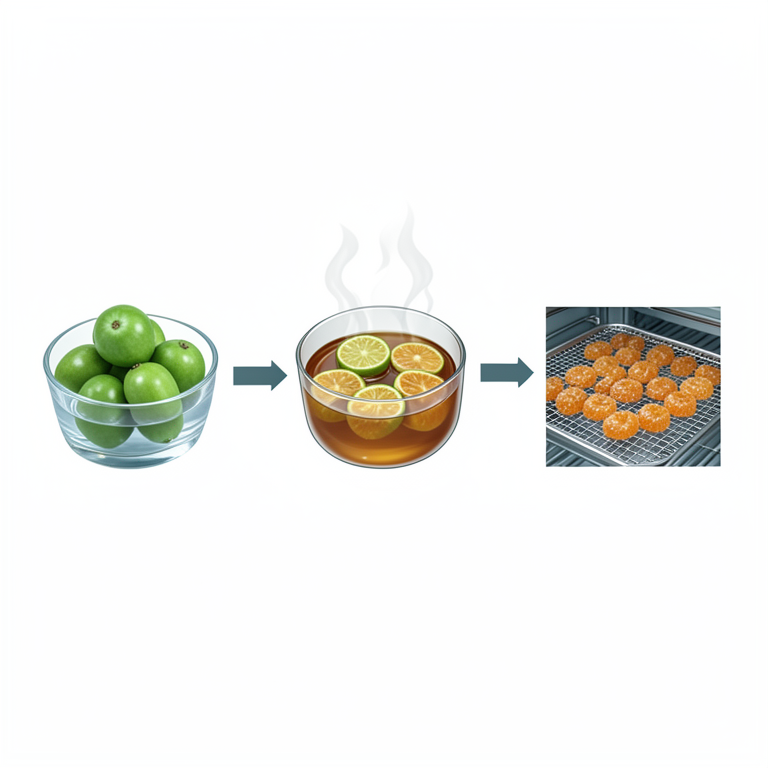
Aonla Candy Processing Workflow
AI-generated conceptual illustration (Aonla (Phyllanthus emblica L.) fruits). It explains the idea and does not show study data.
View source evidence ↗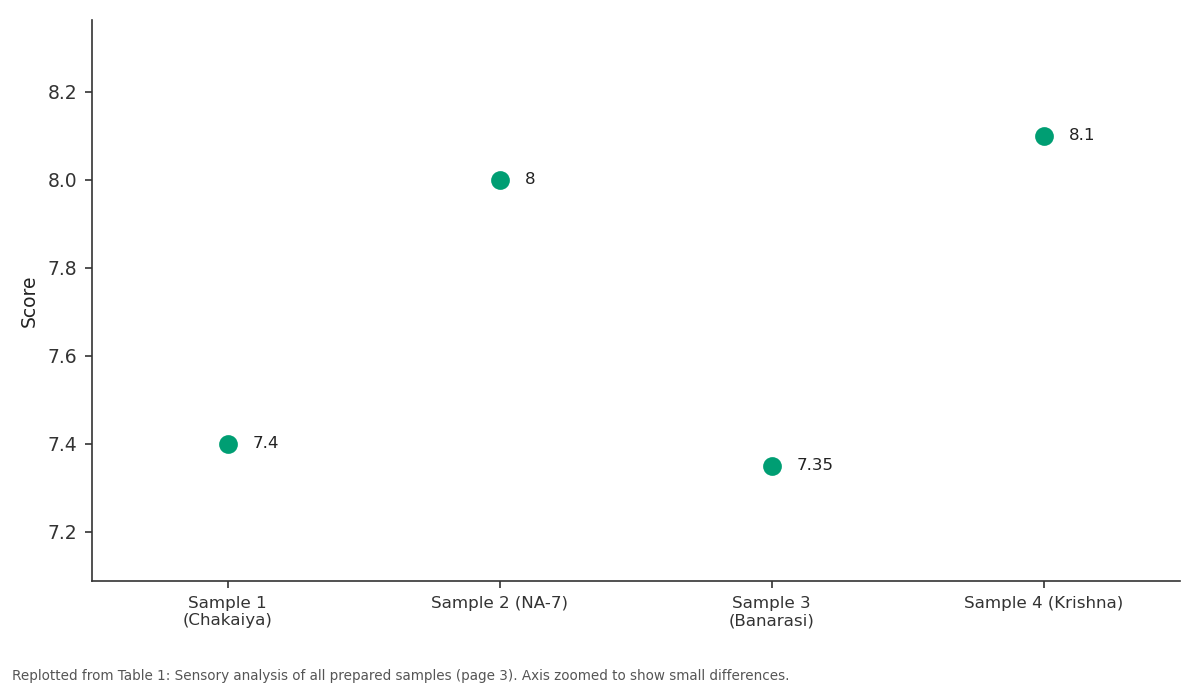
Taste: Sample 1 (Chakaiya) vs Sample 2 (NA-7) vs Sample 3 (Banarasi) vs Sample 4 (Krishna)
Replotted from Table 1 (page 3) of the original paper. Every bar is the paper's own table value.
View source evidence ↗Figures & tables
From the original paper Table 1
Introduction
Indian gooseberry (Phyllanthus emblica L.), commonly known as Aonla, is widely regarded as a valuable gift of nature and is often referred to as a "wonder fruit for health" due to its exceptional medicinal and nutritional properties. Among the prominent cultivars of Aonla are Chakaiya, NA-7, Banarasi, Hathijhool, Bansi Red, Pink-tinged, and Krishna. In India, Aonla is cultivated over an area of approximately 50,000 hectares, yielding an estimated annual production of around 200,000 metric tonnes. The average yield per tree ranges from 100 to 300 kilograms per year (Goyal et al., 2008) [4] . The fruit is highly nutritive, being one of the richest natural sources of vitamin C, and is extensively used in traditional and modern medicinal systems. Due to its versatility and functional properties, Aonla serves as an ideal raw material for a wide range of value-added products. In the beverage segment, products such as Aonla juice, squash, and sherbet are popular for their refreshing flavor and health-promoting benefits. In the category of preserved foods, Aonla is processed into murabba, pickle, candy, and powder, valued for their extended shelf life and convenient consumption. Furthermore, Aonla is incorporated into various health and dietary supplements, including capsules, tablets, herbal teas, and chyawanprash, owing to its immune-boosting and general wellnessenhancing attributes. Aonla candy is a widely recognized value-added product, offering an optimal combination of nutritional benefits and sensory appeal. It falls under the category of candied fruits products derived by impregnating fruits with concentrated sugar syrup, followed by draining and drying processes. Such products are known for their extended shelf life, concentrated nutrient profile, reduced bulk, and high consumer acceptability. Aonla candy, in particular, has gained popularity due to its health-promoting properties, minimal thirst-inducing nature, and convenience as a ready-to-eat snack (Ranote and Singh, 2006) [2] . Different Aonla varieties differ significantly in physical, chemical, and sensory attributes, which can influence the quality of processed products. However, limited research has been done to compare the suitability of various Aonla cultivars for candy production. Therefore, this study aims to assess the impact of different Aonla varieties on the development and quality of Aonla candy.
Materials and Methods
Materials and Methods
Selection of Raw Materials
The different varieties of Aonla fruits required such as Chakaiya, NA-7, Banarasi, Krishna for preparation of candy and other materials such as sugar, alum solution were procured from the local market, Kolhapur, Maharashtra, India. Fruits were sorted for uniform size, color, and absence of defects.
Methods
The physical properties of different of Aonla fruits varieties size was evaluated using a digital guage meter of about 0.01mm precision. The weight of 10 fruits randomly selected was measured by weighing balance (AOAC, 2000). The nutritional parameters of different varieties of Aonla fruits such as moisture, protein, fat, fibre, ash, carbohydrate, titrable Acidity, Vitamin C (mg/100gm) and Total Sugar were determined by using standard methods (AOAC, 2000). The energy value of food is typically calculated based on the macronutrient content: carbohydrates, proteins and fats. The formula for calculating the energy value is:
For the preparation of Aonla candy, only healthy, diseasefree, pest-free, and bruise-free mature fruits were selected to ensure optimal product quality. Initially, the fruits were pricked and soaked in a 2% sodium chloride (NaCl) solution for 24 hours to reduce bitterness and enhance textural properties. After soaking, fruits were thoroughly washed under running tap water to remove residual salt. Subsequently, the fruits were blanched in boiling water for 10 minutes, as per the method described. The blanched fruits were then deseeded and segmented manually, following the procedure outlined by Kumar et al. (2001) [13] . These segments were further soaked in a 2% alum (aluminium potassium sulfate) solution for 24 hours to promote tissue firmness. The following day, segments were rinsed thoroughly to eliminate residual alum. The osmotic dehydration process was carried out based on the protocol described by Tandon et al. (2006) [13] . The pretreated fruit segments were initially immersed in 45° Brix sugar syrup at room temperature for 24 hours. After soaking, the same syrup was concentrated by heating to 70° Brix, cooled to ambient temperature, and reused for further steeping. The fruit segments were again soaked in this 70° Brix syrup for an additional 72 hours to achieve osmotic equilibrium. This step ensured adequate sugar impregnation while preserving the structural and sensory qualities of the fruit. After osmotic treatment, the fruit segments were removed from the syrup, washed gently to remove residual surface sugar, and evenly distributed on aluminum trays. Drying was carried out in a cross-flow cabinet tray dryer at 60°C until the product attained a leathery texture and a final moisture content of approximately 15%. The dried Aonla candy was then cooled to room temperature, packed in appropriate packaging materials, and sealed immediately to prevent moisture uptake and contamination.
Quality Evaluation of Prepared Aonla candy
The nutritional parameters of different varieties of Aonla Candies such as moisture, protein, fibre, ash, titrable Acidity and Vitamin C (mg/100gm) were determined by using standard methods (AOAC, 2000). The candy sample have been evaluated for different sensory attributes such as appearance, colour, texture, flavour, taste and overall acceptability by using 9-point Hedonic scale with the help of 20 member panel. The mean of observations has been considered for evaluating the quality of prepared candy.
Results and Discussions Quality Evaluation of Fresh Aonla Fruits
The physical attributes assessed for the selected Aonla varieties included fruit length, diameter, and weight. Among the four varieties examined, Chakaiya exhibited the greatest fruit length at 3.54 cm, followed by Banarasi (
Conclusion
The study concludes that the choice of Aonla variety significantly affects the quality and acceptability of Aonla candy. Among the four varieties tested, NA-7 was the most suitable based on chemical composition and sensory evaluation. This finding underscores the importance of varietal selection in the development of value-added products, as it significantly influences nutritional quality, organoleptic properties, and overall consumer acceptability. Utilizing the appropriate variety, such as NA-7, can enhance product appeal and functionality, thereby supporting successful commercialization and wider consumer adoption.
Figures and tables from the paper
| Sample No. | Appearance | Colour | Texture | Flavour | Taste | Overall Acceptability |
|---|---|---|---|---|---|---|
| Score | ||||||
| Sample 1 (Chakaiya) | 7.35 | 7.5 | 7.0 | 7.25 | 7.4 | 7.35 |
| Sample 2 (NA-7) | 8.45 | 8.2 | 8.15 | 8.15 | 8 | 8.1 |
| Sample 3 (Banarasi) | 7.45 | 7.35 | 7.35 | 6.45 | 7.35 | 7.5 |
| Sample 4 (Krishna) | 7.9 | 8 | 7.8 | 7.8 | 8.1 | 7.9 |
Table text extracted from the original PDF; superscript letters are shown inline. The original table image is below.
View original table image
References
13 in the original paper- AOAC. Official Methods of Analysis. 17th ed. Gaithersburg, MD: Association of Official Analytical Communities; 2000.
- Alam MS, Singh A. Optimization of osmotic dehydration process of Aonla fruit in salt solution. Int J Food Eng. 2010;6(1):4-24.
- Barthakur NN, Arnold NP. Chemical analysis of emblica (Phyllanthus emblica L.) and its potential as a food source. Sci Hortic. 1991;47:99-105.
- Goyal RK, Patil RT, Kingsly ARP, Waila H, Pradeep Kumar. Status of post-harvest technology of Aonla in India-a review. Am J Food Technol. 2008;3(1):13.
- Katke SD, Pandhare GR, Patil PS. Studies on process standardization of sugarless Aonla (Phyllanthus emblica) candy. J Pharmacogn Phytochem. 2018;7(6):396-400.
- Keerthana, Ravana Shree M. Processing and preparation of sugar-coated Aonla candy. 2024.
- Lal G. Studies on the effect of sugar and citric acid treatment on quality attributes of Aonla syrup during storage. Prog Hortic. 2006;38(1):109-13.
- Mishra P, Srivastava V, Verma D, Chauhan OP, Rai GK. Physico-chemical properties of chakiya variety of Aonla (Emblica officinalis) and effect of different dehydration methods on quality of powder. Afr J Food Sci. 2009;3(10):303-6.
- Mondal SC, Kamal MM, Mumin MA, Hosain MM, Ali MR. Effect of sucrose on the physicochemical properties, organoleptic qualities and shelf-life stability of Aonla (Emblica officinalis) candy. IOSR J Environ Sci Toxicol Food Technol. 2017;11:85-94.
- Naik AG, Chundawat BS. Storage behavior of various Aonla products made from 'Gujarat Amla'-1 variety. J Appl Hortic. 1996;2(1-2):40-3.
- Pareek S, Kaushik RA. Effect of drying methods on quality of Indian gooseberry (Emblica officinalis Gaertn.) powder during storage. J Sci Ind Res. 2012;71(11):727-32.
- Sivakumar KP. Standardization and storage stability of Aonla sweet candy. Madras Agric J. 2013;100(JanMar):1. International Journal of Agriculture and Food Science https://www.agriculturaljournals.com
- Tandon DK, Yadav RC, Sood S, Kumar S, Dikshit A. Effect of blanching and lye-peeling on the quality of Aonla candy. Indian Food Packer. 2003;57(6):147-52.