
Research article · 2025 · Full text
International Journal of Biology SciencesOptimizing micro irrigation efficiency in water-scarce agroecosystems using AI and remote sensing technologies
Volume 7(4) · Pages 33–37 · DOI: 10.33545/26649926.2025.v7.i4a.324 ↗
Research areasSmart Agriculture and AI
Abstract
Author-writtenIn dryland farming, water shortages require creative irrigation solutions. In dry and semi-arid areas, drip, sprinkler, and subsurface irrigation are becoming more popular to maximize water use. These systems still struggle to distribute water efficiently, use a lot of energy, and make real-time decisions. Using AI and remote sensing to overcome these restrictions is revolutionary. AI-driven irrigation systems use machine learning algorithms, predictive analytics, and IoT-enabled smart sensors to maximize water use, minimize waste, and increase crop yields. UAVs, satellites, and multispectral imaging are remote sensing technologies. These technologies enable real-time soil moisture, evapotranspiration, and plant health monitoring. For site-by-site water management, GIS, AI, and remote sensing improve precise irrigation. This review examines the pros, cons, and future uses of artificial intelligence (AI) for remote sensing and automated irrigation in dryland farming using recent studies. Comparing current studies shows that wide adoption requires better policy frameworks, sensor networks, and AI algorithms. It also identifies key research gaps. The results show that we need better water management technology and approaches from different fields to sustain farming. Future research should expand remote sensing in small-scale farming, incorporate blockchain for data security, and develop affordable AI-driven irrigation models. To implement policies and infrastructure widely, policymakers and stakeholders must collaborate. Researchers, agronomists, and lawmakers who want to improve irrigation efficiency with AI and remote sensing will benefit from this study.
Summary
Source-checkedPlain-language reading of the full paper, prepared with AI and checked against the text. Each point links to the authors' own words.
Why it matters
- Water efficiency is critical for long-term crop production in dryland agriculture because of unpredictable rainfall and high evaporation rates. View evidence ↗
- Traditional irrigation often wastes resources and distributes water inefficiently due to manual monitoring and fixed schedules. View evidence ↗
- Micro-irrigation improves efficiency by delivering water directly to plant roots, which minimizes runoff and evaporation. View evidence ↗
The question
- The study aims to review the advantages, disadvantages, and future applications of AI and remote sensing for automated irrigation in dryland farming. View evidence ↗
What they did
- The authors conducted a comparative analysis of current research to identify requirements for wide adoption and existing research gaps. View evidence ↗
- The reviewed technologies include IoT-enabled sensors, predictive analytics, and machine learning algorithms to optimize water use. View evidence ↗
- Remote sensing tools such as satellites, UAVs, and multispectral imaging are used to monitor plant health, evapotranspiration, and soil moisture in real time. View evidence ↗
What they found
- AI-powered irrigation models can reduce water usage by up to 30% in dry regions without reducing crop production. View evidence ↗
- In Rajasthan, India, using remote sensing to map soil moisture for irrigation planning reduced water use by 25% while maintaining crop yields. View evidence ↗
- The integration of GIS and remote sensing for site-specific irrigation planning resulted in a 30% reduction in water use without affecting yields. View evidence ↗
- High installation costs make drip and subsurface irrigation unaffordable for some smallholder farmers. View evidence ↗
- Operational complexity and costs are increased by system wear and the blockage of emitters. View evidence ↗
What it means
- The authors suggest that governments should standardize sensor networks, encourage data sharing, and increase the transparency of AI models. View evidence ↗
- Digital literacy and training programs are recommended to help farmers adopt these advanced technologies. View evidence ↗
- Current challenges include high implementation costs, data accuracy issues, and the need for extensive farmer education. View evidence ↗
- Future research needs to focus on affordable solutions for smallholders, secure data sharing via blockchain, and hybrid AI models that incorporate physics-based hydrological data. View evidence ↗
Visual summary
1 visualsIllustrations explain the paper; they do not show study data.
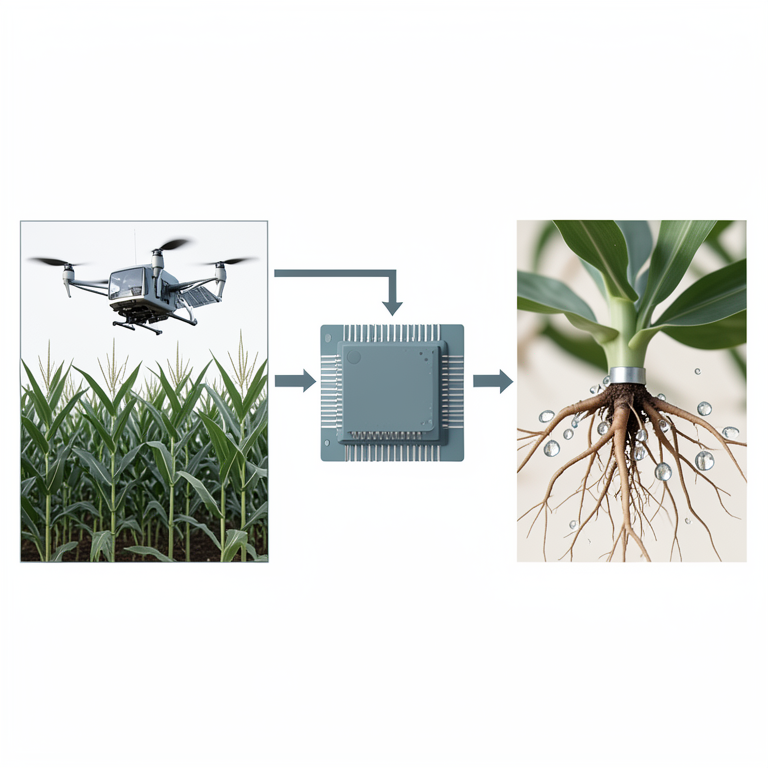
AI-Driven Irrigation Workflow
AI-generated conceptual illustration (maize plants in a field with drip irrigation emitters). It explains the idea and does not show study data.
View source evidence ↗Figures & tables
From the original paper Table 1
Introduction
Dryland agriculture faces water scarcity due to high evaporation and unpredictable precipitation, making water efficiency essential for long-term crop production. Microirrigation using drip and sprinkler systems has become an important water-saving tool. Plant roots receive specific amounts of water directly. In traditional irrigation methods, water is often not distributed efficiently and resources are wasted because of set schedules and monitoring that has to be done by hand. AI and remote sensing have made it possible for dryland farming solutions that are based on data. This has completely changed how irrigation is managed. Irrigation systems that are powered by AI use machine learning algorithms, IoT sensors, and predictive analytics to keep real-time track of the weather, crop water needs, and soil moisture. By making decisions automatically, these smart systems make sure that crops get the right amount of water at the right time and reduce water loss. UAV hyperspectral images, satellite images, and Geographic Information Systems (GIS) all help with precise irrigation by showing how water is spread out in the soil, how healthy plants are, and how quickly plants lose water through evaporation. With AI and remote sensing, you can always keep an eye on things and find ways to save water by changing how you water based on the weather. A new study says that AI and remote sensing can make micro-irrigation work better in dry and semi-dry areas. To save water and make crops last longer, (Wei et al., 2024) [17] weigh the pros and cons of AI-driven irrigation. (Wang et al., 2024) [10] talk about how machine learning and remote sensing can help farmers use data to decide when to water their crops, which makes precision agriculture better. AI can figure out how much water and energy sensor-based micro-irrigation systems should use, as shown by more research like that by (Mohammed et al., 2023) [13] .
International Journal of Biology Sciences https://www.biologyjournal.net
Even with these changes, there are still issues with how much it costs to implement, how accurate the data is, and how many farmers need to be taught. There is a lot of information in this review about how AI and remote sensing can be used to improve micro-irrigation for dryland farming.
In places that don't get a lot of water, smart irrigation systems make things grow better and last longer. This paper looks at what has already been written and talks about problems, trends, and possible new research.
Micro Irrigation in Dryland Agriculture
Micro-irrigation, which delivers water directly to plant roots, reduces evaporation and runoff. It excels in dryland farming (Vaijnath Kantiram Chavan et al., 2024) [19] , where unpredictable rainfall and water scarcity make crop production difficult. Micro-irrigation uses drip, subsurface, and sprinkler irrigation. Drip irrigation conserves water and maintains soil moisture (Ahmed et al., 2023) [1] . Through emitters, water is slowly released into the soil around plant roots. Pressurized nozzles in sprinkler irrigation cover larger areas and simulate rainfall (Patel et al., 2023) [14] . Subsurface irrigation uses buried tubing to deliver water directly to plant roots, reducing surface evaporation and increasing water efficiency (Alharbi et al., 2024) [2] . Many dry and semi-arid regions benefit from microirrigation. Evaporation and deep percolation losses are reduced, improving water-use efficiency and agricultural yields (Xing & Wang, 2024) [10] . Micro-irrigation saves soil fertility and promotes sustainable agriculture by reducing erosion and nutrient leaching. (Bwambale et al., 2022) [5] say these systems help farmers in water-scarce areas grow crops more precisely by channelling water to specific areas. Micro-irrigation systems have pros and cons. Some smallholder farmers cannot afford drip and subsurface irrigation due to their high installation costs (Gaznayee et al., 2023) [8] . Emitter blockage and system wear increase operational costs and complexity (Lakhiar et al., 2024) [10] .
Role of AI in Micro Irrigation Management
Micro-irrigation management is changing because artificial intelligence (AI) is making it easier to accurately distribute water. This is making things more efficient and cutting down on waste. The best use of water can be found through AI-driven scheduling and automation for irrigation that checks and analyses things like soil moisture, temperature, and weather forecasts all the time. Most irrigation systems have set times for when they should work (Mohammed et al., 2023) [13] but AI-based systems change when they water plants based on what they need. (Wei et al., 2024) [17] say that these smart systems use data from sensors and past weather records to figure out how much water dryland farms will need for irrigation. This helps farmers make better use of water. In order to make irrigation models, machine learning (ML) and predictive analytics look at very large datasets. This is an important part of taking care of water.
Based on data from sensors on the ground, remote sensing technologies, and satellite images, Xing and (Wang 2024) [10] say that ML algorithms can accurately guess how much water plants need. Farmer can use these models to make smart choices that will help them stay away from water stress and over-irrigation. (Ashoka et al., 2024) [3] say that decision support systems that are powered by AI can also suggest the best way to water crops based on their type, the texture of the soil, and the rate at which they lose water through evaporation and transpiration. (Tan et al., 2024) [15] say that these kinds of predictive analytics help make the best use of water and also help with sustainable farming by lowering the use of resources and increasing crop yields.
Intelligent sensors and the Internet of Things (IoT) make farming even more accurate. According to a study by (Yacoob et al., 2024) [20] , weather stations, drones, and sensors that measure soil moisture are used by irrigation networks built on the Internet of Things (IoT) to keep track of real-time field conditions. These sensors report data to cloud-based platforms. An algorithm using artificial intelligence would then look at it and set up automatic irrigation. According to (Wiang et al., 2024), smart irrigation controllers change how much water plants get based on the soil to keep them from getting too wet or too dry. Efficiency in water utilization, cost reduction, and improved sustainability in dryland agriculture are all achieved through the real-time monitoring capability of these systems (Mmbando, 2025) [12] . Multiple case studies have shown that micro irrigation based on AI works. According to (El-Gindy et al., 2024) [6] , AI-powered irrigation models have diminished the quantity of water used by as much as 30% in dry areas without affecting the production of crops. One study from 2024 by [15] says that high-resolution data from UAVs and drones with high-tech imaging sensors lets water resources be managed and studied in the field. It is very important to use multispectral and hyperspectral imaging to find out about crop water stress and soil moisture. (Sharma et al., 2024) [3] say that NIR and SWIR reflectance can be that farmers can make irrigation plans that are specific to their land, use water more efficiently, and take less damage to the environment. It is said by (Patel et al., 2024) that this type of integration works best in semi-arid and dry areas where water is scarce and crops need to be watered. Remote sensing is a good way to water dry land. A study by (Verma et al., 2023) found that mapping soil moisture with remote sensing made it easier to plan irrigation in Rajasthan, India. This used 25% less water and didn't hurt crop yields. UAVs have used hyperspectral imaging to keep an eye on vineyards in the Central Valley of California that are having trouble with water. This has helped find places that need watering and make the grapes better (Rodriguez et al., 2024) [17] . These examples show how remote sensing is making farming better for the environment and water-wise by making it easier to run irrigation systems. [3] . AI-driven decision support systems will integrate weather forecasts, crop growth models, and real-time field data to dynamically optimise water usage (Patel et al., 2023) [14] . Remote sensing technologies are also changing irrigation management. Hyperspectral imaging, UAV-based multispectral sensors, and high-resolution satellite imagery will improve soil moisture estimation and crop health monitoring (Li et al., 2024) [15] . In overcast weather, new synthetic aperture radar (SAR) systems will improve water content detection for 24/7 tracking. Remote sensing and IoT devices like soil moisture probes and climate sensors can improve irrigation (Wang & Chen, 2024) [10] . Even with these technological advances, agriculture needs policies and infrastructure for AI-driven irrigation and remote sensing. Governments and agricultural agencies should implement policies to make AI models more transparent, standardize sensor networks, and encourage data sharing, according to (Zhang al., 2024) [10] . Cloud computing, edge AI processing, and affordable smart irrigation systems are needed to support small and mediumscale farmers. Training and digital literacy programmes should help farmers use these cutting-edge technologies. (Xie et al., 2024) recommend developing affordable remote sensing solutions for smallholder farmers, integrating AI with blockchain for secure irrigation network data sharing, and studying hybrid AI models that combine physics-based hydrological models with machine learning. Filling these knowledge gaps will enable a more efficient and environmentally friendly irrigation system, saving water and increasing agricultural yields.
Comparative Analysis of Existing Studies
Comparative Analysis of Existing Studies
Conclusion
Irrigation management systems that use AI and remote sensing may make better use of water, better use of resources, and more sustainable farming. Smart irrigation systems that are powered by AI use sensor data in real time, automated scheduling, and predictive analytics to better distribute water. This makes less water waste and more crop yields. GIS integration, satellite imagery, and UAVs can help farmers figure out the best way to water their crops by showing them how much water is in the soil, how healthy the crops are, and how the weather changes. If AI and remote sensing are to be used in farming, farmers need open technology, standardized data, and money for R&D. The use of smart irrigation technology will grow faster if infrastructure investments are made in cloud computing and connecting things to the Internet of Things, and farmers are given financial incentives to do so. With AI models that are more accurate, researchers can lower the cost of remote sensing and come up with new ways to use older hydrological models with AI. AI and satellites can help farmers get more done with their land, save money on inputs, and improve irrigation. Small and medium-sized farmers need to get training and computer programs to learn how to use these high-tech tools. Government agencies, agricultural experts, and tech developers should work together to fill in the gaps in our knowledge and get more people to use new technologies. Last but not least, AI and remote sensing are making management of irrigation more effective and scalable, which is good for farming in the long term. Through research and smart investments, precision irrigation will get better. Even though it's not cheap, easy to get to, or backed by strong policy, this technology will save water and keep food safe in a climate that is changing.
Figures and tables from the paper
| Study | Technology Used | Methodology | Key Findings |
|---|---|---|---|
| (Zhang et al., 2023) | AI & Satellite Remote Sensing | AI-driven irrigation scheduling using satellite soil moisture data. | Improved irrigation efficiency in semi-arid regions. |
| (Gao et al., 2024) | Deep Learning & UAV Hyperspectral Imaging | AI model trained on hyperspectral images for crop water stress detection. | Early identification of drought stress, improving water-use efficiency. |
| (Wang & Chen 2024) [10] | GIS & Remote Sensing | GIS-based spatial analysis with remote sensing data for irrigation planning. | 30% reduction in water use while maintaining yields. |
Table text extracted from the original PDF; superscript letters are shown inline. The original table image is below.
View original table image
References
11 in the original paper- Ahmed Z, Gui D, Murtaza G, Yunfei L, Ali S. An overview of smart irrigation management for improving water productivity under climate change in drylands. Agronomy. 2023;13(8):2113.
- Alharbi S, Felemban A, Abdelrahim A, Al-Dakhil M. Agricultural and Technology-based strategies to improve water-use efficiency in Arid and Semiarid areas. Water. 2024;16(13):1842.
- Ashoka P, Devi BR, Sharma N, Behera M, Gautam A, Jha A, et al. Artificial Intelligence in Water Management for Sustainable Farming: A Review. Journal of Scientific Research and Reports. 2024;30(6):511-525.
- Mmbando GS. Harnessing artificial intelligence and remote sensing in climate-smart agriculture: the current strategies needed for enhancing global food security. Cogent Food & Agriculture. 2025;11(1):2454354.
- Mohammed M, Hamdoun H, Sagheer A. Toward sustainable farming: implementing artificial intelligence to predict optimum water and energy requirements for sensor-based micro irrigation systems powered by solar PV. Agronomy. 2023;13(4):1081.
- Tan J, Ding J, Wang Z, Han L, Wang X, Li Y, et al. Estimating soil salinity in mulched cotton fields using UAV-based hyperspectral remote sensing and a Seagull Optimization Algorithm-Enhanced Random Forest Model. Computers and Electronics in Agriculture. 2024;221:109017.
- Wang J, Wang Y, Li G, Qi Z. Integration of remote sensing and machine learning for precision agriculture: a comprehensive perspective on applications. Agronomy. 2024;14(9):1975.
- Wei H, Xu W, Kang B, Eisner R, Muleke A, Rodriguez D, et al. Irrigation with artificial intelligence: problems, premises, promises. Human-Centric Intelligent Systems. 2024;4(2):187-205.
- Xing Y, Wang X. Precision agriculture and water conservation strategies for sustainable crop production in arid regions. Plants. 2024;13(22):3184.
- Chavan VK, Patil PK. A study of agriculture land use efficiency of Dhule district: A geographical analysis. Int J Geogr Geol Environ 2024;6(1):170-173. DOI: 10.22271/27067483.2024.v6.i1c.217
- Yacoob A, Gokool S, Clulow A, Mahomed M, Mabhaudhi T. Leveraging Unmanned Aerial Vehicle Technologies to Facilitate Precision Water Management in Smallholder Farms: A Scoping Review and Bibliometric Analysis. Drones. 2024;8(9):476.
Cited by 2
From OpenAlex, OpenCitations and reference lists read by Scinovex
- Integrating IoT and communication technologies for smart and precision irrigation systems toward sustainable water management ↗
Suman Dutta, Subrata Gorain, Subhradip Roy -, Santanu Banerjee, Rameswar Prasad Sah · Discover Internet of Things · 2026
Global agriculture is under unprecedented strain, tasked with meeting rising food demand while confronting rapidly depleting freshwater resources. This crisis is intensified by climate change, with agriculture consuming 70–80% of global freshwater withdrawals, often inefficiently. In this context, precision irrigation (PI) has emerged as a critical strategy for enhancing water use efficiency. However, its potential is largely untapped due to…
❝ 2PDF - Edge AI for Climate-Aware ET 0 Forecasting and Autonomous Precision Irrigation: A Hardware-Software Co-Design for Autonomous Precision Irrigation ↗
Horatio Harley Koffivi HODOUTO, Abel Cherouat, Milohum Mikesokpo Dzagli, David Bassir · E3S Web of Conferences · 2026
Precision agriculture is hindered by its dependence on centralized cloud infrastructures, which prevents deployment of advanced deep learning (DL) in disconnected, resource‑constrained rural environments. We propose a globally transferable Edge AI framework capable of executing reference evapotranspiration (ET₀) forecasting directly on low‑power microcomputers. To overcome hardware limitations, we introduce a Distilled Noise‑Invariance training paradigm: offline Empirical Mode Decomposition and Wavelet…
❝ 0PDF