
Research article · 2025 · Full text
International Journal of Biology SciencesPlants of botanical curiosity found in North-Eastern region of India
Volume 7(4) · Pages 28–32 · DOI: 10.33545/26649926.2025.v7.i4a.323 ↗
Research areasEthnobotanical and Medicinal Plants StudiesBotanical Research and ChemistryEssential Oils and Antimicrobial Activity
Abstract
Author-writtenPlants of ‘Botanical Curiosity’ are those which astonish people from both botanical and other community with their unique modifications and adaptations. The world owns many such plants and North-East India is one of the significant regions in the list. The reason for the crumbled occurrence of such plants in certain regions of the world is the prevailing geographical, climatic and vegetation pattern of the area. These plants hold certain peculiarities compared to others which may be in terms of their habitat, mode of nutrition, morphology or unique functional role in the environment. Rare, Endemic and Endangered (RET) status of most of such plants is a major concern for their protection, maintenance, conservation and sustainable utilization. This article briefly enlists some plants (20 nos.) found in North-Eastern region of India along with their peculiarities, the family they belong to, abundance status and a reference picture for each of them. This review paper also provides an insight to the significance of these plants from different perspectives and need of effective conservation strategies.
Summary
Source-checkedPlain-language reading of the full paper, prepared with AI and checked against the text. Each point links to the authors' own words.
Why it matters
- Plants of 'Botanical Curiosity' are defined as species that astonish people due to their unique adaptations and modifications. View evidence ↗
- The occurrence of these unique plants in specific regions is driven by local vegetation patterns, climate, and geography. View evidence ↗
- North-East India is a critical region for biodiversity, containing over one-third of India's total flora and fauna. View evidence ↗
The question
- The primary goal of the study is to record botanically unique plants found in North-East India. View evidence ↗
- The authors aim to enumerate these plants, highlight their peculiarities for general readers, and discuss their conservation needs. View evidence ↗
What they did
- The study was conducted primarily as a desktop review supplemented by the authors' personal analysis. View evidence ↗
- The study area includes seven North-Eastern Indian states, excluding Sikkim due to a lack of available data. View evidence ↗
- Taxonomic names and family classifications were verified using the International Plant Names Index (IPNI) and Plants of the World Online (POWO). View evidence ↗
What they found
- The review identifies 20 plant species in North-East India characterized by botanical curiosities. View evidence ↗
- Aeginetia indica L. is identified as an extremely rare holoparasite and foot parasite on grass. View evidence ↗
- Nepenthes khasiana Hook.f. is an insectivorous plant that is both endemic and rare. View evidence ↗
- Amentotaxus assamica is an endangered gymnosperm used as a source for the chemotherapy drug 'Taxol'. View evidence ↗
- Paphiopedilum species are threatened or endangered orchids known for their long-lasting, slipper-shaped flowers. View evidence ↗
- Crytosia falconeri is noted as the tallest saprophytic orchid and is extremely rare. View evidence ↗
What it means
- The authors conclude that cataloging and popularizing these plants can promote botanical tourism and facilitate their conservation and sustainable use. View evidence ↗
- The authors recommend participatory forest management involving local communities as a sustainable conservation strategy. View evidence ↗
- The authors state that the floristic diversity of the North-Eastern region has not yet been fully explored. View evidence ↗
Visual summary
1 visualsIllustrations explain the paper; they do not show study data.
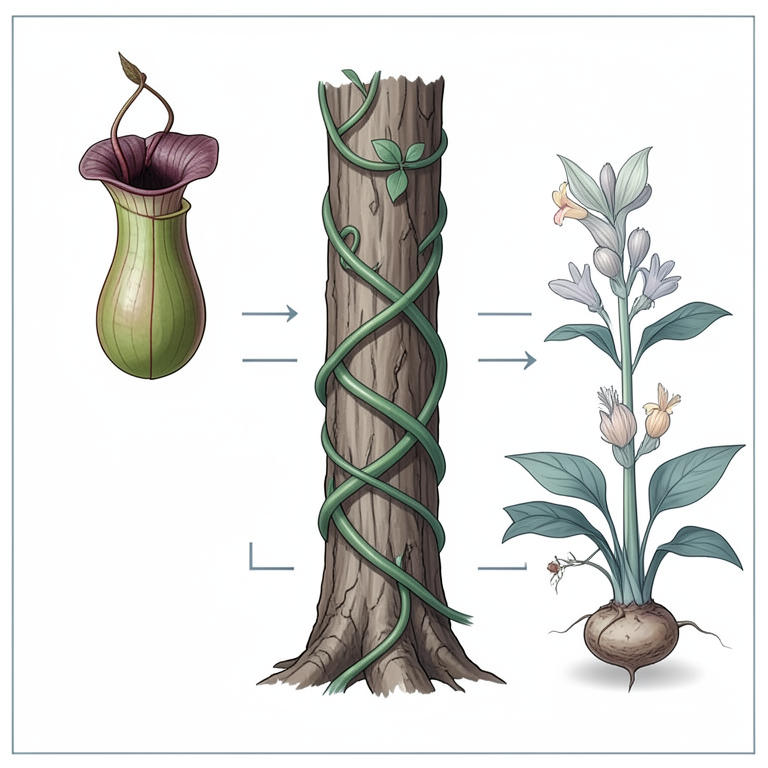
Concept of Botanical Curiosity
AI-generated conceptual illustration (Diverse tropical plants of North-East India, including pitcher plants and parasitic vines). It explains the idea and does not show study data.
View source evidence ↗Figures & tables
From the original paper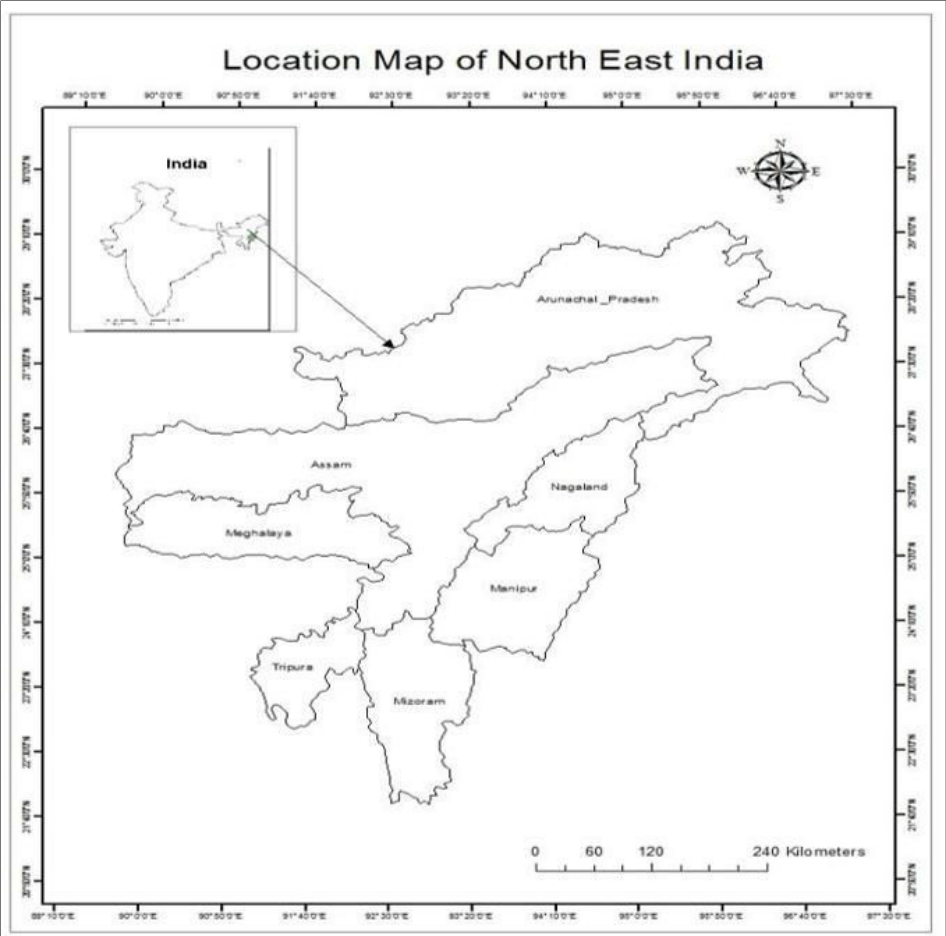 Figure 1
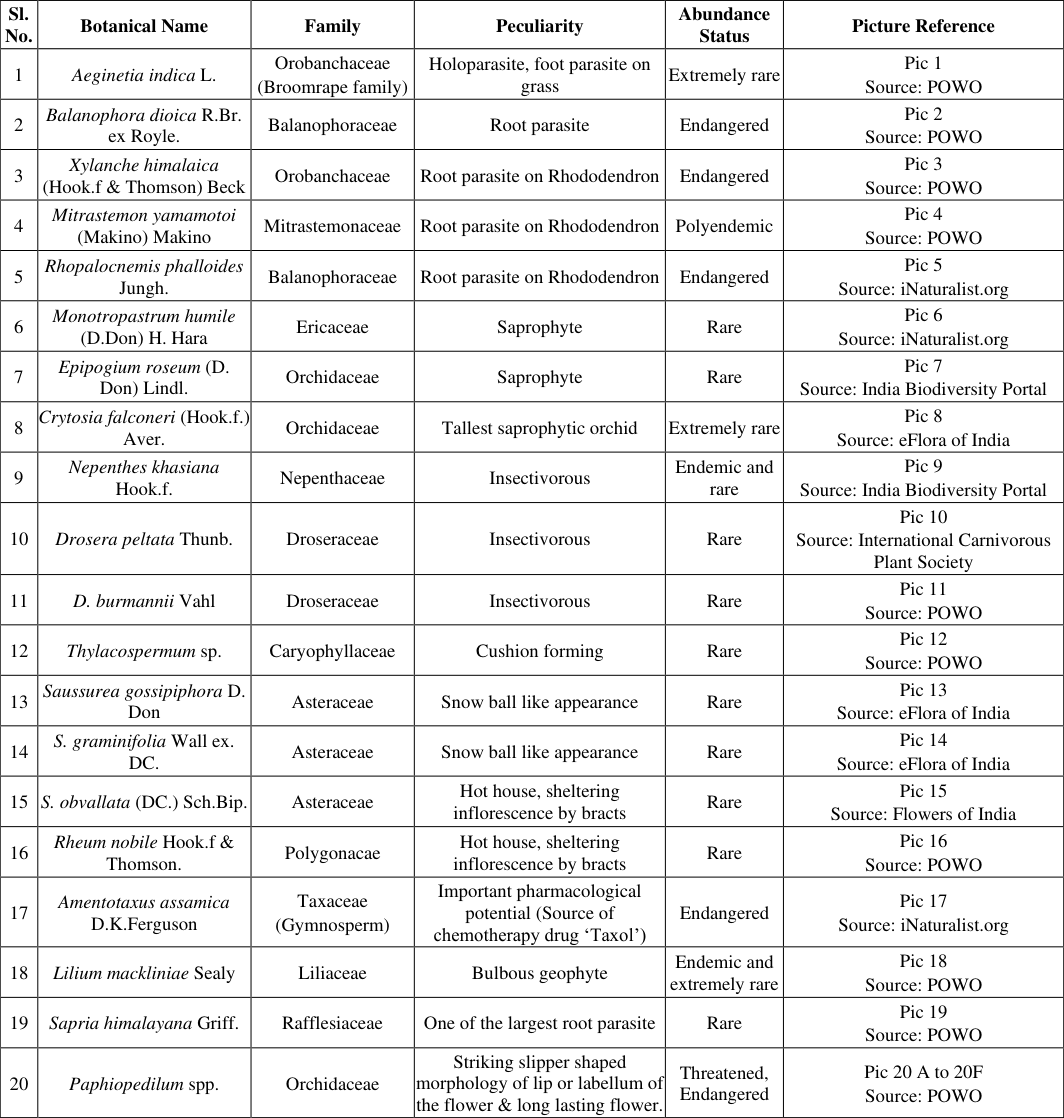 Table 1
 Table 2
Introduction
Introduction
What is Botanical Curiosity?
The plants have always been a source of astonishment for many reasons. Being the primary source of productivity, they not only provide energy (in the form of food) to the organisms of other trophic levels, but also uniquely showcase the wonders of nature in many ways. Therefore, several plant species are considered as "Botanical Curiosity" because of their special modifications (both structural and functional) and adaptations (to environment and enemy) [4] . Such characteristics occur to certain plants for different reasons like vegetation type, climate patterns, genetic criteria, ecological adaptability etc. However, at the end they become one of a kind species on earth.
The reason of significant availability of such plants in North-Eastern Region of India:
Out of the 36 biodiversity hotspots in the world, India has four hotspot areas. Again, the North-Eastern part of India is one of the richest in biological values with more than one-third of the country's total biodiversity (both flora and fauna) [1,2,3] . In terms of floristic diversity (flora only), the region is the richest one in India [1,2] . Takhtajan (1969) considered North-East India region as the "Cradle of flowering plants" as nearly half of the total flowering plants of India were recorded from this region [5] . In fact, it is the geographical "gateway" to much of India's flora as it is the transition zone between the Indian, Indo-Malayan and Indo-Chinese bio-geographic regions and also a meeting place of Himalayan mountains with that of Peninsular India [Rao, 1994]. Along with other geographical benefits on its side, the highly humid tropical climate is the remarkable force for the wealthy and diverse flora in the region. The unique bio-geographical position thus provides a profusion of habitats for featuring diverse floristic composition with a high level of endemism. [1] . It also results in the presence of numerous plants with botanical curiosities and botanical rarities [1,2,3] . Mentionable that, many of such plants are also categorized in the threatened, endangered category of IUCN. Most of these are endemic too [4] .
Aim and Objective
The primary aim of this review paper is to specifically record the botanically unique plants of North-East India. At the same time, the paper is written with the objective of i) enumerating the plants in distinct manner; ii) to highlight different peculiarities of plants to the eye of common readers and iii) to reflect light upon the conservation status and need for such plants.
Materials and Methods
The major portion of this paper is desktop reviewed along with the authors' personal inputs in terms of required analysis. Though North-East India politically consists of 8 states viz., Arunachal Pradesh, Assam, Meghalaya, Mizoram, Nagaland, Manipur, Tripura and Sikkim; but in this paper, the other 7 states being considered as the study area excluding the state of Sikkim due to lack of proper data (Picture Map 1). For the updated names of plants and their families, the online taxonomic websites viz., Plants of the World Online (POWO), International Plant Names Index (IPNI) were cited. For easy reference, pictures are attached for each species from available and trustworthy websites.
The plants of Botanical Curiosity
Handique in 2000 has enumerated 16 plants of botanical curiosities from N-E India with peculiarities and their status of abundance [4] . This article is however an extension of that enumerated list with 20 such plant species incorporating the plants with updated names, their families and a picture for reference [
Conclusion and significance of the study
The flora of a country is one of the major economic assets.
In case of India as a developing country, plant resources have enormous economic potential along with other aspects.
For that matter, North-Eastern region is the primary centre of attention. While, covering 7.98% of the nation's land Apparently, all the mixed types of flora are equally important. However, as per the plants of botanical curiosity is concerned, these plants are not only significant to the botanical community but also for different stakeholders of the country. Inventorization and popularization of such plants could be a purpose of botanical tourism. At the same time, it will also lead to their effective protection, maintenance, conservation and sustainable utilization [4] .
Major chunk of the north-eastern population depends on the utilization of plant resources, thus it is important to make sure that plants of botanical curiosity are not pushed into extinction because most of these are endangered and endemic. The irreplaceable nature of endemism again signifies the uniqueness of such flora. Thus, these plants could also be the flagship species for different environmental programmes. With respect to conservation aspect, participatory forest management practices indulging the local communities are definitively a sustainable approach.
Despite the fact that NE Region has a huge pool of floristic diversity, it is not fully explored till date. Characterization and estimation of these floras into fuller extent is need of the hour and for that a well-designed collaboration among concerned stakeholders is must. Here, only planned strategies would play the key role. Needless to say that, due to strategic location of these North-Eastern states in India: the largest democratic country; positive approach from governance structures is instrumental in bringing out the desired result.
Figures and tables from the paper
| Sl. No. | Botanical Name | Family | Peculiarity | Abundance Status | Picture Reference |
|---|---|---|---|---|---|
| 1 | Aeginetia indica L. | Orobanchaceae (Broomrape family) | Holoparasite, foot parasite on grass | Extremely rare | Pic 1 Source: POWO |
| 2 | Balanophora dioica R.Br. ex Royle. | Balanophoraceae | Root parasite | Endangered | Pic 2 Source: POWO |
| 3 | Xylanche himalaica (Hook.f & Thomson) Beck | Orobanchaceae | Root parasite on Rhododendron | Endangered | Pic 3 Source: POWO |
| 4 | Mitrastemon yamamotoi (Makino) Makino | Mitrastemonaceae | Root parasite on Rhododendron | Polyendemic | Pic 4 Source: POWO |
| 5 | Rhopalocnemis phalloides Jungh. | Balanophoraceae | Root parasite on Rhododendron | Endangered | Pic 5 Source: iNaturalist.org |
| 6 | Monotropastrum humile (D.Don) H. Hara | Ericaceae | Saprophyte | Rare | Pic 6 Source: iNaturalist.org |
| 7 | Epipogium roseum (D. Don) Lindl. | Orchidaceae | Saprophyte | Rare | Pic 7 Source: India Biodiversity Portal |
| 8 | Crytosia falconeri (Hook.f.) Aver. | Orchidaceae | Tallest saprophytic orchid | Extremely rare | Pic 8 Source: eFlora of India |
| 9 | Nepenthes khasiana Hook.f. | Nepenthaceae | Insectivorous | Endemic and rare | Pic 9 Source: India Biodiversity Portal |
| 10 | Drosera peltata Thunb. | Droseraceae | Insectivorous | Rare | Pic 10 Source: International Carnivorous Plant Society |
| 11 | D. burmannii Vahl | Droseraceae | Insectivorous | Rare | Pic 11 Source: POWO |
| 12 | Thylacospermum sp. | Caryophyllaceae | Cushion forming | Rare | Pic 12 Source: POWO |
| 13 | Saussurea gossipiphora D. Don | Asteraceae | Snow ball like appearance | Rare | Pic 13 Source: eFlora of India |
| 14 | S. graminifolia Wall ex. DC. | Asteraceae | Snow ball like appearance | Rare | Pic 14 Source: eFlora of India |
| 15 | S. obvallata (DC.) Sch.Bip. | Asteraceae | Hot house, sheltering inflorescence by bracts | Rare | Pic 15 Source: Flowers of India |
| 16 | Rheum nobile Hook.f & Thomson. | Polygonacae | Hot house, sheltering inflorescence by bracts | Rare | Pic 16 Source: POWO |
| 17 | Amentotaxus assamica D.K.Ferguson | Taxaceae (Gymnosperm) | Important pharmacological potential (Source of chemotherapy drug ‘Taxol’) | Endangered | Pic 17 Source: iNaturalist.org |
| 18 | Lilium mackliniae Sealy | Liliaceae | Bulbous geophyte | Endemic and extremely rare | Pic 18 Source: POWO |
| 19 | Sapria himalayana Griff. | Rafflesiaceae | One of the largest root parasite | Rare | Pic 19 Source: POWO |
| 20 | Paphiopedilum spp. | Orchidaceae | Striking slipper shaped morphology of lip or labellum of the flower & long lasting flower. | Threatened, Endangered | Pic 20 A to 20F Source: POWO |
Table text extracted from the original PDF; superscript letters are shown inline. The original table image is below.
View original table image
| Sl. No. | Botanical Name | Native state | Picture Reference |
|---|---|---|---|
| 1 | Paphiopedilum fairrieanum (Lindl.) Stein | Arunachal Pradesh | Pic: 20 A |
| 2 | P. insigne (Wall. Ex Lindl.) Pfitzer | Meghalaya | Pic: 20 B |
| 3 | P. villosum (Lindl.) Stein | Mizoram | Pic: 20 C |
| 4 | P. spicerianum (Rchb.f.) Pfitzer | Assam | Pic: 20 D |
| 5 | P. hirsutissimum (Lindl. Ex. Hook.) Stein | Meghalaya, Mizoram, Nagaland | Pic: 20 E |
| 6 | P. venustum (Wall. Ex Sims.) Pfitzer | Meghalaya | Pic: 20 F |
Table text extracted from the original PDF; superscript letters are shown inline. The original table image is below.
View original table image
References
2 in the original paper- Chakravarty S, Suresh CP, Puri A, Shukla G. Northeast India, the geographical gateway of India's phytodiversity. Indian Forester. 2012;138(8):702.
- Handlique PJ. Biodiversity in North East India: Vegetation and Plant Species Diversity. Journal of the Asssam Science Society. 2000;41(4):336-351.