
Research article · 2025 · Full text
International Journal of Biology SciencesIntegrated fish fauna farming system in north Bihar: Focus on Kosi region
Volume 7(4) · Pages 01–04 · DOI: 10.33545/26649926.2025.v7.i4a.319 ↗
Research areasFish Biology and Ecology StudiesFisheries and Aquaculture StudiesAgricultural Economics and Practices
Abstract
Author-writtenThe Kosi region of North Bihar, with its fertile floodplains, abundant water bodies, and tropical monsoon climate, offers immense potential for integrated fish farming. This sustainable approach combines fish culture with agriculture, horticulture, and livestock rearing to enhance productivity, resource efficiency, and rural income. The study explores ichthyofaunal diversity and the scope of integrated fish farming in the Kosi region, highlighting systems such as fish-cum-paddy, poultry, duck, pig, horticulture, and makhana cultivation. Survey findings reveal that 65% of farmers practice integrated methods, with Rohu, Catla, Grass Carp, and Makhana-fish mixes as dominant species. Despite flood-related challenges affecting 70% of farmers, integrated systems provide natural pest control, improved nutrient recycling, and dual-income opportunities. The paper emphasizes the need for technical support and policy incentives to address challenges and scale sustainable aquaculture. Integrated fish farming in this region demonstrates a viable model for ecological balance, food security, and socioeconomic development in flood-prone areas.
Summary
Source-checkedPlain-language reading of the full paper, prepared with AI and checked against the text. Each point links to the authors' own words.
Why it matters
- The Kosi region in North Bihar is highly suitable for integrated fish farming due to its tropical monsoon climate, abundant water bodies, and fertile floodplains. View evidence ↗
- Integrated fish farming is a sustainable method that increases rural income and resource efficiency by combining fish culture with livestock, horticulture, and agriculture. View evidence ↗
- Human pressure over recent decades has degraded riverine ecosystems, resulting in the loss of fish habitats. View evidence ↗
The question
- The study aims to explore the scope of integrated fish farming and ichthyofaunal diversity in the Kosi region, specifically looking at systems involving poultry, pigs, ducks, paddy, horticulture, and makhana. View evidence ↗
What they did
- The researchers conducted a survey of farmers in the region to determine the prevalence of integrated farming practices. View evidence ↗
- The surveyed farms had an average size of 1.5 hectares. View evidence ↗
What they found
- Approximately 65% of the surveyed farmers utilize integrated farming methods. View evidence ↗
- The dominant fish species cultured in the region include Catla, Rohu, Grass Carp, and mixes involving Makhana. View evidence ↗
- Farmers earn an average annual income of ₹2.5 lakhs from fish farming. View evidence ↗
- Flooding is a significant challenge, with 70% of farmers reporting flood-related losses. View evidence ↗
- Only 45% of the farmers have benefited from government schemes. View evidence ↗
- There is high interest in modernization, with 80% of farmers willing to adopt new techniques. View evidence ↗
- In fish-cum-paddy systems, fish provide ecological benefits by aerating the soil and controlling weeds and pests. View evidence ↗
- Fish-cum-poultry systems utilize poultry droppings to stimulate plankton growth, which acts as a natural feed for the fish. View evidence ↗
- The study found that the Cypriniformes order, including the Cyprinidae, Balitoridae, and Cobitidae families, was the primary fish order in the Kosi River tributaries. View evidence ↗
What it means
- The authors conclude that the Kosi region can become a major integrated fish farming hub if stakeholders provide technical support, financial aid, and better market access. View evidence ↗
- The study identifies infrastructure deficiencies, specifically poor storage and transportation facilities, as a major challenge. View evidence ↗
Visual summary
2 visualsIllustrations explain the paper; charts are replotted from the paper's own table values.
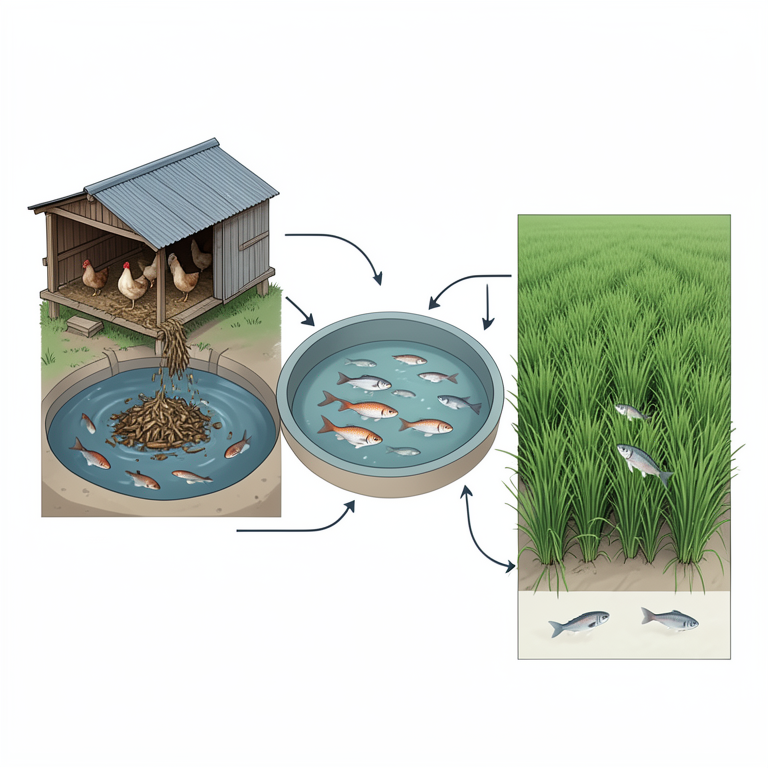
Integrated Farming Cycle
AI-generated conceptual illustration (Integrated fish, poultry, and paddy farming system). It explains the idea and does not show study data.
View source evidence ↗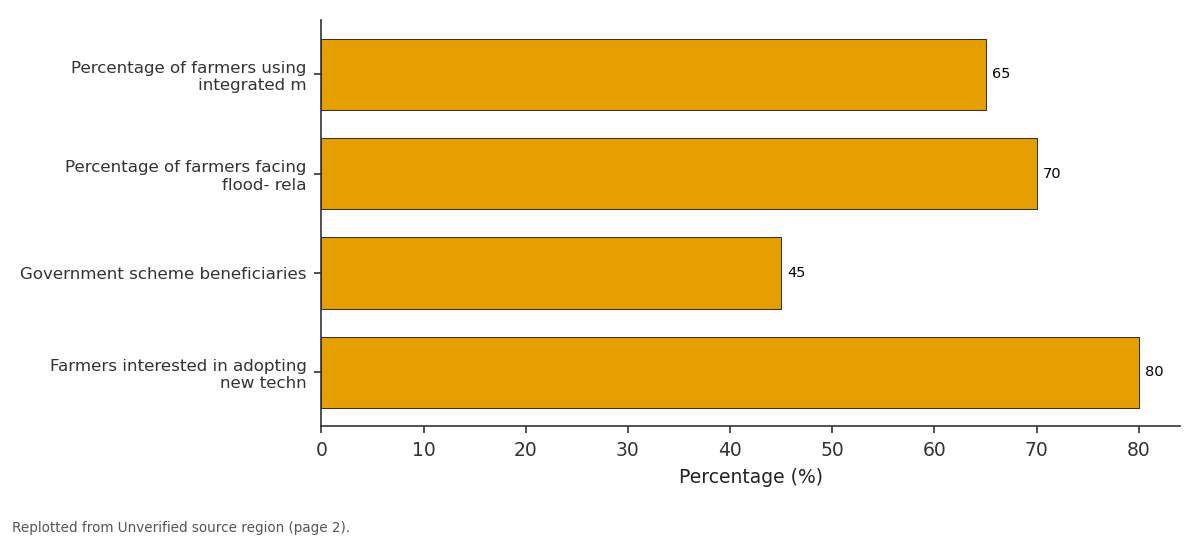
Survey Findings / 1.5 hectares: Percentage of farmers... vs Percentage of farmers... vs Government scheme... vs Farmers interested in...
Replotted from a table (page 2) of the original paper. Every bar is the paper's own table value.
View source evidence ↗Figures & tables
From the original paper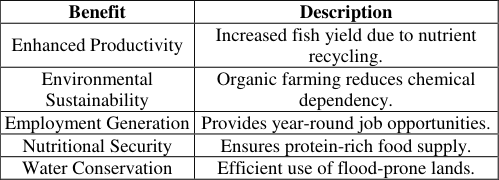 Table 1
Introduction
With their vast diversity in shape, habitat, and biology, fish species are an essential component of the aquatic environment. The diversity of fish species and their abundance is referred to as ichthyofaunal diversity. There are currently 28,500 known species of fish. Among these, 2200 fish species are known to exist in India's various aquatic ecosystems. Riverine ecosystems have been under tremendous human strain for the past few decades, which has led to their degradation and the loss of fish habitat. Many fish species are now seriously endangered as a result. The variety of fish species in rivers and Temperature, size and surface area, yearly discharge, depth, flow velocity, topography, substrate type, and climate are some of the biological factors that interact to determine tributary. Fish are a vital component of the aquatic food chain, energy flow, nutrient cycling, and ecological services in addition to being a significant edible food source for humans. Because of its large floodplains, rich alluvial soil, and profusion of water bodies, the Kosi region of North Bihar is a perfect place for integrated fish fauna farming. To optimize resource use and productivity, integrated fish farming is a sustainable method that blends fish culture with horticulture, livestock, and agriculture. The Kosi region's marshy conditions and frequent flooding present both potential and difficulties for fish farming. The scope, practices, advantages, difficulties, and potential of the integrated fish fauna farming system in the Kosi area in North Bihar are examined in this paper.
Geographical and Climatic Conditions of Kosi Region
Originating in Nepal, the Kosi River, sometimes known as the "Sorrow of Bihar," flows across North Bihar, impacting districts like Supaul, Saharsa, Madhepura, Araria, and Purnia. The area encounters: • Seasonal flooding, which creates natural water reservoirs suitable for aquaculture.
• High soil fertility, beneficial for integrated fish-agriculture systems.
• Tropical monsoon climate, with high humidity and abundant rainfall supporting fish farming.
Parameter
Survey Findings Average farm size 1.5 hectares Percentage of farmers using integrated methods 65%
Major fish species cultured Rohu, Catla, Grass Carp, Makhana-fish mix Average annual income from fish farming ₹2.5 lakhs per farmer Percentage of farmers facing floodrelated losses 70%
Government scheme beneficiaries 45% Farmers interested in adopting new techniques 80%
Concept of Integrated Fish Farming
In order to establish a self-sustaining environment, integrated fish farming entails raising fish alongside crops, cattle, or other aquatic species. The main elements consist of:
1. Fish-cum-Paddy Farming 2. Fish-cum-Poultry Farming 3. Fish-cum-Duck Farming 4. Fish-cum-Pig Farming 5. Fish-cum-Horticulture Farming 6. Fish-cum-Makhana Cultivation (specific to Bihar)
Types of Integrated Fish Farming Systems in Kosi
Region: Fish-cum-Paddy Farming • Practiced in flood-prone areas where rice fields remain submerged for long periods. • Fish control pests and weeds in paddy fields while enhancing soil aeration.
Advantages
• Increased rice yield and additional fish production.
• Natural pest and weed control reduce pesticide use.
• Additional income source for farmers.
Fish-cum-Poultry Farming
• Poultry sheds are constructed over fish ponds, allowing manure to fertilize pond water. • Poultry droppings enhance plankton growth, serving as natural fish feed.
Advantages
• Dual-income from fish and poultry products.
• Improved nutrient recycling.
Fish-cum-Duck Farming
• Ducks are raised on fish ponds, and their droppings act as organic manure. • Ducks aerate the water while feeding on insects and weeds.
Advantages
• No additional feed cost for fish.
• Sustainable, eco-friendly fish farming method.
• Income from duck eggs and meat.
Fish-cum-Pig Farming
• Pig pens are located near ponds, allowing pig manure to enrich pond nutrients.
• Common in areas where pig farming is culturally accepted.
Advantages
• Organic manure enhances fish growth.
• Lowers cost of fish feed.
• Dual-income source from fish and pigs.
Fish-cum-Horticulture Farming
• Pond embankments are used for growing banana, papaya, vegetables, and medicinal plants. • Pond water is utilized for irrigation, reducing the need for chemical fertilizers.
Advantages
• Efficient use of pond surroundings.
• Diversified agricultural income.
• Soil fertility is improved.
Fish-cum-Makhana Cultivation (Specific to North Bihar)
• Makhana (fox nut) is traditionally cultivated in ponds and water bodies in the Kosi region. • Fish farming is integrated with makhana cultivation to enhance productivity.
Advantages
• Sustainable use of water resources.
• Additional income from fish and makhana production.
• Enhances rural employment.
Challenges in Integrated Fish Farming in the Kosi Region Frequent Flooding
• Disrupts fish farming activities.
• Requires flood-resistant pond designs.
Lack of Technical Knowledge
Farmers need training in modern integrated fish farming techniques.
Infrastructure Deficiency
Poor transportation and storage facilities for fish.
Fish Disease Management
High risk of disease outbreaks due to organic waste accumulation.
Market Challenges
Lack of direct market linkages for fish and associated products.
Government Support and Initiatives
• The Bihar government, along with central agencies, has launched several schemes to support fish farming in the Kosi region: • Pradhan Mantri Matsya Sampada Yojana (PMMSY):
This program provides funding for aquaculture facilities.
• Blue Revolution Scheme: Encourages environmentally friendly methods of fish aquaculture. • Initiatives of the State Fisheries Department: distribution of fish seeds, subsidies, and technical training. • One organization that supports integrated fish farming methods is the National Fisheries Development Board (NFDB).
Graph: Fish Production Trends in North Bihar
Graph: Fish Production Trends in North Bihar
Future Prospects and Recommendations
• Flood-Resistant Aquaculture Systems Promotion of cage culture and deep-water fish farming techniques.
• Training and Skill Development
Establishing fish farming training centers in floodprone districts.
• Infrastructure Development
Improving cold storage, transportation, and processing facilities.
• Research and Innovation
Developing disease-resistant fish species for better survival in flood-prone areas.
• Public-Private Partnerships
Encouraging private investment in fish farming infrastructure.
Conclusion
The results of this study showed that a large variety of native species that sustain commercial fisheries can be found in the tributaries of the Kosi River in the Mahepura region of North Bihar. fishing in this area. The main order was Cypriniformes, which includes the Cobitidae, Balitoridae, and Cyprinidae families. Fish diversity was also positively influenced by the orders Siluriformes and Perciformes. The Kosi River's tributaries are the primary source of revenue and livelihood for fishermen and rural residents, but they are also the most severely affected by environmental deterioration. Since fish diversity and availability have decreased more quickly in recent decades, local fisheries must be managed to achieve high productivity.
Because of its abundant water supplies and lush floodplains, the Kosi region of North Bihar offers enormous potential for integrated fish fauna farming. Integrated fish farming provides a viable and lucrative source of income despite obstacles such seasonal flooding and a lack of infrastructure. The government and stakeholders can make the Kosi region a major hub for integrated fish farming, guaranteeing both environmental sustainability and economic development, by putting modern aquaculture methods into place, expanding market access, and offering financial and technical support.
Figures and tables from the paper
| Benefit | Description |
|---|---|
| Enhanced Productivity | Increased fish yield due to nutrient recycling. |
| Environmental Sustainability | Organic farming reduces chemical dependency. |
| Employment Generation | Provides year-round job opportunities. |
| Nutritional Security | Ensures protein-rich food supply. |
| Water Conservation | Efficient use of flood-prone lands. |
Table text extracted from the original PDF; superscript letters are shown inline. The original table image is below.
View original table image
References
8 in the original paper- Nelson JS. Fishes of the World. 4th ed. New York: John Wiley & Sons; 1994. p. 600. International Journal of Biology Sciences https://www.biologyjournal.net
- Harris JH. The use of fish in ecological assessments. Aust J Ecol. 1995;20:65-80.
- Sarkar UK, Pathak AK, Lakra WS. Conservation of freshwater fish resources of India: New approaches, assessment and challenges. Biodivers Conserv. 2008;17:2495-2511.
- Gurumayum SD, Kosygin L, Tamang L. Ichthyofaunal diversity of Arunachal Pradesh, India: A part of Himalaya biodiversity hotspot. Int J Fish Aquat Stud. 2016;4(2):337-346.
- Vishwakarma KS, Vyas V. Diversity and composition of freshwater fishes of Dudhi River: A tributary of River Narmada, Central India. Int J Zool Stud. 2017;2(6):110-115.
- Abujam SK, Kumar R, Darshan A, Gogoi B, Das DN. Enumeration of fish and alimentation of fisherman at Tezu River in Lohit district of Arunachal Pradesh, India. J Fish Sci. 2017;11(3):55-63.
- Mali JD, Chutia P, Biswas SP. Fish diversity and habitat ecology of Jia Bhorelli River: A major tributary of River Brahmaputra. Int J Zool Stud. 2017;2(5):229233.
- Chandran R, Itagi LK, Jaiswar AK, Raizada S, Mandal S, Mayekar TS, et al. Diversity and distribution of fish fauna in the Ib River, a tributary of Mahanadi, India. Indian J Fish. 2019;66(1):92-98.