
Research article · 2025 · Full text
International Journal of Agriculture and Food SciencePerception of farmers on attributes of zero budget natural farming
Volume 7(3) · Pages 145–150 · DOI: 10.33545/2664844x.2025.v7.i3b.326 ↗
Research areasAgricultural Economics and Practices
Abstract
Author-writtenIn India, a country deeply rooted in agricultural traditions, the emergence of Zero Budget Natural Farming (ZBNF) has marked a significant shift in the way farmers cultivate their crops. ZBNF is a revolutionary agricultural technique that emphasizes minimal external inputs, zero chemical pesticides, and a strong focus on natural and sustainable farming practices. This approach has gained immense popularity in India and is gradually transforming the agricultural landscape of the country. In the study, perceived attributes of ZBNF were studied in terms of relative advantage, compatibility, complexity, trialability, observability and predictability. The study was conducted in YSR Kadapa district of Andhra Pradesh and Wardha district of Maharashtra purposively. Majority of farmers in Andhra Pradesh (61.25%) and Maharashtra (58.75%) had high level of perception. Majority of the farmers had high level of perception in terms of relative advantage, compatibility, complexity, trialability, observability and predictability in both the states for ZBNF practices.
Summary
Source-checkedPlain-language reading of the full paper, prepared with AI and checked against the text. Each point links to the authors' own words.
Why it matters
- Agriculture is a critical pillar of the Indian economy, providing employment for approximately 58% of the population. View evidence ↗
- The Indian agricultural sector is currently struggling with soil degradation, falling productivity, high debt, and an over-reliance on chemical inputs. View evidence ↗
- Zero Budget Natural Farming (ZBNF) is proposed as a sustainable alternative that eliminates chemicals and minimizes external inputs to restore ecological balance. View evidence ↗
The question
- The study aims to evaluate the awareness, experiences, and perceptions of farmers in Andhra Pradesh and Maharashtra regarding the economic and environmental benefits and barriers of ZBNF. View evidence ↗
What they did
- The research was purposively conducted in the Wardha district of Maharashtra and the YSR Kadapa district of Andhra Pradesh. View evidence ↗
- A total of 240 farmers were randomly selected, consisting of 80 ZBNF practitioners and 40 non-ZBNF farmers from each of the two states. View evidence ↗
- Farmer perceptions were measured using a three-point scale: Agreed (3), Partially Agreed (2), and Disagreed (1). View evidence ↗
What they found
- In Andhra Pradesh, 61.25% of ZBNF farmers had a 'high' level of perception regarding ZBNF attributes, while 52.50% of non-ZBNF farmers had a 'positive' perception. View evidence ↗
- In Maharashtra, the majority of both ZBNF farmers (58.75%) and non-ZBNF farmers (57.50%) reported a positive perception of ZBNF attributes. View evidence ↗
- Regarding relative advantage in Andhra Pradesh, 85.00% of ZBNF farmers and 75.00% of non-ZBNF farmers agreed that ZBNF reduces production costs. View evidence ↗
- In Andhra Pradesh, 91.25% of ZBNF farmers and 80.00% of non-ZBNF farmers strongly agreed that ZBNF lowers cultivation costs by eliminating off-farm resources. View evidence ↗
- In Maharashtra, 61.25% of non-ZBNF farmers strongly agreed and 57.50% of ZBNF farmers partially agreed that yields are initially low but increase gradually, stabilizing after three years. View evidence ↗
- In Maharashtra, 80.00% of ZBNF farmers and 70.00% of non-ZBNF farmers strongly agreed that ZBNF improves drought tolerance by increasing soil moisture holding capacity. View evidence ↗
- In Andhra Pradesh, 92.50% of ZBNF farmers and 70.00% of non-ZBNF farmers agreed that ZBNF promotes soil aeration. View evidence ↗
What it means
- The authors conclude that farmers in both states generally perceive ZBNF positively, though those already practicing ZBNF show higher acceptance levels. View evidence ↗
- The authors identify high labor demand and inadequate market linkages as primary challenges to the scalability of ZBNF. View evidence ↗
Visual summary
3 visualsIllustrations explain the paper; charts are replotted from the paper's own table values.
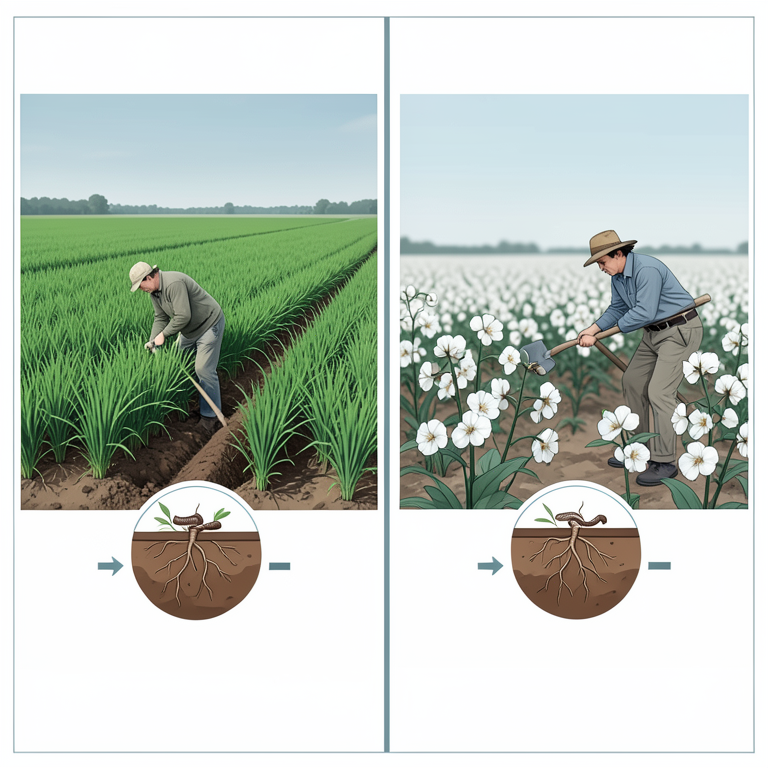
Comparison of ZBNF Perception by State
AI-generated conceptual illustration (Indian farmers in rice and cotton fields). It explains the idea and does not show study data.
View source evidence ↗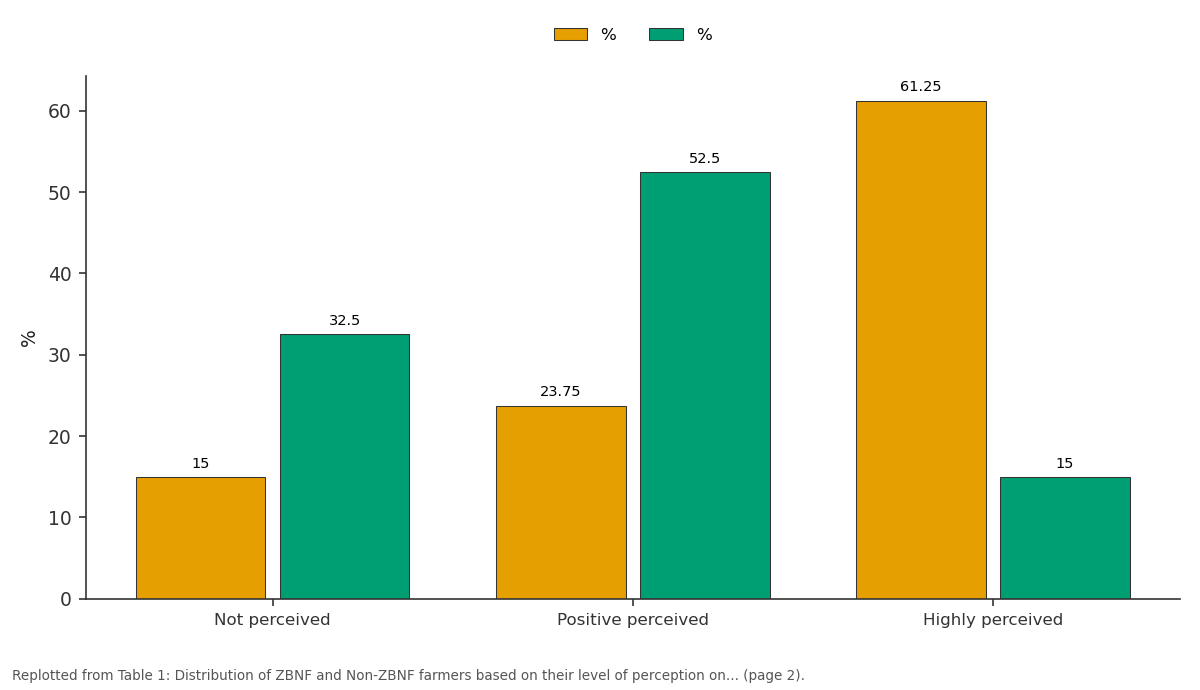
% and %: Not perceived vs Positive perceived vs Highly perceived
Replotted from Table 1 (page 2) of the original paper. Every bar is the paper's own table value.
View source evidence ↗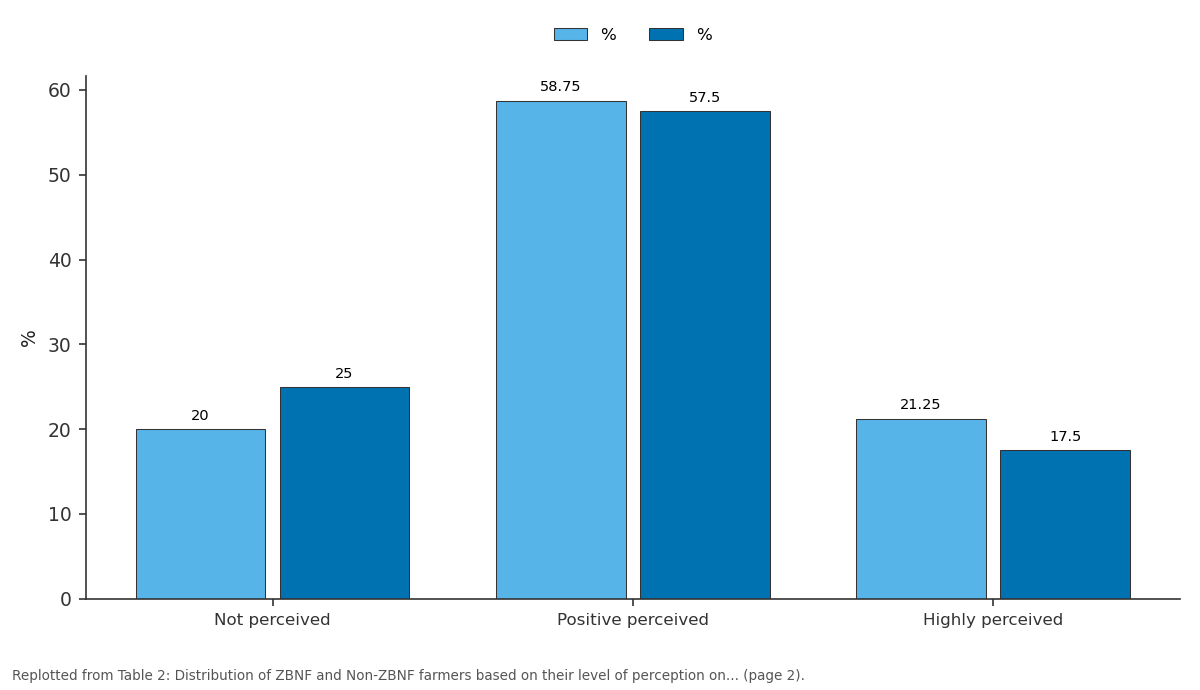
% and %: Not perceived vs Positive perceived vs Highly perceived
Replotted from Table 2 (page 2) of the original paper. Every bar is the paper's own table value.
View source evidence ↗Figures & tables
From the original paper Table 1
 Table 2
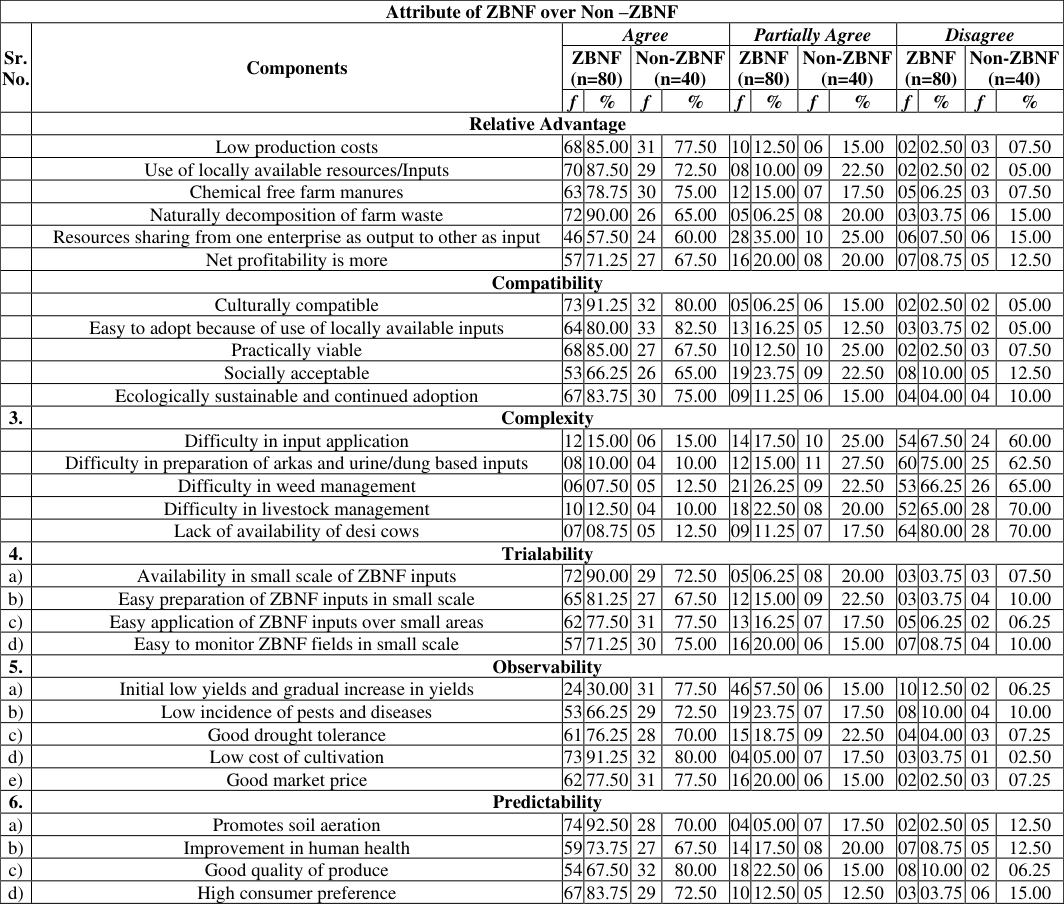 Table 3
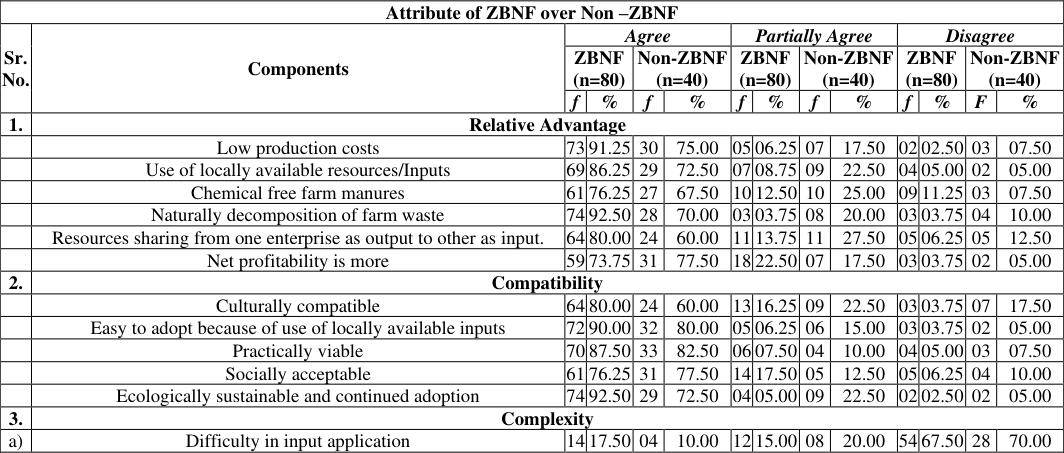 Table 4
Introduction
Agriculture remains the backbone of the Indian economy, employing nearly 58% of the population and contributing significantly to the nation's GDP (Sharma, 2023) [4] . However, the sector faces numerous challenges, including soil degradation, declining productivity, increased dependence on chemical inputs, and rising debt among farmers. Conventional farming, which relies heavily on synthetic fertilizers, pesticides, and high-input costs, has exacerbated these issues, prompting the need for sustainable agricultural alternatives. One such alternative gaining traction in India is Zero Budget Natural Farming (ZBNF), a chemical-free farming system that minimizes external inputs and promotes ecological balance (Palekar, 2006) [12] . This research explores farmers' perceptions regarding the attributes of ZBNF in the states of Andhra Pradesh and Maharashtra, where this model has witnessed notable adoption and institutional support. Zero Budget Natural Farming system is based on four core principles: Jeevamrut (microbial culture), Bijamrut (seed treatment), Acchadana (mulching), and Waaphasa (moisture retention) (Palekar, 2006) [12] . These techniques aim to enhance soil fertility, reduce dependence on external inputs, and increase farm resilience to climate variability (Khadse et al., 2018) [6] . Unlike conventional farming, ZBNF encourages the use of locally available materials, thereby significantly reducing production costs and financial risks associated with agriculture (Pretty et al., 2014) [13] . The Andhra Pradesh Community-Managed Natural Farming (APCNF) initiative has set ambitious targets to transition six million farmers to natural farming by 2030 (Reddy et al., 2021) [14] . Maharashtra has also witnessed an increasing interest in ZBNF, particularly among smallholder farmers who seek cost-effective, sustainable farming solutions (Gowda & Seema, 2020) [5] . Despite these efforts, the widespread adoption of ZBNF is contingent on farmers' perceptions of its economic viability, ease of implementation, and agronomic benefits. Some farmers view ZBNF as a reliable and sustainable alternative, while others remain skeptical due to concerns about yield stability, transition challenges, and marketability of naturally grown produce (Bharucha et al., 2020) [2] . Understanding these perceptions is critical for scaling up ZBNF and addressing the concerns of potential adopters. This study aims to evaluate farmers' awareness, experiences related to ZBNF in Andhra Pradesh and Maharashtra. Specifically, it seeks to assess their level of understanding, perceptions of its economic and environmental benefits, and barriers to adoption. Furthermore, the study explores the role of government policies, extension services, and peer influence in shaping farmers' attitudes toward ZBNF. By addressing these research objectives, this study will provide valuable insights into the factors influencing the acceptance and sustainability of natural farming practices in India. The adoption of agricultural innovations depends on key attributes such as relative advantage, compatibility with existing practices, complexity, trialability, and observability (Rogers, 2014) [16] . Farmers' willingness to transition to ZBNF is influenced by their perception of these attributes. Perception-based studies are inherently subjective, necessitating careful interpretation of results. Nonetheless, the study's insights will be valuable for policymakers, extension agencies, and agricultural scientists seeking to enhance ZBNF adoption and support farmers in transitioning toward sustainable farming models.
Methodology
Attributes refer to qualities and characteristics possessed by an object. According to Rogers, 1995 [15] any innovation has attributes viz, relative advantage, compatibility, complexity, trialability and observability. In this study, perceived attributes of ZBNF were studied in terms of relative advantage, compatibility, complexity, trialability, observability and predictability. The study was conducted in YSR Kadapa district of Andhra Pradesh and Wardha district of Maharashtra purposively. Eighty (80) ZBNF practicing farmers and forty (40) Non-ZBNF farmers were selected from each states were selected randomly. A total of 240 farmers were selected for the study. The schedule was developed to study perceived attributes of ZBNF based on the scale developed by Shireesha (2015) with the suitable modifications. Three-point continuum (Agreed=3, Partially Agreed=2, Disagreed=1) was used to measure the perceived attributes of the ZBNF. [17] on perception of the farmers on zero budget natural farming in Prakasam district of Andhra Pradesh and found that the majority (65.00%) of the farmers had medium perception on ZBNF followed by high (18.33%) and low (16.67%). The study on natural farming was carried out in the Andhra Pradesh district of Visakhapatnam by Saradhi, K. V. et al., (2021) [18] and found that the majority of ZBNF farmers had greater levels of perception than non-ZBNF farmers (55% versus 51,66%). The study came to the conclusion that the respondents' main challenges in the study area were a lack of adequate marketing facilities and a high demand for labour. In addition, our findings are consistent with several studies showing that organic farming (e.g., natural farming) improves soil properties compared to conventional farming by Liao, et al., (2019) [10] , Liao, et al., (2018) [9] and Tu, et al., (2006) [19] .
Results and Discussion
Results and Discussion
Perceived attributes of ZBNF: Relative advantage
Relative advantage is the degree to which an innovation is perceived as being better than the idea it supersedes. The relative advantage of ZBNF studied and in Andhra Pradesh, majority of the ZBNF farmers (85.00%) and Non-ZBNF farmers (75.00%) agreed that ZBNF practices having advantage of lower production costs followed by majority of ZBNF farmers (87.50%) and Non-ZBNF farmers (72.50%) realized the use of locally available resources/inputs for ZBNF farmers favours the adoption of ZBNF practices. Majority of ZBNF farmers (90.00%) and Non-ZBNF farmers (65%) fully agreed with naturally decomposition of farm waste, the farm manures would be available by natural decomposition method. In case of Maharashtra, majority of ZBNF farmers (91.25%) and had agreed that the by adopting ZBNF practices the cost of production decreases as compared to Non-ZBNF practicing farmers (75.00%). The availability and use of locally available resources/Inputs in case of ZBNF farmers (86.25%) and Non-ZBNF farmers (72.50%) agreed that inputs are available locally. Majority of ZBNF farmers (73.75%) and Non-ZBNF farmers (77.50%) agreed that the ZBNF provided more net profitability. The similar results were also observed by Duddigan et al., (2022) [3] that the perception of the ZBNF system is that the amendments applied strongly increase soil biodiversity and, as a result, this diverse below ground biological community provides multiple ecosystem services, including the supply of nutrients, carbon sequestration, and resilience to external stresses. The study also supported by Anand et al., (2020), Naresh et al., (2018) [11] .
Perceived attributes of ZBNF: Compatibility
Compatibility is the degree to which Zero Budget Natural farming is compatible and consistent with the existing value, their situation and past experiences of the respondents viz., culturally compatible, practically feasible, socially acceptable and ecologically sustainable. In Andhra Pradesh, the majority of ZBNF farmers (91.25%) and Non-ZBNF (80.00%) farmers agreed that the ZBNF practices were culturally compatible followed by majority of ZBNF practicing farmers (80.00%) and Non-ZBNF farmers (82.50%) agreed on easy to adopt because of use of locally available inputs. In case of Maharashtra, majority of ZBNF farmers (80.00%) and Non-ZBNF farmers (60.00%) believed that ZBNF practices were culturally compatible followed by majority of ZBNF practicing farmers (90.00%) and Non-ZBNF farmers (80.00%) agreed by on easy to adopt because of use of locally available inputs. In Andhra Pradesh, majority of ZBNF farmers (67.50%) and Non-ZBNF farmers (60.00%) didn't not found any difficulty in input application followed by most of the ZBNF farmers (75.00%) and Non-ZBNF farmers (62.50%) were didn't not found any difficulty in preparation of arkas and urine/dung based input. In Maharashtra, majority of Non-ZBNF farmers (70.00%) and ZBNF farmers (67.50%) were dis agreed with difficulty in input application followed by most of the Non-ZBNF farmers (77.50%) and ZBNF farmers (73.75%) were not agreed with difficulty in preparation of arkas and urine/dung based inputs. The similar results were also observed by Khurana & Kumar (2020) [7] that ZBNF promotes the cultivation of diverse species of crops depending on site-specific agro-climatic conditions. With the help of diversified/mixed cropping practices, farmers can harvest different types of produce at regular interval from small parcels of land and earn regular incomes.
Perceived attributes of ZBNF: Complexity
Complexity is the degree to which Zero Budget Natural farming is relatively difficult to understand and use it was measured in terms of difficulty in input application, Difficulty in preparation of arkas and urine/dung based inputs, difficulty in weed management, difficulty in livestock management and lack of availability of desi cows. In Andhra Pradesh, majority of ZBNF farmers (90.00%) and Non-ZBNF farmers (72.50%) were strongly agreed that it was easy to procure ZBNF inputs on small scale followed by majority of ZBNF farmers (85.00%) and Non-ZBNF farmers (67.50%) strongly agreed that it was easy to prepare ZBNF inputs on small scale. In the state of Maharashtra, most of the ZBNF farmers (87.50%) and Non-ZBNF farmers (70.00%) were strongly agreed that it was easy to procure ZBNF inputs followed by majority of ZBNF farmers (85.00%) and Non-ZBNF farmers (77.50%) strongly agreed that it was easy to prepare ZBNF inputs on small scale.
Perceived attributes of ZBNF: Trialability
Trialability is the 'degree to which Zero Budget Natural farming practices can be experimentally practiced in a small scale for assessing the advantage' it was measured in terms of availability in small scale of ZBNF inputs, easy preparation of ZBNF inputs in small scale, easy application of ZBNF inputs over small areas and easy to monitor ZBNF fields in small scale. In Andhra Pradesh, majority of ZBNF farmers (90.00%) and Non-ZBNF farmers (72.50%) were strongly agreed that it was easy to procure ZBNF inputs on small scale followed by majority of ZBNF farmers (85.00%) and Non-ZBNF farmers (67.50%) strongly agreed that it was easy to prepare ZBNF inputs on small scale. In the state of Maharashtra, most of the ZBNF farmers (87.50%) and Non-ZBNF farmers (70.00%) were strongly agreed that it was easy to procure ZBNF inputs followed by majority of ZBNF farmers (85.00%) and Non-ZBNF farmers (77.50%) strongly agreed that it was easy to prepare ZBNF inputs on small scale. In case of Andhra Pradesh state, majority of ZBNF farmers (57.50%) partially agreed and Non-ZBNF farmers (77.50%) strongly agreed with initial low yields and gradual increase in yields followed by majority of ZBNF farmers (66.25%) and Non-ZBNF farmers (72.50%) strongly agreed of low incidence of pests and diseases. In the state of Maharashtra, majority of Non-ZBNF farmers (61.25%) strongly agreed and ZBNF farmers (57.50%) partially agreed with initial low yields and gradual increase in yields followed by majority of Non-ZBNF farmers (75.00%) and ZBNF farmers (73.75%) strongly agreed of low incidence of pests and diseases. [8] in is study on natural farming in Andhra Pradesh reported that the natural farmers will gain more from lower cultivation costs, higher crop yields, higher earnings, better, healthier, more nutrient-rich food, environmental preservation, and reduced soil erosion. In addition, ecological farming requires less capital, which lowers debt loads.
Perceived
Perceived
Conclusion
The study highlights that farmers in Andhra Pradesh and Maharashtra have a generally positive perception of Zero Budget Natural Farming (ZBNF), with ZBNF farmers demonstrating higher levels of acceptance compared to their non-ZBNF counterparts. In Andhra Pradesh, a majority (61.25%) of ZBNF farmers highly perceived the benefits of ZBNF, while 52.50% of non-ZBNF farmers had a positive perception. Similarly, in Maharashtra, 58.75% of ZBNF farmers and 57.50% of non-ZBNF farmers positively perceived ZBNF attributes. The findings align with previous research, affirming the benefits of ZBNF in reducing production costs, promoting sustainable farming practices, and improving soil health and biodiversity. Farmers acknowledged the ease of adopting ZBNF due to the availability of locally sourced inputs and its compatibility with traditional agricultural practices. However, challenges such as inadequate market linkages and high labor demand remain key concerns. Addressing these issues through policy interventions and support mechanisms can enhance the scalability and long-term sustainability of ZBNF.
Figures and tables from the paper
| Sr. No. | Perceived attributes category | Class interval | — | ZBNF (n=80) | — | Non-ZBNF (n=40) | — |
|---|---|---|---|---|---|---|---|
| ZBNF | Non-ZBNF | f | % | f | % | ||
| 1. | Not perceived | 25 – 39 | 27 – 41 | 12 | 15.00 | 13 | 32.50 |
| 2. | Positive perceived | 39 – 52 | 41 – 55 | 19 | 23.75 | 21 | 52.50 |
| 3. | Highly perceived | 52 - 66 | 55 - 69 | 49 | 61.25 | 06 | 15.00 |
Table text extracted from the original PDF; superscript letters are shown inline. The original table image is below.
View original table image
| Sr. No. | Perceived attributes category | Class interval | — | ZBNF (n=80) | — | Non-ZBNF (n=40) | — |
|---|---|---|---|---|---|---|---|
| ZBNF | Non-ZBNF | f | % | f | % | ||
| 1. 1 | Not perceived | 25 – 39 | 27 – 41 | 16 | 20.00 | 10 | 25.00 |
| 2. 2 | Positive perceived | 39 – 52 | 41 – 55 | 47 | 58.75 | 23 | 57.50 |
| 3. 3 | Highly perceived | 52 - 66 | 55 - 69 | 17 | 21.25 | 07 | 17.50 |
Table text extracted from the original PDF; superscript letters are shown inline. The original table image is below.
View original table image
| Attribute of ZBNF over Non –ZBNF | — | — | — | — | — | — | — | — | — | — | — | — | — |
|---|---|---|---|---|---|---|---|---|---|---|---|---|---|
| Sr. No. | Components | Agree | Partially Agree | Disagree | |||||||||
| ZBNF (n=80) | Non-ZBNF (n=40) | ZBNF (n=80) | Non-ZBNF (n=40) | ZBNF (n=80) | Non-ZBNF (n=40) | ||||||||
| f | % | f | % | f | % | f | % | f | % | f | % | ||
| Relative Advantage | |||||||||||||
| Low production costs | 68 | 85.00 | 31 | 77.50 | 10 | 12.50 | 06 | 15.00 | 02 | 02.50 | 03 | 07.50 | |
| Use of locally available resources/Inputs | 70 | 87.50 | 29 | 72.50 | 08 | 10.00 | 09 | 22.50 | 02 | 02.50 | 02 | 05.00 | |
| Chemical free farm manures | 63 | 78.75 | 30 | 75.00 | 12 | 15.00 | 07 | 17.50 | 05 | 06.25 | 03 | 07.50 | |
| Naturally decomposition of farm waste | 72 | 90.00 | 26 | 65.00 | 05 | 06.25 | 08 | 20.00 | 03 | 03.75 | 06 | 15.00 | |
| Resources sharing from one enterprise as output to other as input | 46 | 57.50 | 24 | 60.00 | 28 | 35.00 | 10 | 25.00 | 06 | 07.50 | 06 | 15.00 | |
| Net profitability is more | 57 | 71.25 | 27 | 67.50 | 16 | 20.00 | 08 | 20.00 | 07 | 08.75 | 05 | 12.50 | |
| Compatibility | |||||||||||||
| Culturally compatible | 73 | 91.25 | 32 | 80.00 | 05 | 06.25 | 06 | 15.00 | 02 | 02.50 | 02 | 05.00 | |
| Easy to adopt because of use of locally available inputs | 64 | 80.00 | 33 | 82.50 | 13 | 16.25 | 05 | 12.50 | 03 | 03.75 | 02 | 05.00 | |
| Practically viable | 68 | 85.00 | 27 | 67.50 | 10 | 12.50 | 10 | 25.00 | 02 | 02.50 | 03 | 07.50 | |
| Socially acceptable | 53 | 66.25 | 26 | 65.00 | 19 | 23.75 | 09 | 22.50 | 08 | 10.00 | 05 | 12.50 | |
| Ecologically sustainable and continued adoption | 67 | 83.75 | 30 | 75.00 | 09 | 11.25 | 06 | 15.00 | 04 | 04.00 | 04 | 10.00 | |
| 3. | Complexity | ||||||||||||
| Difficulty in input application | 12 | 15.00 | 06 | 15.00 | 14 | 17.50 | 10 | 25.00 | 54 | 67.50 | 24 | 60.00 | |
| Difficulty in preparation of arkas and urine/dung based inputs | 08 | 10.00 | 04 | 10.00 | 12 | 15.00 | 11 | 27.50 | 60 | 75.00 | 25 | 62.50 | |
| Difficulty in weed management | 06 | 07.50 | 05 | 12.50 | 21 | 26.25 | 09 | 22.50 | 53 | 66.25 | 26 | 65.00 | |
| Difficulty in livestock management | 10 | 12.50 | 04 | 10.00 | 18 | 22.50 | 08 | 20.00 | 52 | 65.00 | 28 | 70.00 | |
| Lack of availability of desi cows | 07 | 08.75 | 05 | 12.50 | 09 | 11.25 | 07 | 17.50 | 64 | 80.00 | 28 | 70.00 | |
| 4. | Trialability | ||||||||||||
| a) | Availability in small scale of ZBNF inputs | 72 | 90.00 | 29 | 72.50 | 05 | 06.25 | 08 | 20.00 | 03 | 03.75 | 03 | 07.50 |
| b) | Easy preparation of ZBNF inputs in small scale | 65 | 81.25 | 27 | 67.50 | 12 | 15.00 | 09 | 22.50 | 03 | 03.75 | 04 | 10.00 |
| c) | Easy application of ZBNF inputs over small areas | 62 | 77.50 | 31 | 77.50 | 13 | 16.25 | 07 | 17.50 | 05 | 06.25 | 02 | 06.25 |
| d) | Easy to monitor ZBNF fields in small scale | 57 | 71.25 | 30 | 75.00 | 16 | 20.00 | 06 | 15.00 | 07 | 08.75 | 04 | 10.00 |
| 5. | Observability | ||||||||||||
| a) | Initial low yields and gradual increase in yields | 24 | 30.00 | 31 | 77.50 | 46 | 57.50 | 06 | 15.00 | 10 | 12.50 | 02 | 06.25 |
| b) | Low incidence of pests and diseases | 53 | 66.25 | 29 | 72.50 | 19 | 23.75 | 07 | 17.50 | 08 | 10.00 | 04 | 10.00 |
| c) | Good drought tolerance | 61 | 76.25 | 28 | 70.00 | 15 | 18.75 | 09 | 22.50 | 04 | 04.00 | 03 | 07.25 |
| d) | Low cost of cultivation | 73 | 91.25 | 32 | 80.00 | 04 | 05.00 | 07 | 17.50 | 03 | 03.75 | 01 | 02.50 |
| e) | Good market price | 62 | 77.50 | 31 | 77.50 | 16 | 20.00 | 06 | 15.00 | 02 | 02.50 | 03 | 07.25 |
| 6. | Predictability | ||||||||||||
| a) | Promotes soil aeration | 74 | 92.50 | 28 | 70.00 | 04 | 05.00 | 07 | 17.50 | 02 | 02.50 | 05 | 12.50 |
| b) | Improvement in human health | 59 | 73.75 | 27 | 67.50 | 14 | 17.50 | 08 | 20.00 | 07 | 08.75 | 05 | 12.50 |
| c) | Good quality of produce | 54 | 67.50 | 32 | 80.00 | 18 | 22.50 | 06 | 15.00 | 08 | 10.00 | 02 | 06.25 |
| d) | High consumer preference | 67 | 83.75 | 29 | 72.50 | 10 | 12.50 | 05 | 12.50 | 03 | 03.75 | 06 | 15.00 |
Table text extracted from the original PDF; superscript letters are shown inline. The original table image is below.
View original table image
| Attribute of ZBNF over Non –ZBNF | — | — | — | — | — | — | — | — | — | — | — | — | — |
|---|---|---|---|---|---|---|---|---|---|---|---|---|---|
| Sr. No. | Components | Agree | Partially Agree | Disagree | |||||||||
| ZBNF (n=80) | Non-ZBNF (n=40) | ZBNF (n=80) | Non-ZBNF (n=40) | ZBNF (n=80) | Non-ZBNF (n=40) | ||||||||
| f | % | f | % | f | % | f | % | f | % | F | % | ||
| 1. | Relative Advantage | ||||||||||||
| Low production costs | 73 | 91.25 | 30 | 75.00 | 05 | 06.25 | 07 | 17.50 | 02 | 02.50 | 03 | 07.50 | |
| Use of locally available resources/Inputs | 69 | 86.25 | 29 | 72.50 | 07 | 08.75 | 09 | 22.50 | 04 | 05.00 | 02 | 05.00 | |
| Chemical free farm manures | 61 | 76.25 | 27 | 67.50 | 10 | 12.50 | 10 | 25.00 | 09 | 11.25 | 03 | 07.50 | |
| Naturally decomposition of farm waste | 74 | 92.50 | 28 | 70.00 | 03 | 03.75 | 08 | 20.00 | 03 | 03.75 | 04 | 10.00 | |
| Resources sharing from one enterprise as output to other as input. | 64 | 80.00 | 24 | 60.00 | 11 | 13.75 | 11 | 27.50 | 05 | 06.25 | 05 | 12.50 | |
| Net profitability is more | 59 | 73.75 | 31 | 77.50 | 18 | 22.50 | 07 | 17.50 | 03 | 03.75 | 02 | 05.00 | |
| 2. | Compatibility | ||||||||||||
| Culturally compatible | 64 | 80.00 | 24 | 60.00 | 13 | 16.25 | 09 | 22.50 | 03 | 03.75 | 07 | 17.50 | |
| Easy to adopt because of use of locally available inputs | 72 | 90.00 | 32 | 80.00 | 05 | 06.25 | 06 | 15.00 | 03 | 03.75 | 02 | 05.00 | |
| Practically viable | 70 | 87.50 | 33 | 82.50 | 06 | 07.50 | 04 | 10.00 | 04 | 05.00 | 03 | 07.50 | |
| Socially acceptable | 61 | 76.25 | 31 | 77.50 | 14 | 17.50 | 05 | 12.50 | 05 | 06.25 | 04 | 10.00 | |
| Ecologically sustainable and continued adoption | 74 | 92.50 | 29 | 72.50 | 04 | 05.00 | 09 | 22.50 | 02 | 02.50 | 02 | 05.00 | |
| 3. | Complexity | ||||||||||||
| a) | Difficulty in input application | 14 | 17.50 | 04 | 10.00 | 12 | 15.00 | 08 | 20.00 | 54 | 67.50 | 28 | 70.00 |
Table text extracted from the original PDF; superscript letters are shown inline. The original table image is below.
View original table image
References
20 in the original paper- Kumar DA. Geographical Analysis of Budget Natural Farming for sustainable agricultural Development in India. International Journal of Research and Analytical Reviews. 2020, 822-30.
- Bharucha ZP, Mitjans SB, Pretty J. Towards redesign at scale through zero budget natural farming in Andhra Pradesh, India. International Journal of Agricultural Sustainability. 2020 Jan 2;18(1):1-20.
- Duddigan S, Collins CD, Hussain Z, Osbahr H, Shaw LJ, Sinclair F, et al. Impact of zero budget natural farming on crop yields in Andhra Pradesh, SE India. Sustainability. 2022 Feb 1;14(3):1689.
- Sharma VP. Transforming Indian agriculture: Emerging trends, challenges and policy options. Indian Journal of Agricultural Marketing. 2023;37(3spl):1-29.
- Gowda MJC, Seema S. The role of policy and extension services in promoting natural farming in Maharashtra. Agricultural Systems. 2020;176:102731.
- Khadse A, Rosset PM, Morales H, Ferguson BG. Taking agroecology to scale: The zero budget natural farming peasant movement in Karnataka, India. The Journal of Peasant Studies. 2018 Jan 2;45(1):192-219.
- Khurana A, Kumar V. State of organic and natural farming: challenges and possibilities. New Delhi. 2020.
- Kumar CP. Sustainable agriculture in India-natural farming spreads roots in Andhra Pradesh. Humanities. 2022;10(2):16-21.
- Liao J, Liang Y, Huang D. Organic farming improves soil microbial abundance and diversity under International Journal of Agriculture and Food Science https://www.agriculturaljournals.com greenhouse condition: A case study in Shanghai (Eastern China). Sustainability. 2018 Oct 22;10(10):3825.
- Liao J, Xu Q, Xu H, Huang D. Natural farming improves soil quality and alters microbial diversity in a cabbage field in Japan. Sustainability. 2019 Jun 3;11(11):3131.
- Naresh RK, Vivek MK, Kumar S, Chowdhary U, Kumar Y, Mahajan NC, et al. Zero budget natural farming viable for small farmers to empower food and nutritional security and improve soil health: A review. Journal of Pharmacognosy and Phytochemistry. 2018;7(2):1104-1118.
- Palekar S. The philosophy of spiritual farming. 2006.
- Pretty J, Bharucha ZP. Sustainable intensification in agricultural systems. Annals of botany. 2014 Dec 1;114(8):1571-1596.
- Galab S, Rao G, Mishra B, Naidu J, Reddy P, Ravi C, Raju D, et al. Assessing the impact of Andhra Pradesh community managed natural farming: a comprehensive approach using crop cutting experiments. Institute for Development Studies Andhra Pradesh, Visakhapatnam. 2021.
- Rogers Everett M. Diffusion of innovations. New York. 1995;12:576.
- Rogers EM, Singhal A, Quinlan MM. Diffusion of innovations. InAn integrated approach to communication theory and research. 2014 Apr 8, p. 432-448.
- Sarada O, Kumar GS. Perception of the farmers on Zero Budget Natural Farming in Prakasam District of Andhra Pradesh. 2018;46(1):34-38.
- Saradhi KV, Jahanara, Tripathy H. Perception of Zero Budget Natural Farming in Visakhapatnam District of Andhra Pradesh, India. International Journal of Current Microbiology and Applied Sciences. 2021:10(08):736744.
- Tu C, Ristaino JB, Hu S. Soil microbial biomass and activity in organic tomato farming systems: Effects of organic inputs and straw mulching. Soil Biology and Biochemistry. 2006 Feb 1;38(2):247-255.
- Veni CP, Harini N, Sailaja A. Perception of farmers on attributes of zero budget natural farming. Gujarat Journal of Extension Education. 2022;33(2):5-11.