
Research article · 2023 · Full text
International Journal of Geography Geology and EnvironmentLava stratigraphy of deccan basalt flows in sautada ghat section of Beed district of Marathwada region
Volume 5(1) · Pages 97–103 · DOI: 10.22271/27067483.2023.v5.i1a.341 ↗
Research areasMineral Processing and Grinding
Abstract
Author-writtenThe lava stratigraphy of the Deccan Basalt Flows in the Sautada Ghat section of the Beed District, Marathwada Region, provides critical insights into the volcanic history, eruption dynamics, and post-emplacement modifications of one of the world's largest flood basalt provinces. This study examines the stratigraphic classification of lava flows, including pahoehoe, aa, compound, and simple flows, along with their textural, mineralogical, and geochemical variations. The identification of vesicular, amygdaloidal, and massive basalts, coupled with structural features such as flow breccias, joints, and fractures, highlights the complex cooling and solidification processes of Deccan volcanism. The presence of red bole horizons and inter-trappean layers provides evidence of intermittent climatic shifts and weathering episodes between successive lava flows. Additionally, fossil evidence from inter-trappean beds indicates significant paleoenvironmental and biological interactions before the Cretaceous-Paleogene (K-Pg) mass extinction event. The study further explores the hydrogeological significance of basalt flows in terms of permeability, porosity, and groundwater potential, particularly in the drought-prone Marathwada region. Understanding the stratigraphy of the Sautada Ghat section allows for better regional correlation of lava sequences and contributes to discussions on the duration and episodic nature of Deccan eruptions. This research enhances geological mapping efforts and provides valuable data for resource management, environmental assessment, and broader interpretations of Deccan volcanism.
Summary
Source-checkedPlain-language reading of the full paper, prepared with AI and checked against the text. Each point links to the authors' own words.
Why it matters
- The Deccan Traps represent one of the largest Large Igneous Provinces in Earth's history, with a lava volume exceeding 1.3 million cubic kilometers. View evidence ↗
- Volcanic activity in the Deccan Traps occurred approximately 66 million years ago during the late Cretaceous period and is linked to the end Cretaceous mass extinction. View evidence ↗
- Studying basaltic flows is critical for water resource management in the drought-prone Marathwada region because these flows vary in porosity and permeability, affecting groundwater storage. View evidence ↗
The question
- The study aims to address the research problem of understanding the lava stratigraphy of the Deccan Basalt Flows specifically within the Sautada Ghat section of the Beed District. View evidence ↗
- The research seeks to determine how various flow types, structural features, and geochemical signatures influence the overall interpretation of Deccan volcanism. View evidence ↗
What they did
- The researchers analyzed the stratigraphic classification of lava flows, focusing on pahoehoe, aa, compound, and simple flows, while examining their mineralogical, textural, and geochemical variations. View evidence ↗
- The methodology included the identification of massive, amygdaloidal, and vesicular basalts, as well as structural features like joints, fractures, and flow breccias. View evidence ↗
- The study examined red bole horizons and inter-trappean layers to find evidence of weathering episodes and climatic shifts between lava flows. View evidence ↗
What they found
- The majority of the flows in the Sautada Ghat section are simple sheet flows and compound pahoehoe, which is typical for Deccan volcanicism. View evidence ↗
- The study found that lower flows exhibit amygdaloidal and vesicular structures (indicating gas escape and rapid cooling), while higher layers consist of massive basalt with occasional flow breccia. View evidence ↗
- Inter-trappean beds contain fossil evidence including plant remains, microfossils, fish bones, mollusks, and dinosaur bones, proving the existence of terrestrial and aquatic ecosystems. View evidence ↗
- The presence of freshwater fish fossils indicates that river systems and lakes existed during the periods between volcanic eruptions. View evidence ↗
- Well-developed red bole horizons indicate that warm, humid climates prevailed and that significant time passed between eruption events. View evidence ↗
What it means
- The authors conclude that the stratigraphic analysis of the Sautada Ghat section improves the understanding of Deccan volcanism and provides essential data for resource management and geological mapping. View evidence ↗
- The authors emphasize that the varying porosity and permeability of these flows are crucial for managing groundwater in the drought-prone Marathwada region. View evidence ↗
Visual summary
1 visualsIllustrations explain the paper; they do not show study data.
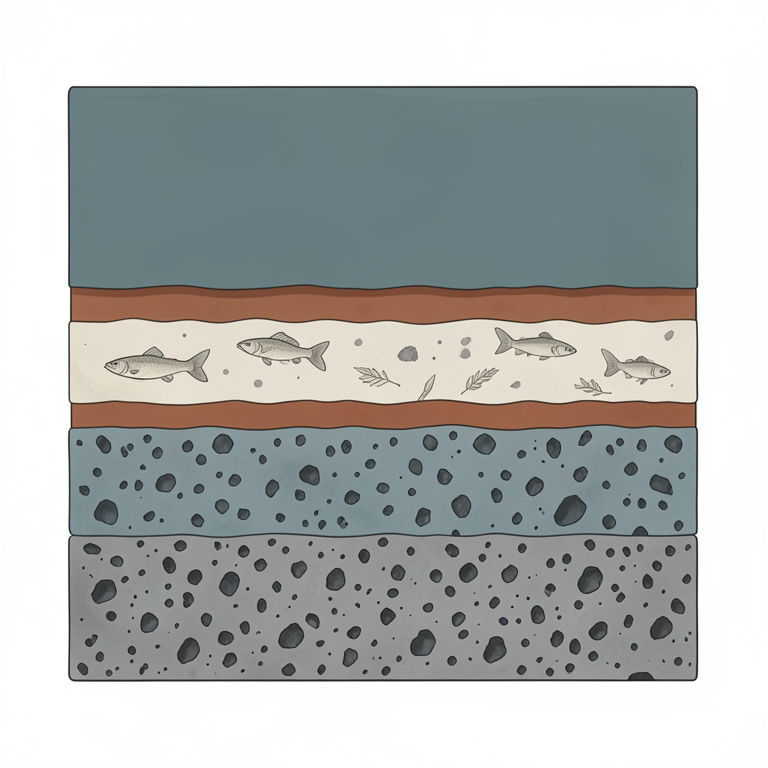
Stratigraphic Sequence of Sautada Ghat
AI-generated conceptual illustration (Deccan basalt lava flows in a geological cross-section). It explains the idea and does not show study data.
View source evidence ↗Introduction
During the late Cretaceous period, the Deccan Traps formed one of the largest volcanic provinces on Earth via large basaltic lava flows. Such flows are spread over a large area of western and central India and consist of several layers of solidified lava separated by a step geometry. The lava flows stratigraphy is key to deciphering the volcanic history, the eruption dynamics and the paleogeographic evolution of the region. An important site to study Deccan basalt flows is the Sautada Ghat section just in the area where the flows are well preserved and easily accessible and in the Beed District of Maharashtra, in the Marathwada region of India. Distinct stratigraphic units are revealed that inform on geochemical variations, flow dynamics and the depositional environment of the Deccan volcanism. In the Sautada Ghat section, the Sautada Ghat section exposes multiple lava flow units that are texturally, mineralogically, and geochemically diverse. Most of these flows are compound pahoehoe and simple sheet flows -typical Deccan volcanicism. The higher layers are massive basalt with occasional flow breccia and the lower flows reveal vesicular and amygdaloidal structures indicating rapid cooling and gas escape. Stratigrapy of these flows will aid in reconstructing the eruptive history and correlating them with other Deccan Traps exposures in Maharashtra. Furthermore, the paleoenvironmental and paleoclimatic information that could be obtained from the study of intercropping beds, red bole horizons, and weathering profiles in this section is also of equal importance. In addition to geological mapping, these studies are important in order to understand the economic importance of these basaltic formations for mineral resources and groundwater potential in the region and the land stability.
Overview of Deccan Traps and their geological significance
One of the most extensive volcanic provinces on Earth, even though the Deccan Traps cover some 500,000 square kilometers in western and central India. Extensive volcanic activity took place in the late Cretaceous period, about 66 million years ago, and it is thought to be connected to the end Cretaceous mass extinction event, and these flood basalts were created. Many of the eruptions involved episodes of multiple layers of lava outpouring which built up thick, layered basaltic sequences that are now the province dominated by Maharashtra, Madhya Pradesh, Gujarat and parts of Karnataka. The approximate lava volume of Deccan Traps exceeds 1.3 million cubic kilometers and it is considered as the one of the biggest Large Igneous Province (LIPs) in Earth's history. Most of these flows are tholeiitic basalts, and mineralogical and geochemical variations of different stratigraphic sequences are recond. Formation of the Deccan Traps has been often associated with the activity of the Réunion hotspot, and involved large scale volcanic eruptions when the Indian plate drifted north. From a geological point of view, the Deccan Traps is highly important because they help capture the processes of flood basalt volcanism and continental break-up event.
Stratigraphically, these lava flows display a complex record of magmatic history characterized by different types of flows, simple, compound and inflated pahoehoe flows, which change with time, as witnessed when the outcrops move from west toward the southeast, downwind. Intertrappean beds, red bole horizons, horizons of sedimentary deposits between lava flows are important in providing evidence of the paleoenvironmental conditions and climatic shifts and the stages in the biological evolution of the late Cretaceous-early Paleogene boundary. The importance of the Deccan Traps for hydrogeological studies also comes from the fact that their vesicular and fractured basalt layers are very good aquifers that supply the groundwater to millions. Most important mineral resources located there are zeolites, bauxite and manganese. The regional tectonic activities, seismicity as well as the landscape evolution can also be understood based on the structural features of the Deccan Traps. Comprehending Earth's volcanic history, the effect of large-scale eruptions to global climate change and the roles of these formations in shaping the geological framework of the Indian subcontinent makes studying these basaltic formations necessary.
Importance of studying lava stratigraphy in Sautada Ghat
Sautada Ghat section in the Beed District of Maharashtra State, India, is an important geological locality for the study of stratigraphy of Deccan basalt flows. The Deccan Traps are a well-preserved complex in a fairly accessible sequence of lava flows suitable for deducing eruptive history and flow dynamics of the Deccan Traps. The lava flow study in this section aids the elucidation of the sequence of volcanic events, type of eruptions as well as post eruption modifications. Important information about the processes governing Deccan volcanism can be deduced from variations in the morphology, thickness of lava flow, mineralogical composition, and the existence of intertrappean layers. Geologists can then reconstruct eruptive phases, estimate length of volcanic activity and correlate these with other Deccan Trap sections elsewhere in India by allowing geologists to analyze different flow units. The study of the lava stratigraphy in Sautada Ghat has also geological significance and has important hydrogeological, environmental and economic implications also. Basaltic flows vary with respect to permeability and porosity and are important for the groundwater movement and storage, hence this is vital in the management of water resource management in the drought prone Marathwada region. In addition, weathered basaltic layers, red bole horizons, as well as inter-trappean sediments have been identified to contribute to the paleoenvironmental information on climate changes during the late Cretaceous-early Paleogene. In terms of economic importance, these formations are notable also since Deccan basalts contain minerals of economic importance, such as zeolites, bauxite and manganese. Moreover, structural features and stability of lava flows in this area are necessary for land use planning, as well as infrastructure development and geohazards mitigation. Thus, the study of lava stratigraphy at Sautada Ghat is relevant to fundamental geological research and practical applications to the resource management and regional development.
Classification of lava flows (pahoehoe, aa, compound, simple flows) Lava flows are normally categorized according to morphology, texture and emplacement dynamics. While they were formed in the Deccan Traps, the major types of lava flows observed are pahoehoe flows, aa flows, compound flows and simple flows. All of these variations are due to differences in cooling history, eruption rate, and lava viscosity. Reconstruction of volcanic processes and the geological evolution of lava provinces such as the Deccan Traps require an understanding of these classifications.
Pahoehoe and Aa Flows
Lava with low viscosity flowing slowly forms pahoehoe lava, which has smooth, ropy or billowy surfaces. The lobes are typically the result of advancing through small breakouts on the distal part of a flow from low effusion rate eruption sources. Tube fed systems are often associated with pahoehoe flows because they have insulated conduits that feed lava unmodified and therefore hot into insulated channels beneath the solidified crust that promote high temperature and fluidity great distances. Instead, aa lava has a rough, jagged, and clinkery (jagged) surface created by quick cooling and quite viscous lava. Aa flows advance as a mass of fragmented, loose and sharp lava blocks that forms a thick flow unit with a rubbly top layer. Under certain circumstances the lava may cool quickly or experience increased shear as it moves and the transition from pahoehoe to aa can occur. These two flow types are both seen in the Deccan Traps, showing differences in how lava erupted and the way the environment was when the lava was being deposited.
Simple and Compound Flows
Thick, laterally extensive lavas of simple flows erupt in a single event, and erupt a large volume of lava. The cooling joints exhibit large, uniform structure with no internal subdivisions. Simple flows are important to regional stratigraphy because they form well defined layers, which are useful to correlate lava sequences between different areas. In contrast, compound flows are made up of several smaller flow units resulting from intermittent, short term lava outpourings. These flows cause overlapping and intermingling lobes to form with complex internal structures. In areas of prolonged or episodic eruptions, olivine generally becomes quickly solidified before new flows cover it, and thus compound flows are more common. Fluctuating eruption rates and localized lava ponding indicated by compound flows within the Deccan Traps helped shape the landscape and geochemical diversity of the area.
Petrographic characteristics and mineralogical variations
Petrographic study of the Deccan basalt flows can give crucial information pertaining to their mineralogical composition, texture and crystallization history. The Deccan Traps basalts are in the main tholeiitic in nature, with finegrained to porphyritic textures. In hand sample, these rocks have an easily visible plagioclase feldspar groundmass (white), and pyroxene (augite) and iron-titanium oxides (dark brown/black), with occasional olivine (green) and sand-and-gravel sized glassy (pale green) components that are apparent under the microscope. Hydrothermal alteration post erupition is a characteristic presence of vesicles and amygdules filled by secondary minerals, like zeolites, calcite, and quartz. Intergranular and intersertal textures and some lava flows are also produced depending on the cooling rate and the crystal growth during the solidification. Basalts with larger plagioclase and pyroxene phenocrysts in a finer groundmass are represented by porphyritic basalts, which indicate variations in the cooling history and magmatic differentiation. Variations in mineralogy within various flow units of the Deccan Traps depend on conditions of eruption, magma chemistry, and alteration after eruption. At lower flows olivine and augite are more abundant and crystallize from relatively primitive magma; the upper flows may be more oxidized with secondary mineralization from extended weathering and hydrothermal activity. Red bole horizons found in between lava flows indicate that the bed was subjected to at least one episode of subaerial exposure, chemical alteration, and subsequent lava reburial. Moreover, trace element and rare earth element (REE) variation assists in correlating of other flow units in different parts of Deccan province. The petrogenesis, evolution, and environmental conditions related to Deccan volcanism were crucially dependent on these mineralogical and petrographic characteristics. In addition, examining these features helps to determine the potential for economic development in basaltic formations, as secondary minerals such as zeolites and calcite have practical use but additionally people could use the alteration patterns to understand groundwater movement and storage in basaltic aquifers.
Flow structures: vesicular, amygdaloidal, and massive basalts
The structural features observed in the lava flows of the Deccan Traps give information regarding the cooling history, gas content and post-eruption modifications. The most common flow structures in the basalts are vesicular, amygdaloidal and massive basalts. Basals are vesicular where many gas cavities or vesicles from gas exsolution during magma ascent and cooling are present. Vesicles size, shape and distribution are determined by the lava viscosity and degassing rate. Vesicular structures are typically found in cleaner upper portions of lava flows where gas bubbles are trapped as the lava is freezing. Eruptive conditions can also affect the degree of vascularity: fluid lava with similarly distributed vesicles as a result, while more viscous lava produces irregular cavities. The second are products of the secondary mineralization of vesicles in basaltic flows over time and produce amygdaloidal basalts. Secondary minerals such as zeolites, quartz, calcite, and chalcedony are precipitated from hydrothermal fluids percolating through this rock and occupy the rock spaces of the amygdules. Basalts containing amygdales are of interest because they show evidence of post-eruption alteration processes and can control groundwater storage in the basalts. Conversely, massive basalts are dense and compact and do not have vesicles or amygdules. Usually they develop in the lower levels of lava flows, in which the slow cooling allows for uniform crystallization of the lava without much gas escape. Basalts often have well developed columnar jointing as a result of thermal contraction during solidification. Structural variations of the Deccan Traps elucidate the flow dynamics, eruptive behavior, and post erosion geological processes; thus, this thesis contributes to the understanding of these aspects. Furthermore, the hydrogeological properties of the vesicular, amygdaloidal and massive basalts are controlled by permeability differences, which in certain respects are of interest to groundwater studies and resource exploration.
Literature review
Duraiswami et al (2014) [1] One such continent flood basalt province is the Deccan Traps, where the emplacement dynamics of large igneous provinces can be expected to be very useful. The architecture and stratigraphy of flood basalt sequences are explored in the western Deccan Traps in order to understand the lava flow transitions. Detailed field investigations of the coils reveal details related to the nature of the flow (e.g. transitions from pahoehoe to rubbly pāhoehoe and 'a'ā), eruption dynamics, lava rheology and emplacement conditions. The efforts of the study result in recognition of key lava flow units and internal structures controlled by variations in effusion rates, eruption duration and topography influences. According to the results, variations in eruption intensity and controls on flow emplacement appear to govern changes in lava form during the eruption of lava. Jay, et al (2008) [2] The southeastern Deccan Traps are an important segment of one of the world's largest continental flood basalt provinces, where stratigraphy, structural evolution, as well as volcanology are well known. Lithological characteristics, flow morphology, internal architecture of basalts in SE Deccan are examined with reference to their mode of emplacement. Numerous lava flow, flow types, and pahoehoe and 'a'ā flows are recognized in field investigation that show discernable flow inter-nal structure and are pass sixty indicative of their emplacement behavior and upwelling eruption rate. Postemplacement deformation of the lava sequences is influenced by faulting, folding, dyke intrusions and can be captured by structural analysis. Episodic phases of eruption and quiescence are indicated by a stratigraphic framework based on flow stacking patterns and intertrappean sedimentary horizons. These flood basalt sequences are interpreted volcanologically in terms of a complex interplay of inflation, flow coalescence, and lava channelization in their development.
Sheth, et al (2004) [3] Enclosing the Bijasan Ghat section within the confines of the Satpura Range is essential to understand the geochemical stratigraphy of the Deccan flood basalts and the manner with which the magmas evolved, interacted with mantle sources and ultimately passed out as magmas during their eruption. A geochemical study at a detailed level is made for lava flows of varying major and trace element characteristics at different stratigraphic levels. The magma batches are clearly indicated by geochemical signatures, and this implies multiple episodes of replenishment and differentiation of the magma chamber. Variations of elemental ratios Ti/Zr, Nb/Y and La/Sm are attributed to mantle heterogeneities and possible crustal contamination during ascent. The stratigraphy of the section shows alternating high and low Ti basalt units signify varying conditions of magmatism. Isotopic analyses of additional samples show a complex mixture between plume and lithosphere mantle sources. Bondre, et al (2004) [4] The Deccan Volcanic Province in India is one of the largest continental flood basalt province with extensive lava flow fields displaying diverse morphological and textural variations. The morphology and emplacement mechanisms of different lava flows within the DVP are examined based mostly on field observations, petrography, and flow dynamics. Pahoehoe flows are smooth, ropy flows, with 'a'ā flows being rough, more thoroughly fragmented, and a range of lava morphologies reflects variations in eruption rate, lava viscosity, and emplacement conditions. Inflation features, lobate structures and vesicle rich cores of these pahoehoe flows suggest that the flows were emplaced over a prolonged duration with low effusion rates. 'a'ā flows, on the other hand, are associated with higher eruption rates and correspondingly rapid cooling and brecciated flow tops. Lava tubes, sheet flows, and channelized flows provide evidence of a complex interplay between topography, eruption dynamics and thermal insulation. However, due to the intricate interplay of flow inflation, cooling contraction and degassing, the final morphology of the lava units was determined the study explains. Self, et al (2022) [5] Deccan Volcanic Province (DVP) is among largest continental flood basalt provinces that yield important insights into large scale volcanic process, mantle dynamics and their environmental fallout. Geological, geochemical and geochronological data herein are synthesized to improve knowledge of Deccan volcanism. Stratigraphic and geochemical analyses reveal a sequence of eruptive phases by their variation in lava composition, a change from sheetlike to thick 'a' flow morphology, and difference in eruption rates. Dating lava sequences at high precision suggests volcanic activity was episodic with possible eruptive pulses that relate to climate and biotic events such as the K-Pg mass extinction. Geochemical signatures draw on a heterogeneous mantle source and the contributions from deep mantle plumes and lithospheric interaction. The role of dike fed fissure eruptions, inflation processes and flow coalescence in forming the province's extensive basaltic sequences is highlighted from structural and petrological studies. Brown, et al (2011) [6] Extensive 'a'ā lava flows of the Deccan Volcanic Province (DVP) yield important information on eruption dynamics and emplacement processes of continental flood basalts. The morphology, internal structure, and distribution of 'a'ā flows of the Deccan Traps are analyzed in this study for understanding their significance in large igneous province volcanism. Thick, brecciated flow tops, dense lava cores, and basal autocracies' suggest high effusion rates and rapid cooling of high rate eruptions documented by field observations. The sharp gradients and high viscosity of 'a'ā flows indicate turbulent lava flow through fragmentation and clinkery nature in the flows. Changes in the composition between various 'a'ā flow units are suggested by geochemical analyses as a result of evolving magmatism and possible mantle heterogeneities. The study also illustrates that along with this influence of lithology on flow dynamics, topography also plays a key role; channelizing, deflecting, inflating and overlapping sequences make their mark on the province's stratigraphy. Verma, et al (2019) [7] One of the largest continental flood basalt provinces, the Deccan Volcanic Province (DVP) in peninsular India has a complex stratigraphy which has been subject to numerous changes in the last few years. Yet, this thesis synthesizes and reviews recent stratigraphic developments of Deccan Traps utilizing stratigraphic, geochemical and geochronological data. Using high precision dating and geochemical fingerprinting, the tripartite subdivision into lower, middle and upper formations has been refined showing different lava flow sequences and regional variations. Stratigraphic correlations among the different sections suggest that the eruptions happened through many and that lava flows of high volume were episodic and isolated from one another with quiescent periods populated by intercropping sedimentary deposits.
Inter-trappean Beds and Paleoenvironments Presence of Red Bole Horizons and Their Significance
These developers are distinct reddish colored clayey layers between surround basalt flows of the Deccan Traps. These are periods of volcanic quiescence, such as layered lava flows and the erosion that occurs between eruptions, these represent periods when lava surfaces were exposed for weathering and soil forming before the next eruption. Because iron rich minerals will oxidize when exposed to subaerial conditions such as atmospheric and hydrological processes, some of the rock is red in coloration. The variation in thickness and composition of red bole horizons stem from the duration of exposure, climatic conditions and chemical composition of the parent basalt. Red bole horizons are of high significance as they can help us with much needed critical pieces of information regarding the paleoenvironment and climatic conditions during Deccan volcanism. As such they help geologists to mark non depositional phases in the succession and hence their time gaps from successive lava flows. In addition, these horizons function as significant paleo-weathering indicators that support warm climatic conditions and episodes of increased rainfall during the late Cretaceous to early Paleogene times. Furthermore, red bole layers contain altered volcanic ash, clay minerals such as kaolinite and montmorillonite as well as traces of organic matter and therefore constitute valuable records for geochemical and paleontological studies. The presence of such layers helps in deciphering the period of eruptions as well as volcanic activity effect on terrestrial ecosystems over time.
Sedimentary Inter-Trappean Layers and Fossil
Evidence: The sedimentary deposits located between the successive lava flows of the Deccan Traps are referred to as intertrappean layers. Sedimentary rocks include these rocks which are composed of limestones, cherts, clays and sandstones and were deposited between eopisodes of volcanic activity. These are formed in low lying areas which developed in temporarily water bodies like lakes and floodplain before being covered by subsequent lava flow. The volcanic hiatus periods are important clues to paleoenvironment and biological activity preserved in these deposits. Microfossils, plant remains, mollusks, fish bones, and fossil dinosaur bones are also found in fossil evidence from within the intercropping beds, which are proof that there were aquatic and terrestrial ecosystems during Deccan volcanism. Some of the inter-trappean sequences, notably, have provided fossilized pollen grains of different plants, which were flourishing in the vicinity until they were covered with volcanic eruptions. Therefore, the discovery of dinosaur eggs and skeletal remains in such layers indicates that the Deccan region also provided for considerable faunal diversity during the late Cretaceous period. The discovery of freshwater fish fossils indicates the lakes and river systems were present at that time and supports the notion that the Deccan wasn't all hostile to life during the period between the volcanic eruptions as previously hypothesized. The inter-trappean layers are important in the correlation of the Deccan volcanic event with the Cretaceous-Paleogene (K-Pg) mass extinction event. It has been argued that the combination may have contributed to the demise of these, and many other species, including nonavian dinosaurs. These fossilized records are preserved in sedimentary intercropping deposits, from which scientists can reconstruct past ecosystems, measure changes in biodiversity and understand the resilience of life during one of Earth's most momentous volcanic eruptions.
Implications for Paleoenvironmental and Climatic Conditions
The study of red bole horizons, inter-trappean sediments and fossil evidence gives comprehensive paleoenvironmental and climatic conditions during Deccan volcanism. Welldeveloped red bole horizons in the volcanics indicate that some considerable time elapsed between eruptions, and that warm and humid climatic conditions prevailed during a part of the volcanic phase. Additional support for intense tropical weathering comes in the form of chemical composition of bole layers, which include elevated amounts of aluminum, iron oxides, and clay minerals. These observations suggest that there have been alternating periods of dry and wet climates over the Deccan region that impacted soil development and sedimentation. Limestones and cherts in intercropping imply that part of the Deccan volcanic landscape was not entirely barren but comprised of freshwater lakes and fluvial systems. Freshwater fish and mollusks as well as the presence of aquatic fossils indicate the intermittent presence in stable water bodies. The results indicate that life could develop in the dismal periods between eruptions, but each eruption had a dramatic impact. Furthermore, stable isotope analysis of intercropping carbonates allows researchers to make an estimate of past atmospheric CO₂ levels, which in turn aid in evaluating the part of volcanic degassing in shaping global climate conditions. The Deccan eruptions and the related environmental changes are important to the timing for the K-Pg boundary event, responsible for the extinction of most species, including non-avian dinosaurs. Despite being known as the Chicxulub asteroid impact as the primary driver of this mass extinction, rising evidence now points to prolonged volcanic activity in the Deccan Traps as playing an important role in creating extreme climate changes, including the global warming, acid rain, and disruption of oceans currents. All of these factors combined probably played an important part in the ecological instability. Therefore, understanding and reconstructing the paleoenvironmental and paleoclimatic conditions of the Deccan Traps gives further insight into how long-term effects of massive volcanism are on Earth's climate and biosphere.
Eruption
Dynamics and Lava Emplacement Mechanisms They represented one of the largest volcanic events in Earth's history, in which basaltic lava was erupted in huge outpourings over a wide area. Although these eruptions took the form of most volcanoes, they were mainly fed by fissure systems, rather than central volcanic cones, as with plateau basalt formations. The magma is a product of deep mantle plumes and the Réunion hotspot made an important contribution. The lava was high temperature (≈1200°C-1300°C), of low viscosity, and permitted it to travel far before cooling and solidification. Their cessation was unfortunately unable to follow an order of ex-vivo due to it's purpose, as it was deeply rooted in the soil. Two principal emplacement types of the Deccan basalt flows are the pahoehoe flows, and the aa flows. Pahoehoe flows were more fluid, flowing as thin, ropy shields covering wide expanses or as lava tubes, joining the lava to one another and piping it interminably far in a molten form while keeping a high temperature. In contrast, aa flows were more viscous, fractured on cooling to form rough, clinkery surfaces. Also noteworthy are compound lava flows where stratigraphy becomes extremely complex through the repeated extrusion of lava, as a crime of overlapping lobes is built up. These mechanisms can be taken to indicate that the Deccan volcanism was not a single catastrophic event in time but actually took place in successive stages, the lava being slowly added, layer by layer.
Research Problem
Volcanic sequences are complex, flow morphology varies, and post emplacement processes alter the sequence of flows; therefore, Sautada Ghat section of Beed District, Marathwada Region, poses a research problem in the understanding of lava stratigraphy of the Deccan Basalt Flows. One of the largest flood basalt provinces on the Earth consists of the Deccan Traps with the multiple layers of lava flows of different texture, mineralogy and geochemistry. In this case, these flows represent an opportunity for an excellent study of the eruption history, flow dynamics, and stratigraphic correlations between layers within the Deccan province in the Sautada Ghat section. Nevertheless, these flows have been thoroughly weathered, eroded, and structurally disturbed, providing challenges in correctly identifying and classifying them. The paleoenvironmental record is further complicated by red bole horizons, intertrappean sediments, and fossiliferous deposits that occurred between eruption phases as these features indicate large paleoenvironmental changes occurred between eruption phases. In addition, determination of permeability, porosity and hydrogeological properties of different flow units is necessary for groundwater resource management in the drought prone Marathwada region. It also aims at understanding how flow types (different types of flows including pahoehoe, aa, compound and simple flows), geochemical signatures, and structural features (joints, fractures, and flow breccias) affect the interpretation of Deccan volcanism. A precise stratigraphic framework for the Sautada Ghat section makes possible such correlation with other Deccan basalt sequences, which can be useful in broader discussions related to petrogenesis, duration and environmental effects of Deccan volcanism.
Conclusion
A study of lava stratigraphy in the Sautada Ghat section of the Beed District, Marathwada Region supplies valuable information about the eruptive history, flow dynamics and post-emplacement processes of the Deccan Basalt Flows. Various eruption styles and magma evolution are revealed by the stratigraphic classification of lava flows (pahoehoe, aa, compound and simple flows). Diverse cooling and solidification styles of these extensive flood basalts are reflected by the presence of vesicular, amygdaloidal, and massive basalts, and their related structural features including flow breccias, joints and fractures. Furthermore, it facilitates the identification of red bole horizons and intertrappean layers which provide important information about the paleoenvironmental conditions between eruptions, including climatic changes and periods of volcanic quiescence. Later, fossil evidence from inter-trappean deposits provided additional support for pre-extinction ecosystems but clues about biotic responses to Deccan volcanism. Their episodic nature and the duration of volcanic activity has broader implications for understanding their part in global climate change, as well as the Cretaceous-Paleogene (K-Pg) mass extinction event. In addition, these basalt flows are important from the hydrogeological point of view since they have varying permeability and porosity and their importance for groundwater management in the drought prone Marathwada region is crucial. The detailed analysis of lava stratigraphy at the Sautada Ghat section in general, helps to better understand Deccan volcanism, provides important data for regional geological mapping and can be used for future works of academic or applied character (resources management).
References
19 in the original paper- Duraiswami RA, Gadpallu P, Shaikh TN, Cardin N. Pahoehoe-a′ a transitions in the lava flow fields of the western Deccan Traps, India-implications for emplacement dynamics, flood basalt architecture and volcanic stratigraphy. Journal of Asian Earth Sciences. 2014;84:146-166.
- Jay AE, Widdowson M. Stratigraphy, structure and volcanology of the SE Deccan continental flood basalt province: implications for eruptive extent and volumes. Journal of the Geological Society. 2008;165(1):177188.
- Sheth HC, Mahoney JJ, Chandrasekharam D. Geochemical stratigraphy of Deccan flood basalts of the Bijasan Ghat section, Satpura Range, India. Journal of Asian Earth Sciences. 2004;23(1):127-139.
- Bondre NR, Duraiswami RA, Dole G. Morphology and emplacement of flows from the Deccan Volcanic Province, India. Bulletin of Volcanology. 2004;66:2945.
- Self S, Mittal T, Dole G, Vanderkluysen L. Toward understanding Deccan volcanism. Annual Review of Earth and Planetary Sciences. 2022;50(1):477-506.
- Brown RJ, Blake S, Bondre NR, Phadnis VM, Self S. A´ ā lava flows in the Deccan Volcanic Province, India, and their significance for the nature of continental flood basalt eruptions. Bulletin of Volcanology. 2011;73:737752.
- Verma O, Khosla A. Developments in the stratigraphy of the Deccan Volcanic Province, peninsular India. Comptes Rendus Geoscience. 2019;351(7):461-476.
- Sheth HC, Melluso L. The Mount Pavagadh volcanic suite, Deccan Traps: geochemical stratigraphy and magmatic evolution. Journal of Asian Earth Sciences. 2008;32(1):15-21.
- Shrivastava JP, Pattanayak SK. Basalts of the Eastern Deccan volcanic province, India. Gondwana Research. 2002;5(3):649-665.
- Kale VS, Dole G, Shandilya P, Pande K. Stratigraphy and correlations in Deccan Volcanic Province, India: quo vadis?. GSA Bulletin. 2020;132(3-4):588-607.
- Hooper P, Widdowson M, Kelley S. Tectonic setting and timing of the final Deccan flood basalt eruptions. Geology. 2010;38(9):839-842.
- Self S, Mittal T, Jay AE. Thickness characteristics of pāhoehoe lavas in the Deccan Province, Western Ghats, India, and in continental flood basalt provinces elsewhere. Frontiers in Earth Science. 2021;8:630604.
- Mittal T, Richards MA, Fendley IM. The magmatic architecture of continental flood basalts I: Observations from the Deccan Traps. Journal of Geophysical Research: Solid Earth. 2021;126(12):e2021JB021808.
- Bondre NR, Duraiswami RA, Dole G. A brief comparison of lava flows from the Deccan Volcanic Province and the Columbia-Oregon Plateau Flood Basalts: Implications for models of flood basalt emplacement. Journal of Earth System Science. 2004;113:809-817.
- Sheth H, Vanderkluysen L, Demonterova EI, Ivanov AV, Savatenkov VM. Geochemistry and 40Ar/39Ar geochronology of the Nandurbar-Dhule mafic dyke swarm: Dyke-sill-flow correlations and stratigraphic development across the Deccan flood basalt province. Geological Journal. 2019;54(1):157-176.
- Peng ZX, Mahoney JJ, Vanderkluysen L, Hooper PR. Sr, Nd and Pb isotopic and chemical compositions of central Deccan Traps lavas and relation to southwestern Deccan stratigraphy. Journal of Asian Earth Sciences. 2014;84:83-94.
- Ganguly S, Ray J, Koeberl C, Saha A, Thöni M, Balaram V, et al. Geochemistry and petrogenesis of lava flows around Linga, Chhindwara area in the Eastern Deccan Volcanic Province (EDVP), India. Journal of Asian Earth Sciences. 2014;91:174-193.
- Bondre NR, Hart WK, Sheth HC. Geology and geochemistry of the Sangamner mafic dike swarm, western Deccan volcanic province, India: implications for regional stratigraphy. The Journal of geology. 2006;114(2):155-170.
- Pakhmode V, Kulkarni H, Deolankar SB. Hydrologicaldrainage analysis in watershed-programme planning: a case from the Deccan basalt, India. Hydrogeology Journal. 2003;11:595-604.
Cited by 1
From OpenAlex, OpenCitations and reference lists read by Scinovex
- Mechanistic Investigation of CO 2 Mineralization Potential in the Ultramafic Lithology of Deccan Traps ↗
Mohd Saif, Chaitanya Krishna Bathula, Rajeev Upadhyay, Raj Kiran · Energy & Fuels · 2026
The increasing atmospheric carbon dioxide concentrations underscore the need for reliable sequestration mechanisms. Mineralization in mafic rocks is a promising and viable option due to the presence of calcium- and magnesium-bearing reactive minerals. In this study, we evaluated the CO 2 sequestration potential and reaction pathways of the tephrite–basanite rock from the Aurangabad Basin in India. We characterized the rock…
❝ 0