
Research article · 2022 · Full text
International Journal of Geography Geology and EnvironmentPetrology and petrochemistry of dykes in Marathwada region of deccan trap province
Volume 4(2) · Pages 84–89 · DOI: 10.22271/27067483.2022.v4.i2a.342 ↗
Research areasMineral Processing and Grinding
Abstract
Author-writtenMany mafic dykes in the Marathwada region of the Deccan Trap Province give important information about petrogenetic and magmatic evolution of this large igneous province. They are one of many dykes composed of tholeiitic basalts that acted as feeder channels for Deccan volcanism, and show distinct textural and mineralogical characteristics. Mineral assemblage consists of plagioclase, clinopyroxene, and olivine with zeolites and calcite as secondary phases indicating post magmatic alteration. Vesicular and porphyritic textures presence indicates variability in cooling rate and degassing during emplacement. Understandably, study of dykes is important for reconstruction of the regional tectonic framework, whose orientation and distribution are related to extensional stress regimes active at the time of Late Cretaceous. Major, trace, and rare earth element (REE) analyses of these dykes from petrochemical investigations have indicated similar geochemical characteristics of these dykes as compared to Deccan basaltic flows, with variation in elemental concentrations, showing fractional crystallization and crustal contamination. Geochemical ratios including Fe/Mg and LREEs vs. HREEs suggest a heterogeneous mantle source in which Réunion hotspot plume was involved. Partial melting and magma differentiation are shown by the study to control chemical evolution of these intrusions. Knowledge of Deccan magmatism is improved by understanding the petrology and petrochemistry of dykes in the Marathwada region and can also be applied more broadly to continental flood basalt provinces and mantle dynamics.
Summary
Source-checkedPlain-language reading of the full paper, prepared with AI and checked against the text. Each point links to the authors' own words.
Why it matters
- The Deccan Trap Province is one of the world's largest volcanic provinces, covering more than half of central and western India. View evidence ↗
- Mafic dykes in this region, composed of tholeiitic basalts, served as the feeder channels for the broader Deccan volcanism. View evidence ↗
- Studying these dykes is essential for reconstructing the regional tectonic framework and understanding the extensional stress regimes of the Late Cretaceous. View evidence ↗
The question
- The primary goal of the research is to determine the source characteristics, mantle melting processes, and differentiation mechanisms that formed the dykes in the Marathwada region. View evidence ↗
What they did
- The study utilized petrochemical investigations, specifically analyzing major, trace, and rare earth elements (REE) of the dykes. View evidence ↗
- Petrological analysis was used to identify the mineral assemblage, which includes primary minerals like plagioclase, clinopyroxene, and olivine. View evidence ↗
- The researchers examined textures, such as vesicular and porphyritic patterns, to determine cooling rates and degassing during emplacement. View evidence ↗
What they found
- The dykes show geochemical characteristics similar to Deccan basaltic flows, though variations in elemental concentrations indicate the occurrence of crustal contamination and fractional crystallization. View evidence ↗
- Analysis of Fe/Mg ratios and the relationship between light rare earth elements (LREEs) and heavy rare earth elements (HREEs) suggests a heterogeneous mantle source involving the Réunion hotspot plume. View evidence ↗
- Mantle melting was found to be polybaric, occurring at depths ranging from 50-70 km (spinel peridotite field) to 100-150 km (garnet peridotite field). View evidence ↗
- Geochemical trends indicating a decrease in MgO and FeO and an increase in SiO₂, Al₂O₃, and alkalis provide evidence for the process of fractional crystallization. View evidence ↗
- The dykes predominantly trend NW-SE, ENE-WSW, and N-S, which implies that extensional tectonism occurred in multiple phases. View evidence ↗
What it means
- The authors conclude that these dykes serve as fundamental geological markers for understanding mantle plume-lithosphere interactions and the magmatic history of continental flood basalt provinces. View evidence ↗
- The authors note that while flood basalts have been studied extensively, the specific role of dykes in magma transport and development has previously been under-addressed. View evidence ↗
Visual summary
1 visualsIllustrations explain the paper; they do not show study data.
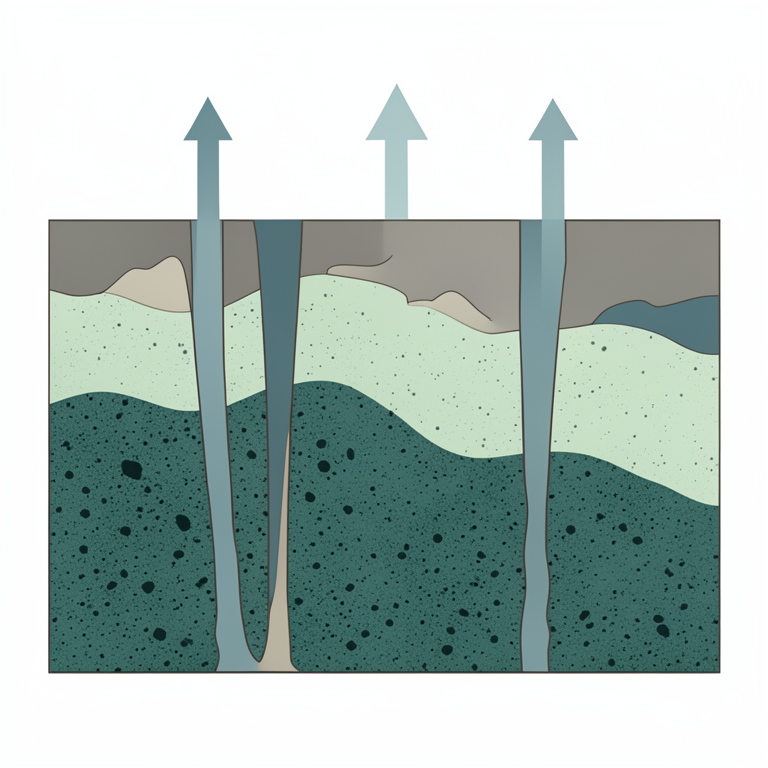
Mantle Melting Depth Zones
AI-generated conceptual illustration (Earth's upper mantle and crust cross-section). It explains the idea and does not show study data.
View source evidence ↗Introduction
Flood basalts account for more than half of western and central India and defined the Deccan Trap Province, which is one of the largest volcanic provinces of the world. Amongst this region, the Marathwada region contains multitude of mafic dykes that are integral to comprehend the magmatic processes associated with the Deccan Volcanism. Key geological features and important aspects of the petrogenesis, geochemical evolution and tectonic significance of Deccan Trap magmatism are provided by these dykes. An understanding of these intrusive bodies would help decipher the nature of the Deccan basalt mantle source, the conditions of melting, and may also elucidate the details of processes of differentiation during formation of Deccan basalts. Petrological and petrochemical studies enable the identification of mineralogical composition, crystallization sequences and of geochemical variations that help frame the magmatic history of the entire region. Major, trace and rare earth elements in petrochemistry of these dykes permit important constraints on their source characteristics and the evolution of magma. Elemental and isotopic geochemical analyses will help to differentiate the various magma batches and to determine whether the magmas can be related to mantle plumes, or they reflect lithospheric contamination. The cooling history and post-emplacement alterations that modified the primary composition of these dykes are determined through textural and mineralogical observations. Additionally, the investigation of dyke in the Marathwada region is important to build up the tectonic framework of the Deccan Volcanic Province, with respect to regional stress regimes and extensional tectonics during the Late Cretaceous. In addition to gaining a greater insight into the magmatic evolution of the Deccan Traps, the petrology and petrochemistry of these dykes help in understanding such large igneous provinces and thereby tracing the implications of continental flood basalt events.
Overview of the Deccan Trap Province
Although the Deccan Trap Province is one of the largest flood basalt provinces in the world (approximately 500,000 square km in western and central India), it has never been defined as part of India's basin and range province. Extensive volcanic activity that occurred in the late Cretaceous period, about 66 million years ago and at the time the Cretaceous-Paleogene mass extinction event occurred formed it. The buildings, roads, water pipes, sewers, and other facilities served by the utilities, are sited in this province almost exclusively of horizontally layered basaltic lava flows, individual flows varying in thickness from few meters to over hundred meters thick. It is sometimes thought that such a gargantuan igneous province is the result of formation by the Réunion hotspot and its accompanying rapid, voluminous eruptions within a very short period in geological terms. Among the man lava flows are intrusive features such as dykes and sills, which are very important in comprehension of magmatic processes in the region. There is significant diversity in geochemistry of the Deccan Trap basalts, implying complex petrogenetic processes such as interaction between mantle plume and lithosphere and processes related to fractional crystallization and crustal contamination. In the broader context, the Deccan Traps in India have broader geological significance as they are a prime site for understanding the Interesting large igneous provinces (LIPs), their climate implications, and their role in mass extinction. Basaltic flows pile up thick sequences that help preserve paleoenvironmental change and the evolution of volcanism. The province also has dyke swarms that are useful for reconstructing the regional stress regime and magma transport pathways. In addition, their rich deposits of groundwater, minerals, and fertile black soil (which sustains farming in the area) also has economic importance as part of the Deccan Traps. Studies have in recent times been conducted on the contribution of Deccan volcanism in the end Cretaceous environmental crisis; whereby, the extended duration of eruptions has been asserted to have led to atmospheric changes capable of producing global warming and ocean acidification. Understanding Deccan volcanism is of interest in lots of ways, from the processes of continental flood basalt formation to mantle plume activity and the geologic and environmental consequences of those processes.
Importance of dykes in understanding magmatic processes
Dykes are important geological structures as they hold keys to the magmatic processes involved in the genesis of the large igneous provinces like the Deccan Trap. Magma intrusions which are vertical or sub-vertical of pre-fitted rock formations are the conduits through which magma is ascending from inner layers of mantle to the surface. The presence there within the Deccan Trap Province indicates multiple episodes of magmatic activity that aided geologists in building the volcanic history of the region. The importance of dykes for studying the nature of mantle melting, magma transport processes and differentiation is obvious. The mineralogical composition, crystallization sequence as well as the physicochemical conditions of the dyke formation can be studied using dyke's petrography and geochemistry. In addition, the variations in major and trace elements compositions of these lavas are used in distinguishing different magma sources, degrees of partial melting, and contamination processes related to Deccan magmatism. In addition, dykes help constraining regional and global tectonic settings, as their orientations relate to the prevailing stress regime at the time of their emplacement. On the other hand, the presence of dyke swarms in the Deccan Trap Province seems to imply widespread extensional tectonics that may have also occurred associated with initial breakup of the Indian subcontinent from Gondwana landmass. They provide the basis to understand large scale plate movements and thus help in identifying locations of magma chambers and reconstruct paleostress directions. Additionally, dykes are significant in exploring the longevity and episodicity of Deccan volcanism, with regard to whether volcanism would have been continuous or in pulses. Their study enables us to further interpret continental flood basalt provinces and in turn to better understand the dynamics of mantle plumes, lithospheric interactions, and their implication to global geological and environmental changes.
Regional geology of the Marathwada region
The occurrence of extensive basaltic lava flows and associated intrusive features like dykes and sills make the Marathwada region very geologically significant, located in the central part of the Deccan Trap Province in the state of Maharashtra. The region is largely characterized by Deccan Basalt Formation, which was emplaced later during the Late Cretaceous (~66 million years ago). The Deccan Volcanic Province has these lava flows made primarily of tholeiitic basalt with columnar jointing, vesicular textures and variation in mineralogical composition. Chemostratigraphic formations of basalts in these key areas, namely, Kalsubai, Lonavala and Wai Subgroups, are grouped together into different suites and help in correlating volcanic events away from these key areas. Moreover, the Marathwada region bears several dykes cutting the basaltic flows and thus contains key data on the magma transport system during Deccan volcanism. They differ in orientation and geochemical composition and represent multiple episodes of magmatic intrusion.
An important part of the geology of Marathwada region is also the tectonic framework. Regional faults, fractures and dyke swarms characterize the area and were related to extensional tectonics associated with the rifting of the Indian plate from Gondwana. Such structural features indicate that the region was experiencing large variations in stress during and post emplacement of the Deccan Traps. Also, the region of Marathwada is underlain by Precambrian basement rocks which includes granitic and metamorphic formations that crops out in some places occasionally. Groundwater storage on all basaltic terrain is hydrogeologically significant and the weathered and fractured basalts are aquifers. Thus the study of the regional geology of Marathwada enables an understanding of Deccan magmatism, tectonic evolution and to a broader geological processes related to the continental flood basalt provinces.
Literature review Krishnamurthy, P. (2020) [1] : Being one of the largest continental flood basalt provinces, the Deccan Volcanic Province (DVP) with its area of about 500,000 km², exerts its influence beyond the Indian subcontinent, associated with volcanic activity. These tholeiitic (primarily) to alkalic and silicic lavas consist of thick basaltic lava flows, the province. These flows are simple and compound types, and their simple and compound sequences and subgroups are well defined as the Wai, Lonavala and Kalsubai Subgroups. Geochemical signatures, magnetic polarity data, and field mapping are used to make stratigraphic correlations across the DVP. Basaltic composition dyke swarms and sills are widespread and these take part in ledger transport. The province is petrographically and mineralogically very diverse with plagioclase, pyroxenes and accessory magnetite and ilmenite. [2] : A complex network of feeder and post Deccan Trap dykes in the northern slope of the Satpura Mountain of the Deccan Volcanic Province (DVP) carry significant information on the magmatic evolution of the region. Multiple phases of intrusion of these dykes have been revealed by new **⁴⁰Ar-³⁹Ar** dating, namely primary feeder dykes formed coevally with the bulk of the main Deccan flood basalt eruption, and later intrusive phases continuing beyond the main phase of volcanism. Magma was transported to the surface along the feeder dykes which were comprised of basaltic compositions and favoured extensive lava flows. However, geochemical differences in post-Deccan dykes imply local mantle heterogeneities and evolving magma sources. Younger magmatic pulses evidenced by some post-Trap intrusions may be related with regional tectonics and reactivation of the lithosphere. The existence of these dykes suggests extended magmatic activity in that region, thus questioning a single phase of Deccan eruption. Such constraints refine the temporal framework of Deccan volcanism, and therefore directly place constraints on mantle dynamics, magmatic processes and their relation to other geodynamic events, such as India Eurasia collision and Reunion plume influence, providing an opportunity to assess large mantle system evolution at this time. These dykes help to reconstruct the magmatic history of the DVP and its role in continental flood basalt provinces. [3] : The origin of silicic rocks within the Deccan Traps Continental Flood Basalt Province (DVP) has been a topic of great geological interest and there have been several hypotheses proposed with regard to field relationships, petrography, and geochemistry. Most abundant are lava flows, dykes, and intrusive bodies of silicic lithologies, rhyolites, trachytes, and granophyres, in the northwestern and central regions of the province. Field relations are interpreted as indicating that some silicic rocks are contemporaneous with Deccan basaltic volcanism but others are evolved magmatic products or products of crustal anatexis. Phenocryst rich textures have quartz, alkali feldspar, and plagioclase as the most abundant phases with accessory zircon and apatite and were differentiated from a mafic parent or were due to crustal assimilation. These rocks are geochemically high SiO₂ facilitating enriched incompatible elements and negative Eu anomaly, suggesting fractional crystallisation of basaltic magma or partial melting of continental crust. [4] : Basic dykes of the Western Deccan Volcanic Province (DVP), Maharashtra, India contain crustal xenoliths exhibiting considerable textural variations which facilitate understanding of magma crust interactions and thermal evolution of the region. They are xenoliths of xenocrystic (granulitic and gneissic) origin entrained in basaltic dykes, exhibiting very various mineralogical and microstructural features. Variations in texture are from coarse grained equigranular to fine grained recrystallized fabrics caused by the degree of thermal metamorphism and partial melting. Other xenoliths have relic igneous or metamorphic textures retained or have extensive assimilation, with resorption rims and reaction zones. Taken together, mineral assemblages usually consist of quartz, feldspar, garnet, pyroxene, and biotite with occasional amphibole and spinel and imply derivation from high grade metamorphic crust. Geochemical analyses demonstrate that incompatible element enrichment indicates a role in interaction with ascending basaltic magma. Partial melting of xenoliths and hybridized zones developed along dyke margins as a result of crust magma interaction testify to the latter's complexity. These textural variations are important for establishing incorporation of crustal material into the Deccan magmatic system and its geochemical evolution. [5] : Petrogenesis, dyke flow relationships and regional lava stratigraphy of the Palitana flood basalt sequence and the Eastern Saurashtra dykes of the Deccan Traps is able to be addressed through the geochemistry of both. The Palitana basalts, a part of the northwestern Deccan Volcanic Province, are compositionally diverse and with tholeiitic-mildly alkalic affinities indicative of varied mantle sources and magmatic evolution. Geochemistry of major and trace elements and isotopic signatures of the samples suggest that their mantle source was heterogeneous and that these rocks underwent different degrees of melting, as well as fractional crystallization and crustal contamination. The predominantly basic Eastern Saurashtra dykes are geochemically related to the Palitana lava flows and therefore probably feeders. Several dykes show different geochemical signatures clearly indicating pulses of multiple magmas and regional mantle heterogeneity. [6] : Early magmatic rocks considered to be the earliest within the Deccan Volcanic Province (DVP) of Kutch, Northwest India, are found to yield vital petrogenetic, geochemical and paleomagnetic information of the region. The heterogeneous signature in major and trace elements of these rocks (basaltic flows and associated intrusions) suggests heterogeneous mantle sources and magmatic differentiation processes. The geochemical analysis shows an enrichment of incompatible elements and thus, indicates involvement of the lithospheric mantle and/or crustal contamination. Paleomagnetic studies provide critical time constraints on when these rocks emplaced, and on tectonic reconstructions, and possibly in some cases correlations with early phases of Deccan volcanism prior to the main phase eruptions. Ray, R., et al (2007) [7] : The Nandurbar-Dhule mafic dyke swarm is a key magmatic feature of the Deccan Traps and yields crucial information for understanding the structure, emplacement record and tectonomagmatic evolution of flood basalts. Most of these dykes, consisting predominantly of basaltic compositions intrude Deccan volcanic sequences and serve as feeder system that fed the immense flood basalt eruptions. Structurally, they are oriented NW-SE and NE-SW, which indicates a strong influence of regional stress fields and lithospheric extension during emplacement. Work reported in Melosh et al., 1980, shows that geochemical similarities with the bulk of Deccan basalts support their role in magma transport and storage. These emplacements are intimately linked with the wider tectonic regime of the Indian plate where it was undergoing lithospheric thinning, mantle upwelling and rifting as part of the Gondwana breakup. Dyke emplacement history is further constrained by paleomagnetic studies, and the paleogeographic setting of the Deccan province can be reconstructed.
Shrivastava, J. P., et al (2017)
Shrivastava, J. P., et al (2017)
Halder, M., et al (2023)
Halder, M., et al (2023)
Ghole, A. N., et al (2019)
Ghole, A. N., et al (2019)
Sheth, H. C., et al (2013)
Sheth, H. C., et al (2013)
Paul, D. K., et al (2008)
Paul, D. K., et al (2008)
Analyze fractional crystallization, mantle melting processes, and crustal contamination
The chemical evolution of dykes in the Marathwada region of the Deccan Trap Province is strongly controlled by the process of fractional crystallization. All magma ascending from the mantle and cooling will crystallise early forming minerals (olivine, clinopyroxene, plagioclase) from the melt and so subtract a gradually different composition from the liquid. The differentiation process described above shows in the geochemical trends of dykes which suggest a decrease of MgO and FeO and an increase of SiO₂, Al₂O₃, and alkalis. In the later stages of crystallization, the dykes become depleted in iron and enriched in incompatible elements such as Rb, Ba, and K, due to the removal of Fe-Ti oxides (magnetite and ilmenite), while trace elements variations (depletion in Cr and Ni) indicate that important fractional crystallization has taken place before the final emplacement of these dykes. This process is supported by the presence of evolved basaltic compositions in some dykes that indicate that different magma batches were to different extents crystallized. Dykes represent a fundamental process for constraining the primary composition of these melts, which are controlled largely by mantle melting. Magmas presumably are derived from a heterogeneous mantle source as inferred from geochemical evidence (high Fe/ Mg ratios and LREE enriched relative to HREE). Melting was polybaric, taking place at variable depths from the spinel to garnet peridotite field (50-70 to 100-150 km). Furthermore, the primary magma compositions appear to have been modified by crustal contamination with exeeded Sr isotopic ratios and enriched incompatible trace elements reflecting interaction of the ascending magmas with continental lithosphere. This contamination process would have been a factor in the observed geochemical variations between different dykes and hence, would also affect their differentiation trends. Knowledge of these processes gives clues about the magmatic evolution, a lithospheric interaction and overall petrogenesis of Deccan magmatism as well as how the region was built volcanic and tectonically.
Tectonic framework and structural significance of dykes
The Marathwada region in context of the Deccan Trap Province is characterized by widespread extensional features; fault systems, and dyke swarms, which constitute an important part of the province's magmatic and structural development. Late Cretaceous emplacement of dykes is closely connected to Late Cretaceous (66 million years) tectonic setting, when the Indian plate was going through a period of rapid northward movement after breaking off Gondwana during a time of considerable rift-related extension. Presence of large number of dykes in the Marathwada region suggests that lithosphere was under the influence of regional stress regimes which caused fracturing and intrusion of magma. The dominant trend of these dykes is in NW-SE, ENE-WSW and N-S implies extensional tectonism in multiple phases. The orientations of these dykes give a direct measure of paleo-stress that was prevailing, when the dykes were emplaced, and thus aid in reconstructing the paleo-stress conditions of the Deccan volcanic episode. Structurally, dykes are important in that they are indicators of magmatic pathways and stress regime during Deccan volcanism. The distribution of their produces important evidence for how crustal extension and magmatic plumbing systems are operating within the province. Often these dykes are regarded as feeder channels for the basaltic lava flows of the Deccan, and so probably had an important role in serving as channels to transport magma from deeper mantle sources to the surface. Moreover, dykes contribute to the mechanical behavior of crust through creating zones of weakness in the crust that are likely to be reactivated during the subsequent tectonic events. Geometry, thickness and geochemical study of these formations enables their distinction based on different phases of magmatism and possible mantle sources. In addition, these structural intrusions affect regional seismicity, groundwater, and landscapes evolution. In order to understand the geologic processes responsible for the origin of the Deccan Trap Province and to establish analogies with other continental flood basalt provinces elsewhere in the world, it is therefore critical to understand the tectonic and structural significance of the dykes in the Marathwada region.
Stratigraphy and lithological characteristics
The main feature of the stratigraphy in the Marathwada region is the presence of Deccan Trap Basalts that were poured onto the region during the Late Cretaceous period, ~66 million years ago. Based on geochemical and lithological analyses distinct geochemical and lithological characteristics, the Deccan volcanic sequence is divided in to three main subgroups; Kalsubai, Lonavala and Wai Subgroups. The subgroups are further divided into different formations that represent successive lava flow units. The stratigraphic sequence is composed of several basaltic lava flow units whose vesicularity ranges from being almost completely vesiculated to essentially completely nonvesiculated, that can have amygdaloidal structures over thick sections, and that possess columns in some sections. Commonly, these are flows with tholeiitic composition interspersed with layers of intertrappean sedimentary layers, which will give valuable paleoenvironmental data. Lower units are often very massive basalt flows with the upper units more vesicular, thus implying changing eruption dynamics and cooling conditions. Furthermore, the basaltic layers are cut by dykes and sills, indicating more than one intrusive event that can help to explain the general magmatic history of the region. With regard to the lithological properties, the Deccan Basalts in Marathwada are dominated by fine to medium grained tholeiitic basalt with mineralogical variations controlled by the characters of differentiation and subsequent secondary alteration. Plagioclase, clinopyroxene, and olivine are the primary minerals and magnetite and ilmenite are accessory minerals. The texture is typically very secondary and is characterized by vesicular mineralization by zeolites, chlorite and calcite after emplacement hydrothermal alterations. The variety of textures seen in these basalts, for instance, porphyritic, aphanitic and intergranular textures, give hints to their histories of cooling and crystallizing. In certain areas, the Intertrappean beds, of limestone, claystone and ferruginous sediments are present indicating temporary breaks in volcanic activity. Therefore, these beds harbor important fossils and geochemical signatures that are necessary to reconstruct the paleoenvironmental conditions of Deccan volcanism. Thus, an understanding of the eruptive history, magma evolution and post volcanic modifications of the Deccan Trap Province can only be achieved by studying stratigraphy and lithology in the Marathwada region.
Magma Evolution and Petrogenesis
Basalts from the Deccan Trap and the dykes in the Marathwada region provide unique source characteristics that illuminate their generation from the mantle. Geochemical studies suggest that the Réunion hotspot, or an equivalent hotspot, was active at the time of eruption, and a primary magma source was derived from a mantle plume. Sr, Nd, and Pb isotopic ratios of Deccan basalts reveal a heterogeneous mantle source, with evidence for deep plume derived material and lithospheric contamination. High MgO contents in primitive basalts indicate derivation from a depleted mantle reservoir and deuteric differentiation to produce the observed geochemical variations in the different lava flows and dykes. Further confirmation of involving a deep seated mantle source possibly communicating with the overlying lithosphere is given by trace element distributions that include enriched large ion lithophile elements (LILEs) and high field strength elements (HFSEs). Mantle melting processes that were responsible for the generation of Deccan magmatism occurred at high degrees of partial melting, which were facilitated by thermal anomalies in the mantle. Petrological studies indicate that melting took place over a polybaric regime from the garnet peridotite stability field (~100-150 km depth) up to the spinel peridotite stability field (~50-70 km depth). Some dykes contain primitive basaltic compositions, which implies that the magma experienced minimal fractional crystallization prior to emplacement, whereas other flows are evolved basaltic compositions indicating substantial differentiation. Second, variable degrees of the crustal assimilation controlled the final geochemical signatures of the erupted magmas under the regions where the Indian continental lithosphere was thicker. The Marathwada region also plays a part in the understanding of processes associated with large igneous provinces (LIPs) formation, the part of mantle plume that interacts with the lithosheric structures and the role of extensive magmatism in the geodynamic and the environmental global changes.
Fractional Crystallization and Differentiation Trends
Magmatic evolution of the Deccan Trap and the dykes in the Marathwada region was very much controlled by the processes of fractional crystallization. Crystallization and removal of minerals from the melt as it cools is a sequential process that gradually changes magma composition. The early crystallizing minerals found in the Deccan basalts as suggested by petrographic and geochemical studies are olivine, clinopyroxene and plagioclase which are typical for mafic magmas. Fractional crystallization of basaltic flows is indicated by clear trends of depletion of MgO and FeO and concurrent enrichment of SiO₂, Al₂O₃, and Na₂O. Evolution of magma from a primitive basaltic composition to a more evolved tholeiitic basalt variety is also brought on by the removal of Fe-Ti oxides like magnetite and ilmenite in later stages. In some areas there are intermediate and silicic compositions indicating further crystallization and differentiation which resulted in generation of more evolved batches of magma but complete differentiation to rhyolitic compositions is rare in the Deccan Traps. Further evidence provided by trace element distributions and REE patterns are also in agreement with the differentiation trend of the Deccan basalts. An interesting aspect of fractional crystallization occurs due to fractionation of incompatible elements like Rb, Ba, and K, which find it difficult to enter crystallizing mineral phases and remain in the melt in the residual portion. Compatible elements such as Ni, Cr, and Co are instead depleted because they are preferentially incorporated into the early crystallizing mafic minerals. Fractionations among the REE, especially between LREEs and HREEs, indicate that differentiation occurred under varied pressures and depths within the crust and upper mantle. The investigation of fractional crystallization and differentiation trends in the Marathwada region informs the magmatic process that formed the Deccan Trap Province, while offering information on the evolution of major igneous provinces and basaltic magmatism.
Research Problem
Mafic dykes occur in large number in the Marathwada region of the Deccan Trap province and it is believed to have acted an important role in the magmatic evolution of the region. Yet, many critical questions are unresolved with respect to their petrogenesis, geochemical variations or tectonic implications. The main research problem is deciphering the source characteristics, mantle melting processes and the differentiation mechanisms responsible for formation of these dykes. Previous studies have addressed the Deccan flood basalts, but dykes have yet received less attention, and the role of dykes in magma transport and development is not well elucidated. Furthermore, the extent of fractional crystallization, crustal contamination, and geochemical heterogeneity in these dykes has uncertaine and might help better understanding the Deccan volcanic system. In addition, there are particular problems associated with emplacement of dykes and the tectonic framework to their emplacement, including regional stress regimes and extensional tectonics and the correlation with Réunion hotspot plume activity. Geochemistry indicates that there are multiple episodes of dykes, but their relationship with the Deccan stratigraphy and magmatic cycles is unclear. Reconstructing magma generation, ascent pathways and emplacement mechanisms in the Deccan Traps requires understanding these dykes. To address these knowledge gaps, they involve integrating petrological, petrochemical, and structural analyses in this research and contribute to a more integrated work up of large igneous provinces and the mantle.
Conclusion
Petrology and petrochemistry of dykes from the Marathwada sector of the Deccan Trap Province yield important information about the magmatic evolution and mantle processes associated with Deccan volcanism. These dykes proved to be predominantly tholeiitic basalts with plagioclase, clinopyroxene and olivine as their constituents with secondary minerals suggesting that there were postemplacement hydrothermal alterations. Porphyritic, vesicular and intergranular textures indicate variations in cooling rate, magma ascent, and degassing. Geochemical analyses show that these dykes have a strong affinity with the Deccan flood basalts but variations in major and trace element, Fe/Mg ratios, and rare earth element (REE) patterns indicate the effects of fractional crystallization, partial melting and crustal assimilation. Isotopic studies of LREE enrichment over HREEs suggests mantle sources, and indicates contributions from deep plume (Réunion hotspot) and lithosphere interactions. Emplacement of their suggests that crustal extension and regional stress regimes represented by their features were active during the Cretaceous. The study of these dykes as a whole also helps in understanding magma generation, differentiation and tectonic evolution in the Deccan Trap Province. These findings aid in more generalized discussions of continental flood basalt provinces, mantle plume-lithosphere interactions, and global geodynamic processes, and stress the role of dykes as fundamental geological markers to unravel Earth's magmatic history.
References
17 in the original paper- Krishnamurthy P. The Deccan Volcanic Province (DVP), India: a review: Part 1: Areal extent and distribution, compositional diversity, flow types and sequences, stratigraphic correlations, dyke swarms and sills, petrography and mineralogy. Journal of the Geological Society of India. 2020;96(1):9-35.
- Shrivastava JP, Kumar R, Rani N. Feeder and post Deccan Trap dyke activities in the northern slope of the Satpura Mountain: Evidence from new 40Ar-39Ar ages. Geoscience Frontiers. 2017;8(3):483-492.
- Halder M, Paul D, Yang S. Origin of silicic rocks of the Deccan traps continental flood basalt province: inferences from field observations, petrography, and geochemistry. Geochemistry. 2023;83(2):125958.
- Ghole AN, Marathe T, Vaddadi S. Textural variation in the crustal xenoliths in basic dykes, Western Deccan Volcanic Province, Maharashtra, India. Current Science. 2019;117(8):1333-1339.
- Sheth HC, Zellmer GF, Kshirsagar PV, Cucciniello C. Geochemistry of the Palitana flood basalt sequence and the Eastern Saurashtra dykes, Deccan Traps: clues to petrogenesis, dyke-flow relationships, and regional lava stratigraphy. Bulletin of Volcanology. 2013;75:1-23.
- Paul DK, Ray A, Das B, Patil SK, Biswas SK. Petrology, geochemistry and paleomagnetism of the earliest magmatic rocks of Deccan Volcanic Province, Kutch, Northwest India. Lithos. 2008;102(1-2):237259.
- Ray R, Sheth HC, Mallik J. Structure and emplacement of the Nandurbar-Dhule mafic dyke swarm, Deccan Traps, and the tectonomagmatic evolution of flood basalts. Bulletin of Volcanology. 2007;69:537-551.
- Bondre NR, Hart WK, Sheth HC. Geology and geochemistry of the Sangamner mafic dike swarm, western Deccan volcanic province, India: implications for regional stratigraphy. The Journal of geology. 2006;114(2):155-170.
- Krishnamurthy P, Mahoney JJ, Gopalan K, MacDougall JD. Clinopyroxene compositions in the Deccan and Rajmahal Traps and their bearing on magma types and evolution. Journal of Asian Earth Sciences. 2014;84:102-117.
- Dessai AG, Viegas A. Petrogenesis of alkaline rocks from Murud-Janjira, in the Deccan Traps, western India. Mineralogy and Petrology. 2010;98:297-311.
- Terker PU. Comparative Study of Petrology & Petrochemistry of Deccan Trap Lava Flows in Ahmadnagar District. Research journey. 2021, 135.
- Cucciniello C, Choudhary AK, Zanetti A, Sheth HC, Vichare S, Pereira R, et al. Mineralogy, geochemistry and petrogenesis of the Khopoli mafic intrusion, Deccan Traps, India. Mineralogy and Petrology. 2014;108:333-351.
- Kumar A, Pal SUCH, Shrivastava JP. Contemporary researches and issues related to the Deccan volcanism. In: Proc. Indian Natl. Sci. Acad. 2020;86:245-261.
- Gadgil R, Viegas A, Iyer SD. Structure and emplacement of the Coastal Deccan tholeiitic dyke swarm in Goa, on the western Indian rifted margin. Bulletin of Volcanology. 2019;81:1-19.
- Melluso L, Sethna SF, D'Antonio M, Javeri P, Bennio L. Geochemistry and petrogenesis of sodic and potassic mafic alkaline rocks in the Deccan Volcanic Province, Mumbai area (India). Mineralogy and Petrology. 2002;74:323-342.
- Rao NC, Rao CD, Das S. Petrogenesis of lamprophyres from Chhota Udepur area, Narmada rift zone, and its relation to Deccan magmatism. Journal of Asian Earth Sciences. 2012;45:24-39.
- Kshirsagar PV, Sheth HC, Shaikh B. Mafic alkalic magmatism in central Kachchh, India: A monogenetic volcanic field in the northwestern Deccan Traps. Bulletin of Volcanology. 2011;73:595-612.