
Research article · 2025 · Full text
International Journal of Biology SciencesExploring the proximate nutrients of cotton gin trash: An alternate roughage feed to ruminants
Volume 7(3) · Pages 39–41 · DOI: 10.33545/26649926.2025.v7.i3a.316 ↗
Research areasAgriculture and Rural Development ResearchAgricultural Systems and Practices
Abstract
Author-writtenCotton gin trash is a by-product of cotton ginning process and serves as an alternate source of roughage in dairy animal feed. Proximate analysis of coarse cotton gin trash samples showed the following nutrient composition: Moisture 11.2%, Crude protein 10.9%, Crude fibre 37.68%, Ether extract 3.2%, Total ash 7.25%, Acid insoluble ash (AIA) 2.3%. The high fibre and moderate protein content make cotton gin trash an important roughage source especially during times of fodder scarcity. Additionally, enhancing its nutrient profile could further increase its value as a beneficial agricultural byproduct for livestock nutrition.
Summary
Source-checkedPlain-language reading of the full paper, prepared with AI and checked against the text. Each point links to the authors' own words.
Why it matters
- Cotton gin trash is a byproduct of the cotton ginning process that can be used as an alternative roughage source for dairy animals. View evidence ↗
- Due to its moderate protein and high fiber content, cotton gin trash is particularly valuable as a roughage source when fodder is scarce. View evidence ↗
- Cotton gin trash is safer for livestock than whole cottonseed because it contains fewer immature seeds, reducing the risk of gossypol toxicity. View evidence ↗
The question
- The study aimed to analyze the proximate nutrient composition of cotton gin trash to determine if it is a suitable alternative roughage for ruminants. View evidence ↗
What they did
- The researchers collected six samples of coarse-type cotton gin trash from different locations in the Tirupur district. View evidence ↗
- To ensure uniform size for analysis, samples were dried and ground to pass through a 2-mm screen. View evidence ↗
- Proximate composition was determined following standard AOAC (2012) procedures. View evidence ↗
- All nutritional results were reported as percentages on a dry matter basis. View evidence ↗
What they found
- The analysis of coarse cotton gin trash showed a composition of 11.2% moisture, 10.9% crude protein, 37.68% crude fiber, 3.2% ether extract, 7.25% total ash, and 2.3% acid-insoluble ash. View evidence ↗
- The nitrogen-free extract content of the samples was found to be 40.06 ± 0.71%. View evidence ↗
- The nutritional profile of cotton gin trash, characterized by moderate protein and energy, is comparable to low-quality forage like bermudagrass hay. View evidence ↗
- A primary advantage of cotton gin trash is its low cost, often requiring only transportation fees from the gin. View evidence ↗
What it means
- The authors conclude that cotton gin trash is a valuable alternative roughage source, especially during fodder scarcity, due to its high fiber and moderate protein levels. View evidence ↗
- The authors recommend cotton gin trash as a cost-effective and sustainable replacement for conventional roughages in ruminant diets. View evidence ↗
- A significant limitation of using cotton gin trash is its low bulk density, which can increase transportation costs and difficulty. View evidence ↗
- The authors state that further research is required to find ways to increase the protein content of cotton gin trash through supplementation or fermentation. View evidence ↗
Visual summary
1 visualsIllustrations explain the paper; they do not show study data.
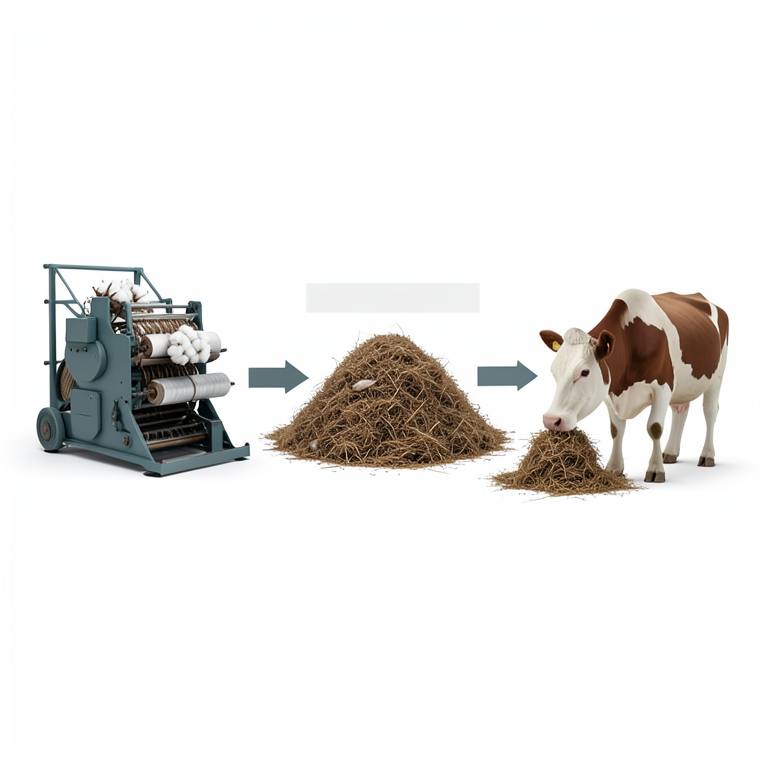
Cotton Processing By-product Flow
AI-generated conceptual illustration (Cotton gin trash and dairy cows). It explains the idea and does not show study data.
View source evidence ↗Figures & tables
From the original paper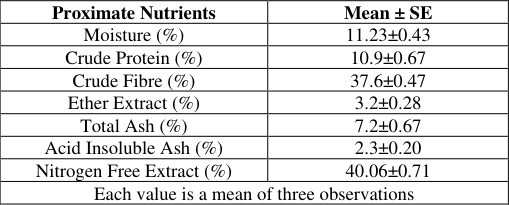 Table 1
Introduction
Cotton is used as a fabric dating back to 2000 BC in India. The industrial revolution brought significant advancements in cotton processing which fuelled the global expansion of cotton market. The processing of cotton produces a variety of by-products that include whole cottonseed, cottonseed meal, cottonseed hulls, cotton mote, textile mill waste, and cotton gin trash. Whole cottonseed is extracted during the ginning process and is primarily used for cottonseed oil production or as ruminant feed (Kunkle et al., 2004) [7] . As it does not require further processing before feeding, which helps reduce costs (Poore and Rogers, 1995) [9] . However, two challenges associated with feeding whole cottonseed are its high fat content and the presence of gossypol, a toxic compound that can affect animal health. Cottonseed hulls, another by-product from cottonseed oil extraction, have relatively low nutritional value. They contain 45% Total Digestible Nutrients (TDN) and crude protein levels ranging from 4% to 5% (NRC, 2000; Waller, 2006) [5,6] . Despite this, cottonseed hulls can still be used in animal feed, especially in ruminant diets where fiber content is crucial. In addition to these, cotton mote and textile mill waste are also generated in the processing of cotton. These by-products, while not as widely studied, may offer alternative uses in animal feed or other agricultural applications. Cotton gin trash, in particular, has gained attention as a valuable source of roughage for livestock, especially during times of fodder scarcity [4] . The diverse by-products of cotton processing highlight the crop's versatility and its potential to contribute not only to the textile industry but also to agricultural and livestock sectors. Proper management and utilization of these by-products can help reduce waste and enhance the sustainability of cotton farming. Cotton gin trash is a by-product of the cotton ginning process and serves as a valuable source of roughage in ruminant diets. It is composed of boll residues, leaves, stems, and lint, which results in a bulky feed that is high in fibre but low in energy. While this composition makes it an effective roughage source, its high fibre content can limit its energy value for livestock. To improve its utilization, reducing the particle size by grinding cotton gin trash makes it easier to handle and increases its intake by animals. Palatability of cotton gin trash is generally good, provided that it does not exceed 40% of the total diet, as higher inclusion levels may lead to reduced feed intake (Lalor et al., 1975) [10] . Unlike whole cottonseed, gossypol is not considered a significant issue in cotton gin trash, as it contains only a small number of immature seeds, which minimizes the risk of toxicity in livestock. The current study aims to analyze the proximate composition of cotton gin trash to assess its suitability as an alternative roughage source for ruminant feeding. This research is crucial for determining the nutritional value of cotton gin trash, as it has the potential to supplement traditional feed resources, especially during periods of feed scarcity. Additionally, with proper processing and formulation, cotton gin trash could serve as an affordable and sustainable feed option in livestock nutrition. Further research could explore methods to enhance the digestibility and nutritional content of cotton gin trash, such as through fermentation, enzyme supplementation, or combining it with other feed ingredients. By improving its nutritional profile, cotton gin trash could become a more widely adopted feed resource, contributing to the sustainability of livestock production and reducing agricultural waste.
Materials and Methods
Six coarse-type cotton gin trash samples were collected from various locations within the Tirupur district. The samples were carefully dried and ground to pass through a 2-mm screen to ensure uniformity in size for analysis. The proximate composition of these samples was determined using standard procedures as outlined by the AOAC (2012) [1] . All results were expressed as percentages on a dry matter basis to ensure accuracy and consistency in comparison. By exploring these aspects, the study could contribute to expanding the use of cotton gin trash as a cost-effective and environmentally friendly feed resource in animal agriculture.
Results and Discussion
The results of the proximate analysis of coarse-type cotton gin trash samples revealed the following composition (Table 1): moisture 11.2%, crude protein 10.9%, crude fiber 37.68%, ether extract 3.2%, total ash 7.25%, and acidinsoluble ash (AIA) 2.3%. These values are consistent with findings from previous studies, such as Bader et al. (1998) [2] , who noted that the nutrient composition of cotton gin trash can vary based on factors such as the variety of cotton, geographical location, harvest method, and the presence of impurities. This variability is further highlighted by Myer et al. (2008) [3] , who reported that crude protein in cotton gin trash ranges from 2% to 16%, moisture content from 2% to 60%, and crude fiber between 28% and 45%. Moisture content in cotton gin trash can be highly variable, depending on the time of harvest and environmental conditions. For example, cotton gin trash harvested in different seasons or under varying climatic conditions may have significant differences in moisture, which could affect its storage and use in animal feed. Cotton gin trash also contains a moderate to high amount of ash, with levels ranging from 8% to 28% (Lalor et al., 1975) [10] , due to the presence of non-combustible minerals like silica, calcium, potassium, and magnesium. In terms of its nutritional profile, cotton gin trash is considered to have moderate protein and energy content, making it comparable to low-quality forage such as bermudagrass hay. Lalor et al. (1975) [10] found that the palatability of gin trash is generally acceptable as long as it does not exceed 40% of the total diet, beyond which feed intake may decrease. Notably, gossypol, a toxic compound found in cottonseed, does not pose a significant concern in cotton gin trash due to the limited presence of immature seeds. This makes it a safer alternative to whole cottonseed, particularly in ruminant diets. The low cost of cotton gin trash is one of its key advantages, as it is often available at little more than the transportation cost from the gin (Kunkle et al., 2004) [7] . This affordability, combined with its fiber content, makes cotton gin trash an attractive option as a roughage source, especially during periods of feed scarcity. Recent studies have also explored the potential benefits of cotton gin trash in livestock feeding. For example, cotton gin trash has been successfully used as an unconventional feedstuff in the feeding of Mecheri sheep, where it was found to improve weight gain and feed efficiency (Nagarajan et al., 2023) [8] . The chemical composition of cotton gin trash in this study was found to contain 15.7% crude protein and 31.9% crude fiber, further supporting its potential as a useful feed resource. One of the major challenges in utilizing cotton gin trash as livestock feed is its low bulk density, which can make transportation difficult and costly (Kunkle et al., 2004) [7] . Despite this, the low cost and potential benefits of incorporating cotton gin trash into animal diets make it a promising option. Further research is needed to explore methods for increasing the protein content of cotton gin trash, such as through fermentation or supplementation, to enhance its nutritional value and expand its potential as a valuable agricultural by-product for livestock nutrition. The variability in protein content, which is influenced by factors such as the number of immature seeds and environmental conditions during the growing season (Lalor et al., 1975) [10] , underscores the importance of further research into optimizing the use of cotton gin trash in livestock feeding. Such efforts could lead to better utilization of this by-product, reducing waste and improving the sustainability of livestock production systems.
| Proximate Nutrients | Mean ± SE |
|---|---|
| Moisture (%) | 11.23±0.43 |
| Crude Protein (%) | 10.9±0.67 |
| Crude Fibre (%) | 37.6±0.47 |
| Ether Extract (%) | 3.2±0.28 |
| Total Ash (%) | 7.2±0.67 |
| Acid Insoluble Ash (%) | 2.3±0.20 |
| Nitrogen Free Extract (%) | 40.06±0.71 |
| Each value is a mean of three observations |
Table text extracted from the original PDF; superscript letters are shown inline. The original table image is below.
View original table image
Conclusion
In conclusion, cotton gin trash is a valuable alternative roughage source, containing a moderate level of protein and a high level of fiber. These characteristics make it suitable for use as a primary roughage source, particularly during periods of fodder scarcity. Given its high fiber content, cotton gin trash can effectively replace conventional roughages in ruminant diets, providing a cost-effective and sustainable solution for livestock feeding. However, further research is needed to optimize its use, particularly regarding its digestibility, protein content, and potential improvements in its palatability and nutrient composition. Enhancing the protein content of cotton gin trash through processing or supplementation could increase its nutritional value and make it an even more viable option for livestock nutrition. Additionally, exploring efficient methods for managing its low bulk density and improving its handling and transportation will further facilitate its adoption as a widespread feed resource, reducing waste and contributing to the sustainability of livestock production systems.
References
10 in the original paper- AOAC. Official methods of analysis. Washington, D.C., USA: Association of Official Analytical Chemists; 2012.
- Bader MJ, Bramwell RK, Stewart RL, Hill GM. Gin trash studies conducted in Georgia. In: Beltwide Cotton Production Research Proceedings. 1998;2:1698-1699.
- Myer RO. Cotton Gin Trash: Alternative Roughage Feed for Beef Cattle: AN177/AN189, 11/2007, EDIS series. Institute of Food and Agricultural Science, University of Florida; 2008.
- Hayavadana GR, Sangam P, N Jaishankar, KP Chethan, MC Shivakumar, B Ramachandra, R Guruprasad, K Gowda H. Utilization of perennial fodder COFS-29 as sole roughage source in Hassan sheep lambs under intensive rearing system. Int J Vet Sci Anim Husbandry. 2024;9(1):76-78.
- Waller JC. By-products and unusual feedstuffs. Feedstuffs Reference Issue and Buyer's Guide. 2006;77:18.
- NRC. Nutrient Requirements of Beef Cattle. 7th rev. ed. Washington, DC: National Academy Press; 2000.
- Kunkle WE, Stewart RL, Brown WF. Using by-product feeds in beef supplementation programs. 2004.
- Nagarajan SB, Ramakrishnan S, Muralidharan J, Vasan P, Sivakumar K, Thiruvenkadan AK. Effect of cotton gin trash supplementation as unconventional feedstuff on feed intake and production characteristics of Mecheri sheep of India. Sustainability. 2023;15(13):10500.
- Poore MH, Rogers G. Feeding whole cottonseed and other cotton by-products to beef cattle; 1995.
- Lalor WF, Jones JK, Slater GA. Cotton gin trash as a ruminant feed. Cotton Gin and Oil Mill Press. 1975;28.