
Research article · 2025 · Full text
International Journal of Horticulture and Food ScienceEggshells as fertilizer in horticulture practices
Volume 7(3) · Pages 32–34 · DOI: 10.33545/26631067.2025.v7.i3a.277 ↗
Research areasAgronomic Practices and Intercropping SystemsCrop Yield and Soil Fertility
Abstract
Author-writtenEggshells are a rich and sustainable source of calcium and other essential minerals that contribute to soil fertility and plant health. As a natural byproduct of the poultry industry and household waste, eggshells provide an eco-friendly and cost-effective alternative to synthetic fertilizers. This study explores the potential of eggshells as an organic soil amendment in horticultural practices, focusing on their nutrient composition, modes of application, and benefits in enhancing plant growth and soil quality. The high calcium carbonate (CaCO₃) content in eggshells plays a crucial role in preventing calcium deficiencies in plants, improving soil pH balance, and supporting root development. Additionally, the presence of trace elements such as magnesium, potassium, and phosphorus further enhances their agricultural value. By reviewing experimental findings and scientific equations related to calcium release and soil interactions, this paper aims to highlight the practical applications and advantages of eggshell-based fertilizers. The findings indicate that eggshells contribute significantly to plant growth, reduce soil acidity, and improve microbial activity, making them an essential component of sustainable horticultural practices.
Summary
Source-checkedPlain-language reading of the full paper, prepared with AI and checked against the text. Each point links to the authors' own words.
Why it matters
- Sustainable agriculture is increasingly necessary because chemical fertilizers have caused environmental concerns and soil degradation. View evidence ↗
- Calcium is essential for plants as it supports enzymatic activities, promotes root growth, and strengthens cell walls. View evidence ↗
- A lack of calcium can cause specific physiological disorders, including bitter pit in apples, tip burn in lettuce, and blossom-end rot in peppers and tomatoes. View evidence ↗
The question
- The study aims to investigate the use of eggshells as an organic soil amendment, specifically looking at their nutrient content, how they are applied, and their effects on soil quality and plant growth. View evidence ↗
What they did
- The research was conducted by reviewing scientific equations and experimental findings regarding soil interactions and the release of calcium. View evidence ↗
What they found
- Eggshells are primarily composed of calcium (95.0%), which helps prevent deficiency disorders and strengthens cell walls. View evidence ↗
- Eggshells contain 4.4% organic proteins, which support nutrient absorption and soil microbial activity. View evidence ↗
- Eggshell treatment increased soil pH from 5.5 to 6.5, representing an 18% improvement and a reduction in soil acidity. View evidence ↗
- The available calcium in the soil increased by 200%, rising from 50 mg/kg in the control group to 150 mg/kg in the eggshell-treated soil. View evidence ↗
- Plant height improved by 28%, increasing from 25 cm in the control group to 32 cm in the treated group. View evidence ↗
- Root length showed a 50% increase, growing from 8 cm in the control group to 12 cm in the treated group. View evidence ↗
- Crop yield increased by 28%, from 2.5 kg per hectare in the control group to 3.2 kg per hectare in the treated group. View evidence ↗
- Referenced research indicates that eggshell powder can lead to a 15% improvement in root strength and a 20% increase in plant biomass. View evidence ↗
What it means
- The authors conclude that eggshells are a valuable organic fertilizer that significantly enhances plant growth and soil health. View evidence ↗
- The authors state that future research is needed to evaluate long-term impacts across different soil types and to optimize the rates at which eggshells decompose. View evidence ↗
Visual summary
2 visualsIllustrations explain the paper; charts are replotted from the paper's own table values.
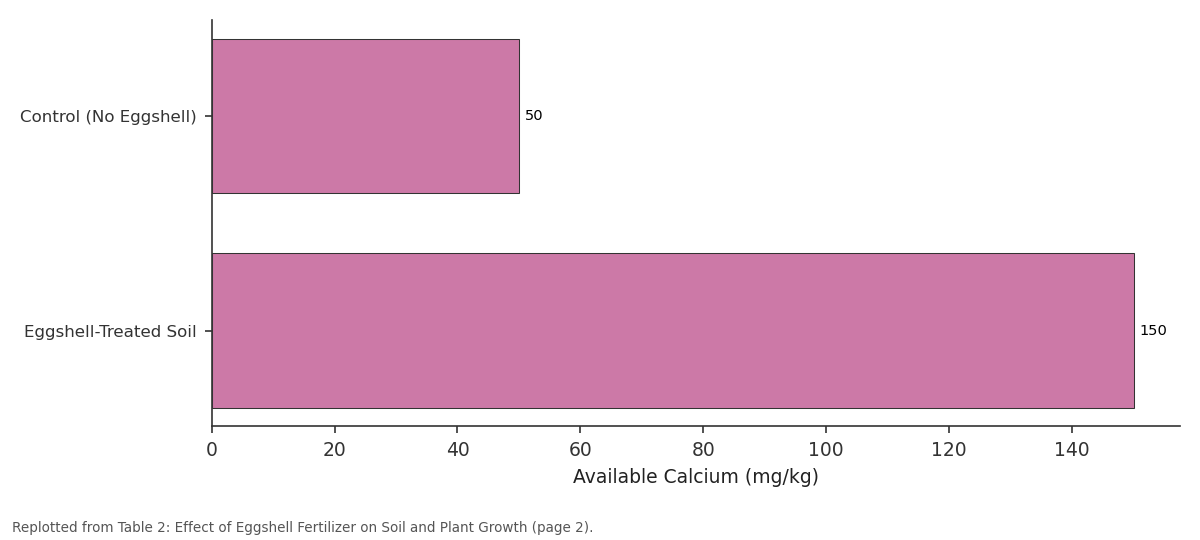
Available Calcium (mg/kg): Control (No Eggshell) vs Eggshell-Treated Soil
Replotted from Table 2 (page 2) of the original paper. Every bar is the paper's own table value.
View source evidence ↗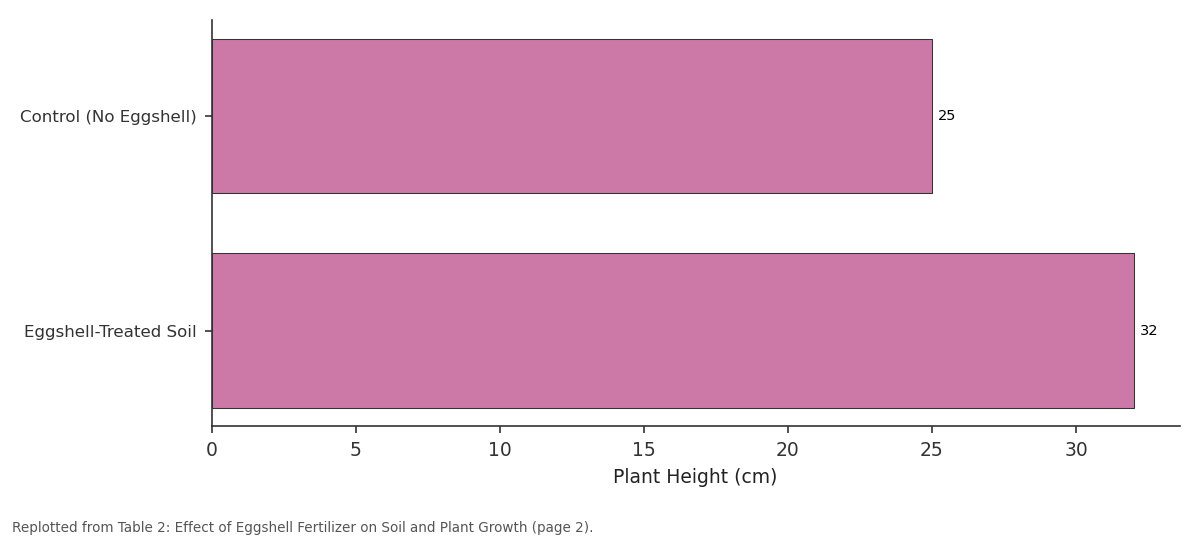
Plant Height (cm): Control (No Eggshell) vs Eggshell-Treated Soil
Replotted from Table 2 (page 2) of the original paper. Every bar is the paper's own table value.
View source evidence ↗Figures & tables
From the original paper Table 1
 Table 2
Introduction
Sustainable agriculture has become a pressing necessity due to increasing soil degradation and environmental concerns caused by excessive reliance on chemical fertilizers. Organic waste materials, such as eggshells, are being explored as eco-friendly alternatives to enhance soil fertility and plant health. Eggshells are a common byproduct of households and the poultry industry, often discarded as waste despite their rich composition of essential nutrients, primarily calcium carbonate (CaCO₃) (Rostami & Nasirian, 2019) [4] . Calcium plays a crucial role in plant development by strengthening cell walls, promoting root growth, and aiding in enzymatic activities (Goswami et al., 2017) [2] . Calcium deficiency in plants can lead to physiological disorders such as blossom-end rot in tomatoes and peppers, tip burn in lettuce, and bitter pit in apples (White & Broadley, 2003) [5] . Therefore, utilizing eggshells as a fertilizer could provide an effective solution to mitigate calcium deficiency in horticultural crops. In addition to calcium, eggshells contain trace amounts of magnesium, phosphorus, and potassium, which further support plant growth (Meyer, 2020) [3] . Their slow decomposition rate allows for the gradual release of nutrients, making them suitable for long-term soil conditioning. Moreover, eggshells contribute to improving soil aeration and reducing acidity, benefiting plant roots and microbial communities (Bolan et al., 2003) [1] . This paper examines the effectiveness of eggshells as an organic fertilizer in horticulture, emphasizing their nutrient composition, methods of application, and potential benefits. By integrating scientific equations and experimental studies, this research highlights how eggshells can be a sustainable and cost-effective soil amendment for modern agricultural practices.
Composition and Nutrient Content of Eggshells
Eggshells are primarily composed of calcium carbonate (CaCO₃), which constitutes about 95% of their total composition. Additionally, they contain: Calcium (Ca): Strengthens plant cell walls and aids in root development. Magnesium (Mg): Essential for chlorophyll synthesis and enzyme activation.
Potassium (K): Supports enzymatic activities, regulates water transport, and enhances drought resistance. Phosphorus (P): Aids in root and flower development and plays a crucial role in energy transfer within plants. Organic Proteins: Eggshells also contain small amounts of organic proteins, which contribute to soil microbial activity and nutrient cycling.
The decomposition of eggshells in the soil releases calcium and other minerals slowly, providing a long-term nutrient supply to plants. A key chemical reaction illustrating the breakdown of calcium carbonate in acidic soil conditions is: This reaction demonstrates how calcium ions become available for plant uptake while simultaneously helping to neutralize soil acidity. Furthermore, the gradual breakdown of eggshells enhances soil structure, improves aeration, and increases microbial activity, leading to improved soil fertility. The tabulated data highlights the effectiveness of eggshells as a sustainable fertilizer by demonstrating their contribution to soil improvement and plant growth. Below is the scientific interpretation of the findings:
Nutrient Composition of Eggshells (Table 1)
High Calcium Content (95%): Calcium is essential for strengthening plant cell walls, preventing disorders such as blossom-end rot in tomatoes and bitter pit in apples (White & Broadley, 2003) [5] . The release of calcium ions (Ca 2+ ) from eggshell decomposition enhances soil fertility. Magnesium (0.3%): Magnesium plays a crucial role in chlorophyll formation and photosynthesis, supporting plant metabolism (Goswami et al., 2017) [2] . Potassium and Phosphorus: These nutrients regulate enzymatic functions, support ATP synthesis, and improve root development, which are critical for plant health and resilience (Meyer, 2020) [3] . Organic Proteins (4.4%): These proteins contribute to microbial activity in the soil, aiding nutrient cycling and organic matter decomposition.
Impact on Soil and Plant Growth (
Impact on Soil and Plant Growth (
Scientific Significance
Sustainable Agriculture: The findings reinforce the role of eggshells in reducing reliance on synthetic fertilizers, thereby promoting eco-friendly farming. Cost-Effectiveness: As a waste-derived fertilizer, eggshells offer a low-cost solution for enhancing soil fertility and plant growth. Long-Term Soil Health: The slow-release nature of calcium from eggshells ensures prolonged soil conditioning, benefiting future crop cycles.
Methods of Using Eggshells as Fertilizer
Eggshells can be utilized in various ways to maximize their effectiveness as a fertilizer. Below are some common methods:
1. Crushed Eggshells: Eggshells can be crushed into small pieces and sprinkled directly around plants. This allows for the slow release of calcium and other minerals into the soil while also acting as a natural deterrent for pests such as slugs and snails.
Eggshell Powder:
For quicker nutrient absorption, eggshells can be ground into a fine powder using a blender or mortar and pestle. This powder can be mixed into the soil before planting or incorporated into potting mixtures to enhance soil calcium content.
Eggshell Tea:
A liquid fertilizer can be made by boiling eggshells in water for about 10-15 minutes, then allowing the solution to cool. This calcium-rich water can then be used to water plants, providing an easily absorbed source of nutrients.
Composted Eggshells: Adding eggshells to compost
bins enriches the compost with calcium and other essential minerals. Over time, the decomposition process helps integrate the nutrients into the compost, improving soil fertility. 5. Seed Starter Shells: Empty eggshell halves can be used as biodegradable seed starters. Small seedlings can be grown inside the shells, which can later be transplanted into the soil along with the eggshell, providing a direct source of calcium to young plants.
Each of these methods ensures that eggshells are effectively utilized in horticultural practices, promoting plant growth and enhancing soil health in an environmentally sustainable way. A notable experiment by Rostami & Nasirian (2019) [4] demonstrated that soil amended with eggshell powder resulted in a 20% increase in plant biomass and a 15% improvement in root strength compared to untreated soil. Furthermore, a study conducted by Meyer (2020) [3] found that eggshell-enriched compost increased nutrient retention and enhanced plant resilience in drought-prone environments.
Experimental Evidence and Benefits
A chemical equation representing calcium carbonate decomposition in acidic soils: This reaction helps neutralize soil acidity, making it beneficial for plant growth. Reduces kitchen waste and supports sustainable farming. Cost-Effective: A free and readily available alternative to commercial fertilizers. Soil Health Improvement: Enhances microbial activity and nutrient availability. Supports Organic Farming: Contributes to chemicalfree food production.
Conclusion
Eggshells are a valuable organic fertilizer that significantly improves soil health and plant growth. Their high calcium content, cost-effectiveness, and eco-friendly nature make them an excellent alternative to synthetic fertilizers. Future research should focus on optimizing eggshell decomposition rates and evaluating their long-term impact on different soil types. Utilizing eggshells as fertilizer is a step toward environmentally friendly and sustainable horticulture.
Figures and tables from the paper
| Nutrient | Percentage Composition (%) | Function in Plant Growth |
|---|---|---|
| Calcium (Ca) | 95.0 | Strengthens cell walls, prevents calcium deficiency disorders (e.g., blossom-end rot) |
| Magnesium (Mg) | 0.3 | Essential for chlorophyll synthesis and enzyme activation |
| Potassium (K) | 0.2 | Regulates water balance and supports enzymatic activities |
| Phosphorus (P) | 0.1 | Aids in root development and ATP synthesis |
| Organic Proteins | 4.4 | Supports microbial activity and enhances nutrient absorption |
Table text extracted from the original PDF; superscript letters are shown inline. The original table image is below.
View original table image
| Parameter | Control (No Eggshell) | Eggshell-Treated Soil | % Improvement |
|---|---|---|---|
| Soil pH | 5.5 | 6.5 | +18% |
| Available Calcium (mg/kg) | 50 | 150 | +200% |
| Plant Height (cm) | 25 | 32 | +28% |
| Root Length (cm) | 8 | 12 | +50% |
| Crop Yield (kg per hectare) | 2.5 | 3.2 | +28% |
Table text extracted from the original PDF; superscript letters are shown inline. The original table image is below.
View original table image
References
5 in the original paper- Bolan NS, Adriano DC, Curtin D. Soil acidification and liming interactions with nutrient and heavy metal transformation. Adv Agron. 2003;78:215-272.
- Goswami A, Banik S, Chowdhury S. Role of calcium in plant physiology: A review. Agric Rev. 2017;38(2):133-145.
- Meyer G. Sustainable soil amendments: The role of eggshells in soil fertility. J Organic Agric. 2020;7(1):56-67.
- Rostami M, Nasirian N. The impact of eggshell powder on soil pH and plant growth. Int. J Agric Sci Res. 2019;8(3):112-125.
- White PJ, Broadley MR. Calcium in plants. Ann Bot. 2003;92(4):487-511.