
Research article · 2025 · Full text
International Journal of Horticulture and Food ScienceCost-effectiveness and profitability analysis of polyhouse and open field cultivation for bottle gourd and marigold
Volume 7(3) · Pages 21–22 · DOI: 10.33545/26631067.2025.v7.i3a.275 ↗
Research areasEducational Reforms and Innovations
Abstract
Author-writtenThis review paper\\\\\\\\\\\\\\\\r\\\\\\\\\\\\\\\\npresents a comprehensive analysis of the comparative microclimate parameters in\\\\\\\\\\\\\\\\r\\\\\\\\\\\\\\\\na polyhouse and open field over four months (April to July) as part of the\\\\\\\\\\\\\\\\r\\\\\\\\\\\\\\\\nSustainable Cropping Model (SCM). The focus is on four key environmental\\\\\\\\\\\\\\\\r\\\\\\\\\\\\\\\\nfactors: temperature, humidity, light, and carbon dioxide (CO2)\\\\\\\\\\\\\\\\r\\\\\\\\\\\\\\\\nlevels. The results highlight the significant differences between the polyhouse\\\\\\\\\\\\\\\\r\\\\\\\\\\\\\\\\nand open field environments, with the polyhouse providing a more stable and\\\\\\\\\\\\\\\\r\\\\\\\\\\\\\\\\ncontrolled atmosphere for crop growth. These differences are substantiated by\\\\\\\\\\\\\\\\r\\\\\\\\\\\\\\\\nstatistical analysis, confirming the positive impact of the polyhouse in\\\\\\\\\\\\\\\\r\\\\\\\\\\\\\\\\nenhancing crop productivity. In addition, we explore the implications of these\\\\\\\\\\\\\\\\r\\\\\\\\\\\\\\\\nmicroclimate conditions on sustainable agriculture and propose future areas for\\\\\\\\\\\\\\\\r\\\\\\\\\\\\\\\\nresearch to improve polyhouse technologies and strategies for enhancing crop\\\\\\\\\\\\\\\\r\\\\\\\\\\\\\\\\nyields.
Summary
Source-checkedPlain-language reading of the full paper, prepared with AI and checked against the text. Each point links to the authors' own words.
Why it matters
- Sustainable agriculture is turning toward controlled environments like polyhouses to optimize crop growth conditions. View evidence ↗
- Polyhouses offer a regulated microclimate, which is more stable than the variable conditions found in open-field farming. View evidence ↗
The question
- The study aims to compare microclimate parameters, specifically temperature, humidity, light, and CO2 levels, between polyhouse and open field environments. View evidence ↗
What they did
- The analysis was conducted over a four-month period from April to July as part of a Sustainable Cropping Model (SCM). View evidence ↗
- Statistical analysis was used to determine the significance of variations in microclimate parameters, utilizing p-values for temperature, humidity, light, and CO2. View evidence ↗
What they found
- Polyhouse temperatures were lower and more stable (avg min 24.08 °C, max 26.1 °C) compared to the open field, which saw extremes between 35.0°C and 42.0 °C from April to July. View evidence ↗
- Humidity was higher in the polyhouse (min 32.67% to 67.67%; max 51.67% to 83.00%) than in the open field (min 19.47% to 65.67%; max 48.60% to 79.00%). View evidence ↗
- Light intensity was significantly lower in the polyhouse (avg min 22,301.92 Lux, max 23,438.8 Lux) compared to the open field (avg min 65,262.7 Lux, max 67,314.5 Lux). View evidence ↗
- CO2 concentrations were higher in the polyhouse (avg min 758.42 ppm, max 912.50 ppm) than in the open field (min 455.25 ppm, max 559.92 ppm). View evidence ↗
- The total production cost for bottle gourd and marigold was lower in the polyhouse (₹1735) than in the open field (₹1924). View evidence ↗
- The lower cost in polyhouses is attributed to reduced labor for weeding, sowing, and field preparation, which offsets higher electricity costs. View evidence ↗
- The Benefit-Cost Ratio (BCR) was reported as -1.02 for the polyhouse (gross return ₹2075 / net return ₹846) and -0.17 for the open field (gross return ₹470 / net return ₹2640). View evidence ↗
What it means
- The authors conclude that polyhouses are a promising solution for increasing crop resilience and yields amidst environmental variability and climate change. View evidence ↗
- The authors suggest that future research is needed to improve polyhouse technologies and strategies for increasing crop yields. View evidence ↗
Visual summary
1 visualsIllustrations explain the paper; they do not show study data.
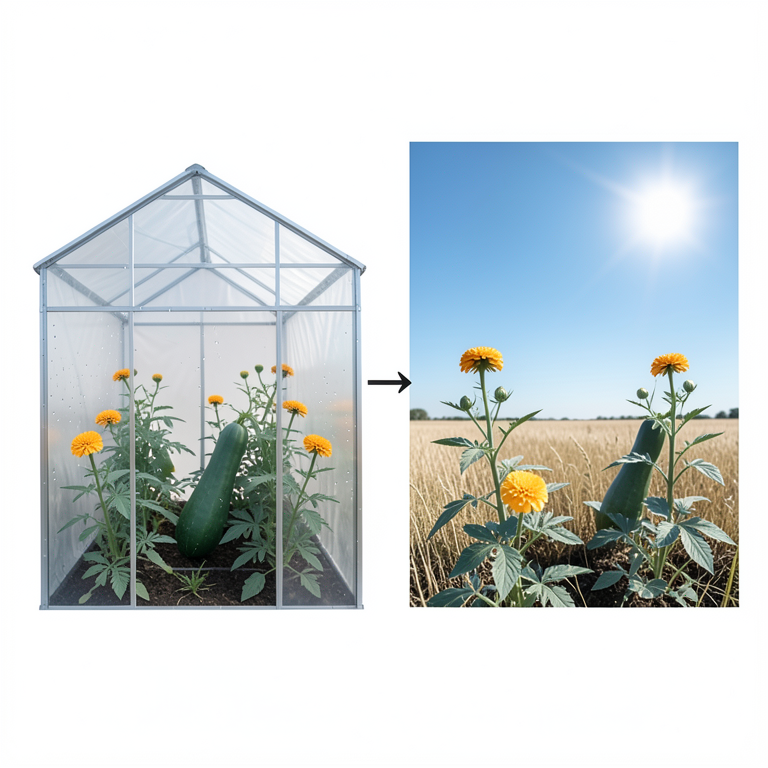
Microclimate Comparison
AI-generated conceptual illustration (bottle gourd and marigold plants in a polyhouse and an open field). It explains the idea and does not show study data.
View source evidence ↗Introduction
Sustainable agriculture is increasingly relying on controlled environments such as polyhouses to optimize the growth conditions for crops. The polyhouse provides a regulated microclimate, which contrasts with the variable conditions of open-field agriculture. This review focuses on the comparative analysis of microclimate parameters temperature, humidity, light, and CO 2 levels within both the polyhouse and open field. Understanding these factors' influence on crop productivity is crucial for developing sustainable cropping models, as explored in the Sustainable Cropping Model (SCM).
Temperature
In this study, the temperature was significantly lower and more stable within the polyhouse. The average minimum temperature in the polyhouse was 24.08 °C, with a maximum of 26.1 °C, making it an optimal environment for crops sensitive to heat stress. In contrast, the open field experienced extreme temperature fluctuations, with a minimum average temperature of 35.0°C and a maximum of 42.0 °C, particularly during the warmer months (April-July). According to Kumari and Jha (2015) [1] , the ideal temperature for crop growth ranges from 22.0 °C to 28.0 °C, a range that is more easily maintained in the polyhouse environment. These findings support the notion that polyhouses offer a more controlled environment, beneficial for minimizing heat stress in crops.
Innovative humidity control systems
Humidity levels were higher in the polyhouse, which is beneficial for crop growth. The minimum humidity ranged from 32.67% in April to 67.67% in July, while the maximum humidity ranged from 51.67% in May to 83.00% in July. The open field showed lower humidity, with minimum humidity ranging from 19.47% in May to 65.67% in July, and maximum humidity between 48.60% and 79.00%. Higher humidity in the polyhouse was found to promote crop growth, as evidenced by Singh (2006) [2] , who observed that polyhouses with a humidity range of 35.40% to 85.50% benefit crop production. The use of humidifiers, such as high-pressure systems and pulsators, further contributes to maintaining ideal conditions in the polyhouse.
Optimization of supplemental lighting
The light levels in the polyhouse were significantly lower than those in the open field, with the polyhouse recording an average minimum of 22,301.92 Lux and a maximum of 23,438.8 Lux. In comparison, the open field had an average minimum of 65,262.7 Lux and a maximum of 67,314.5 Lux. While natural sunlight is abundant in open-field agriculture, the polyhouse offers reduced light intensity. However, supplementary lighting can be used in polyhouses to ensure crops receive adequate light for photosynthesis, particularly during overcast weather or in regions with limited sunlight (Jarvis, 2014). This highlights the need for innovative lighting technologies to support polyhouse farming during shorter daylight periods.
Impact of elevated CO2 on crop yield
Polyhouses also maintain higher CO 2 concentrations, with an average minimum of 758.42 ppm and a maximum of 912.50 ppm. In comparison, the open field had lower CO 2 levels, with a minimum of 455.25 ppm and a maximum of 559.92 ppm. Enriched CO 2 levels in polyhouses are known to enhance plant growth and resilience, as demonstrated by Choudhury and Das (2023) [3] . Managing CO 2 levels in polyhouses can lead to more efficient photosynthesis and better crop yields, particularly for crops that benefit from elevated CO 2 concentrations.
Statistical analysis
The statistical analysis of the differences in microclimate parameters (temperature, humidity, light, and CO 2 levels) revealed significant variations between the polyhouse and open field, with p-values for temperature (0.04), humidity (0.01), light (0.03), and CO 2 (0.02). These differences were particularly pronounced in the months of April, May, and June, indicating that polyhouse conditions significantly diverge from those of the open field. Such findings validate the notion that polyhouses provide a more controlled environment conducive to crop growth.
Production cost of SCM (Bottle gourd + Marigold)
The analysis of production costs for cultivating bottle gourd and marigold reveals that the total cost is lower in the polyhouse (₹1735) compared to the open field (₹1924). This cost difference is primarily due to reduced labor costs for field preparation, sowing, and weeding in the polyhouse, despite the higher electricity expenses. A similar study by Kishore indicated that under polyhouse cultivation, the major expenses seed and sowing, harvesting, and fertilizers & manure totalled ₹2000, while under open field conditions, these costs amounted to ₹3000.
Economic Feasibility of SCM (Bottle Gourd + Marigold)
In terms of economic feasibility, both the polyhouse and open field models show a Benefit-Cost Ratio (BCR) of -1.02 for the polyhouse (gross return of ₹2075 divided by net return of ₹846) and -0.17 for the open field (gross return of ₹470 divided by net return of ₹2640). Similar findings were reported by Murthy, who observed that the returns for marigold were higher in polyhouse conditions, with a BCR of 2.21, compared to 1.82 for open field cultivation.
Conclusion
The findings from this review confirm the significant advantages of polyhouse farming over open-field agriculture in terms of providing a stable and controlled environment for crop growth. Temperature, humidity, light, and CO 2 levels are all crucial factors in determining crop productivity, and the polyhouse offers a clear advantage in maintaining optimal conditions. As sustainable agriculture continues to evolve, polyhouses represent a promising solution for improving crop yields and resilience, particularly in the face of climate change and environmental variability.
References
5 in the original paper- Kumari S, Jha D. Effect of temperature on crop growth in polyhouses. J Agric Sci., 2015.
- Singh R. Role of humidity in polyhouse cultivation. Agric Eng J., 2006.
- Choudhury A, Das M. CO 2 enrichment in polyhouses for improved crop production. Environ Agric J., 2023.
- Jarvis P. Supplemental lighting for polyhouse crop production. Int J Hortic Sci., 2014.
- Singh HP, Dhankhar SS, Dahiya KK. Horticultural crops. Stadium Press (India) Pvt Limited; 2009.
Cited by 1
From OpenAlex, OpenCitations and reference lists read by Scinovex
- Innovative nursery and propagation technique
Kalpana Kunjam, Ritika Samrath, Eshu Sahu, Sarita Paikra · International Journal of Research in Agronomy · 2026
Nursery management and propagation techniques are central to producing high-quality planting material in horticulture, forestry, and agriculture. Traditional practices such as cuttings, grafting, and seed propagation are increasingly complemented by advanced methods including micro propagation, aeroponics, and integrated technology systems. These innovations improve propagation rates, genetic fidelity, resource efficiency, and year-round production. This paper reviews contemporary advances, discusses their applications, and highlights future research needs.