
Research article · 2025 · Full text
International Journal of Agriculture and Food ScienceImpact of polyhouse cultivation on yield, microclimate, and profitability: A comparative study with open-field farming
Volume 7(3) · Pages 15–16 · DOI: 10.33545/2664844x.2025.v7.i3a.309 ↗
Research areasGreenhouse Technology and Climate Control
Abstract
Author-writtenThis review explores the impact of polyhouse and open-field environments on the production parameters and economic feasibility of cultivating marigold and chrysanthemums. The study analyses factors such as irrigation, temperature, humidity, light intensity, and CO2 levels while also evaluating economic returns. Findings indicate that polyhouse conditions offer enhanced environmental control, leading to improved yield, resource efficiency, and financial viability compared to open-field cultivation.
Summary
Source-checkedPlain-language reading of the full paper, prepared with AI and checked against the text. Each point links to the authors' own words.
Why it matters
- Floriculture is a vital part of modern agriculture, playing a major role in the commercial production of flowers and the ornamental plant industry. View evidence ↗
- Polyhouses are used to control microclimatic factors like CO2 levels, light intensity, humidity, and temperature, which directly affect how plants develop and their overall productivity. View evidence ↗
- Polyhouse technology is especially useful in areas where inconsistent weather patterns make it difficult to produce flowers reliably. View evidence ↗
The question
- The study aims to critically examine the differences in economic feasibility and production parameters when growing chrysanthemums and marigolds in polyhouses versus open fields. View evidence ↗
What they did
- The evaluation focused on CO2 levels, light intensity, humidity control, temperature regulation, and irrigation efficiency, as well as a financial analysis of profitability and yield. View evidence ↗
- A t-test was used to analyze the statistical significance of the differences in environmental parameters between the open field and the polyhouse. View evidence ↗
What they found
- In the polyhouse, marigold and chrysanthemum crops needed irrigation every 16 days, whereas in the open field, they required it every 24 days. View evidence ↗
- Over a four-month period, the polyhouse required only four weeding sessions, while the open field required eight. View evidence ↗
- During peak summer, the polyhouse temperature stayed between 19.2°C and 28.3°C, which was significantly lower than the open field's 33.4°C to 37.3°C. View evidence ↗
- Average humidity in the polyhouse was higher, ranging from 57.2% to 80%, compared to 52.75% to 71% in the open field. View evidence ↗
- Light intensity was lower in the polyhouse (average range 21,962.5 to 61,365.2 Lux) than in the open field (26,370.5 to 63,776.0 Lux). View evidence ↗
- CO2 levels were higher in polyhouses, ranging from 517 ppm to 665.2 ppm, compared to 426.75 ppm to 600.7 ppm in the open field. View evidence ↗
- Polyhouse yields were significantly higher: marigolds reached 10 kg (a 100% increase over 5 kg in open fields) and chrysanthemums reached 7 kg (a 250% increase over 2 kg in open fields). View evidence ↗
- The polyhouse model had a significantly higher benefit-cost ratio (BCR) of 12.94 (gross return ₹3250, net return ₹251) compared to the open field's BCR of 1.14 (gross return ₹1600, net return ₹-1401). View evidence ↗
- When land rent was excluded, the polyhouse BCR was 2.2, while the open field had a negative BCR of -7.4. View evidence ↗
What it means
- The authors conclude that polyhouse farming is superior to open-field cultivation regarding economic feasibility, climate regulation, and resource efficiency. View evidence ↗
- The authors recommend polyhouse farming as a sustainable and profitable choice for agripreneurs wanting to optimize the production of floral crops. View evidence ↗
Visual summary
1 visualsIllustrations explain the paper; they do not show study data.
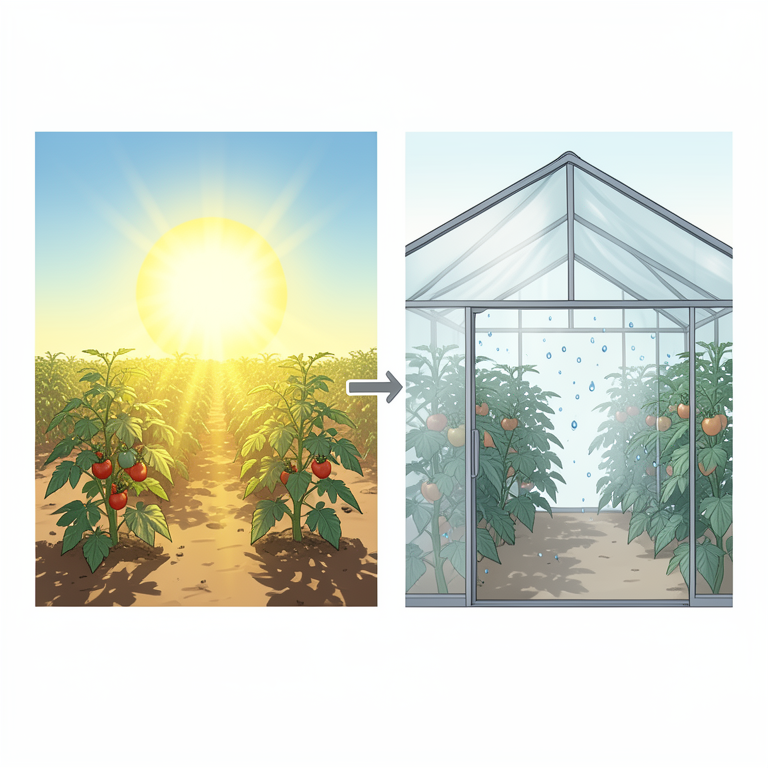
Microclimate Comparison
AI-generated conceptual illustration (Tomato plants in an open field and a polyhouse). It explains the idea and does not show study data.
View source evidence ↗Introduction
Floriculture is an essential component of modern agriculture, contributing significantly to the ornamental plant industry and commercial flower production. The cultivation of flowers such as marigold (Tagetes erecta) and chrysanthemum (Chrysanthemum morifolium) is widely practiced in both polyhouse and open-field environments. While open-field cultivation remains a conventional method, polyhouses have gained popularity due to their ability to provide controlled environmental conditions that optimize plant growth and yield. Polyhouses regulate key microclimatic factors such as temperature, humidity, light intensity, and CO2 concentration, all of which directly influence plant development and productivity. The adoption of polyhouse technology is particularly advantageous in regions where climatic variability poses challenges to consistent flower production. By mitigating extreme temperature fluctuations, conserving water, and enhancing CO2 availability, polyhouses create an ideal setting for floriculture. However, the economic viability of these structures remains a crucial consideration for farmers and agripreneurs. This review critically examines the differences in production parameters and economic feasibility between polyhouse and open-field cultivation of marigold and chrysanthemum. It evaluates irrigation efficiency, temperature regulation, humidity control, light intensity, and CO2 levels in both systems, alongside a financial assessment of yield and profitability. By analysing these factors, the study aims to provide insights into the benefits and challenges associated with polyhouse farming, offering guidance for sustainable agribusiness practices in floriculture.
Research Production Parameters in Polyhouse and Open-Field Cultivation Irrigation and Weeding:
The controlled environment of a polyhouse reduces water consumption and maintenance efforts. Marigold and chrysanthemum crops required irrigation every 16 days in the polyhouse, compared to every 24 days in the open field. Similarly, weeding frequency in the polyhouse was significantly lower, occurring only four times over four months, whereas the open field required eight weeding sessions in the same period. Studies by Alam and Rahman (2022) [1] emphasize the efficiency of modern irrigation techniques, particularly drip irrigation, in conserving water and promoting plant health.
Temperature Regulation
The polyhouse maintained a temperature range of 19.2°C to 28.3°C, significantly lower than the open field, where temperatures fluctuated between 33.4°C and 37.3°C during peak summer months. Mukazhanov et al. (2017) [7] highlighted the influence of temperature on crop yield, indicating that optimal temperature control (18.5-29.5°C) in polyhouses facilitates better plant growth and productivity.
Humidity Levels
Humidity levels were consistently higher in the polyhouse, particularly in August when maximum humidity reached 99%. The average humidity levels in the polyhouse ranged from 57.2% to 80%, compared to 52.75% to 71% in the open field. Johnson and Patel (2023) [5] demonstrated that controlled humidity (fluctuating between 55% and 85%) in enclosed environments significantly impacts plant growth and moisture retention.
Light Intensity
Polyhouses exhibited lower light intensity compared to open fields, particularly during August and September. The open field recorded light levels between 26,370.5 and 63,776.0 Lux, whereas the polyhouse had an average range of 21,962.5 to 61,365.2 Lux. Research by Thompson and Lee (2023) [8] suggests that polyhouses, while providing a controlled environment, may not always match the optimal light intensity required for maximum photosynthesis and crop yield.
CO2 Levels
CO2 concentration in polyhouses was consistently higher than in the open field, with levels ranging between 517 ppm and 665.2 ppm, compared to 426.75 ppm to 600.7 ppm in open conditions. Studies by Garcia and Chen (2023) [3] indicate that higher CO2 levels (525.5 to 680.5 ppm) enhance photosynthesis, leading to increased crop productivity.
Microclimate Comparison: Statistical Analysis
A t-test analysis revealed significant differences in environmental parameters between the polyhouse and open field. Temperature was consistently higher in polyhouses, with significant p-values (0.01) in September and October. Humidity levels showed significant variations (p-values of 0.06 and 0.03 in August and September, respectively). Light intensity was significantly higher in open fields, with a pvalue of 0.03. Similarly, CO2 concentrations varied significantly, particularly in September and October (pvalues of 0.04 and 0.03). Kumar and Singh (2022) [6] highlighted the advantages of controlled temperature and humidity in polyhouses, facilitating off-season cultivation and improving yield quality.
Economic Feasibility of Polyhouse and Open-Field Cultivation
A financial assessment comparing polyhouse and open-field cultivation analyzed total production costs, gross returns, net returns, and benefit-cost ratios (BCR). Results indicated that the polyhouse model yielded a significantly higher BCR of 12.94 (gross return: ₹3250, net return: ₹251), compared to an open-field BCR of 1.14 (gross return: ₹1600, net return: ₹-1401). Excluding land rent, the BCR for polyhouses was 2.2, while the open field recorded a negative BCR of -7.4.
Bijalwan et al. (2017) [2] also observed higher BCRs in polyhouse floriculture, with values ranging from 1.89 to 2.39 for marigolds, as opposed to lower BCRs for other open-field flower crops.
Production Yield Analysis
Marigold and chrysanthemum yields were significantly higher in polyhouses, with marigold production reaching 10 kg (100% increase over open-field yields of 5 kg). Chrysanthemum production in polyhouses was 7 kg, a 250% increase compared to the 2 kg yield in open fields. Hinai et al. (2022) [4] reported similar trends in marigold cultivation, emphasizing that controlled environments enhance production efficiency. In India, key marigold-producing states contribute substantially to national output, with polyhouse production surpassing open-field yields in several regions.
Conclusion
The findings of this review highlight the advantages of polyhouse farming over open-field cultivation in terms of resource efficiency, climate regulation, and economic feasibility. Polyhouses offer a controlled environment that enhances irrigation efficiency, maintains optimal temperature and humidity levels, and increases CO2 concentration, all contributing to improved crop yield and financial viability. The economic analysis further underscores the profitability of polyhouse farming, making it a sustainable choice for agripreneurs looking to optimize floral crop production.
References
8 in the original paper- Alam M, Rahman S. Modern irrigation techniques and water conservation in floriculture. Agric Water Manag. 2022;204:106345.
- Bijalwan A, Sharma C, Kumar R. Economic analysis of floriculture: A case study of polyhouse marigold cultivation. Int J Agric Sci. 2017;9(2):124-130.
- Garcia R, Chen L. CO2 enrichment in greenhouse environments and its impact on crop yield. Environ Plant Physiol. 2023;45(3):215-230.
- Hinai A, Patel R, Verma D. Trends in marigold production and the impact of climate-controlled environments. Indian J Hortic. 2022;67(1):78-91.
- Johnson L, Patel S. Humidity regulation in polyhouse cultivation and its effects on plant growth. J Agron Crop Sci. 2023;189(4):321-335.
- Kumar A, Singh R. Off-season floriculture and climatecontrolled polyhouse farming. Hortic Res Technol. 2022;21(5):56-72.
- Mukazhanov A, Lee H, Thompson M. Temperature influence on floriculture crop yield in controlled environments. J Greenhouse Stud. 2017;30(2):112-129.
- Thompson A, Lee M. Light intensity management in polyhouses and its implications for photosynthesis. Plant Growth Environ. 2023;14(1):52-67.