
Research article · 2025 · Full text
International Journal of Biology SciencesThe role of tunnels in predator-prey interactions and their significance in Mugger Crocodile survival and behavior
Volume 7(2) · Pages 106–108 · DOI: 10.33545/26649926.2025.v7.i2b.307 ↗
Research areasPaleontology and Evolutionary BiologyEvolution and Paleontology StudiesAvian ecology and behavior
Abstract
Author-writtenThis study has recorded observations on maintenance behaviour pertaining to basking and use of tunnels by Mugger crocodiles Crocodylus palustris and also the role of tunnels in predator-prey interaction of Bhor-Saidan Crocodile Sanctuary, located in the Kurukshetra district of state Haryana. The Mugger crocodile moves between land and water, driven by its circadian rhythm, primarily to regulate its body temperature. It was observed using a mix of heat-seeking and heat-avoiding behaviors, which include immersing itself in water, basking, and retreating to tunnels. When emerging from the water to bask on land, the Mugger adopts intermediate postures such as pre-basking, surface basking, and shallow water basking, with the amount of time spent in each posture varying with the seasons. Additionally, the Mugger was seen digging separate tunnels along riverbanks for resting and nesting. The study also documents interactions between the Mugger and both conspecifics and other species sharing its habitat. The research highlights the importance of understanding crocodile behavior to gain insights into their species-specific natural history and inform conservation management efforts.
Summary
Source-checkedPlain-language reading of the full paper, prepared with AI and checked against the text. Each point links to the authors' own words.
Why it matters
- The Mugger, or Indian Marsh Crocodile, is a freshwater species primarily found in Iran and the Indian subcontinent. View evidence ↗
- Research on crocodilians has historically focused on ecology and human-wildlife conflicts, leaving their ethology (behavior) understudied. View evidence ↗
- Studying animal behavior is critical for conservation management because it reveals how species utilize and occupy habitat resources. View evidence ↗
The question
- The study aimed to observe the maintenance behaviors of Mugger crocodiles, specifically their basking patterns and the use of tunnels, including the role of tunnels in predator-prey interactions. View evidence ↗
What they did
- The researchers conducted direct field observations of Mugger crocodiles at the Bhor-Saidan Crocodile Sanctuary in Haryana, India, starting in 2023. View evidence ↗
- The methodology involved seasonal observations using binoculars from the riverbank, with each individual crocodile monitored for a minimum of 20 minutes. View evidence ↗
- Data collection was supplemented by digital photography, video recording, and interviews with local community members. View evidence ↗
What they found
- Mugger crocodiles regulate their body temperature via circadian rhythms, alternating between heat-seeking behaviors like basking and heat-avoiding behaviors like immersing in water or retreating to tunnels. View evidence ↗
- The crocodiles use seasonal intermediate postures, including pre-basking, surface basking, and shallow water basking, when transitioning from water to land. View evidence ↗
- The study identified only 'simple' tunnels across all four sites, which measured between 12 and 14 feet in length. View evidence ↗
- Nesting tunnels are distinguished from resting tunnels by their crescent-shaped openings, the use of stones to block the entrance, and angled passages designed to prevent flooding. View evidence ↗
- Evidence of tunnel usage during summer was confirmed by indirect signs, specifically belly-crawl imprints and tail drag marks in the mud. View evidence ↗
- Local fishing communities provided evidence of hatchling presence during the monsoon season. View evidence ↗
What it means
- The authors conclude that the Bhor-Saidan Crocodile Sanctuary must be preserved as it faces serious threats from pollution, urbanization, and infrastructure projects. View evidence ↗
- The authors state that understanding species-specific behaviors is essential for gaining insights into natural history and informing conservation strategies. View evidence ↗
Visual summary
1 visualsIllustrations explain the paper; they do not show study data.
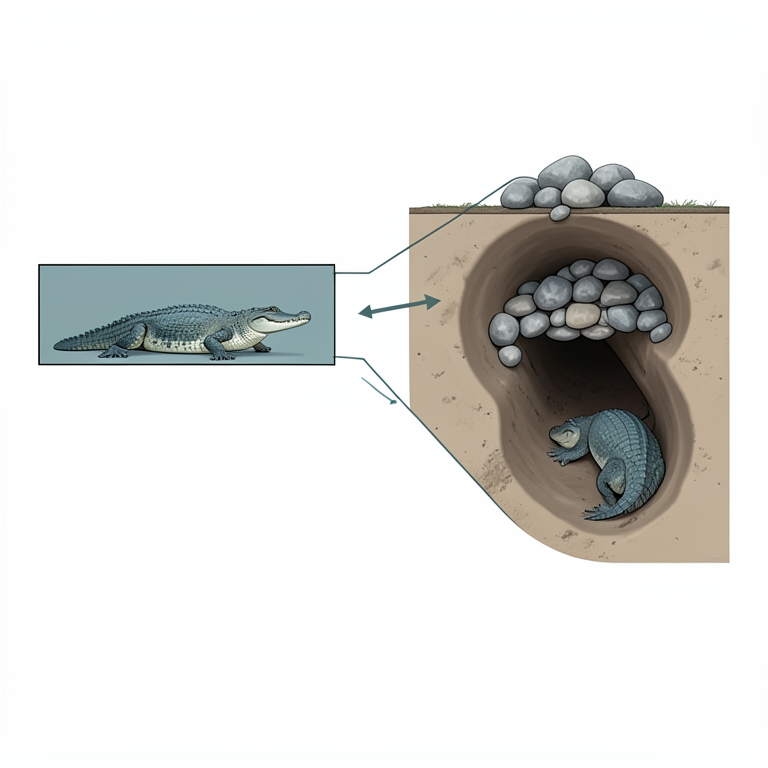
Nesting vs Resting Tunnel Structure
AI-generated conceptual illustration (Mugger crocodiles in riverbank tunnels). It explains the idea and does not show study data.
View source evidence ↗Introduction
The Mugger, or Indian Marsh Crocodile (Crocodylus palustris), once widely distributed, is now primarily found in the Indian subcontinent and Iran, where it inhabits freshwater environments such as rivers, lakes, and marshes. In India and Sri Lanka, Muggers can also be found in artificial habitats like reservoirs, irrigation canals, ponds, and even estuarine waters (Whitaker and Whitaker, 1989) [26] . The species is considered a source of conflict in some areas (Borkar et al., 1993; Distefano, 2008; Whitaker, 2008; Rao and Gurjwar, 2013; Upadhyay and Sahu, 2013; Vasava et al., 2015; Pooley, 2016) [27] . Once severely endangered, the Mugger has made a remarkable recovery and is now found in healthy, viable populations across India (De Vos, 1984; Jacobson, 1999; Singh, 1999; Da Silva and Lenin, 2010; Gour et al., 2022) [32,31] . While crocodilian research primarily focuses on ecology and conflicts, little attention has been paid to their ethology. The study of crocodilian behavior in India is still in its early stages, with much of the understanding of their behavior coming from observations of captive animals (Desai et al., 2022) [33] . Their tendency to remain relatively still presents a challenge for behavioral biologists, compounded by their shyness, quiet nature, elusive behavior, and sensitivity to disturbances. A key aspect of behavioral studies is understanding how the species adapt to their environments, blending innate and learned behaviors to enhance their survival in dynamic and often challenging habitats. Crocodilian behavior is often viewed as stereotypical and driven by innate responses. However, extended in situ observations indicate that these behaviors exhibit plasticity, pointing to potential learning capabilities. Traditionally, crocodile behavior is classified according to its main functions: maintenance, social interaction, and reproduction (Lang, 1987a) [41] . Since the effective use and occupancy of resources in a habitat depend on the behavior of the species, ethology offers valuable insights for conservation management.
Materials and Methods
Since 2023, we have been monitoring the Muggers at the Bhor-Saidan Crocodile Sanctuary in Kurukshetra district, Haryana, through direct field observations. These observations involved long hours using binoculars while sitting on the riverbank to study their basking patterns, tunnel constructions, and usage. Observations were made across all seasons, with each individual being monitored for at least 20 minutes at a time. All basking sites were mapped and regularly visited, and we noted the wariness and distribution patterns during basking. We observed a dominance of intermediate phases between submergence in water and emergence for basking across seasons. The riparian areas along the river were searched for tunnels, and upon finding any, we thoroughly examined them for active and abandoned nests and other indirect signs. Digital and DSLR cameras were used to capture photographs and videos, and additional information was gathered through interviews with local residents.
Results and Discussion
Cott (1975) [35] concluded that crocodilian thermoregulation is influenced by both habitat selection and behavioral adaptations. Species like the Mugger use burrows or tunnels as shelters during cold and dry periods (Ross et al., 1989). Several studies (Bayani et al., 2011; Gupta, 2011; Zafar and Malik, 2018) [37,25,38,36] have documented Muggers digging tunnels to escape extreme sunlight in the summer and to take refuge during the monsoon rains. In our field study, Muggers were observed building nests at the entrances of these tunnels. The link between tunnels and nesting has been well established (Mazzotti, 1983; Whitaker and Whitaker, 1984) [40] . Zafar and Malik (2018) [25] reported that Mugger crocodiles inhabit holes (likely tunnels) closest to water bodies. Of the four types of tunnels described by Bayani et al. (2011) [37] , we only found simple tunnels, measuring 12-14 feet long, at all four sites in this study. The nests were either just outside the tunnel entrance or located immediately inside. The nesting tunnels, with their crescentshaped openings, differ from resting tunnels in that they are blocked with stones at the entrance and have an angled passage to prevent flooding. Habitat modifications around nesting areas, such as clearing and creating trails or runways, have also been reported (Lang, 1987a) [41] . The site with the steepest slope we studied contains numerous resting and nesting tunnels. For safety reasons and to preserve the integrity of the tunnels, we refrained from photographing Muggers inside them. However, indirect signs of tunnel use, such as tail drag marks and belly-crawl imprints on the soft mud outside, were observed during the summer months. Additionally, local fishing communities confirmed the presence of many hatchlings during the monsoon season. Gupta (2011) [38] reported that older Muggers tend to occupy tunnels at higher levels on the earth mound, while younger crocodiles prefer tunnels closer to the water, at the lower edge of the mound. Their use of tunnels is also influenced by the daily light cycle, in alignment with temperature changes. Some tunnels, meanwhile, remain unoccupied and may be from previous seasons.
Conclusion
The data on tunnel behavior presented here comes from a long-term monitoring study of Muggers at the Bhor-Saidan Crocodile Sanctuary in Haryana, India. This crocodile habitat is under serious threat from rapid urbanization, pollution, and proposed linear infrastructure projects, and it must be preserved. Tunnel construction and use serve both maintenance and reproductive functions. These behaviors have species-specific characteristics and are essential for understanding the Mugger's natural history, as well as for refining conservation management strategies.
References
41 in the original paper- Brown GP, Shine R. Do microbiota in the soil affect embryonic development and immunocompetence in hatchling reptiles? Front Ecol Evol. 2021;9:780456. doi:10.3389/fevo.2021.780456
- Buenviaje G. Studies on skin diseases of crocodiles [PhD thesis]. Townsville: James Cook University; 2000.
- Behrouzi B, Abtin E, Mobaraki A. Mugger crocodile habitat suitability study. Crocodile Specialist Group Newsletter. 2010;29:8-10.
- Buenfil-Rojas A, Alvarez T, González MJ, Rendon von Osten J, Cedeño-Vázquez J. Effectiveness of Morelet's crocodile as a bioindicator of metal pollution and metallothionein response to spatial variations of metal exposure. Environ Adv. 2022;8:100251. doi:10.1016/j.envadv.2022.100251
- Choudhary S, Choudhury BC. Spatio-temporal partitioning between two sympatric crocodilians (Gavialis gangeticus & Crocodylus palustris) in Katarniaghat Wildlife Sanctuary, India. Aquat Conserv Mar Freshw Ecosyst. 2018;28(10). doi:10.1002/aqc.2965
- Choudhury BC, de Silva A. Crocodylus palustris. In: The IUCN Red List of Threatened Species. 2013. Available from: https://doi.org/10.2305/IUCN.UK.20132.RLTS.T5667A3046723.en
- Davidson NC. How much wetland has the world lost? Long-term and recent trends in global wetland area. Mar Freshw Res. 2014;65:936-941. doi:10.1071/MF13160
- De Silva A. Crocodiles of Sri Lanka: Preliminary assessment of their status and the human crocodile conflict situation. Report submitted to Mohamed Bin Zayed Species Conservation Fund. Gampola: Mohamed Bin Zayed Species Conservation Fund; 2010.
- Fellows S. A survey of the abundance, population structure, and distribution of Mugger Crocodiles (Crocodylus palustris) using day ground surveys in District Bhopal and its impact on the community. JOJ Wildl Biodivers. 2019;1:14-22.
- Hennessy DJG. Green aisles: A story of the jungle of Ceylon. Colombo: Colombo Book Centre; 1949.
- Kommanee J, Preecharram S, Daduang S, Temsiripong Y, Dhiravisit A, Yamada Y, et al. Antibacterial activity of plasma from crocodile (Crocodylus siamensis) against pathogenic bacteria. Ann Clin Microbiol Antimicrob. 2012;11:22. doi:10.1186/1476-0711-11-22
- Madawala MB, Amarasinghe AAT, Botejue WMS, Somaweera R, Karunarathna DMS, de Silva A. The Muggers of Sri Lanka-Conflicts and conservation. In: Proceedings of the Association for Tropical Biology and Conservation 51st Annual Meeting; 2014 Jul 15-19;
- Cairns, Australia. Cairns: Association for Tropical Biology and Conservation; 2014. p. 1-5.
- Mobaraki A, Abtin E. Estimate of Mugger population in Iran. Crocodile Specialist Group Newsletter. 2013;32:11-21.
- Nicholas CW. Administrative report of the warden. Department of Wildlife for 1955. Colombo: The Government Press; 1956.
- Rahim A, Gabol K, Ahmed W, Batool A. Population assessment, threats, and conservation measures of Marsh Crocodile at Dasht River, Gwadar. Pak J Mar Sci. 2018;27:45-53.
- Santiapillai C, de Silva M. Status, distribution, and conservation of crocodiles in Sri Lanka. Biol Conserv. 2001;97:305-318. doi:10.1016/S0006-3207(00)00175X
- Santiapillai C, de Silva M, Dissanayake S, Jayaratne BVR, Wijeyamohan S. An ecological study of crocodiles in the Ruhuna National Park, Sri Lanka. J Bombay Nat Hist Soc. 2000;97:33-41.
- Singh Y, Gurjwar RK, Lodhi R, Rao RJ. People's perception on wildlife in National Chambal Sanctuary, Madhya Pradesh, India. Int J Biol Sci. 2020;2:8-15. doi:10.32991/ijbs.02020
- Tickner D, Opperman JJ, Abell R, Acreman M, Arthington AH, Bunn SE, et al. Bending the curve of global freshwater biodiversity loss: An emergency recovery plan. BioScience. 2020;70:330-342. doi:10.1093/biosci/biaa002
- Vasudevan K. Nesting ecology of Mugger Crocodylus palustris in Amaravathi, southern India. Hamadryad. 1998;22:107-110.
- Whitaker R, Andrews HV. Crocodile conservation, Western Asia region: An update. J Bombay Nat Hist Soc. 2003;100:432-445.
- Whitaker R, Daniel RC. The status of Asian crocodilians. Tiger Paper. 1978;5:12-17.
- Whitaker R, Whitaker Z. Sri Lanka crocodile survey. Loris. 1977;15:239-241.
- Zafar M, Malik MF. A review on status and conservation of mugger crocodile. Environ. 2018;19:21. doi:10.1146/108-909.
- Whitaker R, Whitaker J. Crocodilian ecology in India. 1989.
- Borkar AM, Distefano G, Whitaker R, Rao S, Gurjwar M, Upadhyay N, Sahu N, Vasava D, Pooley S. The conflict between crocodiles and humans. 1993; 2008; 2013; 2013; 2015; 2016.
- De Vos V. Crocodilian conservation in India. 1984.
- Jacobson ER. Crocodiles in India: Conservation challenges and successes. 1999.
- Singh P. The recovery of the Mugger crocodile. 1999.
- Da Silva M, Lenin A. Mugger crocodile populations in India: A review. 2010.
- Gour A, et al. Viable crocodile populations in India: A study. 2022.
- Desai R, et al. Behavioral ecology of crocodilians in India. 2022.
- Lang JW. Crocodilian behavior: A study of the Mugger's ethology. 1987.
- Cott HB. Thermoregulation and habitat selection in crocodilians. 1975.
- Ross CA, et al. Crocodile sheltering behaviors and adaptations. 1989.
- Bayani M, et al. Thermoregulatory behavior in Mugger crocodiles. 2011.
- Gupta D. Tunnels and nesting of Mugger crocodiles in India. 2011.
- Zafar U, Malik M. Tunnels and nesting sites of Mugger crocodiles. 2018.
- Mazzotti FJ. The role of nesting tunnels in crocodilian behavior. 1983.
- Lang JW. Crocodile nesting behavior and habitat modification. 1987.