
Research article · 2025 · Full text
International Journal of Horticulture and Food ScienceEffect of three insecticides on the life table parameters of a Harpactorinae reduviid Rhynocoris longifrons (Stal°) (Hemiptera: Reduviidae)
Volume 7(2) · Pages 53–56 · DOI: 10.33545/26631067.2025.v7.i2a.269 ↗
Research areasHemiptera Insect Studies
Abstract
Author-writtenThree commonly used\r\norganophosphorus insecticides in the agro ecosystems namely, monocrotophos,\r\nquinalphos and dimethoate were studied for their efficacy on the life table\r\nparameters in the laboratory in a Harpactorinae reduviid predator Rhynocoris\r\nlongifrons (Stal). The LC50 was calculated for all the three\r\ninsecticides for 24, 48, 72 and 96 hour durations. All the insecticides\r\nincreased their incubation period, stadial period, pre oviposition period and\r\nnymphal mortality and decreased their fecundity, hatchability and adult\r\nlongevity. Maximum reduction was noticed in the monocrotophos treated category\r\nfollowed by quinalphos and dimethoate. The Gross reproductive rate and Net\r\nreproductive rate of R. longifrons is 78.00 and 94.38 respectively which\r\nis reduced to 57.00 and 29.36, 69.00 and 34.54 and 64.00 and 31.58 respectively\r\nfor monocrophos, quinalphos and dimethoate treated category in R. longifrons.
Summary
Source-checkedPlain-language reading of the full paper, prepared with AI and checked against the text. Each point links to the authors' own words.
Why it matters
- Broad-spectrum insecticides intended for plant pests often have significant negative impacts on non-target species within agricultural ecosystems. View evidence ↗
- The reduviid predator Rhynocoris longifrons is a valuable biological control agent in fruit and vegetable crops because it predates on economically important pests. View evidence ↗
- There is a knowledge gap regarding how chemical pesticides affect predators and parasites compared to their known effects on herbivorous pests. View evidence ↗
The question
- The study aims to understand how three common organophosphate insecticides affect the Harpactorinae reduviid Rhynocoris longifrons. View evidence ↗
What they did
- R. longifrons adults and nymphs were collected from the foothills of Chunkankadai in the Kanyakumari district of Tamil Nadu. View evidence ↗
- Laboratory conditions were maintained at 30±2 °C, 75-80% relative humidity, and an 11-13 hour photoperiod, with insects fed on Corcyra cephalonica larvae. View evidence ↗
- Sub-lethal concentrations were set at 1/10th of the 48-hour LC50, resulting in 0.0016% for monocrotophos, 0.0058% for quinalphos, and 0.0030% for dimethoate. View evidence ↗
- Fifteen III instar nymphs per group were treated topically on the thorax with 20 µl of insecticide, while a control group of 15 nymphs received 20 µl of water. View evidence ↗
What they found
- Insecticides extended the incubation period from a control of 7.31±0.34 days to 9.51±0.46 days (monocrotophos), 8.42±0.22 days (quinalphos), and 7.84±0.31 days (dimethoate). View evidence ↗
- Adult longevity decreased for both sexes; monocrotophos caused the greatest reduction, lowering male longevity from 81.38±10.43 to 70.46±6.31 days and female longevity from 89.62±12.48 to 72.23±0.55 days. View evidence ↗
- The gross reproductive rate decreased from 78.00 in the control group to 57.00 (monocrotophos), 64.00 (quinalphos), and 69.00 (dimethoate). View evidence ↗
- The mean generation length increased from 94.84 days in control insects to 120.14 days with monocrotophos, 116.33 days with quinalphos, and 103.56 days with dimethoate. View evidence ↗
- The weekly multiplication rate fell from 1.286 in control insects to 1.184 (monocrotophos), 1.220 (quinalphos), and 1.256 (dimethoate). View evidence ↗
What it means
- The authors conclude that all three insecticides negatively impact the biology and life table parameters of R. longifrons and are not recommended for use in integrated pest management. View evidence ↗
- While monocrotophos was the most toxic and quinalphos followed, the authors suggest dimethoate is relatively safer for application in IPM programs. View evidence ↗
Visual summary
3 visualsIllustrations explain the paper; charts are replotted from the paper's own table values.
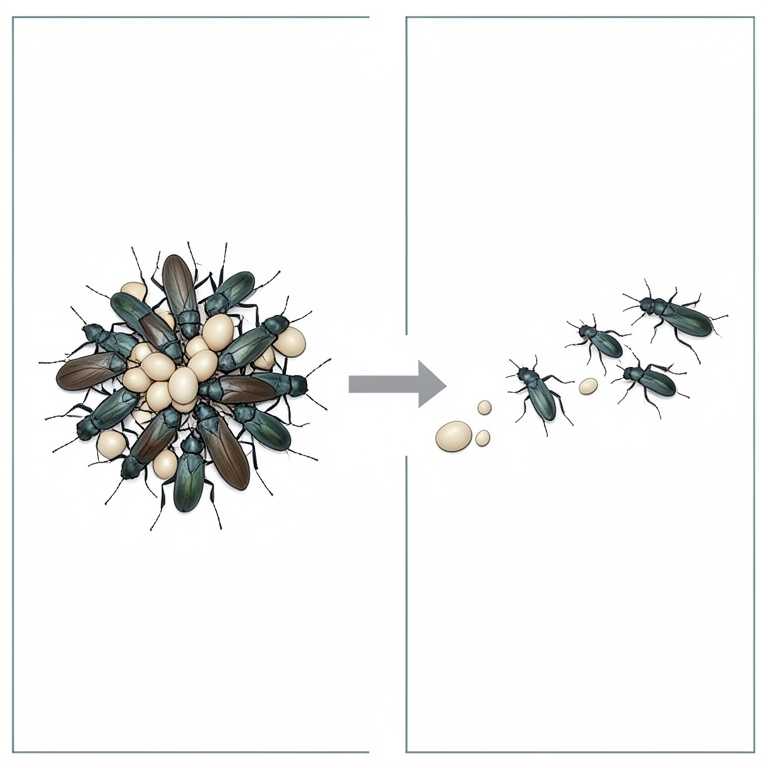
Relative Toxicity Comparison
AI-generated conceptual illustration (Rhynocoris longifrons (assassin bug)). It explains the idea and does not show study data.
View source evidence ↗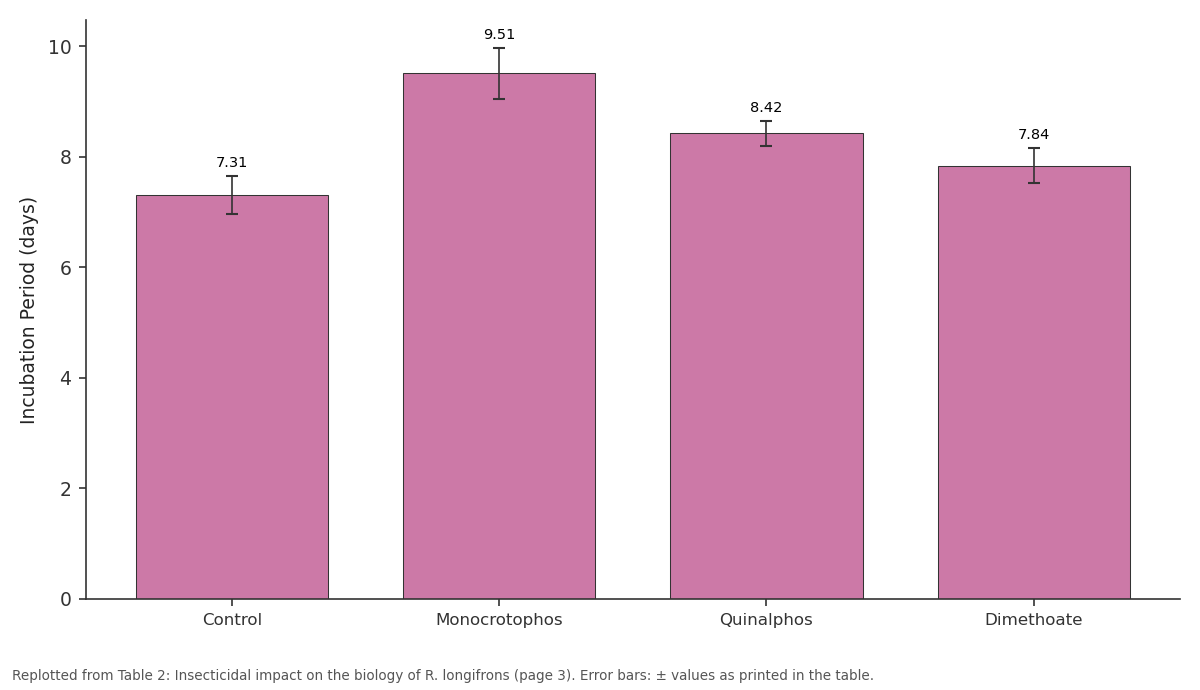
Incubation Period (days): Control vs Monocrotophos vs Quinalphos vs Dimethoate
Replotted from Table 2 (page 3) of the original paper. Every bar is the paper's own table value.
View source evidence ↗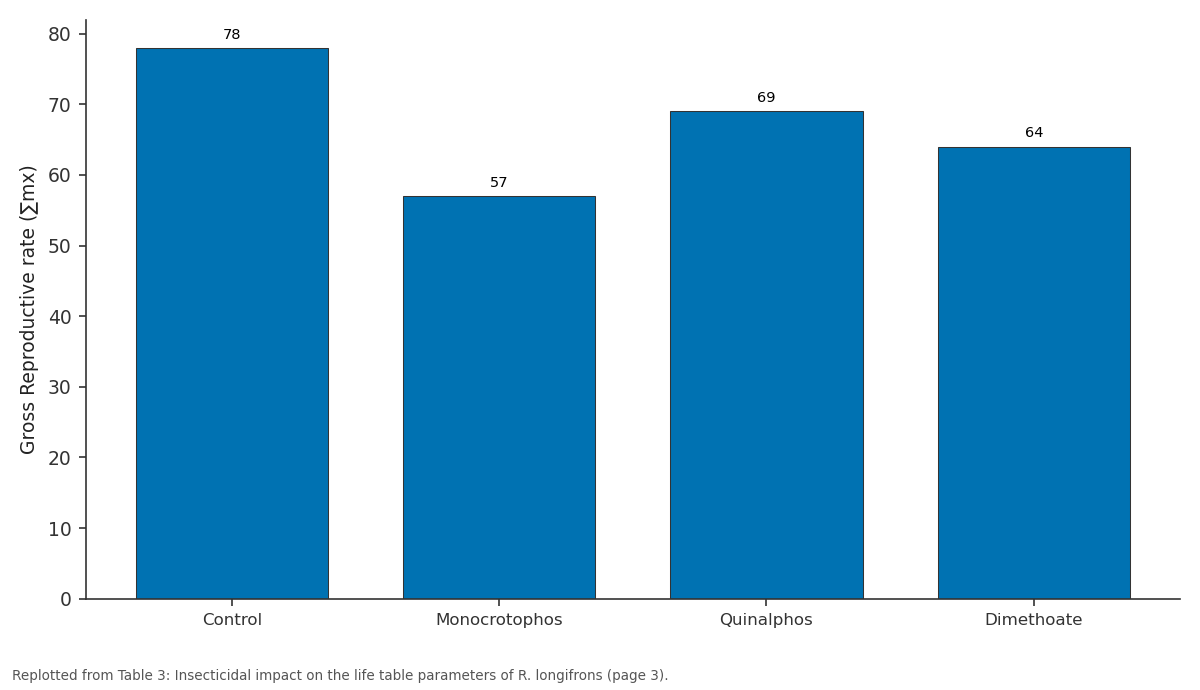
Gross Reproductive rate (∑mx): Control vs Monocrotophos vs Quinalphos vs Dimethoate
Replotted from Table 3 (page 3) of the original paper. Every bar is the paper's own table value.
View source evidence ↗Figures & tables
From the original paper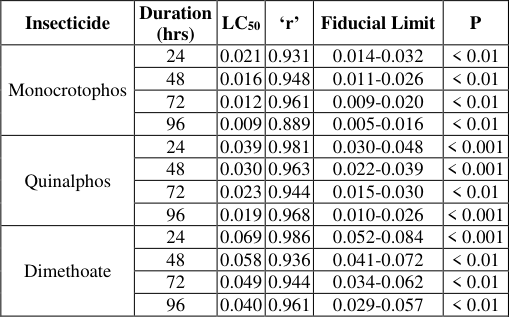 Table 1
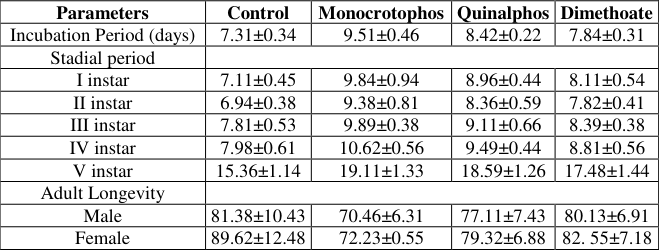 Table 2
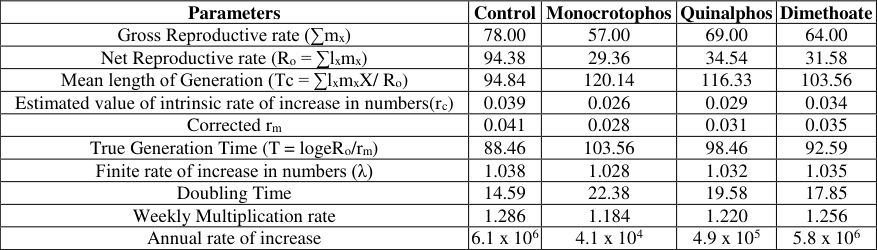 Table 3
Introduction
There is less awareness among the people in the usage of synthetic pesticides on beneficial insects. In order to achieve sustainability, integrated pest management (IPM) represents a remarkable improvement over previous conventional approaches, so optimizing the effectiveness of the entomophagy activity of natural enemies of pests is a determining factor. IPM does not necessarily require the suppression of insecticides, but rather affects the need to reduce their dependence, by eliminating unnecessary applications. Although these toxins are targeted at plant pests, many of them are broad spectrum biocides that have profound effects on non-target species in agro ecosystems. However, the correct integration of chemical and biological control is essential part of sustainable pest management, for which a correct interpretation of the impact of insecticide treatments, is required. Much less is known about the effects of chemical pesticides on predators and parasites than on herbivorous pests (Croft, 1990; Croft and Brown, 1975) [8,9] . Exposure to insecticides to predators can occur from direct contact with spray residues, even by feeding on plant material and also consuming prey contaminated with pesticides (Cloyd and Bethke, 2011; He et al., 2012, 2018) [7,19,18] . Conventional pest management practices mostly rely on intervention technologies without regard to measurable pest management needs and disrupt natural enemies and the ecosystem services that an integrated pest management strategy provides (Douglas et al., 2015) [10] . In IPM agro ecosystems a great proportion of non-target insects are mainly affected by sub lethal dose/concentration values. A sub lethal dose/concentration defined as inducing no apparent mortality in the experimental population. The effects induced have been described affecting biology, physiology, or behavior of individuals or populations that survive to the exposure to a toxicant at lethal or sub lethal dose/concentration. For the correct integration of insecticide applications and biological control, the influence of the insecticide side effects on beneficial insects should be evaluated. There seems to be a close relationship between the application of insecticides and the development of behavioral resistant populations. This finding has suggested establishing a practical procedure based on the realization of small scale field applications, to subsequently monitor beneficial insect reactions, useful for identifying ecological agro ecosystems.
Life table analysis is one of the most effective means of studying population density, which is also altered by the sub lethal doses of insecticides by affecting the physiology of insects. It is from this standpoint that the present investigation has been undertaken and the information incorporated in this paper examine these issues with respect to R. longifrons exposed to the sub lethal dose of monocrotophos, dimethoate and quinalphos. In continuation of this, the present study is aimed at understanding the impact of three commonly used organophosphate insecticides on a Harpactorinae reduviid Rhynocoris longifrons (Stal). Reduviids (commonly called assassin bugs) are very promising biological control agents included in the family Reduviidae and R. longifrons is predominantly found in the agroecosystems particularly in the fruit and vegetable crops and voraciously predates on various economically important insect pests such as Achaea janata Linnaeus (Paramasiva I et al., 2024) [24] , Helicoverpa armigera Hubner, Spodoptera litura (Fabricius) and Corcyra cephalonica Stainton (Ambrose, 2003) [2] . They possess essential characteristics for acting as an active biocontrol which include limited prey range, host searching efficiency, high fecundity, short life cycle, female-biased population, high predatory efficacy, favourable for mass culture, adaptability to new environmental conditions and free from parasites, parasitoids as well as predators (Ambrose and Kumar, 2016) [3] . It is crucial to consider the potential impacts of insecticides on beneficial insects like assassin bugs and adopt strategies to minimize harm. Hence, this study will be very useful in the selection of insecticides in the agro ecosystems where R. longifrons is commonly used for biocontrol programme.
Materials and Methods
Adults and nymphs of R. longifrons were collected from the foothills of Chunkankadai (longitude-77°23′5.03′′E; latitude-8°12′2.74′′N), Kanyakumari district, Tamilnadu. They were maintained in the laboratory at 30±2 °C, relative humidity ranging from 75-80% and photoperiod between 11-13 hrs on the larvae of Corcyra cephalonica Stainton. LC50 concentration of each insecticide was calculated for the III instar nymphs of R. longifrons by conducting preliminary studies. LC50 concentration of 48 hr duration was taken as one toxic unit and 1/10 values of the 48 hr LC50 of each insecticide was considered as sub lethal concentration. They were 0.0016, 0.0058 and 0.0030% for monocrotophos, quinalphos and dimethoate, respectively. Twenty µl of the insecticide were applied topically on the thoracic region. For each insecticide fifteen III instar nymphs were treated, separately. A control set up was maintained with 15 III instar nymphs and they were treated with 20 µl of water. Both the experimental as well as control individuals were maintained at room temperature (30±2 °C). Insecticidal concentration was maintained continuously for 20 days with fresh fresh application of insecticide every day and were fed daily. The insects which are applied with the insecticides were reared up to adults. All the data on the stadial period, nymphal mortality, adult longevity, pre oviposition period, post oviposition period, age specific survival/mortality were recorded daily. Fecundity was also recorded daily until all the females died. Life tables were constructed by the determination of each age interval, the survival rate (lx) and the mean number of female progeny per female (mx) still alive at such age intervals. The intrinsic rates of increase of population (rc), finite rate of increase in numbers, true generation time, time required to double the population, rate of multiplication per week and annual rate of increase were calculated by using Birch's formula (1948) which was elaborated by Watson (1964) [26] , Laughlin (1965) [21] , Southwood (1978) [25] and Bellows et al (1996) [4] where the finite rate of increase in population (λ) represents the number of individuals added to the population per female per day.
Results and Discussion
The present work investigated the sub lethal effects of three commonly used insecticides in the agroecosystems against R. longifrons. Among the three insecticides tested monocrotophos exhibited highest toxicity followed by quinalphos and dimethoate against the reduviid R. longifrons. The LC50 value recorded was 0.021, 0. 039 and 0.069 mg/litre-1 for monocrotophos, quinalphos and dimethoate, respectively for 24 hrs duration (Table 1). In 48 hrs duration also monocrotophos recorded maximum toxicity followed by quinalphos and dimethoate with the LC50 value of 0.016, 0.030 and 0.058 respectively. Similar trend was noticed for the 72 and 96 hrs duration also. Highest mortality was observed in the monocrotophos treated insects followed by quinalphos and dimethoate treated insects which is similar to the observation of George and Ambrose (2006) [16] in R. marginatus and George (2004) [12] in R. longifrons. These results resulted due to either the insecticides affect the nervous system or disrupt the hormonal balance and it is in corroboration with results of another Harpactorinae reduviid Sycanus collaris Kammatterikunnu and Thattanteparambil (2025) [20] . [5] . Similar increase in the stadial period was also noticed by George and Ambrose (2004) [15] in R. marginatus and George and Ambrose (2006) [16] in R.kumarii by treatment with different insecticides. 2). Life table studies have been used to assess the effects of different variables on insect population dynamics (George, 2004) [15] . Life table parameters such as the intrinsic rate of increase, net reproductive rate and total pre oviposition period can be used to determine population growth chatacteristics (George et al., 2002) [17] . The gross reproductive rate and the net reproductive rate (Ro) are drastically reduced by the insecticides. Normal gross reproductive rate of 78.00 is reduced to 57.00, 69.00 and 64.00 by the insecticides monocrotophos, dimethoate and quinalphos, respectively. (Table 3). The maximum reduction was noticed in the monocrotophos treated insects. Similar trend was noticed in the net reproductive rate also which indicates the highest negative impact of monocrotophos. on the capacity to multiply in a generation. This might be due to the hydroxylation processes of some steroids which reduce the availability of ecdysone by which insecticides increased the moulting period (George and Ambrose, 2004) [15] . The mean length of generation in the normal insects (94.84 days) is increased by the insecticides. Maximum increase was observed in the monocrotophos treated category (120.14 days) followed by quinalphos (116.33 days) and dimethoate (103.56 days). Similar observation was noticed in another three Harpactorinae reduviids R. marginatus, R.kumarii and R. fuscipes by George 1996; George and Ambrose, 1998 and 1999 which indicates the highest toxicity of monocrotophos. The intrinsic rate of natural increase (Rc) and Finite rate of increase (λ) are also reduced by the insecticides than the normal insects which shows the effect of insecticides on the development of insects by reducing the egg output. The reduced fecundity by insecticides was caused by the disruption of parental reproductive physiology or it might be due to the lower food intake (Ambrose, 1999) [21] . This means that the insects develop well only in the absence of heavily toxic insecticides in the field and also by the sufficient supply of food.
| Parameters | Control | Monocrotophos | Quinalphos | Dimethoate |
|---|---|---|---|---|
| Gross Reproductive rate (∑mx) | 78.00 | 57.00 | 69.00 | 64.00 |
| Net Reproductive rate (Ro = ∑lxmx) | 94.38 | 29.36 | 34.54 | 31.58 |
| Mean length of Generation (Tc = ∑lxmxX/ Ro) | 94.84 | 120.14 | 116.33 | 103.56 |
| Estimated value of intrinsic rate of increase in numbers(rc) | 0.039 | 0.026 | 0.029 | 0.034 |
| Corrected rm | 0.041 | 0.028 | 0.031 | 0.035 |
| True Generation Time (T = logeRo/rm) | 88.46 | 103.56 | 98.46 | 92.59 |
| Finite rate of increase in numbers (λ) | 1.038 | 1.028 | 1.032 | 1.035 |
| Doubling Time | 14.59 | 22.38 | 19.58 | 17.85 |
| Weekly Multiplication rate | 1.286 | 1.184 | 1.220 | 1.256 |
| Annual rate of increase | 6.1 x 10⁶ | 4.1 x 10⁴ | 4.9 x 10⁵ | 5.8 x 10⁶ |
Table text extracted from the original PDF; superscript letters are shown inline. The original table image is below.
View original table image
| Insecticide | Duration (hrs) | LC50 | ‘r’ | Fiducial Limit | P |
|---|---|---|---|---|---|
| Monocrotophos | 24 | 0.021 | 0.931 | 0.014-0.032 | < 0.01 |
| 48 | 0.016 | 0.948 | 0.011-0.026 | < 0.01 | |
| 72 | 0.012 | 0.961 | 0.009-0.020 | < 0.01 | |
| 96 | 0.009 | 0.889 | 0.005-0.016 | < 0.01 | |
| Quinalphos | 24 | 0.039 | 0.981 | 0.030-0.048 | < 0.001 |
| 48 | 0.030 | 0.963 | 0.022-0.039 | < 0.001 | |
| 72 | 0.023 | 0.944 | 0.015-0.030 | < 0.01 | |
| 96 | 0.019 | 0.968 | 0.010-0.026 | < 0.001 | |
| Dimethoate | 24 | 0.069 | 0.986 | 0.052-0.084 | < 0.001 |
| 48 | 0.058 | 0.936 | 0.041-0.072 | < 0.01 | |
| 72 | 0.049 | 0.944 | 0.034-0.062 | < 0.01 | |
| 96 | 0.040 | 0.961 | 0.029-0.057 | < 0.01 |
Table text extracted from the original PDF; superscript letters are shown inline. The original table image is below.
View original table image
The weekly multiplication rate of normal R. longifrons is 1.286 times which is reduced by the insecticides to 1.184, 1.220 and 1.256 times respectively by the insecticides monocrotophos, quinalphos and dimethoate (Table 3). The same trend in reduction was noticed in the annual rate of increase also which is in line with the findings of Muthupandi (2001) [22] and Nambirajan (2003) [23] in another Harpactorinae reduviids.
Conclusion
By this study it was clearly understood that the insecticides reduced the reproductive capacity, longevity and increased the developmental time. This observation suggest that the application of these three commonly used insecticides monocrotophos, quinalphos and dimethoate in the agroecosystem could affect the biology and physiology of non-target reduviid biocontrol agent R. longifrons. Moreover, the studies revealed that all the three tested insecticides considered to induce a more negative impact for all the biology and life table parameters of R. longifrons both in the larval and adult stage and was they are not recommended for use as an inevitable part of integrated pest management. Among the three insecticides tested monocrotophos was highly toxic followed by quinalphos. Dimethoate is somewhat a safer insecticidewhich can be applied in the IPM programme. Hence, screening of insecticides is very much important to safe guard the nontarget beneficials such as R. longifrons which is proved as an excellent ecofriendly biocontrol agent on various vulnerable insect pests in the fruit and vegetable crops.
Figures and tables from the paper
| Parameters | Control | Monocrotophos | Quinalphos | Dimethoate |
|---|---|---|---|---|
| Incubation Period (days) | 7.31±0.34 | 9.51±0.46 | 8.42±0.22 | 7.84±0.31 |
| Stadial period | ||||
| I instar | 7.11±0.45 | 9.84±0.94 | 8.96±0.44 | 8.11±0.54 |
| II instar | 6.94±0.38 | 9.38±0.81 | 8.36±0.59 | 7.82±0.41 |
| III instar | 7.81±0.53 | 9.89±0.38 | 9.11±0.66 | 8.39±0.38 |
| IV instar | 7.98±0.61 | 10.62±0.56 | 9.49±0.44 | 8.81±0.56 |
| V instar | 15.36±1.14 | 19.11±1.33 | 18.59±1.26 | 17.48±1.44 |
| Adult Longevity | ||||
| Male | 81.38±10.43 | 70.46±6.31 | 77.11±7.43 | 80.13±6.91 |
| Female | 89.62±12.48 | 72.23±0.55 | 79.32±6.88 | 82. 55±7.18 |
Table text extracted from the original PDF; superscript letters are shown inline. The original table image is below.
View original table image
References
26 in the original paper- Ambrose DP. Assassin bugs. Science Publishers; New Hampshire, U.S.A: Oxford and Hill, New Delhi; 1999. p. 337.
- Ambrose DP. Biocontrol potential of Assassin bugs (Hemiptera: Reduviidae). J Exp Zool India. 2003;6(1):1-44.
- Ambrose DP, Kumar AG. Reduviid predators. In: Ecofriendly pest management for food security. 2016. p. 217-257. Available from: https://doi.org/10.1016/B978-0-12-803265-7.00007-5.
- Bellows TS Jr., Van Drieschi RG, Elkinton JS. Effect of pesticides on drug and steroid metabolism. Clin Pharmacol Ther. 1996;8:2-19.
- Bhat PS, Srikumar KK, Raviprasad TN, Vanitha K, Rebijith KB, Asokan R. Biology, behavior, functional response, and molecular characterization of Rihirbus trochantericus Stal var. luteous (Hemiptera: Reduviidae: Harpactorinae), a potential predator of Helopeltis spp. (Hemiptera: Miridae). Entomol News. 2013;123:264-277. Available from: https://doi.org/10.3157/021.123.0409.
- Birch S. The intrinsic rate of natural increase in an insect population. J Anim Ecol. 1945;17:15-26.
- Cloyd RA, Bethke JA. Impact of neonicotinoid insecticides on natural enemies in greenhouse and interiorscape environments. Pest Manag Sci. 2011;67(1):3-9. Available from: https://doi.org/10.1002/ps.2015.
- Croft BA. Arthropods: Biological control agents and pesticides. New York: John Wiley & Sons; 1990.
- Croft BA, Brown AWA. Responses of arthropod natural enemies to insecticides. Annu Rev Entomol. 1975;20:285-335.
- Douglas MR, Rohr JR, Tooker JF. Neonicotinoid insecticide travels through a soil food chain, disrupting biological control of nontarget pests and decreasing soybean yield. J Appl Ecol. 2015;52(1):250-260. Available from: https://doi.org/10.1111/13652664.12372.
- George PJE. Impact of chosen insecticides on three nontarget reduviid biocontrol agents (Insecta: Hemiptera: Reduviidae). PhD thesis, Manonmaniam Sundaranar University, Tirunelveli, 1996. p. 117.
- George PJE. Insecticidal impact on the life table parameters of a Harpactorinae reduviid predator Rhynocoris marginatus (Fabricius). Entomol Croat. 2004;8:13-23.
- George PJE, Ambrose DP. Relative toxicity of five insecticides to Rhynocoris marginatus (Fabricius), a potential predator of insect pests (Insecta: Heteroptera: Reduviidae). Fresenius Environ Bull. 1998;7(7-8):396402.
- George PJE, Ambrose DP. Biochemical changes by insecticides in a nontarget Harpactorinae reduviid Rhynocoris marginatus (Fabricius) (Heteroptera: Reduviidae). Indian J Environ Toxicol. 1999;9(2):7880.
- George PJE, Ambrose DP. Insecticidal impact on the predator Rhynocoris marginatus, a potential predator in the cotton ecosystem. Entomol Croat. 2004;1-2:13-21.
- George PJE, Ambrose DP. Impact of insecticides on the haemogram of Rhynocoris kumarii Ambrose and Livingstone (Hemiptera: Reduviidae). J Appl Entomol. 2006;128(9-10):600-604. Available from: https://doi.org/10.1111/j.1439-0418.2004.00896.
- George PJE, Kannagi J, Ambrose DP. Nutritional influence of prey on the biology and biochemistry in Rhynocoris marginatus (Fabricius) (Heteroptera: Reduviidae). J Biol Control. 2002;16(1):1-4.
- He F, Sun S, Sun X, Ji S, Li X, Zhang J, et al. Effects of insect growth-regulator insecticides on the immature stages of Harmonia axyridis (Coleoptera: Coccinellidae). Ecotoxicol Environ Saf. 2018;164:665674. Available from: https://doi.org/10.1016/j.ecoenv.2018.08.076.
- He Y, Zhao J, Zheng Y, Desneux N, Wu K. Lethal effect of imidacloprid on the coccinellid predator Serangium japonicum and sublethal effects on predator voracity and on functional response to the whitefly Bemisia tabaci. Ecotoxicology. 2012;21:1291-1300. Available from: https://doi.org/10.1007/s10646-0120883-6.
- Kammatterikunnu A, Thattanteparambil R. Stagespecific sensitivity of reduviid bug Sycanus collaris (Fabricius) to insecticides: A toxicity analysis in laboratory conditions. Hexapoda. 2025;32(2):1-7. Available from: https://doi.org/10.55446/hexa.2025.571.
- Laughlin R. Capacity for increase: A useful population strategy. J Anim Ecol. 1965;14:77-91.
- Muthupandi I. Impact of chosen insecticides on the biology and life table parameters of a nontarget biocontrol reduviid Rhynocoris kumarii Ambrose and Livingstone (Hemiptera: Reduviidae). M.Phil thesis, Manonmaniam Sundaranar University, Tirunelveli, 2001. p. 82.
- Nambirajan SP. Impact of chosen insecticides on the biology and life table parameters of a nontarget biocontrol reduviid Rhynocoris marginatus (Fabricius) (Hemiptera: Reduviidae). M.Phil thesis, Manonmaniam Sundaranar University, Tirunelveli, 2003. p. 47.
- Paramasiva I, Madhusudhan, P Vineetha U and Srilakshmi CH. Possible impact of climate change on incidence of insect pests of rice. Int. J. Adv. Biochem. Res. 2024;8(1):498-501.
- Southwood TRF. Ecological methods with particular reference to the study of insect populations. London: Chapman and Hall; 1978. p. 524.
- Watson TF. Influence of host plant condition on population in Tetranychus telarius (Acarina: Tetranychidae). Hilgardia. 1964;35:273-322.