
Research article · 2025 · Full text
International Journal of Biology SciencesFirst record of Coronilla valentina (Fabaceae) in Libya: Taxonomic and ecological perspectives
Volume 7(2) · Pages 93–97 · DOI: 10.33545/26649926.2025.v7.i2b.303 ↗
Research areasMediterranean and Iberian flora and faunaBotanical Research and ChemistryAfrican Botany and Ecology Studies
Abstract
Author-writtenThis study documents the first record of Coronilla valentina L. (Fabaceae) from Wadi Om El-Amaym in the Al-Jabal Al-Akhdar in eastern Libya. Extensive morphological examinations, including a perennial subshrub habit, orbicular and caducous stipules, imparipinnate leaves, emarginated leaflets, umbeliform inflorescences with bright-yellow corollas, and terete pods with constricted seed chambers confirm the taxonomic identity of this species as C. valentina. Populations were found in rocky limestone slopes under a semiarid Mediterranean climate, resembling the calcareous habitats of native distribution in the western and central Mediterranean Basin. Historically, only C. repanda (Poir.) Guss, and C. scorpioides (L.) Koch were reported from Libya, and the floristic relevance of this finding and the necessity for further systematic botanical studies were emphasized. With new insights into legume phylogenomics and refined climate scenarios, this record reflects the dynamic Mediterranean plant diversity and the necessity to align conservation and sustainable horticulture efforts. The recorded ornamental role of C. valentina in the other Mediterranean areas clearly highlights its potential use in ecological restoration programs, considering the careful management of its in-situ populations.
Summary
Source-checkedPlain-language reading of the full paper, prepared with AI and checked against the text. Each point links to the authors' own words.
Why it matters
- The Fabaceae family is globally significant both economically and ecologically, containing between 19,500 and 20,000 species. View evidence ↗
- Legumes support ecosystem health by stabilizing soil, fixing nitrogen, and providing resources for pollinator networks. View evidence ↗
- Identifying species within the genus Coronilla is often difficult due to significant morphological overlap between different species. View evidence ↗
The question
- The study aims to document the first occurrence of Coronilla valentina in Libya to expand the known geographical range of the genus. View evidence ↗
What they did
- Field surveys took place during March and April of the 2021-2022 seasons to coincide with the plants' flowering and fruiting stages. View evidence ↗
- Morphometric data were gathered by measuring ten representative flowers and leaves per specimen to calculate means and ranges. View evidence ↗
What they found
- The identified plants were perennial subshrubs that could reach heights of up to 100 cm. View evidence ↗
- The leaves were imparipinnate and fleshy, with 4-5 pairs of leaflets (ranging from 2 to 6) that reached a maximum length of 20 mm. View evidence ↗
- The plant's inflorescences consisted of 4 to 14 bright-yellow flowers. View evidence ↗
- Floral analysis showed a glabrous calyx with five teeth measuring 3-4 mm and a corolla that extended up to 16 mm. View evidence ↗
- The plant produced terete pods that constricted between seeds, with oblong seeds measuring approximately 2-3 x 1 mm. View evidence ↗
- In Libya, C. valentina was found specifically on rocky limestone slopes in a semiarid Mediterranean environment. View evidence ↗
- Unlike C. scorpioides and C. repanda, which are annuals, C. valentina is a perennial species. View evidence ↗
What it means
- The authors conclude that this first confirmed record of C. valentina in eastern Libya expands the genus's known range and increases the documented plant diversity of the country. View evidence ↗
- The authors suggest that C. valentina could be used in ecological restoration and sustainable horticulture due to its ornamental potential. View evidence ↗
- The authors state that future research combining morphometric analysis with high-throughput molecular phylogenetics is necessary to fully understand the evolutionary relationships of the genus. View evidence ↗
Figures & tables
From the original paper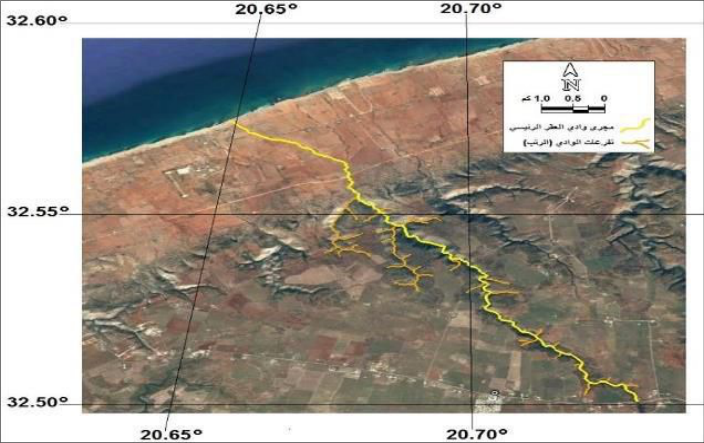 Figure 1
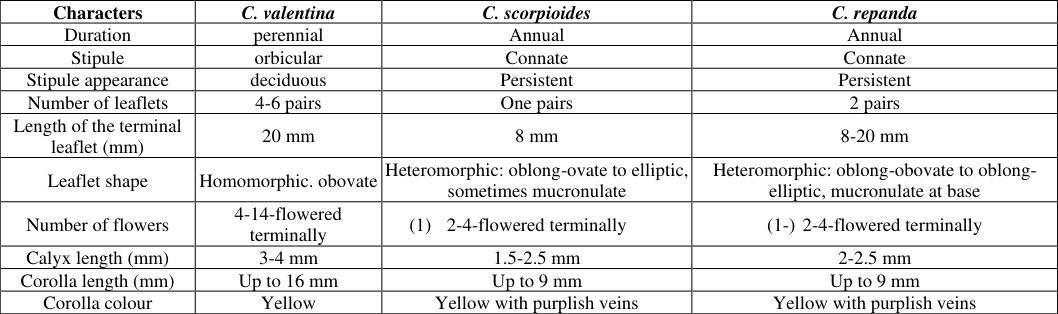 Table 1
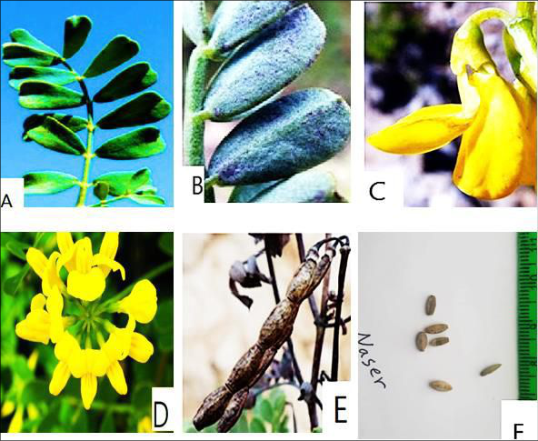 Figure 2
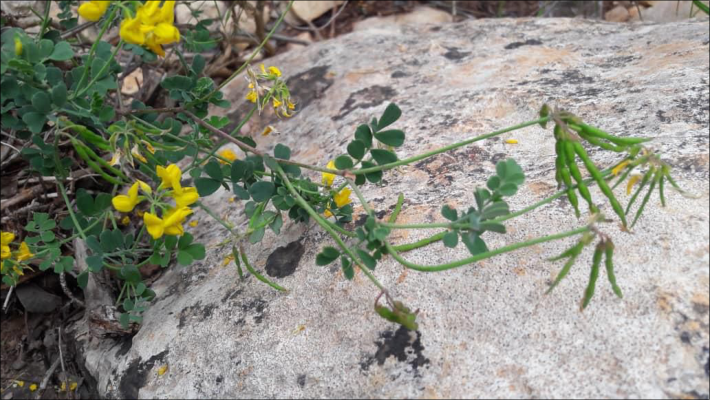 Figure 3
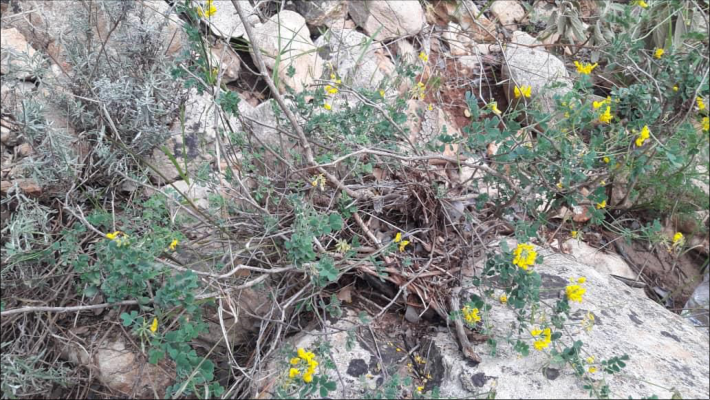 Figure 4
Introduction
The Fabaceae (Leguminosae) is one of the most ecologically and economically significant families of angiosperms, with an estimated 19,500-20,000 species occurring worldwide (Christenhusz & Byng 2016; Azani et al. 2017) [3,8] . Legumes exhibit tremendous morphological and ecological diversity and contribute significantly to ecosystem functioning through nitrogen fixation, soil stabilization, and support of diverse pollinator networks (Graham & Vance, 2003; Sprent, 2009) [12,21] . Recent advances in next-generation sequencing and phylogenomic analyses have profoundly enhanced our understanding of legume evolution, facilitating a more robust resolution of phylogenetic relationships (Bruneau et al., 2013) [5] . Within the tribe Loteae (subfamily Papilionoideae), the genus Coronilla comprises approximately 50 species of annual or perennial herbs and small shrubs). These taxa are distributed across North and Central Europe, the Canary Islands, the Mediterranean region, North Asia, and some parts of China (Hutchinson, 1964; Piovan et al., 1996; González-Melero et al., 1997; Cano et al., 2012) [7,11,13,19] . However, considerable morphological overlap among species has long challenged taxonomic identification (Polhill, 1981; Cano et al., 2012) [7,20] . Although systematic and molecular approaches have contributed to resolving these complexities, as evidenced by the recent description of taxa such as C. montserratii from the Balearic Islands (Fraga & Rosselló, 2009) [10] and the documentation of C. vaginalis in Poland (Mirek et al., 2015) [17] , this genus remains poorly characterized, particularly in underexplored regions. The Mediterranean Basin is recognized as one of the most biodiversity hotspots (Myers et al., 2000; Blondel et al., 2019) [4,18] , with a climate characterized by mild, wet winters and hot, dry summers. These conditions, coupled with predominantly calcareous soils, facilitate high levels of endemism and the persistence of calcicolous taxa such as Coronilla (Jafri & El-Gadi, 1980 [15] ; Tison et al., 2014) [22] . In North Africa, representatives of Coronilla are mainly confined to coastal and subcoastal limestone outcrops. In Libya, floristic surveys have documented only C. repanda and C. scorpioides (Jafri & El-Gadi, 1980) [15] . The present study extends the known range of the genus by documenting the first record of C. valentina in Libya, thereby establishing critical data for regional biogeography, taxonomy, and conservation amidst accelerating climate change and anthropogenic disturbance (IPCC, 2021; Ali et al., 2022) [1,14] .
Materials and Methods
Study Area and Sampling: Living plant materials of Coronilla valentina were collected from natural populations at Wadi Om El-Amaym in the Al-Jabal Al-Akhdar region of eastern Libya. The study area encompasses a north-south trending valley approximately 17 km in length, extending from its mouth at the Mediterranean Sea in the north to its inland terminus. The valley is flanked by Farzugha to the west and Al-Marj to the east. The precise geographic coordinates of sampling sites ranged from 20°45′00″ to 20°01′42″ E and 32°35′00″ to 32°01′15″ N (Figure 1).
Elevation varied between sea level and approximately 380 m. The terrain is characterized by rocky limestone outcrops, calcareous slopes, and sparse herbaceous vegetation, a mosaic that typifies the Mediterranean calcareous habitat (Coste, 1901; Tison et al., 2014) [9,22] . Climatic records indicate a typical Mediterranean regime with mild, rainy winters and hot, dry summers, conditions that favor the persistence of calcicolous species. [15,22,23] to ascertain species identity.
Morphological Examination: Morphological characters were evaluated using both macroscopic observation and stereo microscopy (10×-40× magnification). Documented diagnostic characters included overall growth habit, leaf architecture (number, shape, and size of leaflets), stipule morphology (with emphasis on orbicular shape and deciduous nature), inflorescence configuration, and floral coloration, dimensions of the calyx and corolla, and fruit (pod) morphology. Measurements were taken from both fresh field specimens and later verified on pressed materials to ensure consistency. In addition, a microscope was employed to capture high-resolution images of seed surface microstructure. Quantitative data were compiled from measurements taken on ten representative leaves and flowers per specimen, and descriptive statistics (means and ranges) were calculated. These morphometric data were subsequently compared with published descriptions (Cano et al., 2012; Fraga & Rosselló, 2009) [7,10] and contextualized with recent phylogenomic insights (Bruneau et al., 2013) [5] .
Data Analysis and Comparison:
The morphometric data were statistically analyzed to ascertain diagnostic thresholds for key quantitative traits such as leaflet length, calyx length, corolla length, and peduncle length. A comparative Field observations indicate that C. valentina is confined to rocky limestone slopes within a semiarid Mediterranean environment as shown in Figure 3 and Figure 4. The calcareous substrate, characterized by thin, alkaline soils interspersed with scattered shrubs and drought-adapted herbaceous species, is consistent with habitats reported for this taxon across the western and central Mediterranean Basin (Coste, 1901; Tison et al., 2014) [9,22] . The flowering period, primarily observed in mid-spring (March-April), corresponds with the seasonal climatic cycle; however, recent climate projections (IPCC, 2021; Ali et al., 2022) [1,14] suggest that such cycles may become increasingly erratic. The morphological data, in conjunction with recent phylogenomic studies (Bruneau et al., 2013) [5] , unequivocally support the taxonomic identification of these populations as C. valentina and represent a significant extension of the known distribution of Coronilla in Libyaa region previously known only to harbor C. repanda and C. scorpioides (Jafri & El-Gadi, 1980) [15] .
Discussion
The currently recorded presence of Coronilla valentina in the Al-Jabal Al-Akhdar area is a notable biogeographical distribution that enriches Libya's floristic inventory. Previous reports of the genus from Libya were limited to C. repanda and C. scorpioides (Jafri & El-Gadi, 1980) [15] . In parallel to earlier findings, the presence of C. Valentina on rocky limestone substrates is consistent with its ecological status as a calcicolous species, a character typical of Mediterranean legumes. The diagnostic morphological features seen in the type of material, especially the orbicular, deciduous stipules, the imparipinnate leaf architecture, and the umbel-shaped inflorescences, consisted with the descriptions in the literature (Cano et al., 2012; Fraga & Rosselló, 2009) [7,10] , and this is now supported by recent molecular assessment (Bruneau et al., 2013) [5] . Ecologically, the specialized habitat of C. valentina is noteworthy. The Mediterranean climate is semiarid, with pronounced seasonality and calcareous soils, because of which a distinctive calcicolous assembly of species can be supported. However, these habitats are becoming more vulnerable to climate change and anthropogenic disturbance.
However, these habitats are increasingly susceptible to climate change and anthropogenic disturbance. Recent projections by the Intergovernmental Panel on Climate Change (IPCC, 2021) [14] indicate that Mediterranean regions may experience significant alterations in precipitation regimes and temperature patterns, potentially leading to habitat fragmentation and loss of biodiversity. Furthermore, local pressures (e.g., agricultural development, overgrazing, and quarrying) exacerbate the risks (Le Houérou, 2001; Tison et al., 2014) [16,22] . The ornamental potential of C. valentina, as evidenced by its use in parts of Italy (Cacciola et al., 2002) [6] , suggests opportunities for its integration into sustainable horticulture and ecological restoration initiatives. However, any ex-situ utilization must be balanced by stringent in-situ conservation measures to protect the genetic integrity of natural populations. Future studies employing integrative taxonomic approaches, including combining detailed morphometric analysis with high throughput molecular phylogenetics (Bruneau et al., 2013) [5] , are essential to unravel Coronilla's evolutionary relationships and detect potential cryptic speciation.
Further floristic surveys across underexplored limestone areas of North Africa, coupled with detailed monitoring of population dynamics, are crucial for developing effective conservation strategies. To inform adaptive management practices, these efforts should also consider the potential impacts of rapid climatic changes, as highlighted by recent climate models (IPCC, 2021; Ali et al., 2022) [1,14] .
Conclusion
Conclusion
Figures and tables from the paper
| Characters | C. valentina | C. scorpioides | C. repanda |
|---|---|---|---|
| Duration | perennial | Annual | Annual |
| Stipule | orbicular | Connate | Connate |
| Stipule appearance | deciduous | Persistent | Persistent |
| Number of leaflets | 4-6 pairs | One pairs | 2 pairs |
| Length of the terminal leaflet (mm) | 20 mm | 8 mm | 8-20 mm |
| Leaflet shape | Homomorphic. obovate | Heteromorphic: oblong-ovate to elliptic, sometimes mucronulate | Heteromorphic: oblong-obovate to oblong- elliptic, mucronulate at base |
| Number of flowers | 4-14-flowered terminally | (1) 2-4-flowered terminally | (1-) 2-4-flowered terminally |
| Calyx length (mm) | 3-4 mm | 1.5-2.5 mm | 2-2.5 mm |
| Corolla length (mm) | Up to 16 mm | Up to 9 mm | Up to 9 mm |
| Corolla colour | Yellow | Yellow with purplish veins | Yellow with purplish veins |
Table text extracted from the original PDF; superscript letters are shown inline. The original table image is below.
View original table image
References
23 in the original paper- Ali E, Cramer W, Carnicer J, Georgopoulou E, Hilmi NJM, Le Cozannet G, et al. Cross-Chapter Paper 4: Mediterranean Region. In: Pörtner H-O, Roberts DC, Tignor M, Poloczanska ES, Mintenbeck K, Alegría A, et al., editors. Climate Change 2022: Impacts, Adaptation and Vulnerability. Contribution of Working Group II to the Sixth Assessment Report of the Intergovernmental Panel on Climate Change. Cambridge University Press; 2022. p. 2233-2272. doi:10.1017/9781009325844.021.
- Aurelle D, Thomas S, Albert C, Bally M, Bondeau A, Boudouresque C-F, et al. Biodiversity, climate change, and adaptation in the Mediterranean. Ecosphere. 2022;13(4):e3915. doi:10.1002/ecs2.3915.
- Azani N, Bruneau A, Dougherty B, Egan AN, et al. A new subfamily classification of the Leguminosae based on a taxonomically comprehensive phylogeny. Taxon. 2017;66(1):44-77. doi:10.12705/661.3.
- Blondel J, Aronson J, Bodiou J-Y, Boeuf G. The Mediterranean Region: Biological Diversity in Space and Time. Cambridge University Press; 2019.
- Bruneau A, Doyle JJ, Herendeen P, Hughes C, Kenicer G, Lewis G, et al. Legume phylogeny and classification in the 21st century: Progress, prospects and lessons for other species-rich clades. Taxon. 2013;62(1):217-248. doi:10.12705/622.8.
- Cacciola SO, Pane A, Davino S, Raudino F. First report of Phytophthora palmivora on Coronilla valentina subsp. glauca in Italy. Plant Dis. 2002;86(3):327. doi:10.1094/PDIS.2002.86.3.327B.
- Cano AL, Gómez PS, Martínez JFJ. A new species of Coronilla (Loteae, Fabaceae) from southeastern Spain: Evidence from morphological and molecular data. Folia Geobot. 2012;47:317-335. doi:10.1007/s12224-0129119-z.
- Christenhusz MJM, Byng JW. The number of known plant species in the world and its annual increase. Phytotaxa. 2016;261(3):201-17. doi:10.11646/phytotaxa.261.3.1.
- Coste H. Flore descriptive et illustrée de la France de la Corse et des contrées limitrophes. Paris: Librairie des Sciences naturelles Paul Klincksieck; 1901. Retrieved from Biodiversity Heritage Library.
- Fraga F, Rosselló JA. Coronilla montserratii, a new hexaploid annual species from the eastern Balearic Islands. Flora Montiberica. 2009;46:19-26. Available from: http://www.floramontiberica.org/FM/Flora_Montiberic a46.pdf.
- González-Melero JA, Pérez-García F, MartínezLaborde JB. Effect of temperature, scarification and gibberellic acid on the seed germination of three shrubby species of Coronilla L. (Leguminosae). Seed Sci Technol. 1997;25:167-75.
- Graham PH, Vance CP. Legumes: Importance and constraints to greater use. Plant Physiol. 2003;131:87277. doi:10.1104/pp.017004.
- Hutchinson J. The Genera of Flowering Plants (Dicotyledons), Vol. 1. Oxford: Clarendon Press; 1964.
- IPCC. Climate Change 2021: The Physical Science Basis. Contribution of Working Group I to the Sixth Assessment Report of the Intergovernmental Panel on Climate Change. Cambridge University Press; 2021. doi:10.1017/9781009157896.
- Jafri SMH, El-Gadi A. Flora of Libya. Tripoli, Libya: Al Faateh University; 1980.
- Le Houérou HN. Biogeography of the arid steppeland north of the Sahara. J Arid Environ. 2001;48(2):103128. doi:10.1006/jare.2000.0679.
- Mirek Z, Piekos-Mirkowa H, Ciepłuch A, Bzdega K. Coronilla vaginalis Lam. -A new species to the flora of Poland. Acta Musei Silesiae, Sci Nat. 2015;64(3):237247. doi:10.5586/asbp.2015.009.
- Myers N, Mittermeier RA, Mittermeier CG, da Fonseca GAB, Kent J. Biodiversity hotspots for conservation priorities. Nature. 2000;403(6772):853-858. doi:10.1038/35002501.
- Piovan A, Filippini R, Innocenti G, Caniato R, Cappelletti EM. Coronilla species: In vitro culture and the production of coumarin compounds. In: Bajaj YPS, editor. Biotechnology in Agriculture and Forestry, Vol. 37: Medicinal and Aromatic Plants IX. Springer, Berlin; 1996. p. 127-143. https://hdl.handle.net/11577/2454601.
- Polhill RM. Loteae and Coronilleae. In: Polhill RM, Raven PH, editors. Advances in Legume Systematics, Part 1. Royal Botanic Gardens, Kew; 1981. p. 371-374. Available from: https://www.kew.org/.
- Sprent JI. Legume Nodulation: A Global Perspective. Chichester, UK: Wiley-Blackwell; 2009. doi:10.1002/9781444316384.
- Tison J-M, Jauzein P, Michaud H. Flore de la France méditerranéenne continentale. Turriers, France: Naturalia Publications; 2014. Available from: https://naturalia-publications.com/.
- Tutin TG, Heywood VH, Burges NA, Moore DM, Valentine DH, Walters SM, et al., editors. Flora Europaea, Vol. 2. Cambridge University Press; 1968.