
Research article · 2025 · Full text
International Journal of Horticulture and Food ScienceProcess optimization and sensory quality of dragon fruit milkshake
Volume 7(2) · Pages 50–52 · DOI: 10.33545/26631067.2025.v7.i2a.268 ↗
Research areasFood Science and Nutritional Studies
Abstract
Author-writtenThe study aimed to “Process optimization and sensory quality of dragon fruit\r\nmilkshake”. Dragon fruit pulp was incorporated at different levels (3%, 6%,\r\nand 9%) with varying sugar concentrations (6% and 8%). The sensory evaluation\r\nwas conducted using a trained panel using a 9-point hedonic scale. The T4\r\ntreatment (6% dragon fruit pulp, 8% sugar) received the highest acceptability\r\nscore (8.76), demonstrating a desirable colour, body and texture, flavour, and\r\noverall acceptability. The findings suggest that moderate levels of dragon fruit\r\npulp enhance sensory properties, making it a nutritious and appealing\r\ndairy-based beverage.
Summary
Source-checkedPlain-language reading of the full paper, prepared with AI and checked against the text. Each point links to the authors' own words.
Why it matters
- Dragon fruit (Pitaya) is becoming more popular in India due to its nutritional value and appealing visual characteristics, such as its red or white pulp. View evidence ↗
- Milkshakes are sweet, refreshing dairy beverages that can be flavored with various sweeteners or fruit syrups. View evidence ↗
The question
- The researchers aimed to optimize the process and evaluate the sensory quality of a milkshake made with dragon fruit. View evidence ↗
What they did
- The study tested three levels of dragon fruit pulp (3%, 6%, and 9%) combined with two different sugar concentrations (6% and 8%). View evidence ↗
- A panel of five trained judges used a 9-point hedonic scale to evaluate the sensory properties of the milkshakes. View evidence ↗
- The evaluation focused on color, appearance, flavor, consistency, mouthfeel, and overall acceptability, with data analyzed using a Completely Randomized Design (CRD). View evidence ↗
What they found
- Flavor scores varied across treatments, with T4 scoring the highest at 8.82 and T6 scoring the lowest at 5.35. View evidence ↗
- For taste, T4 was rated highest (8.88) and T1 was rated lowest (6.24). View evidence ↗
- T4 (6% pulp, 8% sugar) was the most acceptable overall, with a score of 8.76. View evidence ↗
What it means
- The authors conclude that the highest quality dragon fruit milkshake is produced using 6% red-fleshed dragon fruit pulp and 8% sugar. View evidence ↗
Visual summary
3 visualsIllustrations explain the paper; charts are replotted from the paper's own table values.
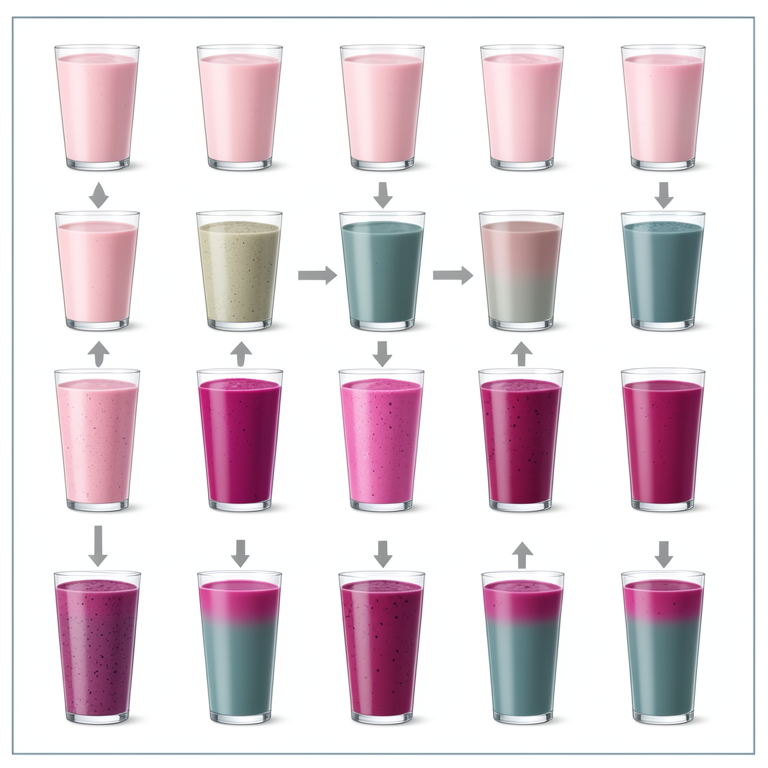
Treatment Matrix
AI-generated conceptual illustration (dragon fruit milkshake in glass tumblers). It explains the idea and does not show study data.
View source evidence ↗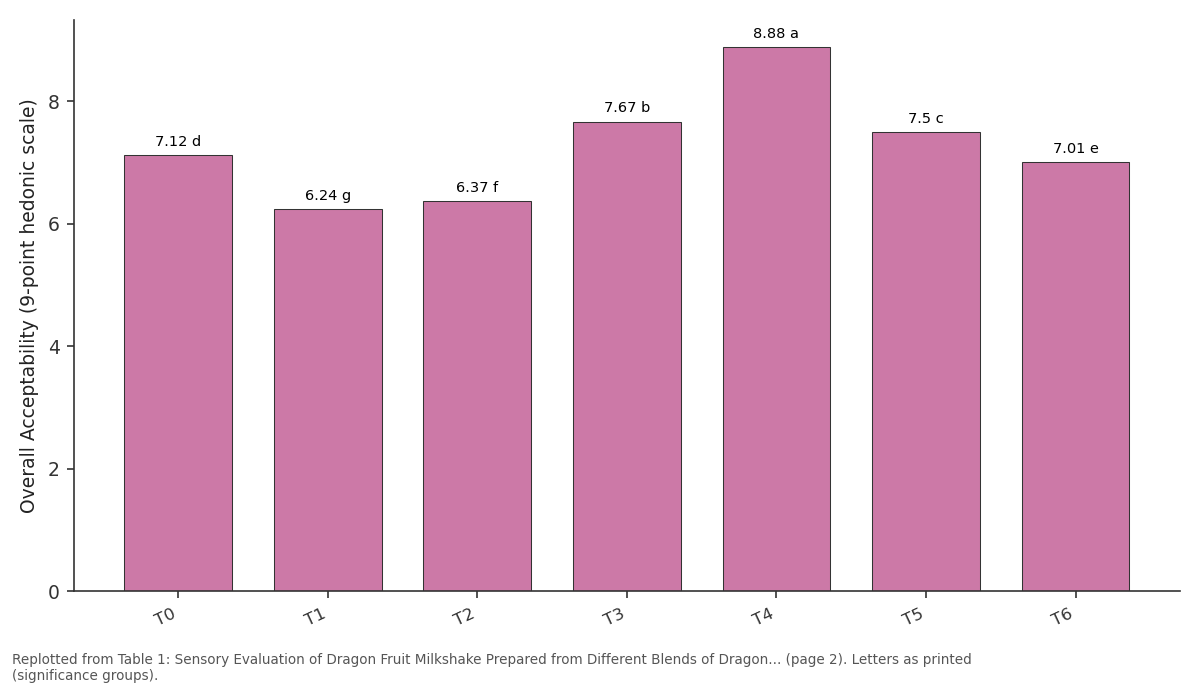
Taste: T0 vs T1 vs T2 vs T3 vs T4
Replotted from Table 1 (page 2) of the original paper. Every bar is the paper's own table value.
View source evidence ↗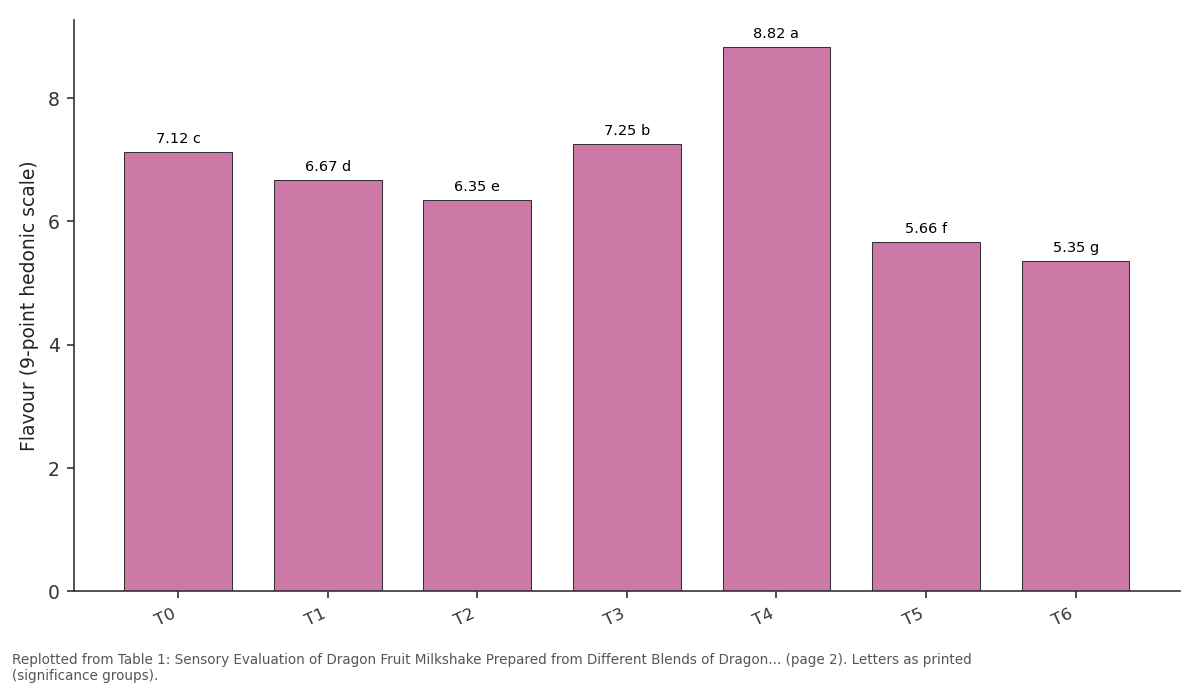
Flavour: T0 vs T1 vs T2 vs T3 vs T4
Replotted from Table 1 (page 2) of the original paper. Every bar is the paper's own table value.
View source evidence ↗Figures & tables
From the original paper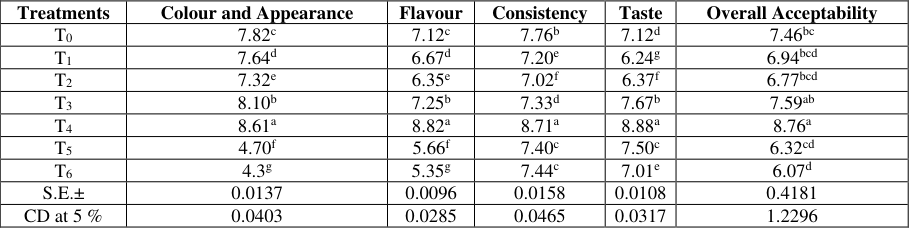 Table 1
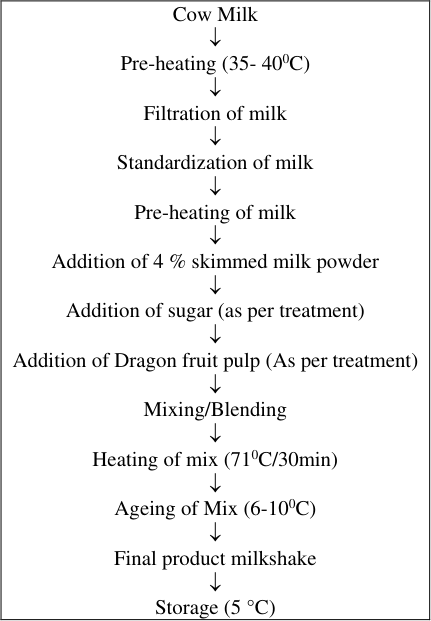 Figure 1
Introduction
A milkshake is a sweet and refreshing beverage typically crafted from milk, ice cream, chilled milk, flavourings, or sweeteners such as fruit syrup or chocolate sauce. Milkshakes, classified as soft frozen products, are commonly prepared for immediate consumption at retail outlets directly from milkshake mixes processed at a dairy processing facility. These mixes are then packaged and transported in bulk containers (Karki, et al., 2015) [4] . Dragon fruit, also known as Pitaya, has recently gained prominence in the Indian market. Its popularity among cultivators is attributed to its attractive fruit colour, delightful white or red pulp, and edible tiny black seeds embedded within the pulp along with its nutraceutical value. Belonging to the Cactaceae family and Hylocereus genus, Dragon fruit, or pitaya, is a round, succulent fruit with significant nutritional benefits. Often red-hued with a scale-like texture, it is native to Mexico, Central and South America. Southeast Asian countries, where the fruit thrives, have also embraced its cultivation and marketing. Dragon fruit is increasingly cultivated as a new crop in countries such as Australia, Nicaragua, Vietnam, China, Malaysia, Taiwan, and Israel. Commercially, Israel, Malaysia, and Taiwan exhibit a production range of approximately 16,000 to 27,000 kg/ha. The overall foliage of the Dragon fruit plant contributes to its structural makeup. While the foliage is abundant, it serves no particular purpose. In the commercial production of fruits, proper foliage reduction is crucial to achieving optimal fruit size and yield (Idris et al., 2012) [2] .
Materials and Methods
The fresh clean composite milk samples of crossbreed cows were procured from the Research cum Development Project on cattle, MPKV, Rahuri, District-Ahilyanagar. Milk was standardized to four per cent fat using Pearson's square formula. The milkshake mix was kept in a freezer at -2 to -6 0 C for 7 min for freezing. Sodium alginate was used as a stabilizer. For the preparation of dragon fruit milkshake, the following blends of dragon fruit pulp and cow milk were prepared. T0: Control T1: (P 1 S 1 ) Cow milk + 3% dragon fruit pulp + 6% sugar level T2: (P 1 S 2 ) Cow milk + 3% dragon fruit pulp + 8% sugar level T3: (P 2 S 1 ) Cow milk + 6% dragon fruit pulp + 6% sugar level T4: (P 2 S 2 ) Cow milk + 6% dragon fruit pulp + 8% sugar level T5: (P 3 S 1 ) Cow milk + 9% dragon fruit pulp + 6% sugar level T6: (P 3 S 2 ) Cow milk + 9% dragon fruit pulp + 8% sugar level SMP was constant throughout the trials @ 4 % of milk. For the preparation of dragon fruit pulp, the first dragon fruit was washed with clean water. The skin was peeled. Slices were made with the help of a knife and finally, it was converted into a homogenous mass of pulp by putting it into the mixer.
Preparation of dragon fruit added Milkshake
The dragon fruit pulp samples were prepared by using procedure prescribed by (Shinde et al. 2018) [6] with slight modification. The fully ripe healthy and fresh red dragon fruit was taken, along with milk, skimmed milk powder and sugar as per treatments. Mix the ingredients thoroughly.
Heat the mixture to around 35 °C. Subsequently, cool it down to room temperature. Pasteurization by heating the mixture to 63 °C for 30 minutes. The dragon fruit milkshake was subjected to sensory evaluation by a panel of five trained judges from Dept. Animal Husbandry and Dairy Science, MPKV., Rahuri. using 9-point Hedonic scale It was judged for colour and appearance, flavour, consistency, mouthfeel and overall acceptability. The results obtained during the course of investigation were subjected to statistical analysis by using Completely Randomized Design (CRD). [6]
Cow
Cow
Results and Discussion
Results and Discussion
Sensory evaluation of Dragon fruit milkshake
The Dragon fruit milkshake prepared from different Conclusion blends of Dragon fruit pulp and cow milk were subjected to sensory evaluation and scores recorded for different parameters are presented in Table 1.
| Treatments | Colour and Appearance | Flavour | Consistency | Taste | Overall Acceptability |
|---|---|---|---|---|---|
| T0 | 7.82c | 7.12c | 7.76b | 7.12d | 7.46bc |
| T1 | 7.64d | 6.67d | 7.20e | 6.24g | 6.94bcd |
| T2 | 7.32e | 6.35e | 7.02f | 6.37f | 6.77bcd |
| T3 | 8.10b | 7.25b | 7.33d | 7.67b | 7.59ab |
| T4 | 8.61a | 8.82a | 8.71a | 8.88a | 8.76a |
| T5 | 4.70f | 5.66f | 7.40c | 7.50c | 6.32cd |
| T6 | 4.3g | 5.35g | 7.44c | 7.01e | 6.07d |
| S.E.± | 0.0137 | 0.0096 | 0.0158 | 0.0108 | 0.4181 |
| CD at 5 % | 0.0403 | 0.0285 | 0.0465 | 0.0317 | 1.2296 |
Table text extracted from the original PDF; superscript letters are shown inline. The original table image is below.
View original table image
Colour and Appearance
The colour and appearance of the milkshake significantly (P<0.05) were influenced by the addition of different levels of dragon fruit pulp milkshake. The mean maximum score for colour and appearance was obtained to treatment T 4 i.e. (8.61) and the lowest colour and appearance for treatment T 6 i.e. (4.3).
Flavour
The mean flavour scores of milkshakes were as 7.12, 6.67, 6.35, 7.25, 8.82, 5.66 and 5.35 for treatments T 0 , T 1 , T 2 , T 3 , T 4 , T 5 and T 6 , respectively. The flavour of milkshake significantly (p<0.05) affected by addition of different levels of dragon fruit pulp milkshake. The treatment T 4 with 6 per cent dragon fruit pulp and 8 per cent sugar was superior over other treatment combinations.
Consistency
The average scores for the consistency attribute of dragon fruit pulp milkshake prepared under each treatment ranged between 7.02 to 8.71 which were significantly (p<0.05) changed by the addition of different levels of dragon fruit pulp in milkshake. Treatment T 4 had the highest score of 8.71 ("Like very much"), whereas treatment T 2 had the lowest score of 7.02 ("Like moderately").
Taste
The taste scores for dragon fruit pulp blended milkshake varied significantly (<0.05) among treatments T 0 (7.12), T 1 (6.24), T 2 (6.37), T 3 (7.67), T 4 (8.88), T 5 (7.50) and T 6 (7.01). Treatment T 1 received the lowest score of 6.24, whereas treatment T 4 obtained the highest score of 8.88 from the panel.
Overall Acceptability
Overall scores for treatments T 0 (7.46), T 1 (6.94), T 2 (6.77), T 3 (7.59), T 4 (8.76) and T 5 (6.32) were comparable, while treatment T 6 (6.07) differed significantly (<0.05) from the others. The overall acceptability scores of dragon fruit pulp blended milkshake ranged from 6.07 to 8.76 as rated by the panel.
Conclusion
The better-quality milkshake blended with dragon fruit pulp can be prepared by using 6 per cent red-fleshed dragon fruit pulp and 8 per cent sugar of milk.
Figures and tables from the paper
References
6 in the original paper- Bakane PH, Khakare MM, Gajabe MH, Khedkar MB. Standardization of process for custard apple milkshake. Int J Environ Agric Biotech. 2016;1(4):708-712.
- Idris J, Som AM, Musa M, Hamid KHK, Husen R, Rodhi MNM. Dragon fruit foliage plant-based coagulant for treatment of concentrated latex effluent: Comparison of treatment with ferric sulfate. J Chem. 2012;1-7.
- Jadhav VS. Study on preparation of sapota milkshake. M.Sc. (Agri.) Thesis, M.A.U., Parbhani (M.S.), India; 1999. p. 43.
- Karki A, Yadav RS, Banerjee J. Development of fibre enriched milkshakes and its quality evaluation. Int J Adv Eng Tech Innov Sci. 2015;1(2):14-20.
- Kadav VB. Preparation of fruit flavoured milkshake. M.Sc. (Agri.) Thesis submitted to Dr. Balasaheb Sawant Konkan Krishi Vidyapeeth, Dapoli and Dist. Ratnagiri; 2001.
- Shinde DV, Gawali AS, Manohar AB, Inamke ND, Kedare VS. Physico chemical analysis of milkshake blended with date pulp. The Pharma Innovation J. 2018;7(5):673-674.