
Research article · 2025 · Full text
International Journal of Agriculture and Food ScienceComparative analysis of accelerated aging and cold testing for evaluating seed quality in brassica species
Volume 7(2) · Pages 185–188 · DOI: 10.33545/2664844x.2025.v7.i2c.295 ↗
Research areasSeed Germination and PhysiologyPlant Genetic and Mutation StudiesPlant Disease Resistance and Genetics
Abstract
Author-writtenThis study evaluates the effectiveness of accelerated aging and cold testing in determining seed quality, vigor, and longevity in six Brassica varieties: PM-28, M-27, TS-36, TS-38, Potsangbam Yella, and Kakching Yella. By assessing germination rates, vigor indices, and physiological integrity under varying aging conditions, the study identifies varietal resilience critical for optimizing seed storage and crop productivity in oilseed species prone to quality loss. Results showed that aged seeds subjected to accelerated aging experienced significant declines in germination and vigor, particularly in TS-38 and Potsangbam Yella, indicating susceptibility to deterioration. Fresh seeds of PM-28 and TS-36 maintained germination rates above 90%, indicating robustness. Cold testing highlighted M-27 and PM-28 as resilient under low-temperature stress. These findings demonstrate that combining accelerated aging and cold tests provides a comprehensive approach to evaluating seed quality, supporting the selection of high-vigor seed lots for diverse environmental conditions.
Summary
Source-checkedPlain-language reading of the full paper, prepared with AI and checked against the text. Each point links to the authors' own words.
Why it matters
- Brassica species are important for global food security and industry due to their high protein and oil content. View evidence ↗
- The high oil content of Brassica seeds makes them prone to quality loss during storage, mainly through membrane degradation and oxidative stress. View evidence ↗
- High humidity and temperature accelerate seed aging, which results in lower germination rates, reduced vigor, and poor emergence in the field. View evidence ↗
The question
- The study aims to evaluate how effectively accelerated aging and cold tests can predict the resilience, vigor, and quality of six different Brassica varieties. View evidence ↗
What they did
- The research was carried out in Manipur during the 2018-2019 Rabi season. View evidence ↗
- The study used a Factorial Randomized Block Design with four replications to test fresh and aged seeds across six varieties: PM-28, M-27, TS-36, TS-38, Potsangbam Yella, and Kakching Yella. View evidence ↗
- Accelerated aging was simulated by exposing seeds to 41°C and nearly 100% relative humidity for a period of 5 to 7 days. View evidence ↗
- Cold tolerance was measured by keeping seeds in a soil matrix at 8°C for five days. View evidence ↗
- Statistical analysis was performed using ANOVA and the Least Significant Difference (LSD) test at a 5% probability level to compare means of germination and vigor. View evidence ↗
What they found
- Fresh seeds of TS-36 and PM-28 showed high initial quality and stress tolerance, with germination rates exceeding 90%. View evidence ↗
- Following accelerated aging, Potsangbam Yella and TS-38 were the most susceptible to deterioration, with germination rates falling below 60%. View evidence ↗
- TS-38 showed a significant decrease in germination during the cold test, indicating it has lower resilience to cold stress than other varieties. View evidence ↗
- Aged seeds showed a more moderate decline in germination during cold testing compared to accelerated aging, suggesting some varieties maintain resilience to low temperatures. View evidence ↗
What it means
- The authors conclude that using both accelerated aging and cold tests together allows for a more accurate selection of high-vigor seed lots for different storage and climate conditions. View evidence ↗
- The authors state that accelerated aging is best for identifying rapid deterioration and longevity, while the cold test is critical for evaluating performance in temperate climates. View evidence ↗
Visual summary
1 visualsIllustrations explain the paper; they do not show study data.
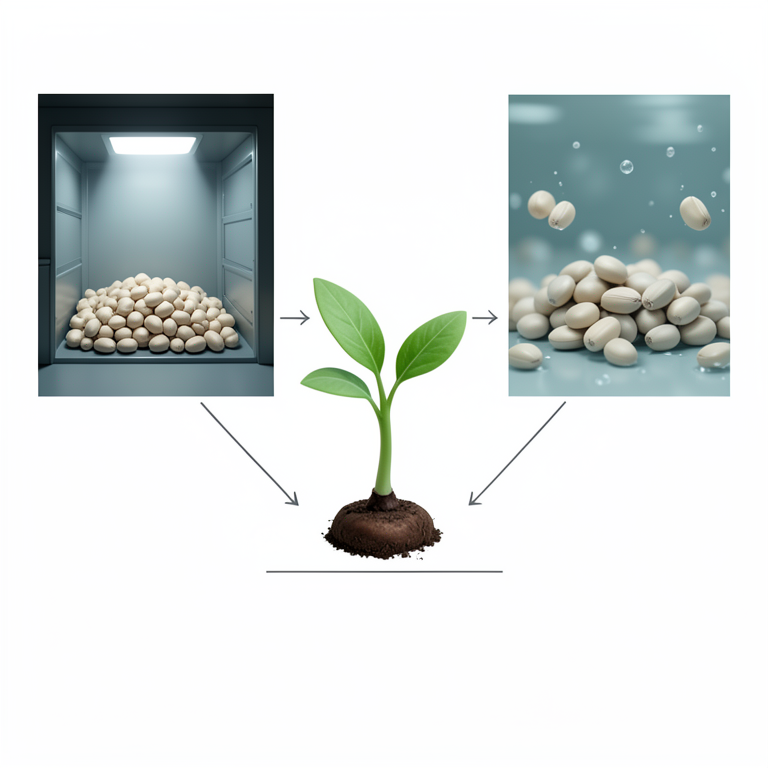
Complementary Seed Testing Framework
AI-generated conceptual illustration (Brassica napus seeds). It explains the idea and does not show study data.
View source evidence ↗Figures & tables
From the original paper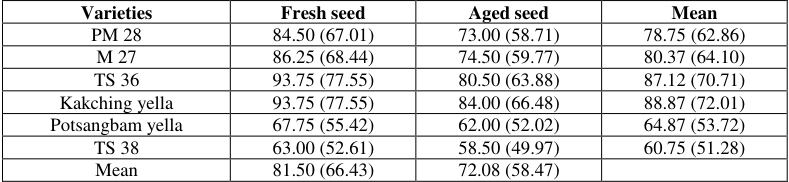 Table 1
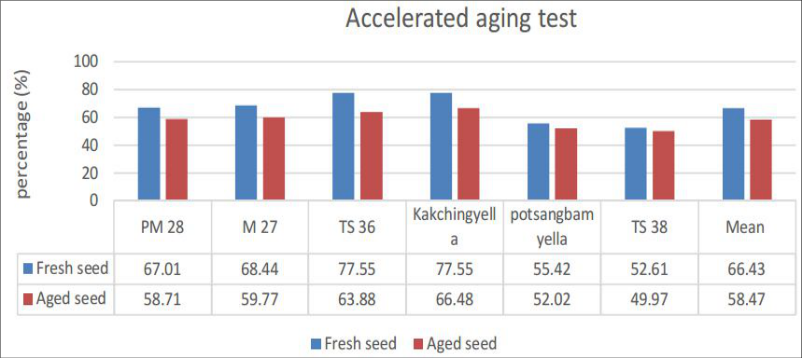 Figure 1
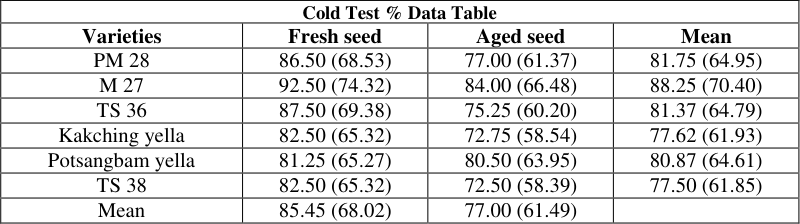 Table 2
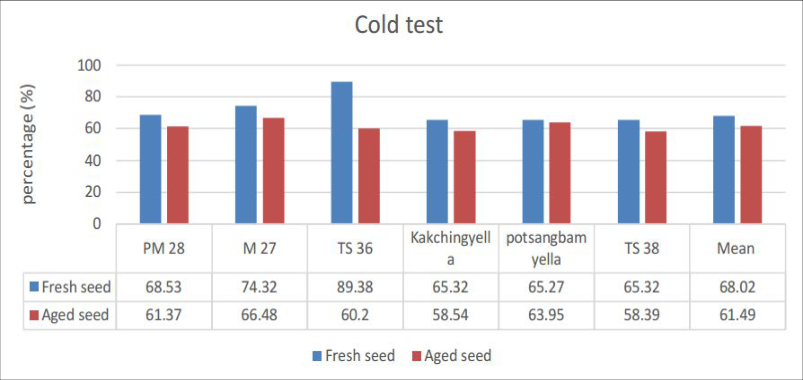 Figure 2
Introduction
The preservation of seed quality and viability is important and crucial for agricultural success, particularly in oilseed crops like Brassica species. These crops are highly valued for their rich oil and protein content, playing a significant role in global food security and various industrial applications. However, their oil-rich composition makes them highly susceptible to quality deterioration during storage, primarily due to oxidative stress and membrane degradation. Environmental factors such as elevated temperature and humidity exacerbate seed aging, leading to reduced vigor, compromised germination rates, and poor field emergence [1][2][3][4][5] . Accelerated aging and cold testing are widely employed methods to assess seed quality and predict storage viability. The accelerated aging test simulates natural aging by exposing seeds to high temperature and humidity, providing a rapid assessment of their deterioration and vigor potential [6][7][8] . Conversely, the cold test evaluates seed germination and vigor under lowtemperature conditions, offering insights into seed resilience and performance during early planting in temperate climates [9][10][11][12][13] . While both methods are extensively used in seed quality research, direct comparisons of their efficacy in Brassica species are limited (ISTA, 2022). This study aims to systematically assess the effectiveness of accelerated aging and cold testing in predicting seed quality, vigor, and resilience across six Brassica varieties. By comparing these tests, we aim to provide a comprehensive evaluation of their utility in selecting highquality seeds suitable for diverse storage and environmental conditions. The findings are expected to contribute to the optimization of seed quality evaluation protocols, ultimately benefiting Brassica breeding and storage strategies.
Materials and Methods
Materials and Methods
Experimental Site and Design
The experiment was conducted during the Rabi season of 2018-2019 at the Pandit Deen Dayal Upadhyay Institute of Agricultural Sciences, Manipur. A Factorial Randomized Block Design (FRBD) was used to assess two factors: Seed age (fresh and aged) and six Brassica varieties (PM-28, M-27, TS-36, TS-38, Potsangbam Yella, and Kakching Yella). Each treatment condition was replicated four times to ensure statistical reliability and minimize variability.
Seed Aging Tests 2.2.1 Accelerated Aging Test:
Seeds were exposed to an aging chamber set to 41°C with nearly 100% relative humidity for 5-7 days to simulate storage under stressful conditions. Following aging, seed germination was assessed under standard laboratory conditions as per ISTA [14] guidelines.
Cold Test:
Cold tolerance was assessed by placing seeds in a soil matrix maintained at 8°C for five days, simulating early planting in low-temperature environments. After cold exposure, seeds were transferred to a controlled environment at 22-25°C to evaluate germination performance and seed vigor.
Data Analysis
Data collected from germination rates, vigor indices, and other seed quality parameters were subjected to analysis of variance (ANOVA) to determine statistical differences across treatments. Mean comparisons were conducted using the Least Significant Difference (LSD) test at a 5% probability level to identify significant variations among treatments and Brassica varieties.
Reproducibility
All experimental procedures, including aging chamber settings and germination assessments, followed standardized protocols to ensure reproducibility. ISTA guidelines and specified environmental controls were adhered to throughout the study, enabling other researchers to replicate the methodology accurately.
Results
Results
Accelerated Aging Test Outcomes
The accelerated aging test results revealed a substantial reduction in germination rates and vigor indices for aged seeds across all varieties (Table 1, Figure 1). TS-38 and PotsangbamYella showed the greatest sensitivity to aging stress, with germination rates declining below 60% postaccelerated aging, highlighting their susceptibility to storagerelated degradation. Fresh seeds demonstrated higher resilience, with varieties such as PM-28 and TS-36 showing over 90% germination, indicating superior initial seed quality and stress tolerance.
| Varieties | Fresh seed | Aged seed | Mean |
|---|---|---|---|
| PM 28 | 84.50 (67.01) | 73.00 (58.71) | 78.75 (62.86) |
| M 27 | 86.25 (68.44) | 74.50 (59.77) | 80.37 (64.10) |
| TS 36 | 93.75 (77.55) | 80.50 (63.88) | 87.12 (70.71) |
| Kakching yella | 93.75 (77.55) | 84.00 (66.48) | 88.87 (72.01) |
| Potsangbam yella | 67.75 (55.42) | 62.00 (52.02) | 64.87 (53.72) |
| TS 38 | 63.00 (52.61) | 58.50 (49.97) | 60.75 (51.28) |
| Mean | 81.50 (66.43) | 72.08 (58.47) |
Table text extracted from the original PDF; superscript letters are shown inline. The original table image is below.
View original table image
Cold Test Results
Cold testing results showed a more moderate decline in germination rates for aged seeds, suggesting that certain varieties retained resilience under low-temperature conditions (Table 2, Figure 2). Varieties M-27 and PM-28 maintained high germination percentages, indicating notable cold tolerance and physiological stability. In contrast, TS-38 exhibited a significant drop in germination, reflecting lower resilience to cold stress compared to other varieties.
| Cold Test % Data Table | — | — | — |
|---|---|---|---|
| Varieties | Fresh seed | Aged seed | Mean |
| PM 28 | 86.50 (68.53) | 77.00 (61.37) | 81.75 (64.95) |
| M 27 | 92.50 (74.32) | 84.00 (66.48) | 88.25 (70.40) |
| TS 36 | 87.50 (69.38) | 75.25 (60.20) | 81.37 (64.79) |
| Kakching yella | 82.50 (65.32) | 72.75 (58.54) | 77.62 (61.93) |
| Potsangbam yella | 81.25 (65.27) | 80.50 (63.95) | 80.87 (64.61) |
| TS 38 | 82.50 (65.32) | 72.50 (58.39) | 77.50 (61.85) |
| Mean | 85.45 (68.02) | 77.00 (61.49) |
Table text extracted from the original PDF; superscript letters are shown inline. The original table image is below.
View original table image
Discussion 4.1 Interpretation of Findings
The study demonstrates that the accelerated aging test is an effective tool for evaluating rapid seed deterioration, as evidenced by the significant decline in germination rates and vigorindices among aged seeds. These results are consistent with prior research, which affirmed the accelerated aging test's predictive capacity for seed longevity and quality under storage conditions [15,16] . Varieties like TS-38 and PotsangbamYella showed rapid quality loss, emphasizing the test's utility in identifying seeds with shorter viability spans, critical for maintaining high-quality seed stocks. Conversely, the cold test provides insight into seed resilience under low-temperature stress, which is crucial for evaluating field performance in cold climates. Varieties such as M-27 and PM-28 demonstrated high cold tolerance, confirming their suitability for cultivation in temperate regions with early sowing requirements. These findings align with prior studies that have shown cold testing as a reliable predictor of crop establishment potential under adverse environmental conditions [17,18] .
Combined efficacy of testing methods
The combined application of accelerated aging and cold tests offers a comprehensive assessment of seed quality. The accelerated aging test yields rapid, reliable data on longevity, while the cold test provides essential information on seedling vigor and adaptability to cold-stress environments. By implementing both tests, seed producers and agricultural researchers can more accurately evaluate and select seed lots with high vigor and resilience, facilitating improved crop management strategies for varying climates and storage conditions. This dual-testing approach enhances the predictive accuracy of seed performance, supporting Brassica crop production and sustainability.
Conclusion
This study highlights the complementary roles of accelerated aging and cold tests in assessing Brassica seed quality. The accelerated aging test proved effective in identifying rapid deterioration, offering valuable insights into seed longevity and viability under storage conditions. Meanwhile, the cold test evaluated resilience to low-temperature stress, a critical factor for field performance in temperate climates and early sowing conditions. By combining these testing methods, researchers and seed producers can develop improved storage strategies and select seed lots with high vigor and resilience, ensuring better crop establishment and productivity in diverse environmental conditions. These findings provide a framework for
References
19 in the original paper- Hampton JG. Seed quality: New approaches to quality assurance. Seed Technol. 1995;17(1):4-14.
- Tekrony DM. Accelerated aging test for seed quality assessment. J Seed Technol. 1995;19(2):12-18.
- Woltz JM, Tekrony DM. Evaluating seed vigor for planting success. Agron J. 2000;92(5):797-802.
- Ghlam MM, Singh P, Jha V. Field emergence predictions for chickpea seed vigor. Crop Sci J. 2010;50(3):487-492.
- McDonald MB. Seed deterioration: Physiology, repair, and assessment. Seed Sci Technol. 1999;27(1):177-237.
- Hampton JG, Tekrony DM. Handbook of vigour test methods. 3 rd Ed. Zurich: The International Seed Testing Association, 1995.
- Powell AA, Matthews S. The damaging effect of water on dry pea embryos during imbibition. J Exp Bot. 1978;29(5):1215-1229.
- Bailly C. Active oxygen species and antioxidants in seed biology. Seed Sci Res. 2004;14(2):93-107.
- Walters C, Wheeler LM, Stanwood PC. Longevity of cryogenically stored seeds. Cryobiology. 2005;48(3):229-244.
- Delouche JC, Baskin CC. Accelerated aging techniques for predicting the relative storability of seed lots. Seed Sci. Technol. 1973;1(2):427-452.
- Filho MJ. Physiological potential of soybean seeds. Abrates J. 1998;20(1):68-71.
- Kumar D, Chandra H, Pandey C, Singh R. Physiological evaluation of seed vigour and viability in soybean. Legume Res. 2017;40(1):191-198.
- Tekrony DM, Egli DB. Relationship of seed vigor to crop yield: A review. Crop Sci. 1991;31(3):816-822.
- Woodstock LW. Biochemical tests for seed vigor. Proc Int Seed Test Assoc. 1969;34(1):197-205.
- Copeland LO, McDonald MB. Principles of seed science and technology. 4 th Ed. New York: Springer, 2001.
- ISTA. International rules for seed testing. 2022. Zurich: The International Seed Testing Association, 2022.
- Rajjou L, Lovigny Y, Groot SPC, Belghazi M, Job C, Job D. Proteome-wide characterization of seed aging in Arabidopsis: A comparison between artificial and natural aging protocols. Plant Physiol. 2008;148(2):620641.
- Savage FWE, Bassel GW. Seed vigour and crop establishment: Extending performance beyond adaptation. J Exp Bot. 2016;67(3):567-591.
- Varier A, Vari AK, Dadlani M. The subcellular basis of seed priming. Curr Sci. 2010;99(4):450-456.