
Research article · 2025 · Full text
International Journal of Agriculture and Food ScienceMothbean (Vigna aconitifolia L.): A comprehensive review
Volume 7(2) · Pages 181–184 · DOI: 10.33545/2664844x.2025.v7.i2c.294 ↗
Research areasAgricultural pest management studiesSoybean genetics and cultivationGenetic and Environmental Crop Studies
Abstract
Author-writtenMothbean (Vigna aconitifolia L.) is a significant legume crop grown extensively in India. It is a drought-tolerant crop that can thrive in poor soil conditions, making it an ideal crop for resource-poor farmers. This review paper aims to provide an overview of mothbean's cultivation, nutritional value, and uses. We also discuss the crop's potential to contribute to food security and its potential uses in various industries. Although mothbean may be grown in a variety of soil types, it likes soil that drains well and has a pH between 6.0 and 7.0. To prepare the soil, plow and harrow it down to a depth of 20 to 25 cm. The distance between mothbean seeds is 20-30 cm, and the seeds are sowed 2-3 cm deep. The rows in which the seeds are sowed are separated by 60 to 90 centimeters. Food, feed, and industrial applications are just a few of the many uses for mothbeans. In many different cuisines, especially Indian and Pakistani cooking, the crop is used as a pulse. Additionally, livestock, especially cattle and poultry, are fed mothbeans. Starch, flour, and other products with added value are among the industrial uses of the crop. In many different cuisines, but especially in Indian and Pakistani cooking, the legume is utilized as a pulse. The crop is used to produce salad, curry, and dal, among other meals. Livestock, especially cattle and poultry, are fed mothbeans. The Tamil Nadu Agricultural University (TNAU) and the Indian Institute of Horticultural Research (IIHR) have created a number of recently released mothbean varieties. Advanced breeding methods, including as genetic engineering and marker-assisted selection (MAS), were used to create these types. All things considered, the recently introduced mothbean cultivars aim to strengthen climate resistance, advance sustainable agriculture, and increase nutritional security. Food security could be greatly enhanced by the use of legumes, especially in emerging nations. The crop is perfect for farmers with limited resources since it can grow in poor soil conditions and is resistant to drought. Another nutrient-dense crop that can supply a variety of vital micronutrients is the mothbean.
Summary
Source-checkedPlain-language reading of the full paper, prepared with AI and checked against the text. Each point links to the authors' own words.
Why it matters
- Mothbean is an important legume in India, particularly suited for resource-poor farmers because it can grow in poor soils and withstand drought. View evidence ↗
- The crop is highly nutritious, providing significant amounts of protein, fiber, and essential micronutrients. View evidence ↗
- Legumes like mothbean have the potential to significantly improve food security in developing countries. View evidence ↗
The question
- The review aims to summarize the cultivation practices, nutritional profile, industrial uses, and the role of mothbean in food security. View evidence ↗
What they did
- Standard cultivation involves plowing to 20-25 cm, sowing seeds 2-3 cm deep with 20-30 cm spacing, and maintaining row spacing of 60-90 cm. View evidence ↗
- The ideal growing environment for mothbean is well-drained soil with a pH between 6.0 and 7.0. View evidence ↗
- The crop's total water requirement during its growth period is approximately 400-500 mm. View evidence ↗
What they found
- Mothbean has a protein content of 22-25%, which is similar to other legumes. View evidence ↗
- The crop contains 4-6% fiber, contributing to digestive health. View evidence ↗
- The use of NPK consortia can increase mothbean yields by 20-30% over control treatments. View evidence ↗
- The Indian Council of Agricultural Research (ICAR) has developed biofortified varieties specifically rich in zinc and iron. View evidence ↗
- Key pests affecting the crop include aphids, whiteflies, thrips, and pod borers, which cause leaf distortion, stunted growth, and yield loss. View evidence ↗
- The crop is susceptible to fungal diseases including root rot, leaf spot, and powdery mildew. View evidence ↗
What it means
- The authors conclude that NPK consortia are an effective method for improving the growth and yield of mothbean. View evidence ↗
- The authors recommend adopting efficient nutrient management, soil testing, and organic farming to improve both production and soil health. View evidence ↗
- The authors state that more research is required to fully explore the crop's potential and create new value-added products. View evidence ↗
Visual summary
1 visualsIllustrations explain the paper; they do not show study data.
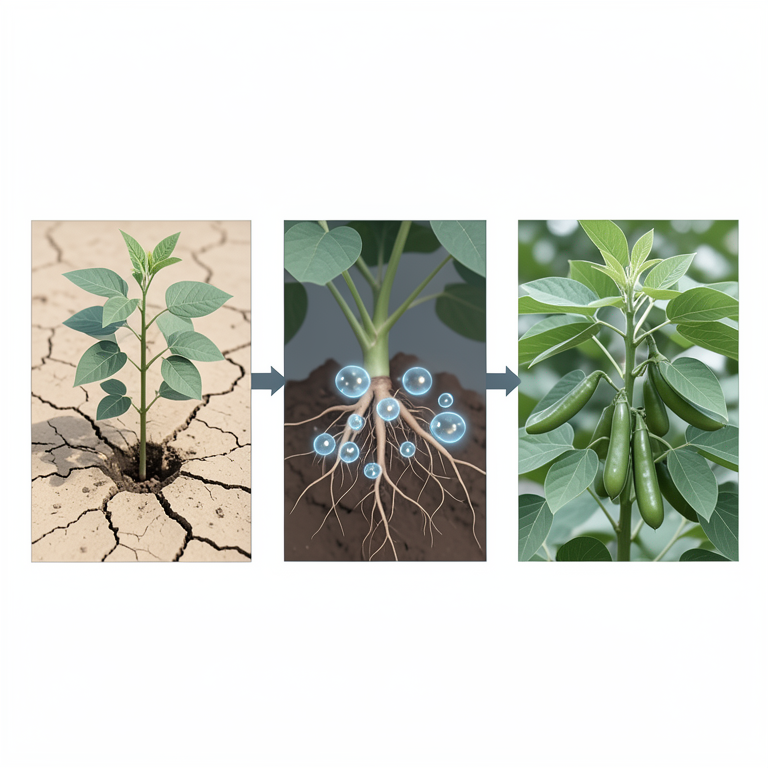
Mothbean Sustainability Cycle
AI-generated conceptual illustration (Mothbean plants (Vigna aconitifolia)). It explains the idea and does not show study data.
View source evidence ↗Introduction
Mothbean (Vigna aconitifolia L.) is a legume crop that belongs to the family Fabaceae. It is a warm-season crop that is widely grown in India, particularly in the states of Maharashtra, Madhya Pradesh, Rajasthan, and Uttar Pradesh. Mothbean is a drought-tolerant crop that can thrive in poor soil conditions, making it an ideal crop for resource-poor farmers. Mothbean is typically grown as a rainfed crop, and its cultivation is done during the kharif season. The ideal time for sowing mothbean is during the last week of June or the first week of July. The crop requires a well-drained soil with a pH range of 6.0-7.0. Mothbean is a low-input crop that requires minimal irrigation and fertilizers. Mothbean is a nutrient-rich crop that is high in protein, fiber, and various micronutrients (Ahmed et al., 2023) [1] . The crop is a good source of energy, and its protein content is comparable to that of other legume crops. Mothbean is also rich in fiber, which makes it an ideal crop for promoting digestive health. Mothbean contains 22-25% protein, which is comparable to that of other legume crops. Mothbean contains 4-6% fiber, which makes it an ideal crop for promoting digestive health. Mothbean is rich in various micronutrients such as iron, zinc, and potassium (Choudhary et al., 2021) [2] . India is the largest producer (25% of global production), consumer (27% of world consumption) and importer (14%) of pulses in the world. Pulses account for around 23% of the area under food grains and contribute around 9-10% of the total foodgrains production in the country. Approx. 30 M ha area under pulses cultivation, about 25 MT of annual production with avg. productivity of 851 kg ha -1 (Avg. of 2018-19 to 2022-23).
Normal Area about 291 L ha (Kharif-136 L ha + Rabi-155 L ha). The seasonal percent share to kharif area is 47% remaining 53% area goes to rabi pulses. Area & Production contribute in total pulses approx. 90% for both; M.P. (19% & 22%), Maharashtra (16% for both), Rajasthan (21% & 16%), Uttar Pradesh (8% & 10%), Karnataka (11% & 8%), Gujarat (4% & 6%), Andhra Pradesh (4% for both), Jharkhand (3% for both), Telangana (2% for both) and Tamil Nadu (3% & 2%). Ever highest area and production in total pulses was 307 L ha and 273 Lt. during 2021-22 and productivity of 902 kg ha -1 during 2022-23. In kharif pulses of about 136 L ha, 33% (46 L ha) is covered by Tur followed by Urd 28% (36 L ha); Mung -27% (37 L ha) and other minor kharif pulses 12% (approx. 17 L ha
Soil Preparation and Sowing
Mothbean (Vigna aconitifolia L.) can be grown on a wide range of soils, but it prefers well-drained soil with a pH range of 6.0-7.0. The soil should be prepared by plowing and harrowing to a depth of 20-25 cm. Mothbean seeds are sown at a depth of 2-3 cm and a spacing of 20-30 cm. The seeds are sown in rows, and the rows are spaced 60-90 cm apart.
Irrigation & Fertilization
Mothbean (Vigna aconitifolia L.) is a drought-tolerant crop, but it requires adequate moisture during the germination and flowering stages. The crop should be irrigated at an interval of 10-15 days during the dry season. Mothbean is a lowinput crop that requires minimal fertilizers. The crop can be fertilized with organic manures such as farmyard manure or green manure.
Uses as Food & Feed
Mothbean (Vigna aconitifolia L.) has various uses, including food, feed, and industrial applications. The crop is used as a pulse in various cuisines, particularly in Indian and Pakistani cooking. Mothbean is also used as a feed for livestock, particularly poultry and cattle. The crop's industrial applications include the production of starch, flour, and other value-added products. Mothbean is used as a pulse in various cuisines, particularly in Indian and Pakistani cooking. The crop is used to make various dishes such as dal, curry, and salad. Mothbean is used as a feed for livestock, particularly poultry and cattle. The crop is rich in protein and fiber, making it an ideal feed for livestock. Mothbean's industrial applications include the production of starch, flour, and other value-added products. The crop's starch can be used to produce various products such as paper, textiles, and adhesives (Gupta et al., 2012) [4] .
Impact of environmental conditions on varieties
Newly released varieties of mothbean with environmental impact are focused on climate resilience, biofortification, and sustainability.
Climate-Resilient Varieties
The Indian Council of Agricultural Research (ICAR) has developed 109 high-yielding, climate-resilient, and biofortified varieties of crops, including mothbean. These varieties can thrive in adverse weather conditions, reducing crop losses due to diseases and pests.
Biofortified Varieties: Biofortification involves improving the nutritional quality of food crops. ICAR has developed biofortified varieties of mothbean with enhanced nutritional content, such as iron and zinc-rich varieties.
Sustainable Production
The new varieties of mothbean are designed to promote sustainable production practices, reducing the environmental impact of farming. For example, they are more waterefficient and require fewer chemical inputs. Some of the newly released varieties of mothbean include those developed by the Indian Institute of Horticultural Research (IIHR) and the Tamil Nadu Agricultural University (TNAU). These varieties have been developed using advanced breeding techniques, including markerassisted selection (MAS) and genetic engineering. Overall, the newly released varieties of mothbean are designed to promote sustainable agriculture, improve nutritional security, and enhance climate resilience.
Food Security
Mothbean (Vigna aconitifolia L.) has the potential to contribute significantly to food security, particularly in developing countries. The crop is drought-tolerant and can thrive in poor soil conditions, making it an ideal crop for resource-poor farmers. Mothbean is also a nutrient-rich crop that can provide a range of essential micronutrients.
Nutrient Management in Mothbean
Mothbean (Vigna aconitifolia L.) is a significant legume crop grown extensively in India. Its growth and production require efficient nutrient management. [5] . Pre-Emergence Herbicides 1. Pendimethalin: Pendimethalin is a pre-emergence herbicide that can be used to control broadleaf weeds and grassy weeds.
Macro
Macro
Types of
Types of
Alachlor:
Alachlor is a pre-emergence herbicide that can be used to control broadleaf weeds and grassy weeds.
Post-Emergence Herbicides 4. Imazethapyr:
Imazethapyr is a post-emergence herbicide that can be used to control broadleaf weeds and grassy weeds. 5. Quinclorac: Quinclorac is a post-emergence herbicide that can be used to control broadleaf weeds and grassy weeds.
Insect and Pest Management in Mothbean
Mothbean (Vigna aconitifolia L.) is a significant legume crop grown extensively in India. Insect and pest management is a critical component of mothbean production, as various insects and pests can cause significant damage to the crop (Manolikar et al., 2007) [6] .
Major Insect Pests 1. Aphids: Aphids are small, soft-bodied insects that feed on plant sap, causing curled or distorted leaves. 2. Whiteflies: Whiteflies are small, winged insects that feed on plant sap, causing yellowing or stunted growth. 3. Thrips: Thrips are small, insects that feed on plant sap, causing stunted growth or distorted leaves. 4. Pod borers: Pod borers are larvae of moths that feed on mothbean pods, causing damage and reducing yields.
Major Diseases 1. Powdery mildew:
Powdery mildew is a fungal disease that causes a white, powdery growth on leaves.
Leaf spot:
Leaf spot is a fungal disease that causes small, circular spots on leaves.
Conclusion
Mothbean is a significant legume crop that has various uses, including food, feed, and industrial applications. The crop is drought-tolerant and can thrive in poor soil conditions, making it an ideal crop for resource-poor farmers. NPK consortia are an effective way to provide essential nutrients to mothbean crops, leading to improved plant growth, enhanced nutrient uptake, and increased yields. Optimal NPK ratios and application methods should be determined based on soil type, climate, and other factors. Mothbean has the potential to contribute significantly to food security, particularly in developing countries. Further research is needed to explore the crop's potential and to develop new value-added products. Efficient nutrient management is critical for mothbean growth and production. Soil testing, fertilizer application, and organic farming practices can help improve soil quality, promote plant growth, and increase production. By adopting these practices, farmers can enhance mothbean production and improve soil health
References
6 in the original paper- Ahmed M, Hyder SI, Ullah A, Khan RU, Ahmad MA, Hayat A, Arshad N. Response of Integrated Nutrient Management (INM) on growth, yield, and nutrient use efficiency under irrigated conditions. J Appl Res Plant Sci. 2023;4(1):363-369.
- Choudhary HR, Singh G, Sharma B. Moth bean cultivation under rainfed conditions of Nagaur District of Rajasthan. J Krishi Vigyan. 2021;9(2):143-146.
- Directorate of Economics and Statistics (DES), Ministry of Agri. & FW. 2018-19 to 2022-23.
- Gupta BR, Tiwari R, Tiwari TP, Tiwari KN. Maximizing yield, nutrient efficiency, and profit in summer black gram. Better Crops with Plant Food. 2012;91(3):22-23.
- Kumar J, Singh SB, Uma. Effect of weeds and weed management in pulses: A review. Technofame J Multidiscip Adv Res. 2023;12(1):130-142. Available from: https://technofame.com/Journal.aspx?ID=20.
- Manolikar RR, Vitkar MN, Vasmate SD, Patil RF, Kalalbandi BM. Effect of Integrated Nutrient Management on growth and yield of pulses. Asian J Hort. 2007;2(2):178-180.