
Research article · 2025 · Full text
International Journal of Agriculture and Food ScienceRemote-controlled smart pesticide sprayer system
Volume 7(2) · Pages 162–165 · DOI: 10.33545/2664844x.2025.v7.i2c.292 ↗
Research areasSmart Agriculture and AI
Abstract
Author-writtenThe most crucial procedures during crop production are those related to plant protection. Using the sprayer, apply the most pesticide products possible. One of the most important and frequent tasks in agriculture is the application of insecticides, fungicides, and herbicides. In agricultural productivity, traditional spraying methods have created a contradiction between environmental preservation and economic expansion. Over the past few decades, spraying techniques have been progressively improved. The type and size of the plant canopy, the area of a plant leaf, the height of the crop, and the volume of plants related to the application of plant protection products are all crucial factors for improving the effects of pesticide application. According to this perspective, the development of agricultural sprayers began in the previous few decades. Variable rate sprayers and other smart pesticide spraying technologies are becoming more and more popular because they increase the rate at which pesticides are used, decrease pesticide residues, provide real-time information, save money, and have a high compatibility with the application of plant protection goods. Precision agriculture is the "umbrella" under which these technologies fall. The mechanical spraying system, which is typically operated by mobile robots or extremely accurate equipment, allows for the selective administration of pesticides at the desired time and location. In addition to saving labor costs, these smart pesticide spraying technologies are also good for protecting the environment. Precision spraying systems for crops and orchards are being designed, developed, and tested experimentally by researchers.
Summary
Source-checkedPlain-language reading of the full paper, prepared with AI and checked against the text. Each point links to the authors' own words.
Why it matters
- The application of herbicides, fungicides, and insecticides is a critical and frequent activity in agricultural production. View evidence ↗
- Traditional pesticide spraying methods often create a conflict between the need for economic growth and the goal of environmental preservation. View evidence ↗
- Conventional backpack sprayers are limited by a capacity of ten liters and can cause physical strain, such as back pain, for the user. View evidence ↗
The question
- The objective of the research was to develop a prototype sprayer to protect farmers from the dangers and damages associated with insecticide spraying. View evidence ↗
What they did
- The researchers designed a trolley-based system to overcome the limitations of manual backpack sprayers. View evidence ↗
- The prototype was constructed using a DC motor, battery, solar panel, microcontroller, nozzle, DC pressure pump, wheels, and a pesticide tank. View evidence ↗
- The system's control architecture utilizes an L298 motor driver and an ESP 32 microcontroller. View evidence ↗
- The device is powered by a 12V solar panel and a 12V battery, and it employs a 12V water pump. View evidence ↗
- The DC pressure pump used in the system has a maximum flow rate of 5 L/min. View evidence ↗
What they found
- The resulting vehicle demonstrated the ability to operate across various types of terrain and soil. View evidence ↗
- The system allows farmers to apply pesticides from a distance, eliminating direct contact with the chemicals. View evidence ↗
- The vehicle's movement and pesticide application are successfully managed using an EPS32 WiFi controller app from the Play Store. View evidence ↗
What it means
- The authors conclude that the device is environmentally friendly because it does not emit pollutants and is easy to operate. View evidence ↗
- The authors state that this solar-powered sprayer is more cost-effective than traditional sprayers powered by engines. View evidence ↗
- The authors conclude that the system was successfully designed and tested with satisfactory performance. View evidence ↗
Visual summary
1 visualsIllustrations explain the paper; they do not show study data.
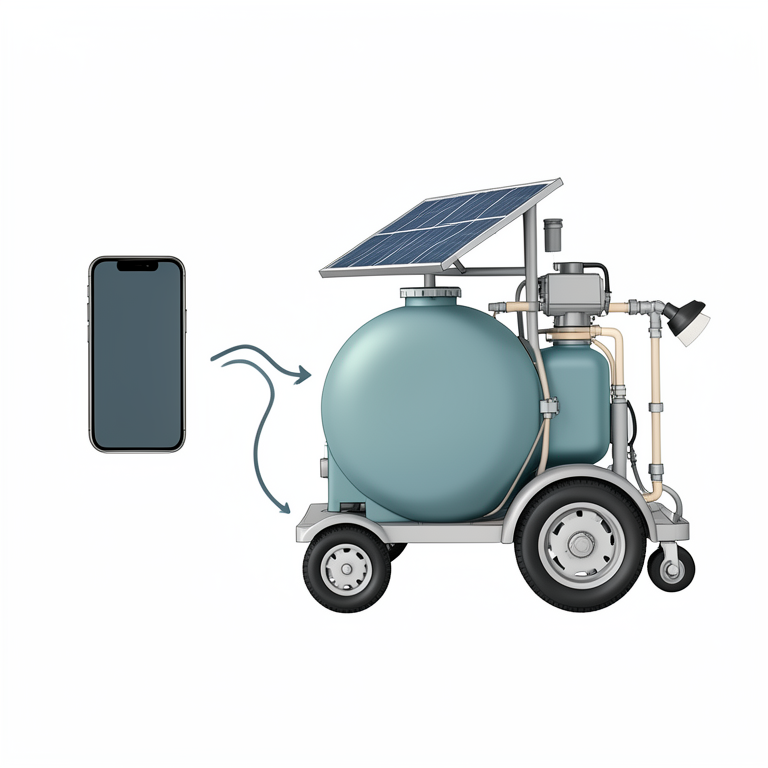
System Architecture Diagram
AI-generated conceptual illustration (remote-controlled pesticide sprayer trolley). It explains the idea and does not show study data.
View source evidence ↗Introduction
Spraying pesticides in the fields is one of the numerous tiresome procedures and activities that make up the agricultural industry. Mechanical devices called sprayers are made expressly to swiftly and easily spray liquids. There are numerous variations of them. We'll examine solar-powered mechanical sprayers in this project. This kind of sprayer is a fantastic method to harness solar power. In areas where spraying is challenging, solar-powered automatic pesticide sprayers are the most economical option. Solar energy sources are used by these solar-powered autonomous pesticide sprayers. First, a storage battery is charged using solar energy. The motor, which doubles as a pump, is powered by the solar energy stored in the battery. The goal of this project is to create a prototype model for farmers and cultivators who find insecticide spraying dangerous and damaging. We must use less people by utilizing this robotics sprayer. Because this sprayer is remote control based, people are not impacted by dangerous chemicals. Work is completed more quickly with this sprayer. It is a sprayer with several uses. In the sectors of agriculture, the project work detailed here is quite beneficial. Insecticide spraying in agricultural areas is one of the laborious procedures and practices that make up the profession of agriculture. Mechanical devices called sprayers are made expressly to swiftly and easily spray liquids. There are numerous variations of them. We'll examine solar-powered mechanical sprayers in this project. This kind of sprayer is a fantastic method to harness solar power. In areas where spraying is challenging, solarpowered automatic pesticide sprayers are the most economical option. Solar energy is the source of power for an autonomous solar-powered pesticide system. First, a storage battery is charged using solar energy. The motor, which doubles as a pump, is powered by the solar energy stored in the battery. We are attempting to create a prototype model for farmers and growers for whom applying pesticides is dangerous and damaging. In agriculture, "bluetooth based pesticide sprayers" are employed. Mechanical devices called sprayers are made expressly to swiftly and easily spray liquids. There are several types of them.
We will examine solar-operated mechanical sprayers in further detail in this research. This kind of sprayer is a fantastic method to harness solar power.
Literature Survey and Background Study
Malatesh D. and others, The current models of pesticide sprayers are either manually driven (man-powered) or fueloperated (fossil power), requiring a lot of human labor and requiring costly, frequent maintenance such as fuel refills. Conventional agricultural sprayers come in backpack shape, and after extended use, they can only hold ten liters and cause back pain or tension for the operator. These issues and limitations are removed by our device, which is essentially a trolley-based system. It can contain a significant amount of insecticide and is conveniently moveable with minimal human effort. We are aware that farming has been used for food and other purposes since ancient times. Pesticides are sprayed on crops to improve their growth. As we travel from east to west and from north to south, we can now see a wide variety of pesticide spraying techniques. It is hard to list all of the methods here. However, we made an effort to highlight the primary methods that we were most familiar with. In India, people employ backpack-style sprayers, which are carried on the back of the user and have a maximum capacity of 15 lights. One hand is used to hold the nozzle, and the other hand is used to pump the machine to generate pressure. Another machine is being developed. Using solar energy, Abhishek Jivrag et al. describe the creation and functioning of a variety of granulated insecticides. A solar panel, an impeller-style centrifugal blower, a gear reduction mechanism, dispensers, DC motors, and batteries are used to create the mixture. Furthermore, the duster has the ability to run on an electric source, which is useful when there isn't any sunshine. In essence, the device distributes insecticide in the form of solid granules. Using toggle switches and push buttons, the operator regulates the pace and release of various insecticides. The technical specifications of the device are worked and examined in a way to minimize the weight of the device and deplete the feeder unit dispenser in a span of three hours. Agriculture plays a major part in our daily lives in India. The yields of the crops determine the overall production and contribute to the nation's economy. In farms, the presence of pests and insects lowers the produce. Insect insecticides and fertilizers are sprinkled manually or with a sprayer to eradicate the pests. Fertilizers and insecticides were formerly applied by hand, but this will have negative consequences for farmers. Various spraying strategies have been developed to address this issue. These sprayers have a variety of mechanics, and the equipment is typically expensive. By removing the pump to spray, we devised a technique that attempted to reduce the equipment cost.
The Proposed Solution
A motor for mobility, a pump for pesticide delivery, sensors for navigation, and a control system to decipher remote control inputs and oversee spraying operations are essential parts. With the help of a remote control unit, this system makes use of a compact, movable, self-propelled vehicle fitted with a pesticide tank and spray nozzle. This enables users to accurately target particular regions in a field while operating the sprayer from a safe distance. It is frequently fueled by solar energy to reduce its environmental impact.
Smart Remote Pesticide sprayer Remote control unit:
A handheld device with intuitive controls to direct the sprayer's movement, including forward, backward, turning, and spray activation. Autonomous navigation: Sensors like GPS, LiDAR, or cameras to enable the sprayer to follow pre-programmed paths or automatically detect crop rows, optimizing spray coverage. Precise spray control: Adjustable nozzle settings and flow rate control to tailor the spray pattern and amount of pesticide applied based on crop needs. Solar power: Solar panels to charge batteries, providing a sustainable energy source for the sprayer's operation. Variable spray height: Adjustable spray boom or nozzle configuration to adapt to different crop heights.
Components Used
If any additions or modifications are needed, we make them and test again until the desired outcomes are achieved. Sprayers that are manually operated pose a risk to human life and consume gasoline. We can solve the aforementioned issues with the aid of the system that has been suggested above. Solar energy is converted by the solar plates, and the battery stores the electrical energy. With the aid of the system, we can solve the issue that farmers encountered in the past and reap its bigger benefits. Instructions are transmitted to the receiver side using Bluetooth applications. The primary parts utilized in the model's fabrication are:
DC Motor
An electric motor is a machine that converts electrical energy into mechanical energy. It is based on the idea that when a current-carrying conductor is exposed to a magnetic field, it experiences a magnetic force whose direction is dictated by Fleming's left-hand rule. When a motor is running, torque is produced. This torque can cause mechanical rotation. DC motors are classified as compound, series, or shunt wound motors, just like generators. As a result, the flux density is reduced in the region immediately below the conductor and increased in the region directly above it. The conductor is found to be subject to a force that attempts to drive it downward, as indicated by the arrow. In the event that the conductor's current is reversed, the conductor will be pushed higher and the flux lines will strengthen below it.
Battery
On distant systems that are not connected to the grid. Batteries are used to store excess solar energy that has been converted into electrical energy. We only expect isolated sunshine loads, such as irrigation pumps or storage drinking water supplies. Yes, for small devices with less than a kilowatt of output. The only storage solution that seems to be both technically and commercially viable is batteries. due to the high upfront expenses of solar panels and batteries. When optimizing the system overall, local demand trends and energy availability must be taken into account. A 12volt battery powers it.
Solar Panel
A collection of photovoltaic cells installed in a framework is called a solar panel, or photovoltaic (PV) module. Direct current electricity is produced by solar panels using sunlight as a source of energy. A PV panel is a group of PV modules, while an array is a system of panels. A photovoltaic system's arrays provide solar power to electrical devices. 12V solar panel.
Microcontroller
Since our system is a vehicle-type system, a microcontroller is required for system control. Our system is controlled by an ESP 32 microcontroller and an L298 motor driver. There are four ports on this microcontroller. For the Bluetooth connection, we use port three. Both the microcontroller's transmitter and the Wifi receiver are connected.
Nozzle
For effective pesticide application, the right nozzle type and size must be chosen. The ounce calibration method, nozzle description, suggested applications, and choosing the right nozzle type are all covered in this article. There is also a list of nozzle manufacturers. For effective pesticide application, the right nozzle type and size must be chosen. The amount of coverage achieved on the target surface, the uniformity of application, the amount of potential drift, and the amount of spray applied to an area are all significantly influenced by the nozzle. The liquid is broken up into droplets by nozzles, which also create the spray pattern and move the droplets in the right direction. The amount of spray volume at a specific operating pressure, travel speed, and spacing is determined by nozzles. By choosing nozzles that generate the biggest droplet size while offering sufficient coverage at the desired application rate and pressure, drift can be reduced. For herbicides, minimizing drift is particularly crucial.
DC Pressure Pump
The benefits of chemical and self-priming pumps are combined in diaphragm pumps. Pumps must be installed in a dry, well-ventilated area because they cannot function in water. self-priming, thermal protection, smooth operation, long-term continuous idling, long-term continuous load operation, and a range of imported corrosion-resistant materials. Completely sealed, stable high pressure. When the pump is operating, the bracket can absorb vibrations from it. It is safe and long-lasting; when the water pressure is too great, the pump will protect itself and continue to function normally, preventing water pipes from bursting. Pressure protection: power protection for pressure switches. 5 L/min is the maximum flow rate. The work is intermittent service, which involves working continuously at various times and under varying pressures. The media used are water or solvents with a PH of 5-8 or oil. Over 500-1000 hours of continuous work is the service life. It uses a 12V water pump.
Wheels
In its most basic form, a wheel is a circular block of hard, durable material with a hole cut through the center that holds an axle bearing. When torque is applied to the wheel about its axis, the wheel turns. One of the six simple machines is the wheel and axle assembly. It takes a lot less effort to move a wheeled vehicle than it does to drag the same weight. The fact that the frictional work is now done in the bearings rather than at the surface the vehicle is traveling on explains the low resistance to motion. A "plain bearing" is the most basic and traditional type, consisting of a round hole that the axle travels through. The frictional work is significantly decreased even with a simple bearing because: The normal force at the sliding interface is same as with simple dragging. The sliding distance is reduced for a given distance of travel. The coefficient of friction at the interface is usually lower.
Pesticide tank
Storage tanks for pesticides are containers that can hold liquids, compressed gases, or media that can be used for either short-term or long-term fluid or gas storage.
Reservoirs can be referred to by this phrase. Storage tanks come in a variety of designs, including flat bottoms, slope bottoms, cone bottoms, and dish bottoms, as well as vertical and horizontal cylindrical open top and closed top tanks. In order to more easily sustain hydraulic hydrostatically produced pressure of confined liquid, large tanks typically feature rounded corners or are vertical cylinders with a vertical side wall transition to the bottom profile. The majority of container tanks used to transport liquids are made to withstand different pressure levels.
Implementation
The central element of the entire system is the microcontroller. The transmitter and the receiver are its two components. The Bluetooth device is the transmitter component.
Result
This vehicle with an agricultural basis turns out to be a useful and efficient device that is simple to maneuver and operate. The vehicle can traverse a variety of soil types and terrains. The EPS32 WiFi controller app, which is accessible through the Play Store, is used to command the movement of the truck and the application of pesticides. Farmers are able to use the vehicle with ease because it is easy to use and not overly sophisticated. Spraying pesticides is a laborious task in agriculture since it calls for a variety of protective gear to keep farmers safe. This vehicle focuses mostly on framers applying pesticides from a distance without coming into direct contact with it. This innovation, which reduces work complexity and turns manned tasks into unmanned ones, will inspire more people to pursue careers in agriculture. Batteries are used to provide the vehicle's necessary power source. Uncontrolled pesticide use will harm the soil and crops, even if spraying pesticides is crucial to raising output yield.
Conclusion
The suggested approach is highly effective and suitable for usage in agricultural fields. The Energy Alternate Device for power sprayers is the best use for this technology. Because it doesn't emit any pollutants, this device is both environmentally friendly and easy to operate. Additionally, this robot can operate in extremely remote locations without access to electricity or fuel. This sprayer is more costeffective than traditional engine-powered sprayers. Furthermore, the same technology and method can be applied to all kinds of power sprayers. We must use less people by utilizing this Remote controlled sprayer. Because this sprayer is controlled by a remote, people are not impacted by dangerous chemicals. Work is completed more quickly with this sprayer. It's a multifunctional sprayer. In the sectors of agriculture, the project work detailed here is quite beneficial. As a result, the system for watering plants was successfully designed and tested, and its performance was determined to be satisfactory.
References
3 in the original paper- Pezzi F, Rondelli V. The performance of an air-assisted sprayer operating in vines. J Agric Eng Res. 2000;76(4):331-340.
- Burrell JBT, Beckwih R. Vineyard computing: sensor networks in agricultural production. Pervasive Computing. IEEE. 2004 Mar;3(1):38-45.
- Baldi I, Lebailly P. Pesticide contamination of workers in vineyards in France. J Expo Sci Environ Epidemiol. 2006;16:115-124.