
Research article · 2025 · Full text
International Journal of Biology SciencesUse of growth regulators & foliar spray of nutrients in black gram (Vigna mungo L.)
Volume 7(2) · Pages 68–71 · DOI: 10.33545/26649926.2025.v7.i2b.299 ↗
Research areasAgricultural Science and Fertilization
Abstract
Author-writtenA field experiment was conducted at Agronomy Section,College of Agriculture, Latur duringkharif season of 2022 to study the effect of foliar spray of nutrients and growth regulators in black gram (Vigna mungo L.).The soil of experimental plot was clayey loam. The experiment was laid out in a Randomized Block Design, with eight treatments and was replicated thrice. The treatments consistofT1- Control, T2- Foliar application of 22% seaweed extract at flower initiation, T3- Foliar application of 0.2% micronutrient grade 2 at flower initiation, T4- Foliar spray of 30 ppm GA3 at flower initiation,T5- Foliar application of 40 ppm NAA at flower initiation, T6 - Foliar spray of 2% urea at flower initiation, T7- Foliar application of 1% NPK (19:19:19) at flower initiation, T8 - Foliar spray of 2% DAP at flower initiation. Among the different treatments, foliar application of 22% seaweed extract at flower initiation (T2) recorded higher growth and yield attributes such as plant height (cm), number of branchesplant-1, total dry matter production (g),seed yield (kg ha-1) and straw yield (kg ha-1). This was followed by foliar application of 1% NPK (19:19:19) at flower initiation (T7) and foliar application of 30 ppm GA3 at flower initiation (T4). The lower values of growth and yield attributes of black gram were recorded in the treatment of Control (T1). Therefore, it can be concluded that foliar application of 22% seaweed extract at flower initiation (T2) is viable practice to enhance the growth and yield of irrigated black gram.
Summary
Source-checkedPlain-language reading of the full paper, prepared with AI and checked against the text. Each point links to the authors' own words.
Why it matters
- Black gram is a primary pulse crop grown in rainfed areas across India. View evidence ↗
- Black gram is nutritionally significant, containing 24% protein and 60% carbohydrate. View evidence ↗
- There is a need to improve the low productivity of black gram through better agronomic practices. View evidence ↗
The question
- The study aimed to evaluate how foliar sprays of various nutrients and growth regulators affect black gram. View evidence ↗
What they did
- The field experiment was conducted during the 2022 kharif season at the College of Agriculture in Latur, Maharashtra. View evidence ↗
- The study used a Randomized Block Design with eight different treatments, each replicated three times. View evidence ↗
- Treatments included a control and foliar applications at flower initiation of 22% seaweed extract, 0.2% micronutrient grade 2, 30 ppm GA3, 40 ppm NAA, 2% urea, 1% NPK (19:19:19), and 2% DAP. View evidence ↗
- The researchers measured growth attributes including plant height, number of branches, functional leaves, leaf area, and dry matter per plant. View evidence ↗
What they found
- Foliar application of 22% seaweed extract resulted in the highest plant height (45.35 cm), branches (7.28), functional leaves (35.33), leaf area (4.64 dm2), and dry matter (18.34 g). View evidence ↗
- The 22% seaweed extract treatment produced the highest seed yield (1435 kg ha-1), straw yield (3023 kg ha-1), pod weight (7.20 g), seed yield per plant (5.04 g), and test weight (44.18 g). View evidence ↗
- The control group exhibited the lowest performance across all yield metrics, including a seed yield of 1117 kg ha-1 and straw yield of 2020 kg ha-1. View evidence ↗
- The yield results for 22% seaweed extract were comparable to those achieved with 1% NPK (19:19:19). View evidence ↗
What it means
- The authors concluded that applying 22% seaweed extract at flower initiation significantly enhances the growth and productivity of black gram. View evidence ↗
- The authors state that foliar nutrition is an effective method for improving plant health and maximizing seed yield. View evidence ↗
Visual summary
2 visualsIllustrations explain the paper; charts are replotted from the paper's own table values.
Comparison of Foliar Treatments
AI-generated conceptual illustration (black gram plants (Vigna mungo L.)). It explains the idea and does not show study data.
View source evidence ↗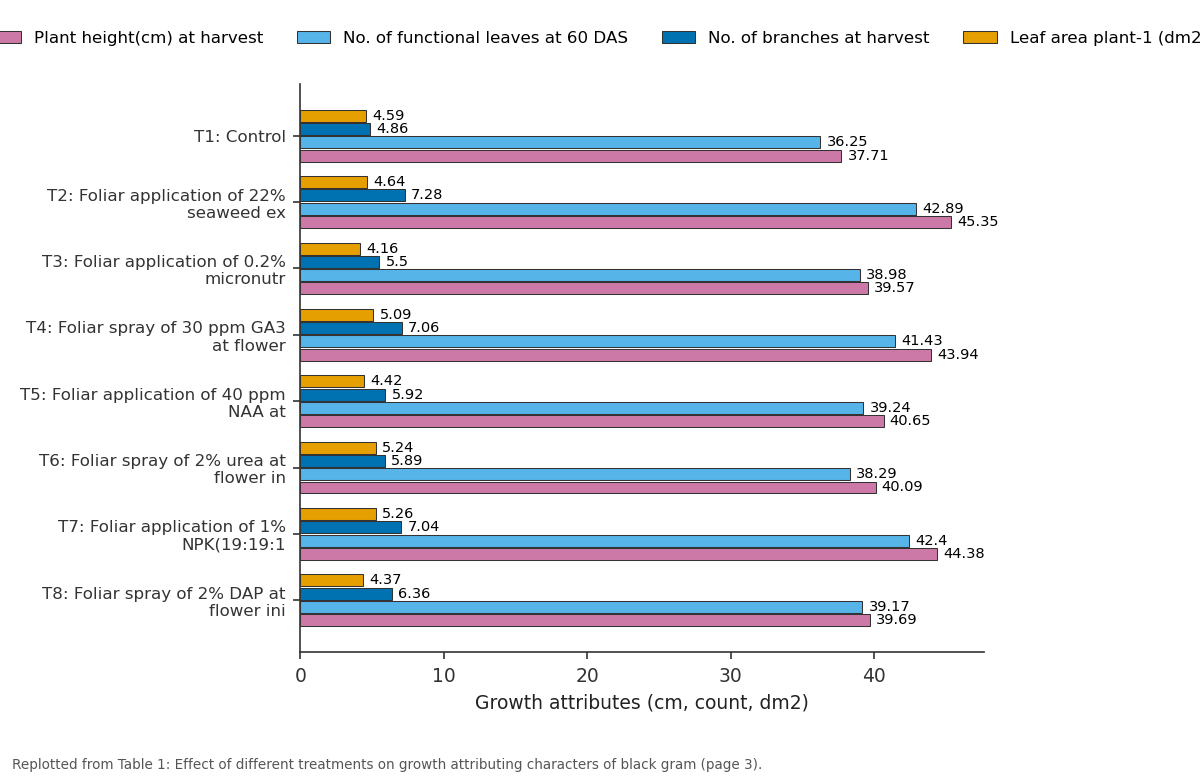
Plant height(cm) at harvest and No. of functional leaves at 60 DAS and more: T1: Control vs T2: Foliar application... vs T3: Foliar application... vs T4: Foliar spray of 30... vs T5: Foliar applicatio
Replotted from Table 1 (page 3) of the original paper. Every bar is the paper's own table value.
View source evidence ↗Figures & tables
From the original paper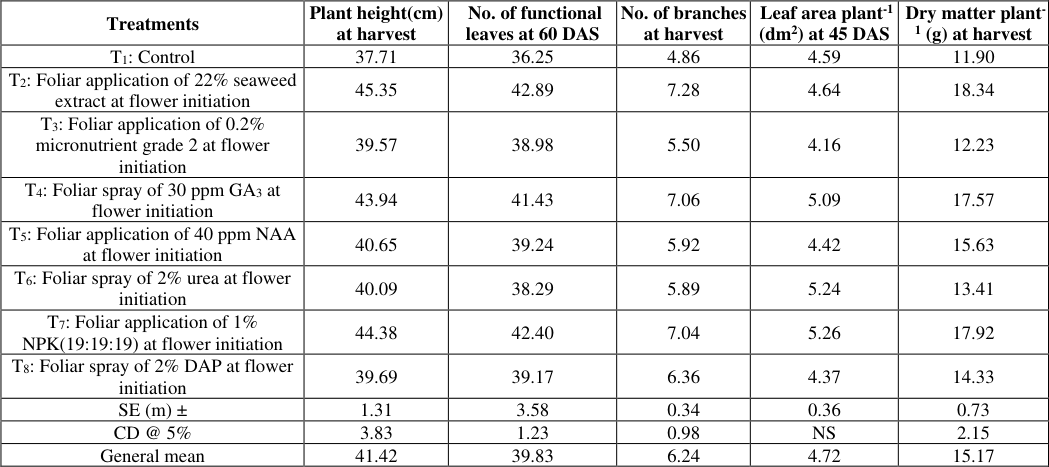 Table 1
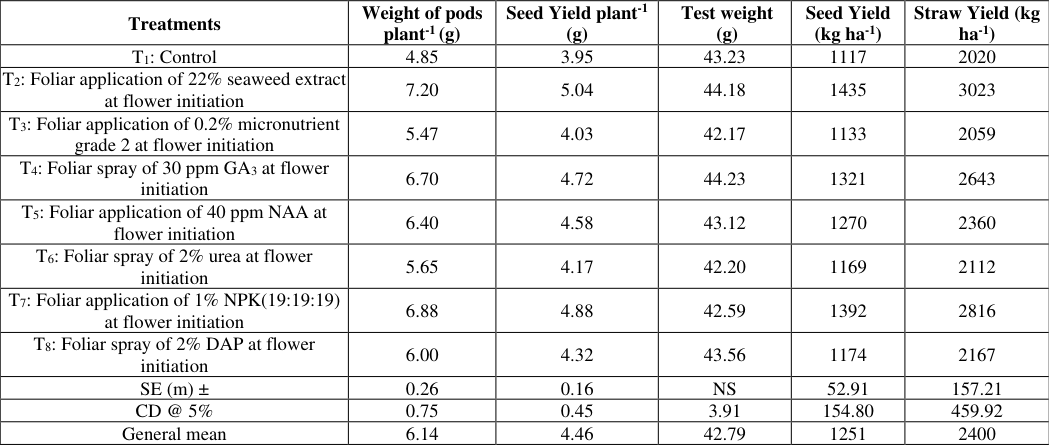 Table 2
Introduction
Pulses are wonderful gift of nature with unique ability of biological nitrogen fixation, deep root system, mobilization of insoluble soil nutrients and bringing qualitative changes in soil properties which restores fertility of soil. Among pulses, black gram [Vigna mungo (L.) Hepper] is one of the most chief pulse crop of rainfed areas grown throughout the country. This crop is grown in diverse cropping system as a mixed crop, catch crop and sequential crop in the country. Black gram (Vigna mungo L.) belongs to family Leguminoceae. The plant attains a height of 30 to 100 cm. The leaves are large, trifoliate and are also hairy, generally with a purplish tinge. The pods are long and cylindrical and about 4 to 6 cm in length. This crop is itself a mini-fertilizer factory as it has unique characteristics of maintaining and restoring soil fertility through fixing atmospheric nitrogen in symbiotic association with rhizobium bacteria present in the root nodules. Black gram (Vigna mungo L.) is also known as black matpe bean, urid, urd beanor urad. It is widely grown in southern Asia as a grain legume and assumes considerable importance with respect to its nutritional value. It contains 24% protein, 60% carbohydrate, 1.3% fat, 3.2% minerals, 0.9% fiber, 154 mg calcium, 385 mg phosphorus, 9.1 mg iron and small amount of vitamin B-complex. It is popularly grown as short durational (75-80 days) pulse crop as it thrives better in all seasons either as sole, inter, mixed or fallow crop. As India is its primary origin and is mainly cultivated in Asian countries including parts of southern Asia. India is the world's largest producer as well as consumer of black gram. Black gram producing major states in India are Andhra Pradesh, Madhya Pradesh, Rajasthan, Uttar Pradesh, Tamilnadu and Maharashtra. In kharif 2021-22, black gram production in India was 20.5 lakh tonnes (1 st advance estimates) in an area of 39.43 lakh hectares (Anonymous, 2021) [3] . In Maharashtra, it is grown on area 5.54 lakh ha with production of 3.72 lakh ha and productivity 672 kg ha -1 (Anonymous, 2021) [3] .
International Journal of Biology Sciences https://www.biologyjournal.net
The major black gram producing districts in Marathwada region are Parbhani, Nanded, Latur, Hingoli, Beed, Chhatrapati Sambhajinagar and Dharashiv. The area under black gram in Latur district is about 1,017.13 hundred ha -1 with production of 497.84 hundred tonnes and productivity of 489.46 kg ha -1 (Anonymous, 2021) [3] . Foliar nutrition is found to have an important method of fertilizer application since foliar nutrients easily penetrate the leaf cuticle or stomata and enters the cells facilitating easy and rapid consumption of nutrients. It has an advantage of quick and efficient utilization of nutrients, elimination of losses through leaching, fixation and regulating the uptake of nutrients by plants (Manonmani & Srimathi, 2009) [11] . It increases the photosynthetic rate, better nutrient translocation from leaves to the developing seeds. It is most economical way of fertilization to achieve quality production and yield while nutrient uptake from the soil is restricted (Thakur et al. 2017) [15] . Therefore, it is hypothesized that foliar nutrition in addition to soil application in commensuration with prevailing weather particularly rainfall will go a long way in meeting the crop nutrient need and thereby help in enhancing the productivity. Moreover, foliar feeding practice of nutrients and biostimulants would be more useful in early maturing of crops which could be combined with regular plant protection programme (Jadhav & Kulkarni, 2016) [10] . The water soluble fertilizers such as urea, DAP, 19:19:19 (NPK) and micronutrient grade 2 get readily dissolved in water. If scarce situation occurs and deficiency of nutrients observed in the field at that time foliar application through water soluble fertilizers can be used directly in the form of foliar spray for better consumption and easy nutrient uptake by plants. Urea, DAP and 19:19:19 contains macronutrients N, P, K at a fixed ratioout of which nitrogen promotes growth of a plant and facilitates maximum yield. Phosphorous promotes flowering and root development while, potassium controls movement of stomata and maintains electroneutrality of plant cells. Hence, they are found significant to enhance growth and eventually yield of crop. Foliar application is effective for the application of major micronutrients like iron, zinc, boron, copper, manganese and molybdenum. This is considered to be an efficient and economic method of supplementing part of nutrients requirement at critical stages. Naphthalene Acetic Acid (NAA) is a synthetic plant hormone in the auxin. It reduces flower drop and eventually yield increases. Gibberellic acids are diterpene plant growth regulators that are biosynthesized from geranyl diphosphate, a common C 20 precursor for diterpenoids, which control miscellaneous aspects of growth and development including seed germination, stem elongation, flowering and pod development. Urea is a diamide of carbonic acid [CO (NH 2 ) 2 ] which contains 46% (N), Foliar spray of urea improves the photosynthetic rate, vegetative growth, leaf area index and yield of crop. Pulse crops particularly black gram gives well response to foliar spray of urea. Diammonium phosphate (DAP) is the world's most widely used phoshphate fertilizer which contains 46% (P) and 18% (N). The foliar spray of 2% DAP twice at flower initiation and pod formation stages of crop growth results in higher number of pods, number of seed, seed index and higher seed yield. Foliar application of watersoluble fertilizer 19:19:19 (NPK) may be a good option which enhances yield of pulse crop and reduces the cost of cultivation. In foliar application of nutrients another best option being used by farmers is the use of seaweed extract as plant nutrient bearing fertilizer. Seaweed extracts are rich in major and minor nutrients, amino acid, vitamins, cytokinins, enzymes and auxin like growth promoting substances thus fulfil the basic requirement of crops and have been reported to stimulate the growth and yield of pulses (Pramanicket al. 2013) [13] . As the productivity of black gram in our country is very low, there is need for enhancement of its productivity with proper agronomic practices (Naik et al. 2022) [5] . One among them is foliar application of nutrient source for maximizing yield potential of the crop. Foliar application has been open up to be favourable in short durational crops where the soil moisture is a limiting factor and the soil-applied fertilizer may not fulfil the basic requirement of nutrients before maturity of the crop. Considering the above facts, the experiment was entitled "Effect of foliar spray of nutrients and growth regulators in black gram (Vigna mungo L.)" was planned [7] .
Material and methods
A field experiment was carried out during kharif season of 2022 Agronomy Section, College of Agriculture, Latur (Maharashtra) to study the effect of foliar spray of nutrients and growth regulators in black gram (Vigna mungo L.). The soil of experimental plot was clayey in texture with chemical composition such as low in available nitrogen (125.3 kg ha -1 ), very low in available phosphorous (18.2 kg ha -1 ) and very high in available potassium (498.58 kg ha -1 ). The soil was slightly alkaline in reaction having pH (7.8). A field experiment was laid out in a Randomized Block Design (RBD) with eight treatments and was replicated thrice. The treatments were T 1 -Control, T 2 -Foliar application of 22% seaweed extract at flower initiation, T 3 -Foliar application of 0.2% micronutrient grade 2 at flower initiation,T 4 -Foliar spray of 30 ppm GA 3 at flower initiation, T 5 -Foliar application of 40 ppm NAA at flower initiation, T 6 -Foliar spray of 2% urea at flower initiation, T 7 -Foliar application of 1% NPK (19:19:19) at flower initiation, T 8 -Foliar spray of 2% DAP at flower initiation. The gross plot size of each experimental unit was 5.4 m x 4.5 m and net plot size was 4.5 m x 3.9 m. The recommended dose of fertilizer (RDF) was 25:50:00 NPK kg ha -1 .
Results and Discussion
Results and Discussion
Growth attributes
Growth attributing characters viz., plant height (cm), number of branches plant -1 , number of functional leaves, leaf area plant -1 (dm 2 ), dry matter plant -1 (g) were influenced significantly due to different treatments (Table1). Foliar application of 22% seaweed extract at flower initiation (T 8 ) recorded significantly higher plant height(45.35 cm),number of branches (7.28), number of functional leaves (35.33), leaf areaplant -1 (4.64 dm 2 ), dry matter plant -1 (18.34 g) at all growth stages of crop except 30 and 45DAS which was at par with foliar application of 1% NPK(19:19:19) at flower initiation (T 7 ) and foliar spray of 30 ppm GA 3 at flower initiation (T 4 ) and also found significantly superior over rest of the treatments. Increase in dry matter production in the treatments were attributed to higher photosynthetic rate of plants, which depends upon number of functional leaves, plant height, and dry matter accumulation in plants. Similar results were also found by similar with Dwivedi et al.
(2014) [18] , Akhila et al. (2017) [1] , Iswarya et al. (2019) [9] , Gawade et al. (2022) [6] , Arutkumaran et al. (2023) [4] .
Yield and yield attributes
The yield attributing characters of black gramviz, weight of grains plant -1 (g), test weight (g), seed yield (kg ha -1 ) and straw yield (kg ha -1 ) were influenced significantly by different treatments (Table 2). weight of pods plant -1 (7.20 g), seed yield plant -1 (5.04 g), test weight (44.18 g), seed yield (1435 kg ha -1 ) and straw yield (3023 kg ha -1 ) was recorded with foliar application of 22% seaweed extract at flower initiation (T 2 ) which was at par with foliar application of 1% NPK (19:19:19) at flower initiation (T 7 ) and foliar spray of 30 ppm GA 3 at flower initiation (T 4 ) and also found significantly superior over rest of the treatments. The control treatment (T 1 ) showed lowest weight of pods plant -1 (4.85 g), seed yield plant -1 (3.95 g), test weight (43.23 g), seed yield (1117 kg ha -1 ) and straw yield (2020 kg ha -1 ). Increase in weight of pods plant -1 , seed yield plant -1 , test weight, seed yield and straw yield might be due to increase in translocation of assimilates from source to sink. The similar results were also found Raja & Geetha (2010) [14] , Pramanick et al. (2013) [13] , Ghosh et al. (2020) [17] , Ammittee et al. (2021) [2] , Merhej et al. (2021) [12] , Huda et al. (2023) [8,16] .
| Treatments | Weight of pods plant-1 (g) | Seed Yield plant-1 (g) | Test weight (g) | Seed Yield (kg ha-1) | Straw Yield (kg ha-1) |
|---|---|---|---|---|---|
| T1: Control | 4.85 | 3.95 | 43.23 | 1117 | 2020 |
| T2: Foliar application of 22% seaweed extract at flower initiation | 7.20 | 5.04 | 44.18 | 1435 | 3023 |
| T3: Foliar application of 0.2% micronutrient grade 2 at flower initiation | 5.47 | 4.03 | 42.17 | 1133 | 2059 |
| T4: Foliar spray of 30 ppm GA3 at flower initiation | 6.70 | 4.72 | 44.23 | 1321 | 2643 |
| T5: Foliar application of 40 ppm NAA at flower initiation | 6.40 | 4.58 | 43.12 | 1270 | 2360 |
| T6: Foliar spray of 2% urea at flower initiation | 5.65 | 4.17 | 42.20 | 1169 | 2112 |
| T7: Foliar application of 1% NPK(19:19:19) at flower initiation | 6.88 | 4.88 | 42.59 | 1392 | 2816 |
| T8: Foliar spray of 2% DAP at flower initiation | 6.00 | 4.32 | 43.56 | 1174 | 2167 |
| SE (m) ± | 0.26 | 0.16 | NS | 52.91 | 157.21 |
| CD @ 5% | 0.75 | 0.45 | 3.91 | 154.80 | 459.92 |
| General mean | 6.14 | 4.46 | 42.79 | 1251 | 2400 |
Table text extracted from the original PDF; superscript letters are shown inline. The original table image is below.
View original table image
References
18 in the original paper- Akhila K, Kaswala AR, Priyanka DP. Effect of liquid fertilizers on growth, yield, and economics of the green gram (Vigna radiata L.) crop under organic farming. Int J Chem Stud. 2017;5(6):809-812.
- Ammitte H, Singh S, Tiwari D, Reddy CM. Effect of nutrient levels and seaweed sap on growth and yield of International Journal of Biology Sciences https://www.biologyjournal.net black gram (Vigna mungo L.). Bioscan. 2021;16(1):9599.
- Anonymous. [Internet]. 2021 [cited YYYY MM DD]. Available from: http://agricoop.nic.in.
- Arutkumaran M, Suseendran K, Kalaiyarasan C, Sriramachandrasekharan MV, Jawahar S, Thiruppathi M. Effect of foliar nutrition on growth and yield of irrigated green gram (Vigna radiata) cv. Vamban 4. Pharma Innov J. 2023;12(3):3584-3588.
- Naik RPK, Singh V, George SG, Singh SK. Effect of sulphur and spacing on growth and yield of blackgram (Vigna mungo L.). South Asian J Agric Sci. 2022;2(1):35-37.
- Gawade AP, Gaikwad GK, Kavar KA. Effect of foliar nutrition of water-soluble fertilizer and growth regulator on growth attributing characters of black gram (Vigna mungo L. Hepper). Pharma Innov J. 2022;11(11):901-904.
- Al-Joubory TGH, Al-Hyali EAS, Al-Hadeethi MR. Preparation and diagnosis of nano-activated carbon from falling SIDR leaves. Int J Adv Chem Res. 2023;5(1):99-105.
- Abera D. Estimating magnitude of standard heterosis in mid-altitude maize (*Zea mays* L.) hybrids for grain yield and yield related traits at Haro Sabu, West Oromia, Ethiopia. Int J Res Agron. 2023;6(1):31-38.
- Iswarya S, Latha KR, Srinivasan K. Evaluation of seaweed extract on growth determinants, yield, and biochemical parameters of green gram (Vigna radiata). J Pharmacogn Phytochem. 2019;8(3):1861-1864.
- Jadhav RL, Kulkarni S. Green gram productivity enhancement through foliar spray of nutrients. Legume Res Int J. 2016;39(5):814-816.
- Manonmani V, Srimathi P. Influence of mother crop nutrition on seed yield and quality of black gram. Madras Agric J. 2009;96(1-6):125-128.
- Merhej MY, Hanoon MB, Atab HA, Jasim AH. Response of mung bean to urea application, spraying times of foliar fertilizers, and seaweed extract. Plant Cell Biotechnol Mol Biol. 2021;466-472.
- Pramanick B, Brahmachari K, Ghosh A. Effect of seaweed saps on growth and yield improvement of green gram. Afr J Agric Res. 2013;8(13):1180-1186.
- Hepper). Int J Plant Sci (Muzaffarnagar). 2010;5(2):513-514.
- Thakur V, Patil RP, Patil JR, Suma TC, Umesh MR. Influence of foliar nutrition on growth and yield of black gram under rainfed condition. J Pharmacogn Phytochem. 2017;6(6):33-37.
- Huda MN, Mannan MA, Bari MN, Rafiquzzaman SM, Higuchi H. Red seaweed liquid fertilizer increases growth, chlorophyll, and yield of mung bean (Vigna radiata L.). Agron Res. 2023.
- Ghosh A, Shankar T, Malik GC, Banerjee M, Ghosh A. Effect of seaweed extracts on the growth, yield, and nutrient uptake of black gram (Vigna mungo L.) in the red and lateritic belt of West Bengal. Int J Chem Stud. 2020;8(3):799-802.
- Dwivedi SK, Meshram MR, Pal A, Pandey N, Ghosh A. Impact of natural organic fertilizer (seaweed saps) on productivity and nutrient status of black gram (Phaseolus mungo L.). Bioscan. 2014;9(4):1535-1539.