
Research article · 2025 · Full text
International Journal of Horticulture and Food ScienceFirmness and instrumental consistency of Buffalo curd prepared with modified ratios of major milk constituents
Volume 7(2) · Pages 36–40 · DOI: 10.33545/26631067.2025.v7.i2a.265 ↗
Research areasFood Industry and Aquatic Biology
Abstract
Author-writtenBuffalo curd was prepared from buffalo milk with altered major milk constituents namely fat and Solids not fat ratio. In fresh buffalo curd after its incubation under 37ºC and 40ºC separately were analysed: Firmness and consistency of buffalo curd samples were analyzed using instrumental texture analyzer. Firmness, consistency attributes of buffalo curd samples, measured by texture analyser, showed a general increasing trend with increasing % Fat and % Solids not fat in milk. By laboratory analysis of instrumental textural profile of buffalo curd in detail it was found that there exhibits a positive correlation between with consistency and firmness of buffalo curd with the fat (F %) and Solids not fat (SNF) content of fresh buffalo curd. Firmness and consistency of buffalo curd were much better with increased fermentation temperature of 40ºC when compared to 37ºC of buffalo curd incubation. buffalo curd prepared at incubation temperature of 40˚C Firmness value probe revealed that increase of fat from 5% and SNF from 9% (Group 1) to Fat 8 %; SNF 14% (Group 7) at incubation temperature of 40˚C has increased the buffalo curd firmness value from 270.19 ±19.16 to 351. 23±13.66 and consistency value from 6484.12±112.34 to 6721.54 ±106.79 respectively.
Summary
Source-checkedPlain-language reading of the full paper, prepared with AI and checked against the text. Each point links to the authors' own words.
Why it matters
- Buffalo curd is valued for its smooth texture, pleasant aroma, and firm consistency. View evidence ↗
- The sensory and textural properties of cultured dairy products are known to be affected by the levels of fat and solids-not-fat (SNF). View evidence ↗
- There has been a lack of detailed research on exactly how fat and SNF levels influence the acceptability and textural quality of buffalo curd. View evidence ↗
The question
- The study aimed to determine how different ratios of fat and SNF, combined with incubation temperatures of 37°C and 40°C, affect the firmness and instrumental consistency of buffalo curd. View evidence ↗
What they did
- Various combinations of fat and SNF were created using the Pearson square method with buffalo milk cream and skim milk powder. View evidence ↗
- Textural analysis involved penetrating a probe 10 mm (20% compression) into the curd at a speed of 1.0 mm/s. View evidence ↗
- Firmness was measured as the resistance (in grams) during probe penetration, while consistency was measured as the area under the positive peak of the force-time curve (in g-sec). View evidence ↗
- All textural measurements were performed in quadruplicate for each sample. View evidence ↗
What they found
- Both firmness and consistency of the buffalo curd generally increased as the percentage of fat and SNF in the milk increased. View evidence ↗
- Incubating the curd at 40°C resulted in better firmness and consistency compared to incubation at 37°C. View evidence ↗
- At 37°C, increasing fat from 5% to 8% and SNF from 9% to 12% increased firmness from 270.19 ±19.16 to 358.26 ±19.22 and consistency from 6465.31 ± 118.26 to 6702.11 ±166.25. View evidence ↗
- At 40°C, increasing fat from 5% to 8% and SNF from 9% to 14% increased firmness from 270.19 ±19.16 to 351.23 ±13.66 and consistency from 6484.12 ± 112.34 to 6721.54 ± 106.79. View evidence ↗
What it means
- The authors concluded that increasing the ratio of fat and solids-not-fat in buffalo milk leads to an increase in the firmness and instrumental consistency of the resulting curd. View evidence ↗
- The authors noted that increasing SNF beyond a certain level may negatively impact body and texture scores due to faster lactic acid bacteria growth and subsequent water oozing (syneresis). View evidence ↗
Visual summary
1 visualsIllustrations explain the paper; they do not show study data.
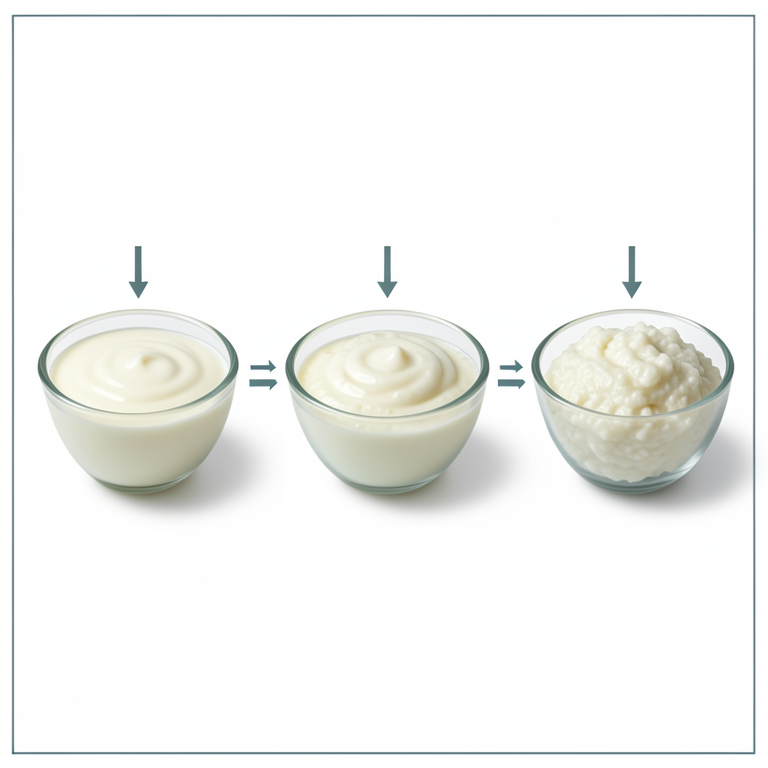
Factors Influencing Buffalo Curd Texture
AI-generated conceptual illustration (Buffalo curd in glass bowls). It explains the idea and does not show study data.
View source evidence ↗Figures & tables
From the original paper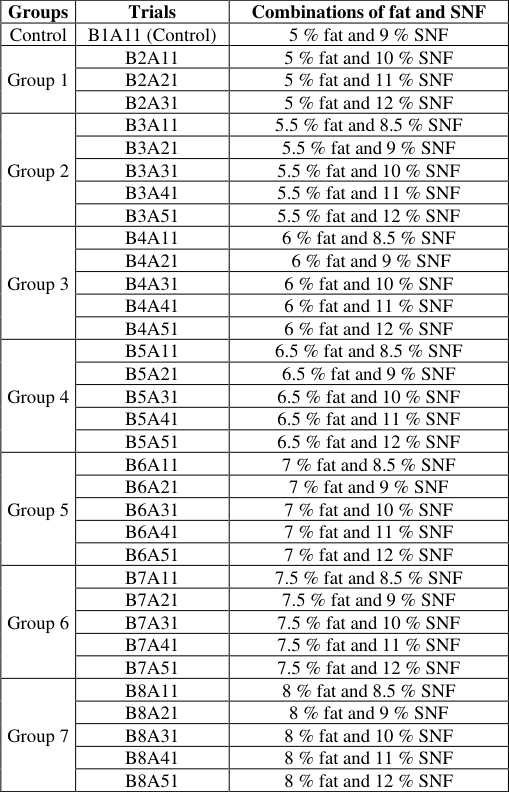 Table 1
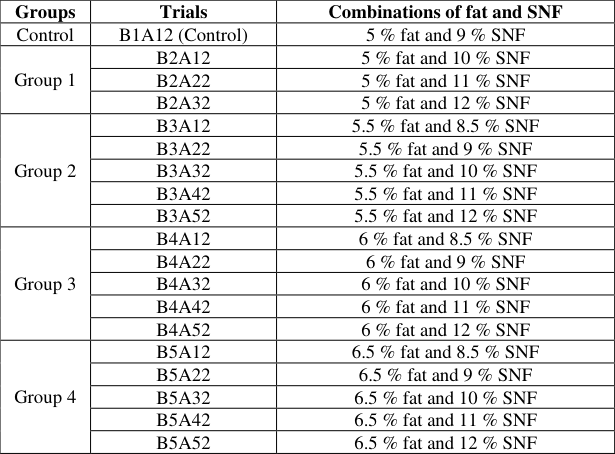 Table 2
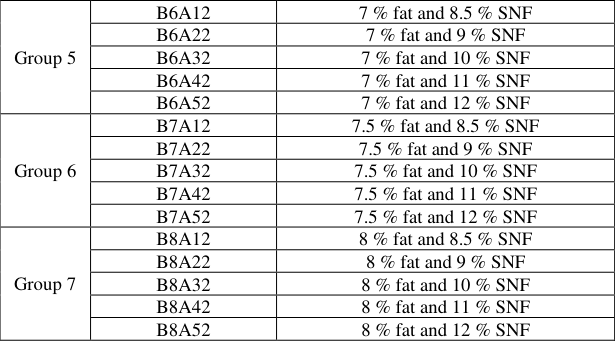 Table 3
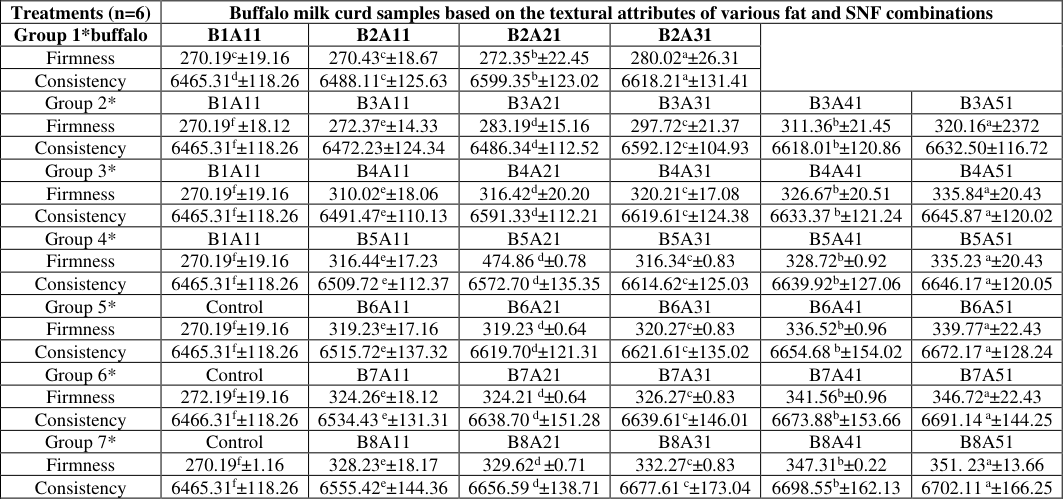 Table 3
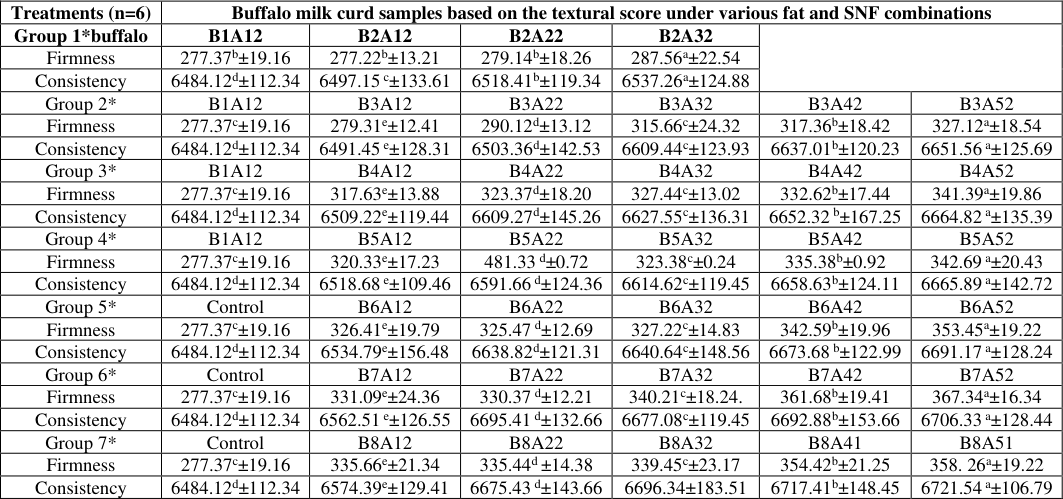 Table 4
Introduction
Buffalo curd has firm consistency, smooth texture, and pleasant aroma. Traditionally, it is prepared by boiling buffalo milk followed by cooling and culturing at ambient temperature using lactic culture and pouring into retail earthen cups and left undisturbed overnight for fermentation. After obtaining firm body curd has set, it is stored at a low temperature (4°C) and served chilled (Aneja et al. 2002; Singh 2007) [1,19] . Various market survey reports on the quality of curd sold in different parts of the country revealed wide variations in the fat (1-12%) and solids not fat contents (6-25%) contents (Sarkar et al. 1996) [18] . Because of the pleasant sour taste cherished by all age groups and the availability of technology for the industrial manufacture (Ghosh and Rajorhia 1990b) [5] , Various studies have reported that fat and solids not fat affects both the sensory and texture properties of cultured dairy products (Rash 1990; Lucey and Singh 1997; Tamime and Robinson 1999; Gayanjalee et al, 2024) [17,9,20,4] . The growing awareness of impact of fermented foods on health among consumers may increase the marketing of curd in future. However, there is no elaborative study conducted on the extent to which fat and Solids not fat affecting its textural quality and acceptability. Hence, the present study was undertaken to see the effect of fat and solids not fat under different altered ratios in buffalo milk and how its impact on the Firmness and instrumental consistency of buffalo curd prepared under different incubation temperatures at 37 °C and also at 40 °C.
Materials and methods
Fresh buffalo milk is obtained from the farm. Using cream obtained from buffalo milk and skim milk powder, with the help of Pearson square method various fat and SNF combinations a
Textural analysis of buffalo curd
Textural attributes such as firmness and consistency of buffalo curd (M/s Scientific and Digital Systems, Delhi) was analysed using Back extrusion method using a texture analyser. For determining the textural attributes, the pasteurized and cooled curd was filled up to 5 cm in a sterilized glass beaker (10 cm height and 6 cm diameter) and tempered at 25°C for 2 h prior to analysis. The probe was penetrated up to 10 mm (20 percent compression) into the curd at a crosshead speed of 1.0 mm/s. The probe displaced the material by compression followed by back extrusion so that the fluid flow upward through the concentric annular space. From the resulting force-time curves, firmness, i.e., the force for compression, stickiness, i.e., the negative peak force during withdrawal, work of shear and work of adhesion were calculated using the Texture Exponent System software supplied by the manufacturer along with the instrument. All measurements were done in quadruplicate per sample. Distance (10 mm) during which it senses a resistance force that is directly proportional to the firmness of the set curd. The resistance offered by the curd samples to the probe during the penetration was measured as the firmness (g) of the curd. The area under the positive peak of the curve was measured as the consistency (g-sec) of the curd and the area under the negative peak was measured as the viscosity index (g-sec) of the curd. The viscosity index i.e. the area of the negative peak is the reflection of the total work done by the probe during its withdrawal from the curd during the test. Texture Measurement Textural attributes such as firmness and consistency were determined by back extrusion method using a texture analyser. For determining the textural attributes, the pasteurized and cooled curd mix was filled (∼125 mL) up to 5 cm in a pre-sterilized glass beaker (10 cm height and 6 cm diameter) and incubation was carried out at different temperature. The beakers were tempered at 25°C for 2 h prior to analysis. The probe (A/BE 35) was penetrated up to 10 mm (20% compression) into the set buffalo curd at a crosshead speed of 1.0 mm/s. The probe displaced the material by compression followed by back extrusion, so that the fluid flowed upward through the concentric annular space. From the resulting force-time curves, firmness, i.e., the force for compression, consistency, i.e., the negative peak force during withdrawal, work of shear and work of adhesion were calculated using the Texture Expert Exceed software (version 2.55) supplied by the manufacturer along with the instrument. All measurements were done in quadruplicate per sample. Effect of major milk components Fat and Solids Not fat under altered combinations in buffalo milk as given in table 1 and 2 were prepared using Pearson square method.
| Groups | Trials | Combinations of fat and SNF |
|---|---|---|
| Control | B1A11 (Control) | 5 % fat and 9 % SNF |
| Group 1 | B2A11 | 5 % fat and 10 % SNF |
| B2A21 | 5 % fat and 11 % SNF | |
| B2A31 | 5 % fat and 12 % SNF | |
| Group 2 | B3A11 | 5.5 % fat and 8.5 % SNF |
| B3A21 | 5.5 % fat and 9 % SNF | |
| B3A31 | 5.5 % fat and 10 % SNF | |
| B3A41 | 5.5 % fat and 11 % SNF | |
| B3A51 | 5.5 % fat and 12 % SNF | |
| Group 3 | B4A11 | 6 % fat and 8.5 % SNF |
| B4A21 | 6 % fat and 9 % SNF | |
| B4A31 | 6 % fat and 10 % SNF | |
| B4A41 | 6 % fat and 11 % SNF | |
| B4A51 | 6 % fat and 12 % SNF | |
| Group 4 | B5A11 | 6.5 % fat and 8.5 % SNF |
| B5A21 | 6.5 % fat and 9 % SNF | |
| B5A31 | 6.5 % fat and 10 % SNF | |
| B5A41 | 6.5 % fat and 11 % SNF | |
| B5A51 | 6.5 % fat and 12 % SNF | |
| Group 5 | B6A11 | 7 % fat and 8.5 % SNF |
| B6A21 | 7 % fat and 9 % SNF | |
| B6A31 | 7 % fat and 10 % SNF | |
| B6A41 | 7 % fat and 11 % SNF | |
| B6A51 | 7 % fat and 12 % SNF | |
| Group 6 | B7A11 | 7.5 % fat and 8.5 % SNF |
| B7A21 | 7.5 % fat and 9 % SNF | |
| B7A31 | 7.5 % fat and 10 % SNF | |
| B7A41 | 7.5 % fat and 11 % SNF | |
| B7A51 | 7.5 % fat and 12 % SNF | |
| Group 7 | B8A11 | 8 % fat and 8.5 % SNF |
| B8A21 | 8 % fat and 9 % SNF | |
| B8A31 | 8 % fat and 10 % SNF | |
| B8A41 | 8 % fat and 11 % SNF | |
| B8A51 | 8 % fat and 12 % SNF |
Table text extracted from the original PDF; superscript letters are shown inline. The original table image is below.
View original table image
Results
Results
Firmness and consistency values for buffalo milk curd with various fat and SNF combinations
The firmness and consistency attributes of the buffalo milk curd made by incubating the sample at 37ºC and 40ºC are presented in Tables 3 and4. As the fat and SNF contents of the milk increased there was a corresponding increase in the firmness and consistency of the buffalo curd samples. Modifications were made in the major milk constituents of buffalo curd milk ie, Fat and solids not fat and analysis were related with texture profile of the best combination of fat and SNF for buffalo milk curd was carried out based on the textural properties. Firmness value, i.e., the peak force obtained during penetration of the probe revealed that increase of fat from 5%to 8% and Solids Not Fat from 9 to 12% (Group 7) at incubation temperature of 37˚C has increased the buffalo curd firmness value from 270.19 ±19. 16 The textural qualities of the buffalo milk curd samples incubated at 37ºC and 40ºC are presented in Tables 3 and4. As the fat and SNF contents of the milk increased, there was a corresponding increase in the firmness and consistency of the buffalo curd samples. Hence, based on the textural qualities the clear-cut conclusion about the fact that increase in fat and SNF will positively increase the firmness and consistency of buffalo curd.
Discussion
Discussion
Firmness and consistency values for buffalo milk curd with various fat and SNF combinations
The laboratory analysis pertaining to the textural scores of the buffalo curd samples prepared with various combinations of fat and SNF and with incubation temperature of 37ºC and 40ºC is presented in Table 3 and4. The values of all measured texture parameters, namely firmness, and consistency were significantly different and increased in the following order of increase in fat and Solids not fat content. (Khalifa, 2019) [8] . Such differences could be attributable to the varying content of total solids and total fat in buffalo milk, and also to depends on the incubation temperature used for manufacture of buffalo curd. These findings are in agreement with Nahar et al. (2007) [11] who found that fat and SNF improved the quality attributes of curd. The results also correlates well with the findings of Anema (2008) [2] , Emirmustafaoğlu et al (2019) [3] that buffalo milk curd fermented at a higher temperature or left in storage is more susceptible to whey separation, more sensitive to the external force indicated by the flow behavior index and less able to recover to the original structure after fermentation, whereas buffalo milk curd fermented at the lower temperatures of 37 or 40°C was more consistent and these temperatures are recommended to improve the microstructure and syneresis of buffalo milk curd. The experimental results are also found in concurrence with findings of Hussain et al., (2016) who stated that lowering of body and texture scores upon increase of solids not fat beyond certain level. This could be ascribed to the faster growth of lactic acid bacteria resulted in higher acid production leading to oozing out of water from the protein matrix in curd.
| Treatments (n=6) | Buffalo milk curd samples based on the textural attributes of various fat and SNF combinations | — | — | — | — | — |
|---|---|---|---|---|---|---|
| Group 1*buffalo | B1A11 | B2A11 | B2A21 | B2A31 | ||
| Firmness | 270.19c±19.16 | 270.43c±18.67 | 272.35b±22.45 | 280.02a±26.31 | ||
| Consistency | 6465.31d±118.26 | 6488.11c±125.63 | 6599.35b±123.02 | 6618.21a±131.41 | ||
| Group 2* | B1A11 | B3A11 | B3A21 | B3A31 | B3A41 | B3A51 |
| Firmness | 270.19f ±18.12 | 272.37e±14.33 | 283.19d±15.16 | 297.72c±21.37 | 311.36b±21.45 | 320.16a±2372 |
| Consistency | 6465.31f±118.26 | 6472.23±124.34 | 6486.34d±112.52 | 6592.12c±104.93 | 6618.01b±120.86 | 6632.50±116.72 |
| Group 3* | B1A11 | B4A11 | B4A21 | B4A31 | B4A41 | B4A51 |
| Firmness | 270.19f±19.16 | 310.02e±18.06 | 316.42d±20.20 | 320.21c±17.08 | 326.67b±20.51 | 335.84a±20.43 |
| Consistency | 6465.31f±118.26 | 6491.47e±110.13 | 6591.33d±112.21 | 6619.61c±124.38 | 6633.37 b±121.24 | 6645.87 a±120.02 |
| Group 4* | B1A11 | B5A11 | B5A21 | B5A31 | B5A41 | B5A51 |
| Firmness | 270.19f±19.16 | 316.44e±17.23 | 474.86 d±0.78 | 316.34c±0.83 | 328.72b±0.92 | 335.23 a±20.43 |
| Consistency | 6465.31f±118.26 | 6509.72 e±112.37 | 6572.70 d±135.35 | 6614.62c±125.03 | 6639.92b±127.06 | 6646.17 a±120.05 |
| Group 5* | Control | B6A11 | B6A21 | B6A31 | B6A41 | B6A51 |
| Firmness | 270.19f±19.16 | 319.23e±17.16 | 319.23 d±0.64 | 320.27c±0.83 | 336.52b±0.96 | 339.77a±22.43 |
| Consistency | 6465.31f±118.26 | 6515.72e±137.32 | 6619.70d±121.31 | 6621.61c±135.02 | 6654.68 b±154.02 | 6672.17 a±128.24 |
| Group 6* | Control | B7A11 | B7A21 | B7A31 | B7A41 | B7A51 |
| Firmness | 272.19f±19.16 | 324.26e±18.12 | 324.21 d±0.64 | 326.27c±0.83 | 341.56b±0.96 | 346.72a±22.43 |
| Consistency | 6466.31f±118.26 | 6534.43 e±131.31 | 6638.70 d±151.28 | 6639.61c±146.01 | 6673.88b±153.66 | 6691.14 a±144.25 |
| Group 7* | Control | B8A11 | B8A21 | B8A31 | B8A41 | B8A51 |
| Firmness | 270.19f±1.16 | 328.23e±18.17 | 329.62d ±0.71 | 332.27c±0.83 | 347.31b±0.22 | 351. 23a±13.66 |
| Consistency | 6465.31f±118.26 | 6555.42e±144.36 | 6656.59 d±138.71 | 6677.61 c±173.04 | 6698.55b±162.13 | 6702.11 a±166.25 |
Table text extracted from the original PDF; superscript letters are shown inline. The original table image is below.
View original table image
| Group 5 | B6A12 | 7 % fat and 8.5 % SNF |
|---|---|---|
| B6A22 | 7 % fat and 9 % SNF | |
| B6A32 | 7 % fat and 10 % SNF | |
| B6A42 | 7 % fat and 11 % SNF | |
| B6A52 | 7 % fat and 12 % SNF | |
| Group 6 | B7A12 | 7.5 % fat and 8.5 % SNF |
| B7A22 | 7.5 % fat and 9 % SNF | |
| B7A32 | 7.5 % fat and 10 % SNF | |
| B7A42 | 7.5 % fat and 11 % SNF | |
| B7A52 | 7.5 % fat and 12 % SNF | |
| Group 7 | B8A12 | 8 % fat and 8.5 % SNF |
| B8A22 | 8 % fat and 9 % SNF | |
| B8A32 | 8 % fat and 10 % SNF | |
| B8A42 | 8 % fat and 11 % SNF | |
| B8A52 | 8 % fat and 12 % SNF |
Table text extracted from the original PDF; superscript letters are shown inline. The original table image is below.
View original table image
Conclusion
Based on the detailed investigation on various samples of buffalo curd, firmness and instrumental consistency of Buffalo curd prepared with altered ratio of major milk constituents found to increase with increase in the ratio of fat and solids not fat.
Acknowledgement
AcknowledgementsAuthors sincerely thank Tamil Nadu Veterinary and Animal Sciences University for providing necessary facilities to carry out this research work.
Figures and tables from the paper
| Groups | Trials | Combinations of fat and SNF |
|---|---|---|
| Control | B1A12 (Control) | 5 % fat and 9 % SNF |
| Group 1 | B2A12 | 5 % fat and 10 % SNF |
| B2A22 | 5 % fat and 11 % SNF | |
| B2A32 | 5 % fat and 12 % SNF | |
| Group 2 | B3A12 | 5.5 % fat and 8.5 % SNF |
| B3A22 | 5.5 % fat and 9 % SNF | |
| B3A32 | 5.5 % fat and 10 % SNF | |
| B3A42 | 5.5 % fat and 11 % SNF | |
| B3A52 | 5.5 % fat and 12 % SNF | |
| Group 3 | B4A12 | 6 % fat and 8.5 % SNF |
| B4A22 | 6 % fat and 9 % SNF | |
| B4A32 | 6 % fat and 10 % SNF | |
| B4A42 | 6 % fat and 11 % SNF | |
| B4A52 | 6 % fat and 12 % SNF | |
| Group 4 | B5A12 | 6.5 % fat and 8.5 % SNF |
| B5A22 | 6.5 % fat and 9 % SNF | |
| B5A32 | 6.5 % fat and 10 % SNF | |
| B5A42 | 6.5 % fat and 11 % SNF | |
| B5A52 | 6.5 % fat and 12 % SNF |
Table text extracted from the original PDF; superscript letters are shown inline. The original table image is below.
View original table image
| Treatments (n=6) | Buffalo milk curd samples based on the textural score under various fat and SNF combinations | — | — | — | — | — |
|---|---|---|---|---|---|---|
| Group 1*buffalo | B1A12 | B2A12 | B2A22 | B2A32 | ||
| Firmness | 277.37b±19.16 | 277.22b±13.21 | 279.14b±18.26 | 287.56a±22.54 | ||
| Consistency | 6484.12d±112.34 | 6497.15 c±133.61 | 6518.41b±119.34 | 6537.26a±124.88 | ||
| Group 2* | B1A12 | B3A12 | B3A22 | B3A32 | B3A42 | B3A52 |
| Firmness | 277.37c±19.16 | 279.31e±12.41 | 290.12d±13.12 | 315.66c±24.32 | 317.36b±18.42 | 327.12a±18.54 |
| Consistency | 6484.12d±112.34 | 6491.45 e±128.31 | 6503.36d±142.53 | 6609.44c±123.93 | 6637.01b±120.23 | 6651.56 a±125.69 |
| Group 3* | B1A12 | B4A12 | B4A22 | B4A32 | B4A42 | B4A52 |
| Firmness | 277.37c±19.16 | 317.63e±13.88 | 323.37d±18.20 | 327.44c±13.02 | 332.62b±17.44 | 341.39a±19.86 |
| Consistency | 6484.12d±112.34 | 6509.22e±119.44 | 6609.27d±145.26 | 6627.55c±136.31 | 6652.32 b±167.25 | 6664.82 a±135.39 |
| Group 4* | B1A12 | B5A12 | B5A22 | B5A32 | B5A42 | B5A52 |
| Firmness | 277.37c±19.16 | 320.33e±17.23 | 481.33 d±0.72 | 323.38c±0.24 | 335.38b±0.92 | 342.69 a±20.43 |
| Consistency | 6484.12d±112.34 | 6518.68 e±109.46 | 6591.66 d±124.36 | 6614.62c±119.45 | 6658.63b±124.11 | 6665.89 a±142.72 |
| Group 5* | Control | B6A12 | B6A22 | B6A32 | B6A42 | B6A52 |
| Firmness | 277.37c±19.16 | 326.41e±19.79 | 325.47 d±12.69 | 327.22c±14.83 | 342.59b±19.96 | 353.45a±19.22 |
| Consistency | 6484.12d±112.34 | 6534.79e±156.48 | 6638.82d±121.31 | 6640.64c±148.56 | 6673.68 b±122.99 | 6691.17 a±128.24 |
| Group 6* | Control | B7A12 | B7A22 | B7A32 | B7A42 | B7A52 |
| Firmness | 277.37c±19.16 | 331.09e±24.36 | 330.37 d±12.21 | 340.21c±18.24. | 361.68b±19.41 | 367.34a±16.34 |
| Consistency | 6484.12d±112.34 | 6562.51 e±126.55 | 6695.41 d±132.66 | 6677.08c±119.45 | 6692.88b±153.66 | 6706.33 a±128.44 |
| Group 7* | Control | B8A12 | B8A22 | B8A32 | B8A41 | B8A51 |
| Firmness | 277.37c±19.16 | 335.66e±21.34 | 335.44d ±14.38 | 339.45c±23.17 | 354.42b±21.25 | 358. 26a±19.22 |
| Consistency | 6484.12d±112.34 | 6574.39e±129.41 | 6675.43 d±143.66 | 6696.34±183.51 | 6717.41b±148.45 | 6721.54 a±106.79 |
Table text extracted from the original PDF; superscript letters are shown inline. The original table image is below.
View original table image
References
18 in the original paper- Anema SG. Effect of temperature and rate of acidification on the rheological properties of acid skim milk gels. J Food Process Preserv. 2008;32(6):10161033.
- Emirmustafaoğlu A, Coşkun H, Güler G. Some chemical, physical, microbiological and sensorial properties of traditional water buffalo yogurts produced in Turkey. Indian J Tradit Knowl. 2019;19(1):83-91.
- Gayanjalee DA, Rasika DMD, Weerathilake WADV. A systematic review on buffalo breeds, lactation performance, and buffalo milk production characteristics in Sri Lanka. J Agric Sci (Sri Lanka). 2024, 19(2).
- Ghosh J, Rajorhia GS. Technology for production of misti dahi-a traditional fermented milk product. Indian J Dairy Sci. 1990;43:239-246.
- Hamdy SM, Abdelmontaleb HS, Mabrouk AM, Abbas KA. Physicochemical, viability, microstructure, and sensory properties of whole and skimmed buffalo set-yogurts containing different levels of polydextrose during refrigerated storage. J Food Process Preserv. 2021;45(7):e15643.
- Hussain I, Bell AE, Grandison AS. Mozzarella-type curd made from buffalo, buffalos' and ultrafiltered buffalos' milk. 1. Rheology and microstructure. Food Bioprocess Technol. 2013;6:1729-1740.
- Khalifa MI, Zakaria AM. Physiochemical, sensory characteristics and acceptability of a new set yogurt developed from camel and goat milk mixed with buffalo milk. Anim Vet Sci. 2019;7(3):172-177.
- Lucey JA, Singh H. Formation and physical properties of acid milk gels: a review. Food Res Int. 1997;30:529542.
- Nahar A, Al-Amin M, Alam SMK, Wadud A, Islam MN. A comparative study on the quality of dahi (yoghurt) prepared from buffalo, goat and buffalo milk. Int J Dairy Sci. 2007;2:260-267.
- Narender Raju P, Pal D. The physico-chemical, sensory, and textural properties of Misti Dahi prepared from reduced fat buffalo milk. Food Bioprocess Technol. 2009;2:101-108.
- Nguyen HTH, Ong L, Lefèvre C, Kentish SE, Gras SL. The microstructure and physicochemical properties of probiotic buffalo yoghurt during fermentation and storage: A comparison with bovine yoghurt. Food Bioprocess Technol. 2014;7:937-953.
- Nguyen HT, Ong L, Kentish SE, Gras SL. The effect of fermentation temperature on the microstructure, physicochemical and rheological properties of probiotic buffalo yoghurt. Food Bioprocess Technol. 2014;7:2538-2548.
- Nguyen HT, Ong L, Kentish SE, Gras SL. Homogenisation improves the microstructure, syneresis and rheological properties of buffalo yoghurt. Int Dairy J. 2015;46:78-87.
- Özmert Ergin S, Gün İ, Kara R, Soyuçok A, Albayrak Karaoğlu A. The physicochemical, textural, microbiological and sensory properties of skimmed buffalo milk yoghurt with tragacanth gum during storage. Food Technol Biotechnol. 2024;62(2):205-217.
- Rash K. Compositional elements affecting flavour of cultured dairy products. J Dairy Sci. 1990;73:36513656.
- Sarkar S, Kuila RK, Misra AK. Organoleptical, microbiological and chemical quality of misti dahi sold in different districts of West Bengal. Indian J Dairy Sci. 1996;59:54-61.
- Singh R. Characteristics and technology of traditional Indian cultured dairy products. Bull Int Dairy Fed. 2007;415:11-20.
- Tripaldi C. Buffalo milk quality. Buffalo Production and Research, FAO Inter-Regional Cooperative Research Network on Buffalo, REU Technical Series. 2005;67:173-183.