
Research article · 2025 · Full text
International Journal of Biology SciencesCorrelation analysis of key economic traits in male and female of selected pure bivoltine breeds of silkworm Bombyx mori L
Volume 7(2) · Pages 40–42 · DOI: 10.33545/26649926.2025.v7.i2a.298 ↗
Research areasSilkworms and Sericulture ResearchInsect Utilization and EffectsAgriculture and Biological Studies
Abstract
Author-writtenThe economic traits selected for correlation analysis revealed a significant breed specific variations among selected six bivoltine silkworm pure breeds viz., APS12, J2, CSR53, A3, H281 and RB18 in both males and females. In APS-12, female larval weight correlates significantly with male larval weight (0.758*) and pupation rate (0.696), while males show strong correlations for larval weight (1.000) and pupation rate (0.746*). J2 females correlate with male cocoon weight (0.594*) and pupal weight (0.560*), and males with cocoon weight (0.653*) and pupation rate (0.976*) significantly. CSR53 shows high cocoon and shell weight in both sexes. A3 females show strong shell weight (0.831**) but males have no significant correlations. H281 exhibits strong significance for larval and cocoon trait and RB18 shows positive correlations in both sexes. APS-12, J2, and H281 have stronger variations among males and females while CSR53 shows notable cocoon and shell weight correlation indicating the importance of parental breed’s contribution for crop improvement programme in fulfilling the specific breeding objectives.
Summary
Source-checkedPlain-language reading of the full paper, prepared with AI and checked against the text. Each point links to the authors' own words.
Why it matters
- Silkworm breeding research focuses on enhancing the quality and yield of silk. View evidence ↗
- The weight of Bombyx mori L. larvae is a key factor that significantly influences various cocoon traits. View evidence ↗
- Bivoltine silkworm breeds are preferred for their superior quality and high silk yield, often showing a positive correlation between larval weight and cocoon traits. View evidence ↗
The question
- The study aims to investigate the relationship between cocoon traits and larval weight in pure bivoltine breeds of Bombyx mori L. View evidence ↗
- The researchers sought to assess economic traits in both male and female silkworms to determine their suitability for breed improvement programs. View evidence ↗
What they did
- Six pure bivoltine breeds were studied: APS12, J2, and CSR53 (white dumbbell-shaped cocoons) and A3, H281, and RB18 (white oval cocoons). View evidence ↗
- The study used replicates of 25 larvae of each sex, randomly selected from cellular rearing beds. View evidence ↗
- Six economic traits were analyzed: pupation rate, pupal weight, shell percentage, shell weight, cocoon weight, and larval weight. View evidence ↗
- Seasonal performance mean data for both sexes were analyzed using SPSS 2.0 software. View evidence ↗
What they found
- In the APS-12 breed, female larval weight positively correlated with male pupation rate (0.696) and male larval weight (0.758*). View evidence ↗
- In the J2 breed, female cocoon weight had a significant positive correlation with male pupal weight (0.560*) and male cocoon weight (0.594*). View evidence ↗
- For CSR53, female cocoon weight showed significant correlations with male shell weight (0.831*) and male cocoon weight (0.594*). View evidence ↗
- In the A3 breed, a highly significant correlation (0.831**) was found between male and female shell weight, though other traits lacked notable correlations. View evidence ↗
- In H281, female larval weight significantly correlated with male pupal weight (0.560) and male larval weight (0.746*). View evidence ↗
- In H281 males, larval weight (0.696*) and cocoon weight (0.976*) were strongly correlated, indicating that heavier larvae result in better cocoons. View evidence ↗
What it means
- The authors conclude that breeds APS12, J2, and H281 are economically viable for farming due to strong correlations between pupation rate, cocoon weight, and larval weight. View evidence ↗
- The authors recommend selecting H281, CSR53, J2, and APS-12 to improve productivity. View evidence ↗
- The authors state that further study is required for breeds RB18 and A3 because they displayed fewer correlations. View evidence ↗
- The authors recommend further research into environmental and genetic influences to optimize strategies for breeding. View evidence ↗
Visual summary
1 visualsIllustrations explain the paper; they do not show study data.
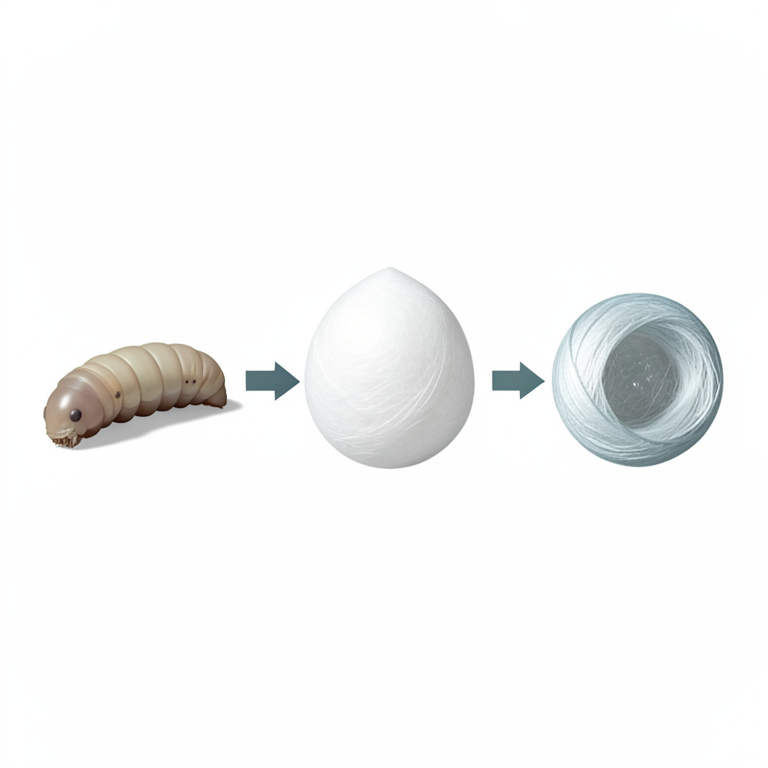
Conceptual Framework of Economic Trait Analysis
AI-generated conceptual illustration (Bombyx mori silkworms). It explains the idea and does not show study data.
View source evidence ↗Figures & tables
From the original paper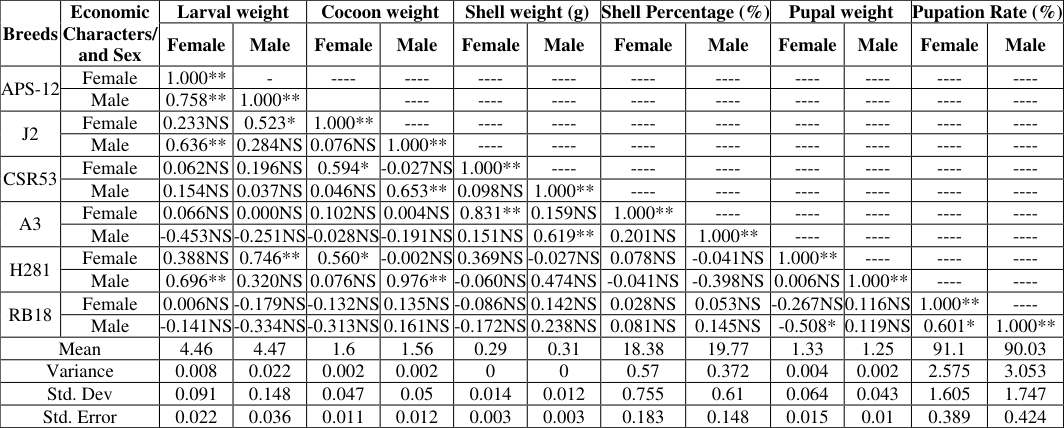 Table 1
Introduction
Silkworm breeding has long been a focal point of sericulture research, with the goal of improving silk yield and quality. The increase in body size and dry weight of larvae is largely dependent on the rate of metabolism (Rao et al., 2020) [11] , nutrient absorption, and the stage of growth and development in the silkworm during the fifth instar which significantly contributes to the phenotypic expression of cocoon traits (Rajanna and Sree Rama Reddy, 1990) [9] . Some of these traits are heritable, while others are influenced by environmental factors (Kumar et al., 2002) [5] . Since the environment affects the determination of phenotypic traits, the phenotype of an individual is often an inaccurate estimate of its genetic potential (Giridhar et al., 1995) [3] . Therefore, the environment has a significant impact on many economically important traits, such as heritability and genetic advancement, which are responsible for improvements in filament length, single cocoon weight, single shell weight, etc. (Kumaresan et al., 2000) [5] . Among the factors contributing to silk production, the larval weight of Bombyx mori L. is known to have a significant impact on various cocoon traits. These traits, including cocoon weight, shell weight, and silk filament length, are critical for the economic value of silk. Studies have shown a positive correlation between larval weight and cocoon traits in bivoltine silkworm breeds, which are preferred for their high silk yield and superior quality (Narasimharaju et al., 1990) [7] . Understanding these correlations helps sericulturists optimize breeding practices and improve overall silk production. In this study, we aim to examine the relationship between larval weight and cocoon traits in bivoltine pure breeds of Bombyx mori L., providing insights that can be applied in breeding programs to enhance cocoon quality, silk yield, and robustness to environmental conditions (Rohith L Shankar et al., 2008) [13] . Previous studies have demonstrated the influence of environmental factors on the expression of economic traits, regardless of the silkworm races and breeds (Uma Shankar and Subramanya, 2002) [17] . The genotype of silkworm races selected for experimental hybridization or basic research must be systematically reared and evaluated under known environmental conditions to understand the expression of economic traits (Murakami, 1992; Tazima, 1998; Reddy et al., 2005; Ding et al., 2006) [6, 16, 8, 2] . This study aims to assess the selected economic traits of both sexes in selected bivoltine pure breeds and their suitability for breed improvement programme has been analyzed.
Materials and Methods
Silkworm breeds studied: The following bivoltine pure breeds were selected for the study: APS12, J2 and CSR53, characterized by white dumbbell-shaped cocoons, and A3, H281, RB18, characterized by white oval cocoons. The replicate of 25 larvae of each sex were randomly picked from the cellular rearing beds.
Fed with mulberry leaves V1 variety in separate rearing beds up to the commencement spinning. Individually recorded the selected economic traits expression in all the breeds of males and females. Economic traits studied: six economic traits were studied in this analysis, viz., larval weight, cocoon weight, shell weight, shell percentage, pupal weight and pupation rate. Statistical methods: The analysis of variance (ANOVA) was performed following the methodology described by Snedecor and Cochran (1976). The mean data obtained on the seasonal performance of the males and females of bivoltine pure breeds were analyzed using the SPSS 2.0 statistical software package.
H281
Female 0.388NS 0.746** 0.560* -0.002NS 0.369NS -0.027NS 0.078NS -0.041NS 1.000** ------------Male 0.696** 0.320NS 0.076NS 0.976** -0.060NS 0.474NS -0.041NS -0.398NS 0.006NS 1.000** --------RB18 Female 0.006NS -0.179NS -0.132NS 0.135NS -0.086NS 0.142NS 0.028NS 0.053NS -0.267NS 0.116NS
Results and Discussion
This study examined the correlation between key economic traits such as larval weight, cocoon weight, shell weight, shell percentage, pupal weight, and pupation rate in six different silkworm breeds (APS-12, J2, CSR53, A3, H281, and RB18) for both male and female silkworms. The analysis reveals breed-specific variations and statistically significant correlations across several traits. In APS-12, a positive correlation was found between female larval weight and male larval weight (0.758*) as well as male pupation rate (0.696), indicating that females with higher larval weights contribute to improved male pupation success. Male larval weight was also strongly correlated with itself (1.000) and male pupation rate (0.746*), emphasizing the critical role of larval weight in successful pupation. These findings align with studies by Yokoyama, (1996), which emphasized the influence of larval weight on silkworm productivity. For J2, female cocoon weight showed a significant positive correlation with male cocoon weight (0.594*) and male pupal weight (0.560*), highlighting the genetic influence of females on male traits. Males exhibited strong correlations between cocoon weight (0.653*) and pupation rate (0.976*), suggesting cocoon weight as a reliable predictor of male pupation success. This is consistent with earlier research (Choudhary and Yadav, 2018) [1] . Which observed similar links between cocoon weight and improved economic traits in silkworms. In CSR53, female cocoon weight was significantly correlated with both male cocoon weight (0.594*) and shell weight (0.831*), indicating a strong genetic link between these traits (Ramesh and Sudhakara Rao, 2010) [12] . Males also showed positive correlations between cocoon weight (0.653) and shell weight (0.619*). These results align with the work by Suresh Kumar et al. (2006) [14] , which emphasized the importance of cocoon and shell weight in improving silkworm breed quality. For A3, a significant correlation was observed between female and male shell weight (0.831**), while other traits showed no notable correlations. Males exhibited no significant correlations, except for a weak negative correlation between pupal weight and pupation rate (-0.398NS). This lack of significant correlations for males suggests other environmental or genetic factors may influence the economic traits in this breed (Reddy et al., 2005) [8] . In H281, female larval weight was significantly correlated with male larval weight (0.746*) and male pupal weight (0.560), indicating that higher female larval weight positively affects male traits. Males displayed strong correlations between cocoon weight (0.976*) and larval weight (0.696*), demonstrating that heavier larvae produce better cocoons, leading to higher economic yields. This supports findings by Rao et al. (2020) [11] , on the importance of larval weight in determining cocoon quality and yield. For RB18, pupation rates in both sexes were significantly correlated (0.601*), suggesting a consistent influence of this trait across genders. However, no other significant correlations were found. The role of pupation rate in enhancing silk production has been documented in previous research (Reddy N and Yang Y, 2013) [10] , justifies the overall healthiness of selected silkworm breeds.
Conclusion
The results of this study emphasize the importance of selecting breeds like APS12, J2, and H281 showed strong correlations between key traits such as larval weight, cocoon weight, and pupation rate, making them economically viable for silkworm farming. CSR53 exhibited significant potential for silk production through strong cocoon and shell weight. In contrast, A3 and RB18 displayed fewer correlations, requiring further study. Selecting breeds like APS-12, J2, CSR53, and H281 is crucial for improving productivity. Further research into genetic and environmental influences is recommended to optimize breeding strategies.
Acknowledgement
AcknowledgementThis study was made possible with the support of the Department of Sericulture Yuvaraja's College. I am deeply grateful to my guide, Prof. Rohith L Shankar, for his invaluable support and for providing the necessary facilities for conducting the experiment, as well as to the University of Mysore for their financial assistance. I would also like to express my gratitude to The Director, CSGRC, Hosur, for providing the specimens.
Figures and tables from the paper
| Breeds | Economic Characters/ and Sex | Larval weight | — | Cocoon weight | — | Shell weight (g) | — | Shell Percentage (%) | — | Pupal weight | — | Pupation Rate (%) | — |
|---|---|---|---|---|---|---|---|---|---|---|---|---|---|
| Female | Male | Female | Male | Female | Male | Female | Male | Female | Male | Female | Male | ||
| APS-12 | Female | 1.000** | - | ---- | ---- | ---- | ---- | ---- | ---- | ---- | ---- | ---- | ---- |
| Male | 0.758** | 1.000** | ---- | ---- | ---- | ---- | ---- | ---- | ---- | ---- | ---- | ||
| J2 | Female | 0.233NS | 0.523* | 1.000** | ---- | ---- | ---- | ---- | ---- | ---- | ---- | ---- | ---- |
| Male | 0.636** | 0.284NS | 0.076NS | 1.000** | ---- | ---- | ---- | ---- | ---- | ---- | ---- | ---- | |
| CSR53 | Female | 0.062NS | 0.196NS | 0.594* | -0.027NS | 1.000** | ---- | ---- | ---- | ---- | ---- | ---- | ---- |
| Male | 0.154NS | 0.037NS | 0.046NS | 0.653** | 0.098NS | 1.000** | ---- | ---- | ---- | ---- | ---- | ---- | |
| A3 | Female | 0.066NS | 0.000NS | 0.102NS | 0.004NS | 0.831** | 0.159NS | 1.000** | ---- | ---- | ---- | ---- | ---- |
| Male | -0.453NS | -0.251NS | -0.028NS | -0.191NS | 0.151NS | 0.619** | 0.201NS | 1.000** | ---- | ---- | ---- | ---- | |
| H281 | Female | 0.388NS | 0.746** | 0.560* | -0.002NS | 0.369NS | -0.027NS | 0.078NS | -0.041NS | 1.000** | ---- | ---- | ---- |
| Male | 0.696** | 0.320NS | 0.076NS | 0.976** | -0.060NS | 0.474NS | -0.041NS | -0.398NS | 0.006NS | 1.000** | ---- | ---- | |
| RB18 | Female | 0.006NS | -0.179NS | -0.132NS | 0.135NS | -0.086NS | 0.142NS | 0.028NS | 0.053NS | -0.267NS | 0.116NS | 1.000** | ---- |
| Male | -0.141NS | -0.334NS | -0.313NS | 0.161NS | -0.172NS | 0.238NS | 0.081NS | 0.145NS | -0.508* | 0.119NS | 0.601* | 1.000** | |
| Mean | 4.46 | 4.47 | 1.6 | 1.56 | 0.29 | 0.31 | 18.38 | 19.77 | 1.33 | 1.25 | 91.1 | 90.03 | |
| Variance | 0.008 | 0.022 | 0.002 | 0.002 | 0 | 0 | 0.57 | 0.372 | 0.004 | 0.002 | 2.575 | 3.053 | |
| Std. Dev | 0.091 | 0.148 | 0.047 | 0.05 | 0.014 | 0.012 | 0.755 | 0.61 | 0.064 | 0.043 | 1.605 | 1.747 | |
| Std. Error | 0.022 | 0.036 | 0.011 | 0.012 | 0.003 | 0.003 | 0.183 | 0.148 | 0.015 | 0.01 | 0.389 | 0.424 |
Table text extracted from the original PDF; superscript letters are shown inline. The original table image is below.
View original table image
References
16 in the original paper- Choudhary A, Yadav K. Impact of shell percentage on silkworm breeding. J Sericult Res. 2018;45(3):221-234.
- Ding F, Yao J, Zhao G. Genetic and phenotypic correlation of cocoon and silk traits in silkworm (Bombyx mori). J Sericult Sci. 2006;21(2):95-102.
- Giridhar K, Nirmal Kumar S, Jula Nair S, Datta RK. Heritability, genetic and phenotypic correlation studies on fitness and quantitative traits of bivoltine silkworm, Bombyx mori L. Indian J Sericult. 1995;34:22-27.
- Kumaresan P, Sinha RK, Sahni NK, Sekar S. Genetic variability and selection indices for economic quantitative traits of multivoltine mulberry silkworm (Bombyx mori) genotypes. Sericologia. 2000;40:515605.
- Kumar NS, Basavaraja HK, Kumar CK, Reddy NM, Datta RK. On the breeding of "CSR18 X CSR19" -A robust bivoltine hybrid of silkworm, Bombyx mori L. for the tropics. Int J Ind Entomol. 2002;5:155-162.
- Murakami A. The hereditary of growth (special lecture). J Growth. 1992;31:7-22. (In Japanese)
- Narasimharaju R, Govindan R, Ashoka J, Rayar SG. Genetic variability for quantitative traits in silkworm, Bombyx mori L. Entomon. 1990;15:197-201.
- Reddy NV, Nair CV, Suryanarayana N. Selection of parental breeds for hybridization in silkworm based on genetic variability and correlation of quantitative traits. Sericologia. 2005;45(3):409-419.
- Rajanna GS, Sreeramareddy G. Studies on the variability and interrelationship between some quantitative characters in different breeds of silkworm Bombyx mori L. Sericologia. 1990;30:67-73.
- Reddy N, Yang Y. Enhancing silk yield through hybridization. J Sericult Res. 2013;45(3):187-193.
- Rao V, Sharma A, Kumar S. Effects of nutritional intake and environmental factors on the growth and weight of silkworm (Bombyx mori) larvae. J Sericult Res. 2020;15(2):125-135.
- Ramesh M, Sudhakara Rao P. Influence of temperature and humidity on economic traits of bivoltine silkworm, Bombyx mori L. J Sericult Technol. 2010;2(1):12-17.
- Shankar RL, Doddaswamy, Murthy N, Subramanya G. Evaluation and identification of promising new bivoltine silkworm hybrids using combined trait selection sericulture. Indian J Sericult. 2008;46(2):117125.
- Suresh Kumar N, Basavaraja HK, Joge PG, Mal Reddy N, Kalpana GV, Dandin SB. Development of new robust bivoltine hybrid (CSR46 x CSR47) of Bombyx mori L. for the tropics. Indian J Sericult. 2006;45(1):219.
- Uma Shankar ML, Subramanya G. Correlation between larval weight and cocoon characters in five breeds of silkworm, Bombyx mori L. Geobios. 2002;29:154-157.
- Yokoyama T. Economic traits in silkworm breeds: A review. J Sericult Res. 1996.