Scinovex

Research article · 2025 · Full text

International Journal of Biology Sciences

Impact of subclinical mastitis on milk yield in dairy crossbred cows: A case study of 217 cows

Mònica Mir

Volume 7(2) · Pages 33–36 · DOI: 10.33545/26649926.2025.v7.i2a.296 ↗

Research areasGenetic and phenotypic traits in livestock

↓ Read full-text PDF0 citations

Abstract

Author-written

Subclinical mastitis is a pervasive and economically significant disease in dairy cows, often characterized by an increase in somatic cell counts (SCC) without visible changes in milk or the udder. This study investigates the effect of subclinical mastitis on milk yield in a sample of 217 dairy crossbred cows, where 97 cows were found to have subclinical infection as detected by the SCC method. Our findings reveal a notable average decline in milk yield by 15% in affected cows compared to the healthy quarters of the same cows, emphasizing the economic implications of subclinical mastitis in dairy farming.

Summary

Source-checked

Plain-language reading of the full paper, prepared with AI and checked against the text. Each point links to the authors' own words.

  1. Why it matters

    • Mastitis is an inflammation of the mammary gland and is considered one of the most economically damaging diseases for dairy cows globally. View evidence ↗

      Why it matters

      Mastitis is an inflammation of the mammary gland and is considered one of the most economically damaging diseases for dairy cows globally.

      In the paper's own words

      “Mastitis, an inflammation of the mammary gland, is one of the most economically impactful diseases affecting dairy cows worldwide.”

      Page 1

      Found in: Introduction

      Read it in the full textOpen PDF at page 1 ↗
    • Unlike clinical mastitis, which has visible symptoms like swelling and redness, subclinical mastitis has no overt signs, making it harder to detect. View evidence ↗

      Why it matters

      Unlike clinical mastitis, which has visible symptoms like swelling and redness, subclinical mastitis has no overt signs, making it harder to detect.

      In the paper's own words

      “While clinical mastitis presents with visible symptoms such as swelling, redness, and abnormal milk, subclinical mastitis lacks overt signs, making it more insidious and challenging to detect.”

      Page 1

      Found in: Introduction

      Read it in the full textOpen PDF at page 1 ↗
    • Subclinical mastitis can lead to significant reductions in milk yield, changes in milk composition, and a higher risk of secondary infections. View evidence ↗

      Why it matters

      Subclinical mastitis can lead to significant reductions in milk yield, changes in milk composition, and a higher risk of secondary infections.

      In the paper's own words

      “Despite the absence of visible symptoms, subclinical mastitis can significantly reduce milk yield, alter milk composition, and increase the risk of secondary infections”

      Page 1

      Found in: Introduction

      Read it in the full textOpen PDF at page 1 ↗
  2. The question

    • The study aims to quantify how subclinical mastitis affects milk yield in dairy crossbred cows using somatic cell count (SCC) for diagnosis. View evidence ↗

      The question

      The study aims to quantify how subclinical mastitis affects milk yield in dairy crossbred cows using somatic cell count (SCC) for diagnosis.

      In the paper's own words

      “This research focuses on quantifying the impact of subclinical mastitis on milk yield in dairy crossbred cows, using somatic cell count (SCC) as a diagnostic tool”

      Page 1

      Found in: Introduction

      Read it in the full textOpen PDF at page 1 ↗
  3. What they did

    • The study enrolled a total of 217 dairy crossbred cows from various farms. View evidence ↗

      What they did

      The study enrolled a total of 217 dairy crossbred cows from various farms.

      In the paper's own words

      “A total of 217 dairy crossbred cows were enrolled in this study from various dairy farms.”

      Page 1

      Found in: Materials and Methods

      Read it in the full textOpen PDF at page 1 ↗
    • Somatic cell counts (SCC) were analyzed using a DeLaval cell counter from milk samples collected aseptically from all quarters of each cow. View evidence ↗

      What they did

      Somatic cell counts (SCC) were analyzed using a DeLaval cell counter from milk samples collected aseptically from all quarters of each cow.

      In the paper's own words

      “Milk samples were collected aseptically from all quarters of each cow and analyzed for SCC using a DeLaval cell counter.”

      Page 1

      Found in: Materials and Methods

      Read it in the full textOpen PDF at page 1 ↗
    • Cows were classified as healthy if SCC was below 200,000 cells/ml and subclinically infected if SCC was 200,000 cells/ml or higher. View evidence ↗

      What they did

      Cows were classified as healthy if SCC was below 200,000 cells/ml and subclinically infected if SCC was 200,000 cells/ml or higher.

      In the paper's own words

      “Cows were categorized into two groups: healthy (with SCC <200,000 cells/ml) and subclinically infected (with SCC ≥200,000 cells/ml).”

      Page 1

      Found in: Materials and Methods

      Read it in the full textOpen PDF at page 1 ↗
    • Milk yield was recorded over six months, comparing production from affected quarters to healthy quarters within the same cows. View evidence ↗

      What they did

      Milk yield was recorded over six months, comparing production from affected quarters to healthy quarters within the same cows.

      In the paper's own words

      “Milk yield data were recorded for individual cows over a six-month period, comparing the production from affected quarters to that from healthy quarters within the same animals.”

      Page 1

      Found in: Materials and Methods

      Read it in the full textOpen PDF at page 1 ↗
  4. What they found

    • Of the 217 cows examined, 97 (44.7%) were found to have subclinical mastitis. View evidence ↗

      What they found

      Of the 217 cows examined, 97 (44.7%) were found to have subclinical mastitis.

      In the paper's own words

      “Out of the 217 cows examined, 97 (44.7%) were identified as having subclinical mastitis based on elevated SCC levels”

      Page 1

      Found in: Results

      Read it in the full textOpen PDF at page 1 ↗
    • Affected quarters showed an average decline in milk yield of 15% compared to the healthy quarters of the same cows. View evidence ↗

      What they found

      Affected quarters showed an average decline in milk yield of 15% compared to the healthy quarters of the same cows.

      In the paper's own words

      “Analysis of milk production data revealed an average decline of 15% in milk yield from the affected quarters compared to the healthy quarters of the same cows.”

      Page 1

      Found in: Results

      Read it in the full textOpen PDF at page 1 ↗
    • The estimated daily loss in milk yield was approximately 0.71 kg per cow. View evidence ↗

      What they found

      The estimated daily loss in milk yield was approximately 0.71 kg per cow.

      In the paper's own words

      “Specifically, the daily milk yield loss was estimated to be approximately 0.71 kg per cow”

      Page 1

      Found in: Results

      Read it in the full textOpen PDF at page 1 ↗
    • Greater milk yield losses correlated with higher SCC levels, which averaged 4 lakh cells per ml in subclinical cases. View evidence ↗

      What they found

      Greater milk yield losses correlated with higher SCC levels, which averaged 4 lakh cells per ml in subclinical cases.

      In the paper's own words

      “The severity of milk yield reduction varied among cows, with higher SCC levels correlating with greater losses with average 4 lakh cells per ml in subclinical cases”

      Page 2

      Found in: Results

      Read it in the full textOpen PDF at page 2 ↗
    • In clinical cases, milk yield losses are greater than 20% and can be even higher in severe cases. View evidence ↗

      What they found

      In clinical cases, milk yield losses are greater than 20% and can be even higher in severe cases.

      In the paper's own words

      “The losses in clinical cases are greater than 20% and can reach upto a substantial percentage in severe cases”

      Page 2

      Found in: Results

      Read it in the full textOpen PDF at page 2 ↗
  5. What it means

    • The authors conclude that subclinical mastitis, detected by SCC, causes a marked average decline of 15% in milk yield in dairy crossbred cows. View evidence ↗

      What it means

      The authors conclude that subclinical mastitis, detected by SCC, causes a marked average decline of 15% in milk yield in dairy crossbred cows.

      In the paper's own words

      “This study demonstrates a marked average decline of 15% in milk yield in dairy crossbred cows affected by subclinical mastitis, as detected by SCC.”

      Page 4

      Found in: Conclusion

      Read it in the full textOpen PDF at page 4 ↗
    • The authors recommend implementing mastitis control strategies, specifically regular SCC monitoring, to reduce economic losses and improve cow health. View evidence ↗

      What it means

      The authors recommend implementing mastitis control strategies, specifically regular SCC monitoring, to reduce economic losses and improve cow health.

      In the paper's own words

      “These findings highlight the importance of implementing effective mastitis control strategies, including regular SCC monitoring, to mitigate economic losses and improve dairy cow health.”

      Page 4

      Found in: Conclusion

      Read it in the full textOpen PDF at page 4 ↗
    • The authors note that economic losses may vary by breed, management, and market, and suggest further research across different farming contexts. View evidence ↗

      What it means

      The authors note that economic losses may vary by breed, management, and market, and suggest further research across different farming contexts.

      In the paper's own words

      “However, the precise economic loss may vary depending on factors such as cow breed, management practices, and market conditions. Therefore, further research is warranted to explore the broader economic implications of subclinical mastitis across different dairy farming contexts”

      Page 4

      Found in: Discussion

      Read it in the full textOpen PDF at page 4 ↗

Visual summary

1 visuals

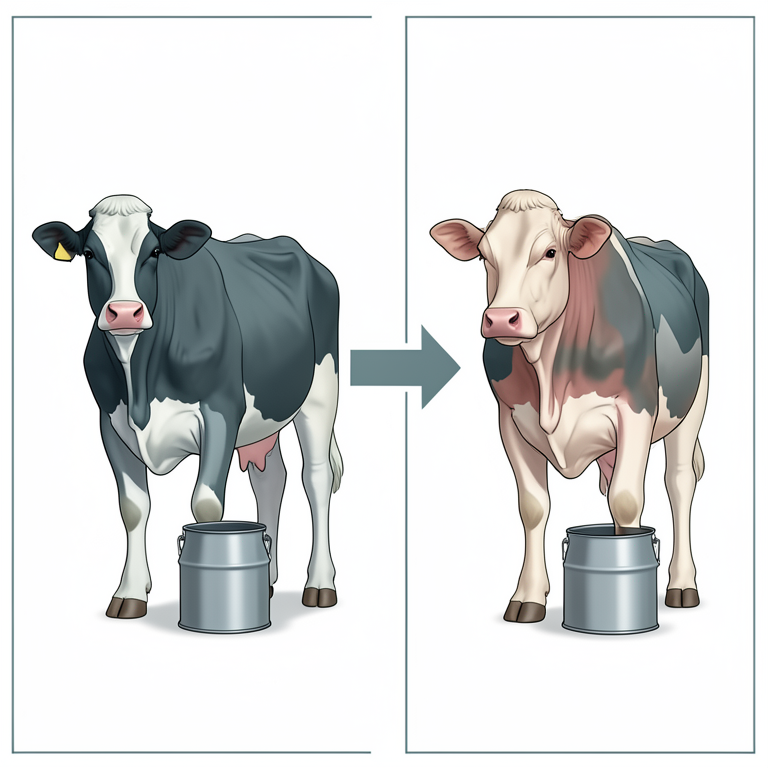
Illustrations explain the paper; they do not show study data.
AI-generated illustration
AI-generated conceptual illustration (dairy crossbred cows). It explains the idea and does not show study data.↗ Enlarge
Correlation of SCC and Milk Yield
AI-generated conceptual illustration (dairy crossbred cows). It explains the idea and does not show study data.

AI-generated conceptual illustration (dairy crossbred cows). It explains the idea and does not show study data.

Open full-size image ↗

Correlation of SCC and Milk Yield

AI-generated conceptual illustration (dairy crossbred cows). It explains the idea and does not show study data.

View source evidence ↗

Figures & tables

From the original paper
Percentage of subclinical cases of MastitisFigure 1Page 2Percentage of subclinical cases of MastitisFigure 1Page 2Reduced milk yield and Increased Somatic cell count in Subclinical casesFigure 2Page 3Correlation between reduction in milk yield and somatic cell count during udder infectionsFigure 3Page 3
FULL TEXT Original article · reflowed for reading

Introduction

Mastitis, an inflammation of the mammary gland, is one of the most economically impactful diseases affecting dairy cows worldwide. While clinical mastitis presents with visible symptoms such as swelling, redness, and abnormal milk, subclinical mastitis lacks overt signs, making it more insidious and challenging to detect. Despite the absence of visible symptoms, subclinical mastitis can significantly reduce milk yield, alter milk composition, and increase the risk of secondary infections (Tandoğan & Güleş, 2024) [1] . Subclinical mastitis is primarily identified through the measurement of somatic cell counts (SCC) in milk, which serve as an indicator of inflammation within the mammary gland. Elevated SCC levels are associated with reduced milk production and compromised milk quality. This condition often goes unnoticed until substantial economic losses occur, underscoring the importance of routine monitoring and early detection (Tesfaye et al., 2010) [2] . The economic impact of subclinical mastitis extends beyond decreased milk yield to include increased veterinary costs, discarded milk, and potential culling of chronically infected cows. This research focuses on quantifying the impact of subclinical mastitis on milk yield in dairy crossbred cows, using somatic cell count (SCC) as a diagnostic tool to provide insights into effective management strategies (Mungube et al., 2005) [3] .

Materials and Methods

A total of 217 dairy crossbred cows were enrolled in this study from various dairy farms. Milk samples were collected aseptically from all quarters of each cow and analyzed for SCC using a DeLaval cell counter. Cows were categorized into two groups: healthy (with SCC <200,000 cells/ml) and subclinically infected (with SCC ≥200,000 cells/ml). Milk yield data were recorded for individual cows over a six-month period, comparing the production from affected quarters to that from healthy quarters within the same animals.

Results

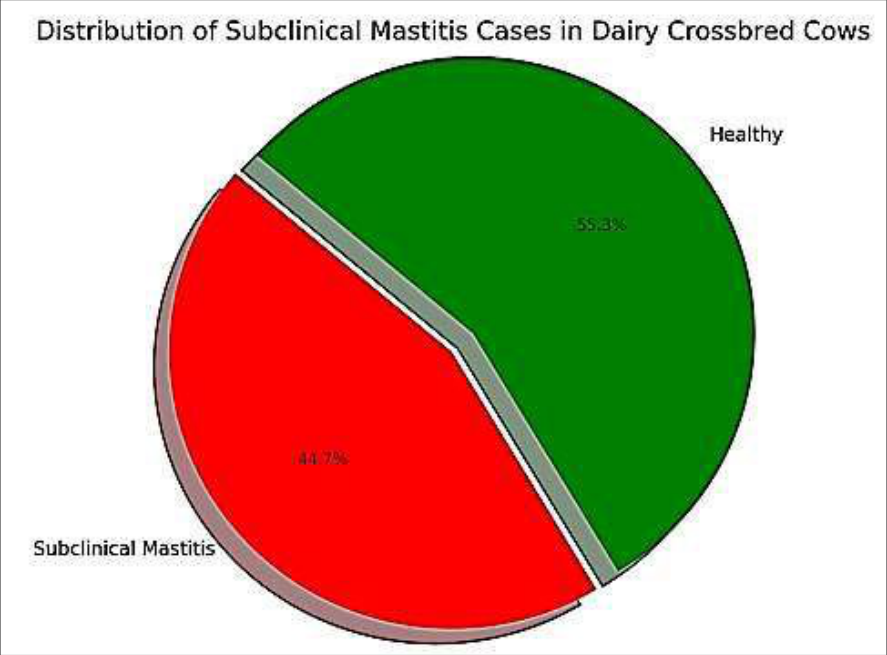
Out of the 217 cows examined, 97 (44.7%) were identified as having subclinical mastitis based on elevated SCC levels (Fig. 1). Analysis of milk production data revealed an average decline of 15% in milk yield from the affected quarters compared to the healthy quarters of the same cows. Specifically, the daily milk yield loss was estimated to be approximately 0.71 kg per cow (Tandogan & Gules, 2024) [1] .

Figure 1. Percentage of subclinical cases of Mastitis
Percentage of subclinical cases of Mastitis↗ Enlarge
Figure 1
Percentage of subclinical cases of Mastitis

Percentage of subclinical cases of Mastitis

Open full-size image ↗
Original paper figureSource PDF · page 2 ↗
Figure 1. Percentage of subclinical cases of Mastitis
Percentage of subclinical cases of Mastitis↗ Enlarge
Figure 1
Percentage of subclinical cases of Mastitis

Percentage of subclinical cases of Mastitis

Open full-size image ↗
Original paper figureSource PDF · page 2 ↗

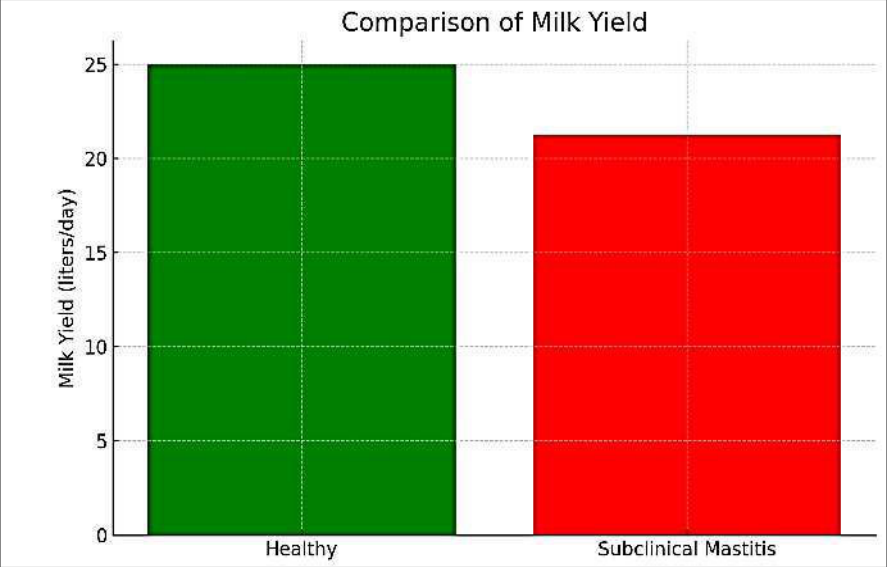
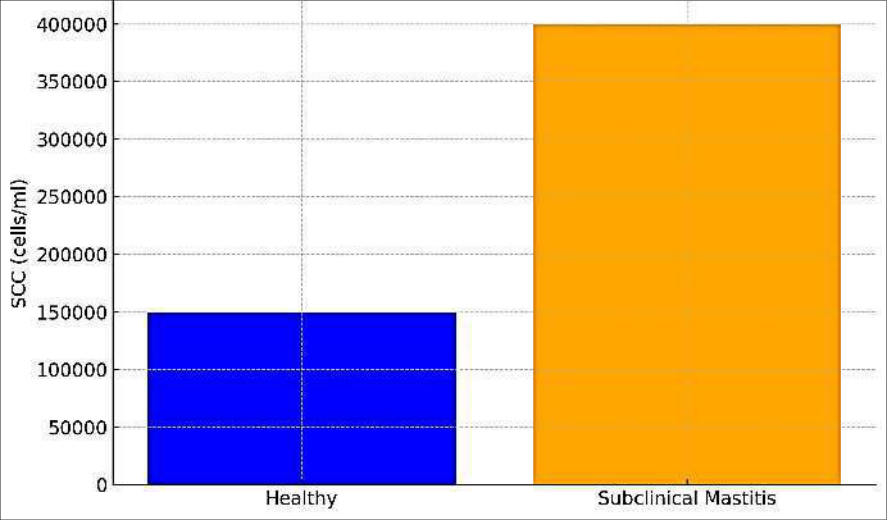
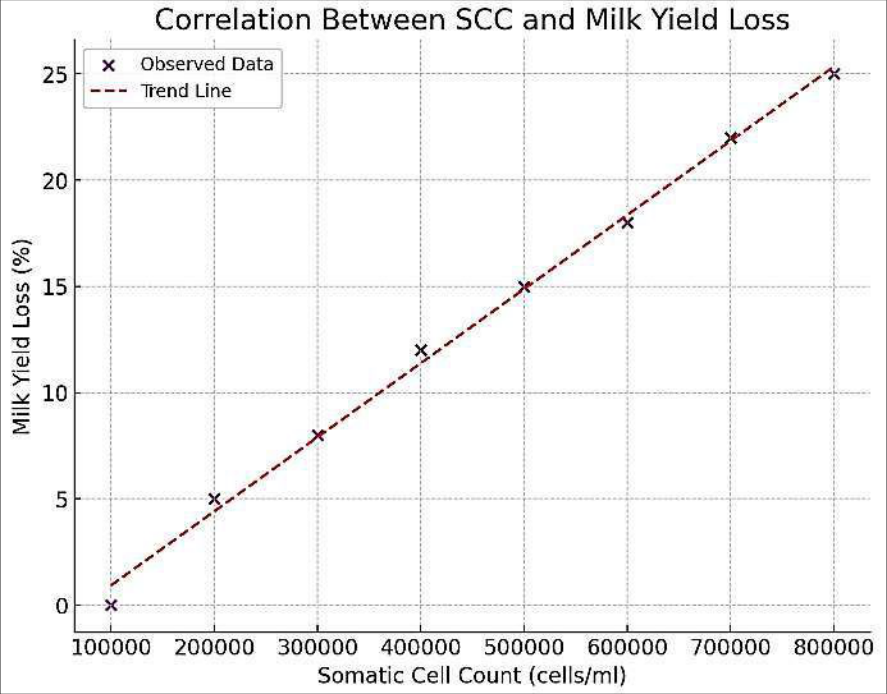
The severity of milk yield reduction varied among cows, with higher SCC levels correlating with greater losses with average 4 lakh cells per ml in subclinical cases (Fig. 2). This reduction in milk production highlights the significant economic loss associated with subclinical mastitis, even in the absence of clinical symptoms (Tesfaye et al., 2010) [2] . The losses in clinical cases are greater than 20% and can reach upto a substantial percentage in severe cases (Fig. 3).

Figure 3. Correlation between reduction in milk yield and somatic cell count during udder infections
Correlation between reduction in milk yield and somatic cell count during udder infections↗ Enlarge
Figure 3
Correlation between reduction in milk yield and somatic cell count during udder infections

Correlation between reduction in milk yield and somatic cell count during udder infections

Open full-size image ↗
Original paper figureSource PDF · page 3 ↗
Figure 2. Reduced milk yield and Increased Somatic cell count in Subclinical cases
Reduced milk yield and Increased Somatic cell count in Subclinical cases↗ Enlarge
Figure 2
Reduced milk yield and Increased Somatic cell count in Subclinical cases

Reduced milk yield and Increased Somatic cell count in Subclinical cases

Open full-size image ↗
Original paper figureSource PDF · page 3 ↗

Discussion

The findings of this study underscore the hidden costs of subclinical mastitis in dairy herds. A 15% decrease in milk yield from affected cows not only represents a substantial loss in potential revenue for dairy farmers but also indicates the broader implications for dairy product quality and animal welfare. The economic impact extends to increased veterinary expenses, reduced reproductive performance, and the potential need for premature culling of affected animals (Mungube et al., 2005) [3] . The use of SCC as a diagnostic tool proved effective in identifying subclinical cases, suggesting that routine monitoring of SCC levels could play a crucial role in early detection and management of mastitis. Implementing regular SCC screening can help farmers identify infected cows early, allowing for timely intervention and treatment to mitigate milk yield losses (Shende et al., 2020) [4] .

This study's results align with previous research indicating that subclinical mastitis can lead to significant reductions in milk production. However, the precise economic loss may vary depending on factors such as cow breed, management practices, and market conditions. Therefore, further research is warranted to explore the broader economic implications of subclinical mastitis across different dairy farming contexts (Gonçalves et al., 2020) [5] .

Conclusion

This study demonstrates a marked average decline of 15% in milk yield in dairy crossbred cows affected by subclinical mastitis, as detected by SCC. These findings highlight the importance of implementing effective mastitis control strategies, including regular SCC monitoring, to mitigate economic losses and improve dairy cow health. Future research should focus on developing cost-effective interventions and management practices tailored to the specific challenges faced by dairy farmers in managing subclinical mastitis.

References

4 in the original paper
  1. Tandoğan M, Güleş Ö. Estimation of milk yield losses from subclinical mastitis in dairy cows. Kocatepe Vet J. 2024. Available from: http://dx.doi.org/10.30607/kvj.1506469.
  2. Tesfaye GY, Regassa F, Kelay B. Milk yield and associated economic losses in quarters with subclinical mastitis due to Staphylococcus aureus in Ethiopian crossbred dairy cows. Trop Anim Health Prod. 2010;42:925-931.
  3. Mungube E, Tenhagen B, Regassa F, Kyule M, Shiferaw Y, Kassa T, et al. Reduced milk production in udder quarters with subclinical mastitis and associated economic losses in crossbred dairy cows in Ethiopia. Trop Anim Health Prod. 2005;37:503-512.
  4. Gonçalves JL, Kamphuis C, Vernooij H, Araújo JP, Grenfell R, Juliano L, et al. Pathogen effects on milk yield and composition in chronic subclinical mastitis in dairy cows. Vet J. 2020;262:105473.